When did I begin my love affair with the music of living composers? The moment I found Yvar Mikhashoff’s ‘Incitation to Desire’ CD of tango music for the piano. The smoky cover, the provocative title track – I was caught before I listened to a single piece. Ah, and what a collection! Tangos from multiple eras and in multiple styles. Tangos that spoke of something illicit, a smoky world of furtive late-night romance, smoky dance halls, and sensuality. These tangos represented a freedom I craved – freedom from the performance practice expectations of standard repertoire, and freedom from the years of insecurities and assumptions I brought to the music I’d been playing my whole life. Tangos broke the rules. I’d never danced a tango in my life, but I knew I needed to make music with the freedom I heard in these pieces.
I’d never worked on music by a living composer before I found this CD, but my love of this music was such that I set about tracking down the scores of my favourite pieces. Many of the tangos were unpublished, which meant I wrote to the composer to purchase a copy. Scott Pender’s tango, ‘Ms Jackson Dances for the World’ was one of these. After I received it, Scott and I kept corresponding. We became friends and have remained so for over a decade. And I loved his music – so much so that I eventually played, performed, and taught most of what he’s written for the piano. Ironically, although Chester Biscardi’s ‘Incitation to Desire’ was easier to find (it was published), I never felt I got inside it well enough to perform it publicly. It sat in my music collection, its provocative title and gorgeous writing teasing me with the promise of something I couldn’t quite grasp.
It took me over a decade to put ‘Incitation to Desire’ on a concert programme. I think this was because I needed to live more before I truly understood it. I needed to go tango dancing and feel the freedom and sensuality of the Argentine tango in my bones. I needed to perform and record Piazzolla tangos with my duo partner Molly Wheeler. And, on a deeper level, I needed to break a whole lot of rules. I needed to experience the judgment that comes from choosing to leave a marriage that had been on life-support for years. I needed to experience being swept off my feet by an unexpected grown-up romance that changed my entire life. In other words, I needed to know freedom before I could play it on the piano.
Because ‘Incitation to Desire’ is about sensuality and freedom. Much like the Argentine dance, it relies on the pianist’s ability to instinctively feel their way through the score. This piece begs to be played almost as an improvisation – just the same way that the Argentine tango is danced. It’s the pianist and the piano and the interplay of notes – sensuous, slinky, unapologetic. Chester Biscardi asks for a flexible interpretation of dynamics and tempi. I take this to mean that that this piece is best played from the senses, not the brain; instinct, not reason. In other words, you can’t play this music until you let yourself be seduced by it.
It was my No Dead Guys post about (and YouTube recording of) ‘Incitation to Desire’ that prompted Chester Biscardi to email and tell me how much he enjoyed my performance of it. That correspondence led to me learning ‘In Time’s Unfolding’ and ‘Companion Piece (for Morton Feldman)’, two pieces that, ironically, I still feel I had more of an innate understanding of than the tango that introduced me to Chester’s music. Best of all, Chet and I kept corresponding, and that correspondence blossomed into another friendship that I cherish.
I’ve never coached a student on ‘Incitation to Desire’; I’m not sure it can be done without introducing topics to a lesson that can get an instructor arrested. Furthermore, because it’s so improvisatory, the key to playing this piece well lies within each pianist’s personal experience. If they’ve lived it, they can play it. If not, no amount of musicianship or technique will bring this piece to life. I can, however, offer some general guidelines on how to navigate the score:
1) Don’t be in a hurry. This is slowly unfolding, sensuous music that can’t be forced by the pianist. All forward momentum must come from the sense that the power of the moment itself is what propels the music forward.
2) Don’t dig in too deeply on the scale passages. These are flourishes, the twirl of a tango skirt, a spin. They’re caresses, not demands.
3) Don’t start your accelerando too quickly at m. 29; you’ve got a very long way to do before you hit the end of it. This – like everything else in the piece – should feel inevitable and effortless.
4) Pay very close attention to the pedalling; it makes or breaks the piece.
5) If you’ve never danced the Argentine tango, watch some videos of it. This will explain the start/stop, slow/fast, gesture-driven nature of the score.
6) When you play it, drop all expectations of the piece, surrender to the music, and let it take you where it wants to go.
Sometimes the best way to find ourselves is to break a bunch of rules. Incitation to Desire gave me the permission I needed to follow my instincts rather than others’ expectations. It seduced me into a lifelong passion for the music of living composers. And even today, it reminds me to let moments and situation unfold naturally; it reminds me that the richest life (and my best playing) lies in releasing rigidity and entering the messy, beautiful, passionate dance of earthy, real life with my hands and heart wide open.
Rhonda (Ringering) Rizzo is a writer and a former performing and recording pianist. Her novel, The Waco Variations, was released in the summer of 2018, and her numerous articles have appeared in national and international music magazines, including Pianist Magazine, American Music Teacher, Clavier, Piano & Keyboard, and Flute Talk. A specialist in music that borrows from both classical and jazz traditions, Rizzo released four CDs, Made in America, Oregon Impressions: the Piano Music of Dave Deason, 2 to Tango: Music for Piano Duet, and A Spin on It.
She holds a BA from Walla Walla University and a MM from Boston University and is a passionate advocate of new music and living composers.
This site is free to access and ad-free, and takes many hours to research, write, and maintain. If you find joy and value in what I do, please consider making a donation to support the continuance of this site
Frances Wilson in conversation with Maxim Vengerov
I’ve admired world-renowned violinist Maxim Vengerov ever since I first heard him at the Proms in 1999, when he played a fabulous, varied programme which included Brahms’ Violin Sonata No 3, Rachmaninov’s Vocalise, Ravel’s Tzigane, and a selection of glittering concert showpieces, including a spellbinding performance of Waxman’s Carmen Fantasie. It was just him and pianist Vag Papian, on a special stage set up in the arena (promenading) area of the Royal Albert Hall, playing to a packed house.
In September this year he returns to the Albert Hall, for a special concert celebrating 40 years on stage – or rather 42 years on stage as this concert, originally scheduled for June 2020, was postponed because of the pandemic. In addition to a celebration of his remarkable performing career, it is, for him, also a celebration of his connection with British audiences. “I’ve been here from right at the start of my career. This is like my second home.” As well as giving many concerts in the UK, since 2016 Maxim Vengerov has been a visiting professor at London’s Royal College of Music.
London was also where he studied with Mstislav ‘Slava’ Rostropovich, an adored mentor and friend, whose name comes up frequently during our conversation.
“I have great memories with Slava, of visiting his home in Maida Vale. Without him I would be a different musician today. He opened my vision for music and he inspired me also to continue and to share music. Not just to be a performer, but to share it. That’s why I became a teacher at the age of 26. I always wanted to make space for teaching, in spite of my busy schedule.”
The two years of the pandemic and lockdowns, and the shutdown of live music, have had a profound impact on the lives of musicians, and for Vengerov, like many others, it was a time to reflect on the demands of the profession. With an empty concert diary, confined to his home with his family and parents-in-law, the first month of lockdown was an “amazing time with family. I’ve never stayed so long with my family…. But after a month, my elder daughter Lisa says, ‘Daddy, aren’t you going away?’. It was the biggest shock of my life! I realised that for my family, I was the father who was always travelling and sometimes coming back. Today it is different; despite my heavy schedule….in my family’s mind and my own, I am the father who is at home and sometimes on tour.”
During lockdown, Vengerov was keen to do something for other people. “It was horrific that we weren’t able to make music, and people weren’t able to listen.” So, as Artist in Residence at ClassicFM, he gathered together a trio and organised a livestreamed concert, an hour of live music, broadcast to some quarter of a million listeners worldwide. This inspired him to continue, to communicate to the world and to share his experience, this time via the medium of interactive online lessons. With the help of a brilliant tech team, he built a platform, created a website and held in excess of 150 free live online lessons with optimal sound and high-quality visuals. These remain in the archive of his website, available to all, while new material is regularly added.
Of this particular lockdown project he says “It was so traumatic to see so many people leaving the profession, but so understandable, because nobody cancelled paying mortgages or bills! But we needed to continue what we feel passionately about and we needed to give some hope. And I did that in my own little modest way.”
Now live music is back and audiences are thrilled to have concerts again “Every venue was full – Elbphilharmonie, Salzburg festival, Carnegie Hall, all amazing experiences! People were crying.”
With such a long performing career, how does he maintain the interest, the excitement and the inspiration? “I am never bored!” Vengerov replies immediately, and then goes on to illustrate this point further:
“How many things are involved in the process of making a concert? It requires great preparation, great delivery on stage, great spirit, great instrument [he plays a 1727 ‘Kreutzer’ Stradivari], great hall, acoustically – a wonderful acoustic together with my instrument is always a different experience because my instrument reacts differently to every concert hall and I always play differently in every hall. Then of course partners that I work with, chamber music…. And audiences…they don’t necessarily have to be educated, but they have to be open, and they have to be there for the right reasons, to discover music. And if you’re not in love with the composition you’re performing you should better not do it! There is not a moment when you can be bored….it’s pure enjoyment and pure challenge.”
Away from the concert stage, he draws inspiration from his family and friends, good food and socialising, playing tennis, and walks with his Shiba Inu dog, Toto. And of course the music.
Returning to his forthcoming London concert, we talk about the Shostakovich Violin Concerto, the centrepiece of this concert, and a work which he has played many, many times. The challenge here is keeping the music, and the performance, fresh, and once again the conversation turns back to Slava, and his advice to always play the work as if performing it for the very first time – or “perhaps the last time”. Deep knowledge of the music is important too, and this is where training to become a conductor has helped Vengerov gain crucial insights into the score which inform his performances and lend greater enjoyment and fulfilment. “Once you know the full score, it adds a new dimension to your performance. It’s no longer a violin piece with orchestral accompaniment… you can refer to one or another line in the orchestra and that’s where you draw your inspiration….The impact that the orchestra has on the soloist is vast. And if you’re not part of it, then it’s a different piece.”
The other major work in this concert is Beethoven’s Triple Concerto, for which Vengerov will be joined by cellist Mischa Maisky and pianist Simon Trpčeski. Too often regarded as a “party piece”, Vengerov asserts that the Triple Concerto is “a most profound work” that requires a very particular relationship between each member of the orchestra and the soloists. The orchestra in this instance is the Oxford Philharmonic, conducted by Marios Papadopoulos, with whom Vengerov has a long-standing association, having shared “so many wonderful things” during his residencies with them. “They are like family members.” Orchestra and soloists will also be joined by students from the RCM for a special arrangement of Sarasate’s Navarra, to celebrate the joy of music-making and music education.
How does it feel to play in such a large venue as the Royal Albert Hall, I ask him, and he replies that it’s important to make the venue “feel cosy”, regardless of its size. He tells me that he encourages students to “play to the last row” when performing at a hall like RAH, to encourage them to think less about volume of sound and more about projection and vibration.
It’s evident from our conversation that for Maxim Vengerov the ongoing pleasure comes from performing and sharing his music to impact people emotionally.
“At the age of 5 I didn’t understand why, but when I played in front of an audience, I understood. It gave it [the music] purpose. I’m the lucky one that can bring it alive – and this is the greatest joy.”
Maxim Vengerov celebrates 40 years on stage in a concert at the Royal Albert Hall, London, on 19th September, with Mischa Maisky, Simon Trpčeski, the Oxford Philharmonic Orchestra and Marios Papadopoulos, and students from the Royal College of Music.
This site is free to access and ad-free, and takes many hours to research, write, and maintain. If you find joy and value in what I do, please consider making a donation to support the continuance of this site
As Weymouth Lunchtime Chamber Concerts celebrates its 20th anniversary, a conversation with Duncan Honeybourne, concert pianist and Artistic Director, in which he gives a history of the series, his original motivation for establishing a lunchtime concert series in Weymouth, and the ongoing ethos of the series.
The Weymouth Lunchtime Chamber Concerts, brainchild of pianist Duncan Honeybourne, were launched at the Weymouth Arts Centre in the summer of 2002. Familiar with the concept of regular lunchtime concerts from his own concert work, Honeybourne had returned to his home town earlier that year and longed to bring regular high quality lunchtime concerts to his own corner of Dorset. He was also keen to establish a platform for chamber music partnerships with friends, to invite friends and colleagues to explore the area, to promote young artists and to try out his own solo programmes. He wanted to build up a loyal audience willing to trust his artistic judgement and give unusual repertoire a hearing as part of a regular series.
Duncan Honeybourne
The Weymouth Arts Centre had earlier been a setting for some of Duncan’s own teenage successes. He had played concertos there, with Angela Nankivell conducting the Arts Centre Orchestra, and it was with Angela – a much-loved and much-missed driving force in Dorset music – that he now drew up a plan for action. Angela, a musician and teacher of rare quality, was by this time – in retirement from the Dorset Music Service – immersing herself in helping the Weymouth Arts Centre evolve and grow, and Duncan tells the story of the chance conversation in which the idea of the Lunchtime Chamber Concerts was born. One day he drove into the car park opposite the Arts Centre and, whilst searching for a parking space, he spotted Angela walking across the car park – with a question for him. “I’m glad I’ve seen you”, she exclaimed. “I’m trying to help the Arts Centre find ways to increase their profile and get people in. Have you got any ideas?” “Yes!” replied Duncan without hesitation. “Why don’t you start a lunchtime concert series?” “Good idea”, said Angela. “Would you like to run it? I’ll do the admin and you can do the artistic side.” By the time he had parked his car, a new strand of Duncan’s future work was sealed. “I had been thinking how much fun it would be to start something like that”, he remembers. “It was something that had to be done, and it was just the right moment in my life for it.”
“We decided to try a summer series on all the Thursdays in August that year,” Duncan recalls. “I gave the first one myself, on the 1st August, and a wonderful team of ladies prepared refreshments. We were gratified by the good turnout, and we decided to make it a regular thing. I was young then, and bursting with ideas. Almost too many ideas! But I’d never have imagined then that we’d still be going two decades later. A lot of water has flowed under the bridge, but the central ideas and priorities have remained unchanged.”
Duncan says that several of his own philosophies have been hard-wired into the raison d’être of the concert series. “Firstly, I abhor the snobbery, elitism and exclusivity which so often attaches itself to classical music. I wanted to create a cosy, welcoming and all-embracing atmosphere, and always to present the music in such a way as everyone felt comfortable, involved and valued. The artists almost always talk to the audience, telling them their own feelings about the works. I’ve always been passionate that you don’t have to have any kind of background in music to get something out of it. It’s all about how you deliver and contextualise it. This sense of dialogue, of our sharing the works we love, aims to foster that very ethos”.
“We’ve also tried to keep admission costs low,” Duncan continues, “because we don’t want money to be a bar to anyone coming to enjoy first class professional music. South Dorset isn’t the wealthiest of areas these days, and I don’t want my concerts to be the preserve of a privileged few, just because they’re the only people who can afford to come. Music provides spiritual and emotional nourishment – just look at what they do in that amazing world of music therapy – and I want that to be on offer to all who would like to be part of the experience.”
Duncan’s second objective has been to support young musicians at the beginning of their careers – “I was one myself, in fact, when I started the whole thing”, he observes with a laugh – and to present a wide and challenging range of music, stepping far beyond the established and well-loved masterpieces of the baroque, classical and romantic repertoire. “The old favourite pieces are there, of course”, he is quick to reassure, “but we are able to take far bigger risks in our regular series than the average music club or concert society would be able to do.” Duncan points out that the concerts receive no outside funding, being entirely dependent on the current modest £5 admission charge.
After less than two years in their original home, the concerts had to move to a new venue. The Weymouth Arts Centre closed in 2004 and, after a few concerts at Weymouth College, the series moved permanently to St Mary’s Church in September that year. “The church is a beautiful setting for music and is ideally located in the town centre. We have had a wonderfully fruitful and happy relationship with our hosts there ever since”, Duncan tells us. “Initially we took the old Arts Centre piano to St Mary’s but, in 2007, the Weymouth and Portland Piano Association purchased a new instrument, a Yamaha, which is now housed at St Mary’s Church. And we are lucky enough to be able to use the piano for our concerts. People are constantly remarking on the wonderful setting and piano, and how fortunate we are to have such an ideal set-up. It’s warm and welcoming, and I’ve always tried to make the concerts like that, too.”
As well as championing young artists and encouraging unfamiliar repertoire, Duncan has always sought to feature living composers and new music in the series. He has frequently played, recorded and broadcast contemporary piano music at home and abroad, and he has brought a taste of this activity to South Dorset – “in small doses, carefully chosen! I’m mindful that many people can be suspicious of contemporary music per se but, by choosing it with care, programming it with sensitivity and having it eloquently introduced by living, breathing composers at the top of their game, I try to demystify it and engage new enthusiasts. And we’ve had some very distinguished composers visiting us over the years.” At one of the first concerts at St Mary’s 15 years ago John Joubert, the late South African-born composer best known for his choral music and with whose piano music Duncan is closely associated, introduced several of his own works. “That was a unique opportunity for us all to hear a titan of his age talking about what fired his creative passions, what he wanted audiences to listen out for and what he hoped they’d get out of his music.” Other visitors have included Grammy-nominated Dobrinka Tabakova, later to become the BBC Concert Orchestra’s Composer in Residence. “At the very first concert, Andrew Downes was in the audience to listen to his First Piano Sonata, and Andrew – for many years Head of Composition at the Royal Birmingham Conservatoire – has been with us on many occasions since, so that’s a very special association too.” But it wasn’t a composer who contributed what, for Duncan, was one of the most memorable and moving verbal additions to the series: “In 2006 we invited Christopher Finzi, son of the composer Gerald Finzi and a distinguished musician himself, to a concert on the very day marking the 50th anniversary of Finzi’s death. I asked him if he would be willing to say a few words to the audience, and he responded with the most wonderful, touching reflection on his father’s personality, musing on what Finzi senior would have thought of the modern world had he come back to see how life had changed. That was a special moment, and a little bit of history was made here in Weymouth.”
The complete song cycles of Finzi were programmed as a series in 2006 and, in 2014-15, Duncan was joined by Catrin Win Morgan, violinist in the renowned Brodowski Quartet, to play the complete violin and piano sonatas of Beethoven and Brahms in a series of concerts spanning the whole season. In 2013-14, Duncan and three colleagues formed the Wessex Piano Quartet for a year-long residency, exploring works for this well-loved combination of piano and strings by Faure, Howells and Dvorak and returning in later seasons to play Mozart, Brahms and Taneyev. Duncan formed the Southampton Piano Trio, originally with teaching colleagues at Southampton University, and gave several successful Weymouth recitals. And, in a collaboration with the Royal Academy of Music in 2013, a memorable concert saw Duncan joining forces with four senior students to play Schubert’s Trout Quintet. Every Christmas is marked by a special seasonal concert, often featuring Vaughan Williams’ Fantasia on Christmas Carols, and one year the actor Freddie Fox – once a pupil of Duncan’s at Bryanston School -contributed Christmas readings and reflections to a specially – devised programme entitled “A West Country Christmas.” The Barn Choir, directed by Richard Hall, have been regular Christmas guests since 2004, and the baritone Timothy Dickinson has become a seasonal favourite in recent years.
Among many other highlights of the first ten years was a special celebrity concert in January 2006, when oboist George Caird and cellist Jane Salmon joined Duncan for a recital of which the Dorset Echo wrote: “The three played as well as I have heard anywhere, and to a packed house.”
Tragedy struck in 2011 when Angela Nankivell died after a long illness. “She shouldered the weight of the administrative burden, which was considerable, and was a wonderful musician and a good friend. I miss her very much, and when she was ill I wondered whether we’d be able to continue”, admits Duncan. Fortunately, his colleague and friend Jean Shannon, formerly General Administrator of the Scottish Baroque Ensemble and other premier professional organisations, came to the rescue and became Concerts Manager for almost a decade. “Jean really saved the series,” Duncan tells me, “and I owe her a huge debt. Jean had organised concerts for decades at the Southbank Centre and other London venues, and she knows her job inside out and at the highest level. I could never have coped with the organisation, but Jean put an immense amount of work in and helped us to build on the structure that Angela had already set in place. We streamlined the planning process to 10 concerts per year – previously we’d had more – and we managed to build up our audiences further. Jean created a website, an electronic mailing list and regular reminder bulletins, and our audiences shot up.”
Jean Shannon retired in the autumn of 2019, but fate once again stepped in to assure a smooth and fortuitous succession. Frances Wilson – a pianist, teacher, writer and a publicist celebrated for her popular blog The Cross-Eyed Pianist – had recently relocated to Dorset and Duncan asked her whether she would like to take over the reins from Jean. “Fortunately, for me, and for all of us,” remarks Duncan, “Frances was able to accept my invitation, and a new chapter in our history began! We both delight in taking the opportunity to welcome friends old and new to South Dorset to make music, and the future looks as exciting as the past!”
Just as Frances was settling into her new role, the COVID-19 Lockdown brought the concerts to a sudden halt in March 2020. Although the remainder of the planned season had to be abandoned, Duncan began a regular series of online mini-concerts to keep in touch with the lunchtime audiences. He played a piece each day from March until June 2020, and commissioned a series of thirty new piano miniatures from contemporary composers. This enterprise was supported by donations for the Help Musicians Coronavirus Hardship Fund and led to a critically acclaimed CD, “Contemporary Piano Soundbites”. During the autumn and winter of 2020 Frances and Duncan pioneered several socially-distanced lunchtime concerts, repeating a shorter programme to smaller audiences. In June 2021 Duncan gave the 200th concert in the series, a recital of Schubert and Beethoven piano sonatas, and an enthusiastic audience was glad to be back. The concerts resumed from September 2021, with a single cancelled concert in December due to rocketing COVID rates.
Another feast of delights is planned for 2022-23 and, as it enters its third decade, the health of the Weymouth Lunchtime Chamber Concerts seems assured.
“After 20 years,” muses Duncan, “we’re now at the stage where performers who are now established tell me that they gave one of their first concerts for us, and what a pivotal experience it was for them. I believe we still have a role to fulfil, and it’s invigorating and challenging to look forward.”
The 2022/23 season of Weymouth Lunchtime Chamber Concerts opens on 7th September with a concert by violinist Leora Cohen, with Duncan Honeybourne.
Concerts take place once a month at St Mary’s Church in the heart of Weymouth. Ticket prices are exceptionally good value at £5 each and concert-goers can enjoy a pre-concert lunch in the church café in exchange for a small donation. Full details here
Piano Sonatas D664, 769a & 894 – Stephen Hough (piano). Hyperion, 2022
In his memoir ‘Every Good Boy Does Fine’, American pianist Jeremy Denk says of Schubert, “He likes to let his ideas spread out, like pets that hog the bed.” He’s referring specifically to Schubert’s penchant for length or expansiveness, most evident in his late piano sonatas. This is not a criticism from Denk; later in the same paragraph he goes on to explain how Schubert uses his “heavenly length” to accumulate meaning.
In the first movement of Schubert’s G major piano sonata, D894, which opens this new recording from recently-knighted Stephen Hough, the ideas are certainly spread out, each clearly delineated, from the chordal, prayer-like first subject to the delicately dancing second subject (where the cantabile clarity of the upper registers of the piano is utterly beguiling in Hough’s hands), yet without the longueurs of Richter’s interpretation (and such a slow tempo really only works in Richter’s hands!). Hough favours a molto moderato which moves forward with vigour and colour when required but also allows time to savour all the details and nuances of this wondrous first movement.
The second movement is genial and intimate, a simple aria elegantly sculpted by Hough, reminding us that this is music for the salon rather than the concert hall. Hough really appreciates this, creating intimacy and introspection through supple phrasing and rubato, pauses (so important in Schubert’s music to create drama and breathing space) and tasteful pedalling.
The third movement scherzo revisits the chords of the first movement, this time in B minor, its robustness quickly offset by another dance figure. The trio, almost entirely in ppp, weaves a pretty melody around a handful of notes, with an offbeat bassline, like the memory of a forgotten Viennese waltz. And when the music shifts into the major key, it is almost more tender and poignant than when Schubert is writing in the minor key. The rondo finale is also a dance, graceful yet playful, occasionally insistent, played with an elegant clarity and some delicious bass details.
A curious interlude between two complete sonatas comes with the unfinished sonata fragment in E minor, D769a, a mere 1 minute of music yet profound and inventive in its expression. It finishes on a repeated figure, pianist and listener suspended, wondering where Schubert might have gone next with this music.
The Sonata in A, D664, is wholly delightful, Schubert at his most good-humoured. The affable first movement sings in Hough’s hands, while the second movement is thoughtful, poignant and tender, marked by gently sighing phrases. The sunny mood is soon restored in the finale, to which Hough brings a joyful light-heartedness with its tumbling scales and dance-like passages.
The recording was made on a C Bechstein Model D piano and there’s an intimacy and warmth to the piano sound which perfectly suits Schubert’s introspection, while a bright but sweet treble brings a lovely clarity to the melody lines and highlights Hough’s deftness of touch.
The Cross-Eyed Pianist is free to access and ad-free, and takes many hours every month to research, write, and maintain.
If you find joy and value in what I do, please consider making a donation to support the continuance of the site


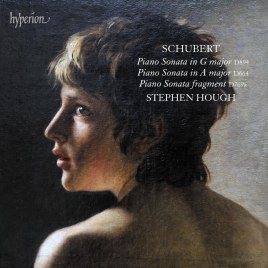 Piano Sonatas D664, 769a & 894 – Stephen Hough (piano). Hyperion, 2022



 The Cross-Eyed Pianist