
At my piano lesson this week, I played the first two and a half pages of the Toccata from J S Bach’s 6th Partita, BWV 830 in E minor. I have not played any Bach to my teacher before; indeed, I have not played any Bach seriously since I was about 14, when I learnt the Prelude & Fugue in D minor BWV 851 from the WTC as part of my Grade 8 repertoire. I’m not sure why Bach dropped off my pianistic radar – it’s not as if I don’t like his music, because I love it, and, if it was up to me, I would programme a whole three hours of continuous Bach for the Radio 3 Breakfast show. To me, there is nothing more enjoyable than waking up to a steaming mug of Redbush tea, a grey Burmese cat purring by my head, and a Bach Cantata or one of the Brandenburgs, or any of the keyboard music playing quietly on the radio at my bedside. Sadly, Rob Cowan, the most regular presenter of the show, favours lively orchestral music to open the show at 7am, and when I switch from argumental John Humphries on Radio 4, I often find my ears assaulted by Viennese ‘oom-pah’ music or some fussy, overblown Wagner. (By the way, I am sure I am not alone in finding John Humphries’ recent malapropism “Peasants and phartridges” hilarious; the best part was hearing James Naughtie snorting audibly on the radio and then the pair of them dissolving into silent giggles – a case of what a friend of mine calls “laughing in church”. A great radio moment.)
Part of my revisiting of the music of Bach came about because I have recently taught two of his keyboard pieces to a couple of my older students. I did one of the Small Preludes with a student in the summer term, encouraging her to overcome her timidity and play it with a sweeping grandeur, as if she were seated at the great organ of a great Baroque church of Mitteleuropa (another of Fran’s famous “visualisations”!). And this term Bella, who is my most advanced student, has learnt a simplified version of the first Prelude of the WTC (simplified only in that the semiquavers have been replaced with quavers and the closing phrase has been shortened), a piece she plays with wonderful colour and texture, a piece which she clearly loves. (She is opening my Christmas concert with it next weekend). Working on this piece, alongside Debussy’s Prelude from Pour le Piano, a piece which draws many influences from the Grand-daddy of them all, reminded me of how much I like the architecture of Bach’s music, his voices, and textures. It’s incredibly satisfying music to play, and requires a high degree of cerebral input, which appeals to the ‘intellectual pianist’.
A brief aside – I am no Bach purist, and will happily listen to his keyboard music played on harpsichord, organ or concert Steinway. To me, Bach was a revolutionary and an innovator: I am fairly certain he would have loved to have been able to compose for the modern piano, fully utilising all its capabilities.
The Toccata from the Partita No. 6 has a grandiose introductory section, the arpeggiated and dotted figures of the opening bar setting the tone, and style (here is another opportunity to imagine one is playing a great organ in another great Baroque church of Mitteleuropa!) before a shift in mood into a tightly-constructed three-part Fugue. Although called a Toccata (from the Italian “toccare“, to touch, and featuring lightly-fingered, fast-moving, virtuosic passages or sections to demonstrate the player’s dexterity: the third piece from Debussy’s ‘Pour le Piano’ suite is a fibrillating Toccata which requires immense fleetness of touch – I haven’t attempted it yet….), this is really a ‘Toccata and Fugue’ in the manner of the (in)famous, D-minor Toccata and Fugue. The introductory material is recapitulated at the close of the piece: the middle section is all fugue.
I played as far as bar 34, just after the subject and counter-subject of the Fugue are heard for the first time; this is all I have learnt so far (and I know this piece is going to be a long and satisfying learning process). My teacher complimented me on my playing, my phrasing and ability to highlight the ‘voices’ (I have never been keen on “monochrome” Bach-playing). We did some work on the opening measures, and then she turned to me and said “Can you explain the structure of a Fugue to me?” – and for a moment I was a 12 year old again, back in Rickmansworth, with my previous teacher, Mrs Murdoch, one of the “48” open on the music rack in front of me, a diagram of the construction of a fugue pencilled-in at the top of the page, which looked something like this:
Fugue Subject__________________________________________
______________Counter-Subject___________________________
_____________________________________Stretto___________
_______________Free Counterpoint_________________________
I managed to prevent myself from woffling about subjects, counter-subjects, stretto and suchlike to my current teacher, and admitted that I had not had to study a Bach fugue since A-level music, over 25 years ago. But as I spoke the various elements that make up the fugue in the Toccata from the BWV 830 seemed to spring out of the music before me, and as Penny asked me to identify the Subject, Answer, Counter-Subject, Codetta and so forth, I found myself playing each example as it appeared. Three pages in, and the music becomes more close-textured, and I was really enjoying this game of “hunt the Fugue”. Meanwhile, Penny was busy writing out my “homework” for me.
On my food blog, I have written about two “deconstructed pies” I recently cooked, where I took the constituent ingredients of two classic pies (steak & kidney and chicken & mushroom), and reconstructed them so that the key elements (filling, pie crust) were obvious and separate. In the same way, my teacher has set me the task of deconstructing Bach’s fugue, identifying the constituent elements and laying them out in such a way (on manuscript paper) so that each one stands alone. By highlighting each element, and writing it out in a different colour, I will be able to fully comprehend the architecture of Bach’s fugue, down to the tiniest detail, and will, I hope, know the piece intimately before I actually play it – rather like stripping out all the curlicues, traceries, columns and pediments of a great Baroque church of Mitteleuropa to see how it was built.
“I’ll start this on the way home” I thought excitedly as I left my teacher’s home and began my great trek back to south London. With a 90-minute commute in prospect, I could get quite a lot done, but tiredness overtook me by the time I reached Waterloo and I spent most of my homeward journey listening to Murray Perahia’s marvellous recording of the Partitas. In the Toccata, under his fingers, we hear great arches of sound (that Baroque church again), a lulling inner-heartbeat, and a middle section redolent of the Chromatic Fantasy and Fugue, with its fanciful codettas and cadenzas. This is one of the things I love about Perahia’s playing – his ability to highlight all the interior architecture, the harmonies, textures and voices. He does it with Chopin too, reminding us that Fred’s music is not just about “laahvely melodies”.
Meanwhile, as I traversed the London Transport system and considered the notes my teacher had made for me to set me on the task of mapping Bach’s landscape, with the different elements of the fugue highlighted in different colours, it occurred to me that my map of the fugue might not be so different from the London Tube map – coloured lines converging and veering off again, each with a distinct place, and role, in the construction of the whole. Just a thought….
I’m off to buy coloured pencils and a big pad of manuscript paper: I’ve got homework to do!
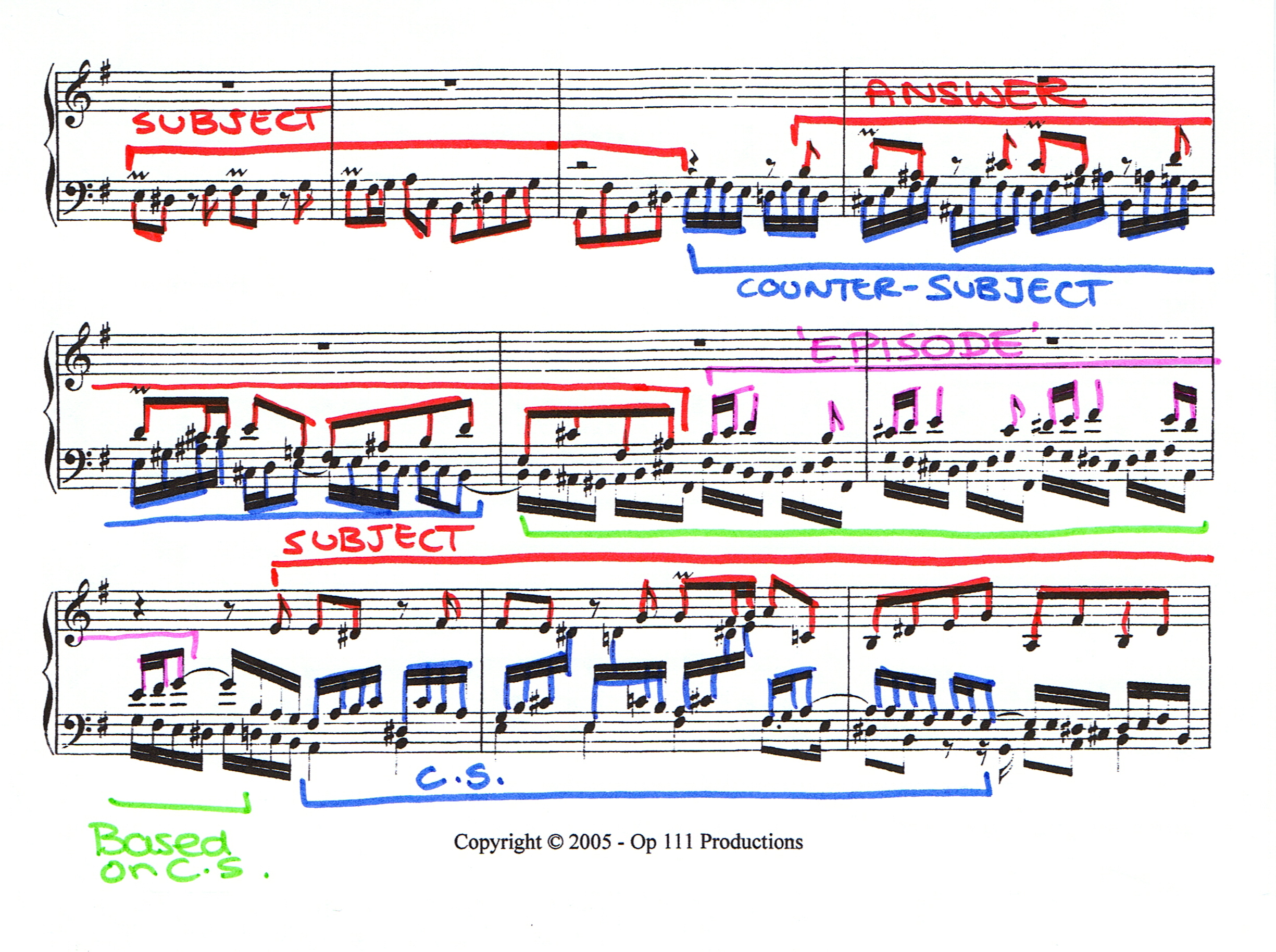
Postscript – a note on Bach’s ornamentation:
When I played the opening measures of the Fugue for my teacher, I played “old school” mordents, the decoration beginning ON the note. This is how I was taught to play such decorations when I first encountered Bach, way back when….. Modern scholarship (within my pianistic lifetime) suggests that a mordent should begin on the note ABOVE (thus, in the example given here, the decoration starts not on E but on F-sharp), thus creating some wonderfully crunchy harmonies and moments of tension.
Links




 The Cross-Eyed Pianist