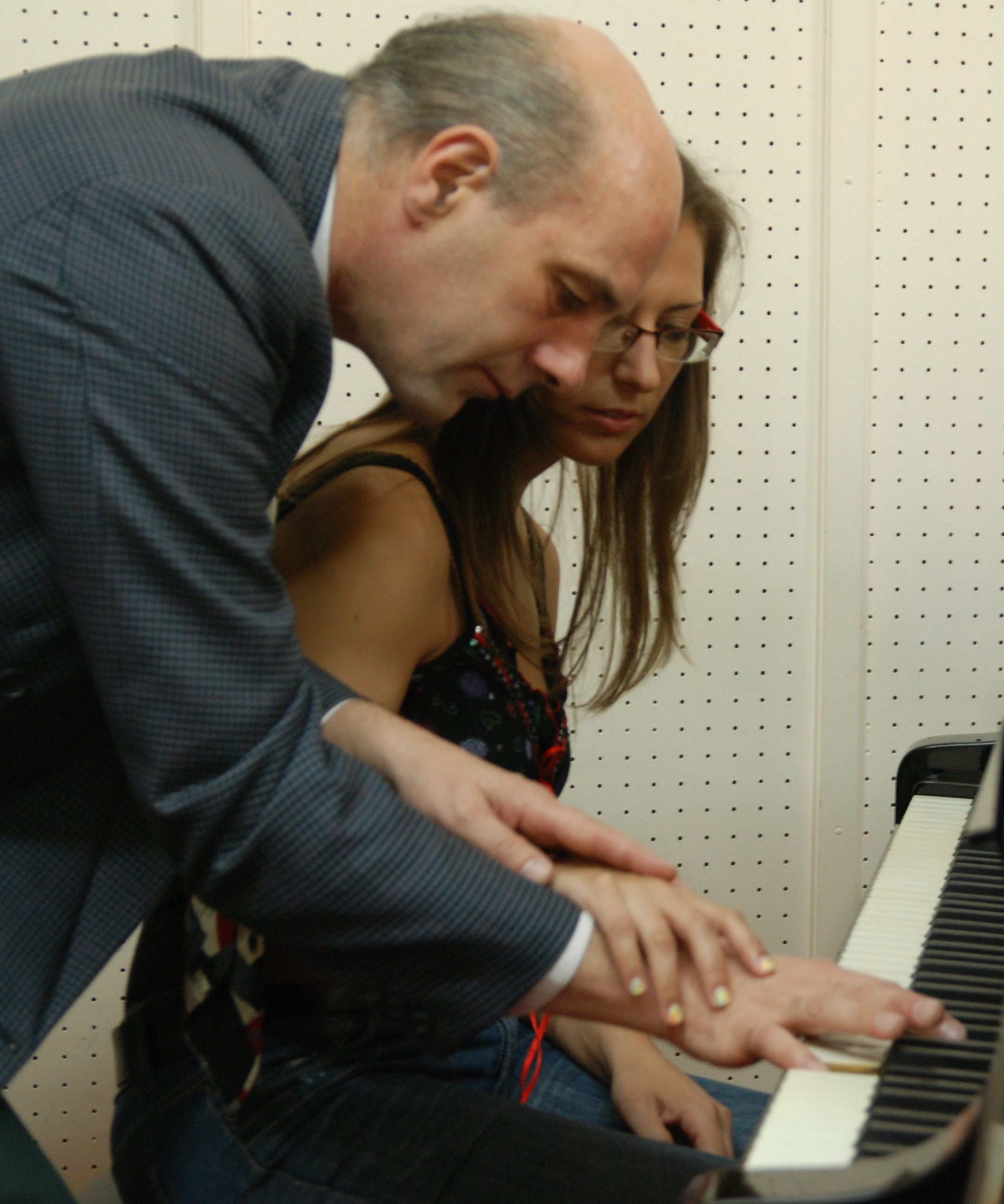
Pierre Tran

What is your first memory of the piano?

My first memory of the piano is from my childhood. Twice a week, my auntie used to teach Chinese songs to small pupils. I liked to join the group after school whenever I could. I still remember when she was at the piano, I was very much impressed with her small hands caressing the keyboard without any effort and without any harshness. Unfortunately the piano was very bad, always out of tune. However these magical moments remained deeply laid in my mind and somehow they have shaped my future both as a musician and as a teacher.

Who or what inspired you to start teaching?

As I said, my love for teaching was subconsciously dictated by my auntie. She was an outstanding teacher, a very patient and dedicated one, as she was also to me as a child. I have never seen her scolding children. Her voice always remained calm. Her manners were soft and gentle under any circumstances. That’s simply amazing! Later, in the course of my own life, I became a very young father. This first fatherhood, not only awoke a great deal of responsibilities towards my son, but at the same time raised many questions about education at large. So, teaching became second nature for me. At the age of 23, when my strong desire to transmit any valuable knowledge was finally fulfilled with music, I knew for certain how my life would be, whatever obstacles I might find ahead.

Who were your most memorable/significant teachers?

Thibaut Sanrame (1932 – 2001), concert pianist and one of the closest Scaramuzza’s disciples (see below), was the most remarkable piano teacher I experienced as a student. As a young adult, I spent ten years studying under his guidance (1979 -1988). Thibaut Sanrame was the leading proponent in France of a new teaching method, radically different from the mainstream curriculum. His students came from many European countries as he spoke German, Italian, French and Spanish (Germany being his third country of adoption – after France, and Argentina, his place of birth). Most of them, as young professionals, were looking to acquire a special tonal quality unseen elsewhere. My last teacher’s musical vision has changed my life from within. I became much more aware of myself in every aspect of playing piano. I discovered the unity of a human being where, for example, it is faulty to separate the so-called technical work from the musical one. From 1979 onwards, I stopped playing scales or any kind of technical exercises devoid of music. Today, I prefer to teach how to tackle any specific technical issue related to an ongoing situation which takes into account, not only the spirit of the composer or the score studied but, more importantly, the real features of the student sitting beside me.

Who or what are the most important influences on your teaching?

Your question is appealing for me because I met all of my musical requirements basically from only one teacher and one School of Piano, the Italian ‘Bel Canto’ applied to piano. So, as you can guess, I am not a mixture of different influences which sometimes garner several antagonist ways of playing piano coming, historically-speaking, from French, German or Russian Schools…, despite having scrutinised many of them. Definitely Maestro Vincenzo Scaramuzza (1885-1968) was the most significant genius teacher I came to know when, more than thirty years ago, I decided to become a teacher myself. Scaramuzza trained numerous internationally renowned pianists in Argentina, such as Martha Argerich, Bruno Leonardo Gelber, Enrique Barenboïm, and Fausto Zadra (who set up a school based on Scaramuzza’s research in Lausanne, Switzerland, the ‘Fondation CIEM-Mozart’, now closed, and the ‘Vincenzo Scaramuzza International Piano Competition’ in Crotone).

Scaramuzza’s extraordinary teaching method remains the main influence in my own way of thinking and of teaching piano. I wrote a book in 2009 titled (in French): ‘le Moi intime du Piano’ (Publisher: Van de Velde) partly focused on his life and on his stunning achievements. My friend, Rossana Cosentino, who lives in Scaramazza’s hometown in Italy, also wrote a small article dedicated to her grand uncle (see http://www.art-piano.com).

Most memorable/significant teaching experiences?

You know, I have had so many memorable situations in my life as a piano teacher, it would be unfair to only pinpoint one! A teacher should live memorable teaching experiences at every lesson, shouldn’t he? For me, the most musical significant experience happens when both teacher and student are mentally and emotionally ONE, both feeling the joy of learning and the joy of discovering the hidden meaning of music….whenever it occurs. On the other hand, I have kept in my mind most of the students I have taught, exactly from the starting point of my career, and perhaps I am also somewhere in their memory. Recently, I received an unexpected email from a student I had not seen in a long time. We immediately started to chat again as if we had never stopped meeting each other: the friendly and musical link was not broken. A very moving situation indeed!

What are the most exciting/challenging aspects of teaching adults?

To make them relaxed and confident. Usually they arrive at their lesson full of stress and tensions. Most of the time they finish their lesson in quite a different mood. This gives me a great satisfaction! I like to teach adults because there is always a kind of freedom in the air during a lesson tailored to an amateur who is ‘just’ fond of music. There is no binding academic syllabus. Thus, we can carry on a very good research on how to be a better musician, whatever the level involved.

What do you expect from your students?

I have no other expectations from my students but to be happy when playing music. Music at its highest goal is linked to ‘self discovery’. Only ‘self discovery’ can bring true happiness to your life. Put another way, I would say the more you are on the path of being a true pianist, the more you need to know about yourself. Then, by reversing the process, the closer you are to the music. Your musical thoughts and feelings are more profound. You can understand Beethoven more accurately when he ‘speaks’ of philosophy during his last sonatas, like in the Arietta from the Opus 111.

What are your views on exams, festivals and competitions?

Please, do not mix up exams or competitions with festivals. I love festivals! There are no better ways for sharing music at large scale. Hence, festivals help classical music to be widespread, not to be confined to enclosed social spaces. I can still remember stories related to the very well known ‘La Roque d’Antheron Festival’ at its debut, at that time when you could move freely from one recital to another, and when most of the artists were easy to reach, mainly because they all shared a simple life inside the same compound. Nobody can forget Maria Joao Pires, when she surprisingly showed up with all of her children and stayed in a caravan! Unfortunately things are not so entertaining nowadays!

On the other hand, I wonder whether exams and competitions are so helpful in terms of inner musical growth. I strongly believe that once playing music has become a social target, it loses its true value. Music, as a noble activity, must remain an unspoiled free educational goal for all of us, even if you are studying at a Conservatoire where examinations are simply unavoidable. Of course, I do not discourage any of my own students to take any exam, when it is needed or simply desired.  Hence, part of my work is to make several of them ready for competing at an international standard.

What do you consider to be the most important concepts to impart to beginning students, and to advanced students?

I do not make much difference between beginners and advanced students. Both of them are treated absolutely equally. As I said, the motto of my school is: ‘the love of music’. I agree with Heinrich Neuhaus, the famous Russian teacher, when he stated that it is a hard job to teach beginners because you must be very clear at your first steps’ guidance. Your student’s future somehow is in your hands! Once he (or she) has been misguided, it can be difficult to correct him (or her). On the other hand, according to my daily experience as a piano teacher, I often need to remind advanced students of the basic laws applied to playing piano because it is so easy to get lost in the midst of overwhelming emotions or even worse, of meaningless virtuosity. So, can you see much difference between of the two?

What do you consider to be the best and worst aspects the job?

I have never encountered the so called ‘worst aspects of the job’.  When you are, like my auntie, fully dedicated to your job, you can spend endless time in searching and in improving yourself without any bad feelings, can’t you?

What is your favourite music to teach? To play?

I like to teach ‘singing music’ like Maestro Scaramuzza did. You know, he taught the Italian ‘Bel Canto’ to all of his students over sixty years! What I like the most is to underline the hidden singing lines in all music. We can still find so many everywhere unnoticed, especially in Mozart’s Sonatas.

I play most of the well-known composers from Couperin to Debussy, and less well-known ones like Komitas, Gurdjieff for example. I also like to discover new pieces. So I do a lot of sight reading and at the same time I am still trying to explore news ideas on music scores I have been playing for decades. It is endless and very inspiring work…

Who are your favourite pianists/pianist-teachers and why?

One may feel uneasy with this question. However, I think that your students have the right to learn more about you and to understand where you want them to go. From my point of view, Grigory Sokolov is probably the most incredible pianist in the world. He is able to underline hidden singing lines in such a colourful way that your musical experience becomes a unique one.

Obviously, there are many great piano teachers in the world. For me, one thing matters: have you made your own path from a thorough practice which allows you to be an efficient teacher?

Personally, I have been pushed to go beyond one’s own limitations where new ideas may rise up. No question must remain unchallenged for the sake of music. For this purpose, I have introduced a new postural sitting position at the piano, using a unique ergonomic cushion, if desired, along with the ‘revolutionary’ application of ‘the indirect weight’ which completely eliminates the habit of striking the keyboard. The use of the pedals was reconsidered. All these new techniques may enlighten your musical thoughts and ultimately may lead you to the quest of how to produce ‘organic sounds’ as applied to music (see document at http://www.art-piano.com).

The Art of the Piano, directed by Pierre Tran, offers one-to-one tuition, workshops for the piano and masterclasses. Teaching beginners and training professionals. A new way of learning the piano, friendly and focused on a thorough understanding of music. Bilingual teacher (French/English).

The Art of the Piano has an expanding customer base, throughout many European countries, including the UK.

The company is run by Pierre Tran who has been involved in the piano tuition business for many years. Pierre Tran is well trained to run the school, having previously worked for L’Art du Piano.

www.art-piano.com

An article about Pierre Tran in Petersfield Life magazine

Benjamin Grosvenor (photo credit: Sussie Ahlberg)

A recent recipient of two Gramophone awards, young British pianist Benjamin Grosvenor made his Queen Elizabeth Hall debut in a concert focusing on stylised dances – from the stately Allemandes and Sarabandes of a Bach Partita through Polonaises, Mazurkas, and Waltzes to a foot-tapping Boogie-Woogie for an encore. Read my full review for Bachtrack here

International Piano Series at the Southbank Centre

Sarah Beth Briggs (image credit: Clive Barda/ArenaPAL)

Who or what inspired you to take up the piano, and make it your career? 

My father was my initial inspiration. He was an English teacher, but he always had a few piano students coming to the house. I was intrigued and wanted to do what they were doing. So he started me off when I was four. Having someone to help me when I was in the mood, rather than being forced into playing was probably the greatest encouragement.

Career wise – I suppose there is a point when music just takes over. It was never an active choice. It happened fairly early for me. I was (at the time) the youngest ever finalist in BBC Young Musician at 11 and things went from there.

Who or what were the most important influences on your playing? 

Denis Matthews was the most incredible inspiration. I was very fortunate to be taught by him from the age of eight until his death. He was such a terrific all round musician. He made me understand that there was far more to being a good musician than playing the piano. Lessons would involve listening to Mozart operas, Beethoven string quartets, Brahms symphonies etc and then making the piano ‘become’ a singer, a string quartet, a pair of horns – always looking way beyond the dots on any given page!

I was then lucky to study chamber music with the great violist, Bruno Giuranna and go on to work with Chilean concert pianist, Edith Fischer (an Arrau pupil) in Switzerland.

What have been the greatest challenges of your career so far? 

The path of a freelance musician is a rocky one and the route to success is never simple. My first huge challenge was to lose my mentor, Denis Matthews (who was a close personal friend in addition to being such a huge musical inspiration) at such an early age.

Poor instruments are always a challenge – battling with the impossible to some extent, but it is a pianist’s responsibility to achieve the very best possible from any given instrument.

Perhaps, however, the greatest challenge of all is to remain true to yourself (whatever external pressures try to dictate). The music business is fickle and it’s impossible to please everyone. A huge self awareness is constantly necessary and being as faithful to the score as possible is, to me, the single most important thing to aim for.

Which performances/recordings are you most proud of?  

There is something very satisfying about feeling that I have contributed towards a particularly exciting chamber music performance, so perhaps my happiest moments of performing to reflect on have been when I’ve been part of a really exhilarating musical collaboration. As far as recordings go, I suppose my latest disc (of Haydn, Mozart and Beethoven) is the one that I feel the most pride in looking back on.

Do you have a favourite concert venue to perform in? 

Actually, no – so much depends on each individual occasion and, to some degree, the association that certain places hold. In terms of beauty, performing at the Mozarteum in Salzburg is special. Whilst it’s not aesthetically the most pleasing hall, I love the acoustic of Fairfield, Croydon (and I particularly like its new model D Steinway). Performing at Stern Grove in San Francisco to 20,000 people was exciting (in spite of the acoustic problems of playing outdoors) and at the other end of the scale, playing to something like 120 people in the delightfully intimate atmosphere of St Mary’s Church in Lastingham was just as special. So, it varies hugely for me and the most prestigious venues in which I’ve played haven’t necessarily been my preferred spaces. I do, however, long to play in the glorious acoustic of the Wigmore Hall – a particular favourite for concert going.

Favourite pieces to perform? Listen to? 

The answer to the first question has to be whatever I am currently performing – otherwise the performance couldn’t be convincing.

One wonderful thing about being a pianist is the vast repertoire of superb music that we are so lucky to have to perform. Composers I couldn’t survive without performing are: Mozart, Beethoven, Haydn, Schubert, Brahms, Debussy and Chopin and on the next tier: Schumann, Bartok, Prokofiev and Mendelssohn. I have notably missed out JS Bach whose music I love but have decided (in the main) to save performance-wise until a few more years have elapsed.

When it comes to listening – anything that isn’t solo piano! My strong preferences lie in the symphonic and chamber fields – if I had to name just a handful of composers – orchestrally, I would again have to choose Mozart, Beethoven, Haydn and Brahms but with a definite addition of Sibelius. Chamber wise – yet again Mozart, Beethoven, Haydn Brahms, Schubert (perhaps at the top of my chamber list) and Schumann. Oh – and the ‘wild card’ is Faure’s Cantique de Jean Racine……six and a half minutes of pure, deeply moving beauty that always manages to de-stress me even in my most highly-charged moments!

Who are your favourite musicians? 

Several of the musicians who I have the good fortune of playing chamber music with – perhaps unfair to single out! When it comes to other pianists, I suppose my very favourites would have to include Radu Lupu, Murray Perahia, Paul Lewis and the stunning Benjamin Grosvenor.

What is your most memorable concert experience? 

Being locked in the dressing room at Morpeth Town Hall (aged 10) with a load of alcohol ready for a wedding reception and not being able to get to the stage. I can still sense the anxiety of knocking on that door and being unable to get out!!!!!

What do you consider to be the most important ideas and concepts to impart to aspiring musicians?

To be able to develop an individual voice whilst trying to honour what we believe the composers’ wishes would have been as much as possible. I think the hardest thing to teach is not so much the sounds as the silences – the way notes are placed and the whole concept of how to breathe is something that really needs to be innate. And yet as teachers, we need to attempt to put our students on the right track. And finally – can anyone help to improve someone’s staying power? I guess that being able to impart the notion that any aspiring musician will need dogged determination is very necessary.

What do you enjoy doing most? 

Away from the piano, I love good food and wine (both at home and discovering it on my travels) the theatre, exploring the countryside with my delightfully lively cocker spaniel and spending time with close friends and family.

Sarah Beth Briggs latest CD of Mozart, Beethoven and Schubert is available now. Further details here

Newcastle born pianist Sarah Beth Briggs was (at that time) the youngest ever finalist in the history of BBC Young Musician competition at the age of 11 and gained a Myra Hess Award at the same age. At 15, she jointly won the International Mozart Competition in Salzburg. She studied in Newcastle, York and Birmingham with Denis Matthews and in Switzerland with Edith Fischer. A Hindemith scholarship also led to chamber music study in Switzerland with violist, Bruno Giuranna.

A soloist and chamber musician, she has broadcast and performed live in the UK, around Europe and the USA and has worked with many renowned orchestras including the Halle, London Mozart Players, London Philharmonic, English Chamber Orchestra, Scottish Chamber Orchestra, Royal Philharmonic, Ulster Orchestra, Manchester Camerata, Royal Liverpool Philharmonic, Northern Sinfonia and Vienna Chamber Orchestra. She has also given numerous masterclasses and chamber music coaching sessions in the UK and abroad.

She is the pianist in three chamber ensembles, The Anton Stadler Trio (with clarinettist Janet Hilton and violist Robin Ireland), Clarion³ (with Janet Hilton and bassoonist Laurence Perkins) and Trio Melzi (with violinist Richard Howarth and cellist Hannah Roberts).

Sarah has produced recordings of Bartok, Beethoven, Brahms, Britten (the world premiere of whose Three Character Pieces she gave in 1989) Chopin, Haydn, Mozart and Rawsthorne on the Semaphore label.

http://www.sarahbethbriggs.co.uk/

(image credit Clive Barda/ArenaPAL)

Interview date: October 2012

Claude Debussy – Images Books I & II, Images oubliées

Toru Takemitsu – Les yeux clos, Les yeux clos II, Rain Tree Sketch, Rain Tree Sketch II

Rika Zayasu, piano

To celebrate the 150th anniversary of the birth of Claude Debussy, pianist Rika Zayasu has released a CD of two books of Images and Images oubliées, and four pieces by Japanese composer Toru Takemitsu.

Recorded at St Bartholomew’s, Brighton, this CD is produced and mastered by Claudio Records, using their new ‘Q-Lab Sound/192-Stereo High Definition Audio’, a technique which results in a remarkably pristine and natural quality of sound (undoubtedly helped by the fine acoustic of the recording venue and the quality Steinway instrument). CDs produced using this technique can be played on high-quality DVD-Audio equipment and Blu-Ray surround sound systems.

Rika plays with great sensitivity, displaying grace and precision in touch and use of pedal, and her understanding of Debussy’s music is clear from the range of musical shadings, nuances, colours, articulation and rhythmic vitality she brings to these works. The first Image from Book I, ‘Reflets dans l’eau’, is supple and fluid, with a rippling, luminous treble over a rich bass, which never overpowers. The oriental elements of this music (as in the other pieces in this suite) are highlighted, reminding us of Debussy’s fascination for Japonisme and eastern gamelan music. ‘Hommage à Rameau’ is haunting, stately and antique, its tempo relaxed but not dragging, so we never lose a sense of its structure, underpinned by the underlying 3-in-a-bar pulse, with some beautifully paced climaxes (again, evident in other works on the CD). ‘Mouvement’, in contrast, is sprightly and animated, with bright, joyful, bell-like sounds which continue into ‘Cloches a travers les feuilles’, in which Debussy evokes the sonorities of bells and carillons, and Far Eastern percussion. Here, there is some lovely, subtle highlighting of the internal melodic lines of this complex music. ‘Poissons d’or’ is vibrant and colourful, shimmering and characterful.

The Images oubliées are more introspective (Debussy described the pieces as “not for brilliantly lit salons … but rather conversations between the piano and oneself.”) . The ‘Lent’ is expressive and melancholy, while the ‘Sarabande’ (later reworked for the middle movement of Pour le Piano, with a few adjustments to harmony and phrasing) moves with a solemn, ancient elegance, with some lovely bright, clean fortes in the climaxes on the final page of the music. ‘Tres Vite’ is humourous, with toccata-like qualities which recall both the ‘Prelude’ and ‘Toccata’ from Pour le Piano, and ‘Jardins sous la pluie’ from Estampes.

The four pieces by Takemitsu perfectly complement the works by Debussy, and are related to them in the use of titles to stimulate the listener’s imagination. Les yeux clos (The Closed Eyes – three pieces in total) are inspired by a lithograph by the French symbolist artist Odilon Redon, which depicts a bust of a woman whose eyes are closed. It suggests a dream or inner world. Takemitsu’s music reflects this in the use of fragmented melodies over sustained pitches, with flexible durations, which freely connect to one another. Similarly, the Rain Tree Sketches were inspired by a poem by Japanese novelist, and friend to the composer, Kenzaburo Oe, which describes ‘the clever rain tree’, an ancient tree whose thousands of tiny leaves collect and store rain water, so that after the storm has passed, rain continues to fall from the tree. Precipitation is suggested through single droplets of quiet, lone sustained notes and sudden dissonant clusters of sounds, as if shaken from saturated branches.

All four pieces are played with immense control and insight. Soft, pastel-coloured sound showers and radiant trebles chime over rich bass sonorities and pedal points, while the silences are as carefully judged as the notes between them. These pieces are evocative and ethereal, their transcendental nature emphasised through the precise use of pedals, and the pianist’s ability to allow sounds to resonate and ring, or fade to nothing, which create an exquisite sense of stillness.

My Meet the Artist interview with Rika Zayasu

www.claudiorecords.com

Rika Zayasu plays Takemitsu Rain Tree Sketch II