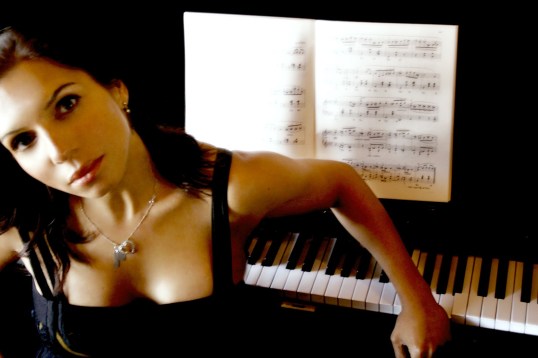
Recently, I had the very great pleasure of interviewing GéNIA, Russian pianist and teacher, and creator of innovative piano technique, Piano-Yoga®. We met at London’s prestigious Steinway Hall to talk about many aspects of piano teaching and performing, and, in a departure from the usual format of the At the Piano….. interviews, our conversation was filmed.

The videos will be published in six short instalments. In the first, we discuss GéNIA’s musical heritage, her first piano, the influence of her great-grand uncle Vladimir Horowitz, significant teachers and other influences that affected GéNIA’s musical development.

For more information on Piano-Yoga® please visit

www.piano-yoga.com

More At the Piano…… interviews

kimiko_di_100-708x352Who or what inspired you to take up the piano, and make it your career? 

The inspiration to play piano came to me at the age of four when my mother first placed my tiny hands on the keyboard and pushed my fingers down with hers, thus teaching me the first piece I learned, the Minuet BWV 114 from Anna Magdalena’s Notebook, which at that time we still believed to be a piece by J.S. Bach. I say inspiration, but really it was a decision: a decision, that I would be a pianist, which was probably made before I was born.

The more interesting moment in time is the point at which I actually embraced my future and identity as a pianist. Certain experiences in my life, which began at university, contributed to my actively making the decision to become a musician for myself: the first time I really connected with an audience as a soloist (my early years were dominated by chamber music); having success at sports; learning a second language: these are all things that I needed to experience before I could embrace fully embrace the decision to be a pianist.

Who or what were the most important influences on your playing/composing? 

Everybody’s playing is a conglomerate of personal experience, and memories. I cannot name any single influence. However, there are many small clues that added up over time to lead me down a road of exploration that eventually allowed me to find my own voice as a pianist.

My experience as a weight lifter taught me that the millimetre matters, that a small change in the shift of your balance can mean the difference between success and failure. Also, my music school professor, Roswitha Gediga, would admonish me to relax my shoulders, to get to the bottom of the keys, and would demonstrate this to me in my lessons.

Those experiences and memories led me to deeply explore the physical aspect of my playing. And in the sanctity of my practice room, with the requisite time for exploration, I’ve looked at my playing and progressively learned about the physical mechanics of piano technique. You can’t do that type of exploration when you’ve got one 70-page chamber piece to get through after the next, where you really can’t ever find the time to get into the detail of each motion.

What have been the greatest challenges of your career so far? 

Every new piece that a pianist learns is a great challenge. It’s never the same set of problems twice, but this is a good thing, really. It keeps it fresh.

One challenge came at the point when I stopped playing in the chamber ensemble that occupied the first 17 years of my career. We had been playing up to 50 concerts a year and that number pretty much went to zero for me overnight when we quit. So while it was a profound change in the rhythm of my life, it afforded me the space and peace to finally embrace my identity as a pianist and make it my own.

Which performances and recordings are you most proud of?

I am most proud of my recent solo recording from the Open Goldberg Variations project that completely occupied the last two years of my life. It was a large project that involved many more people than just myself, and we produced something that is truly new and beautiful.

The recording of J.S. Bach’s Goldberg Variations is now in the public domain, as is the new engraving of the score of the piece, which I assisted in editing. People can get this recording directly from the Open Goldberg website – www.opengoldbergvariations.org – and enjoy the full freedom of a public domain work. That means you can download it, share it, and even use it as the starting point for new creative works.

Do you have a favourite concert venue to perform in? 

Any hall with a Bösendorfer and an attentive audience.

I recently played in the Shalin Liu Performance Center in Rockport, Massachusetts. The hall features a window behind the performer that looks out over the ocean. I liked that quite a bit because as I was warming up during the day, all sorts of birds were swimming in the water right below me.

There are some halls on my wish list as well. From the photographs I imagine that it is divine playing in the Snape Maltings Concert Hall in Suffolk.

In the end, music is this ephemeral thing with a very strange heartbeat of its own. When it’s a good performance, the music is all that matters. So whether it’s a large audience or small, whether the piano is working with you or against you, and whether the hall is resonant or dull, the pianist only has the music to think about in every case.

Favourite pieces to perform? Listen to? 

Music is a very personal thing. I recently performed a concert that was half Bach and half Chopin. It was interesting to me after the concert to listen to the audience members debating amongst themselves whether the Bach part or the Chopin part was the better, more enjoyable half.

Just like the audience at that concert, I have my personal preferences. I seek out the pieces that speak to me in the most profound way. The piano repertoire is very large, and there is far too much for anybody to play in a lifetime. So I have focused on a few composers to whom I have the closest relationship. This includes Bach, Schubert, Debussy, and more recently, Chopin. This is something that will certainly continue to evolve.

Who are your favourite musicians?

There are many, of course, though I don’t listen to recordings nearly as much as one would expect. One of the most inspiring concerts I’ve attended recently was Radu Lupu performing Schubert and Schumann in Amsterdam.

What is your most memorable concert experience? 

When I was 11, the trio I played in with my brothers debuted at the Sogakudo Concert Hall in Tokyo. At the time all three of us played both piano and a string instrument – mine was the violin. We played every combination of violin, cello, and piano music possible, including 6-handed piano.

What I remember distinctly was the audience’s extreme enthusiasm for what we had done. Many of them had brought flowers, and they placed the bouquets on the stage as we played successive encores. By the end there were over 30 bouquets, and this made a strong impression on me as a child.

What do you consider to be the most important ideas and concepts to impart to aspiring musicians? 

Be yourself. Attending your 20th masterclass won’t make you any smarter than the 19th did. Study the music, the actual piece. Not someone’s analysis of it, or the composer’s life, or the 10 other pieces that were written at the same time. The piece is supposed to stand by itself, and it’s got its own message, but you need to take the time to find it.

What do you enjoy doing most? 

Taking walks in the fresh snow. When the snow and ice go crunch under my feet I experience an advanced elevated state of happiness that cannot be equalled by anything.

German-born Japanese pianist Kimiko Ishizaka performs the first book of Bach’s Well-Tempered Clavier at the 1901 Arts Cub, London on Wednesday 30th January. Further information and tickets here

The Open Goldberg Project

Kimiko Ishizaka’s biography

In November 2012, I was asked to contribute to a podcast for Bachtrack on reviewing piano concerts. This post takes some of the points from the podcast and expands them.

There was a time, not so long ago and at least within my living memory, when critics were regarded as significant arbiters of taste and culture who could, seemingly, make or break a career with one well-aimed stroke of their incisive pen. But critics are not gods (and never have been), and these days, with the rise of blogging and tweeting, music criticism has become far more democratic. Many bloggers are not professional journalists, but many are musicians or teachers, who are competent and intelligent writers with a depth and range of knowledge often superior to that of broadsheet music writers. Many of us (myself included) write about classical music simply because we love it. Bloggers and online critics tend to publish their reviews well in advance of broadsheet providers, sometimes the same night as the concert or at least the next morning, and offer a more personal but no less objective view of the concert. I also love the concept of tweeting during* and immediately after the concert, thus bringing an immediacy to the review, and an off the cuff, instant reaction comment can sometimes express far more than a considered paragraph written the next morning (*during the interval – naturally, my phone is turned off during the performance!).

“Audiences do not wish to be patronised”. This quote from a concert pianist friend of mine, in fact about the necessity to play all the repeats in Schubert’s last piano sonatas, could equally be applied to the reviewer’s attitude to his/her audience. While many audience members may not share the reviewer’s depth of knowledge or musical vocabulary, we should never talk down to our readers in the manner of children’s tv presenters. Good reviews should not seek to tell the public how to listen – nor instruct the musician in his art. A good review offers an objective overview of the concert.

“Classical music reviews are important because, if well written, they can serve as a guide for non-specialists or people new to the music, as well as providing a point of reference for those who attended the event reviewed. We believe that the best reviewers are very knowledgeable about music, and have the additional gift of being able to explain musical details in clear, accessible language. Because at Bachtrack we ask reviewers to write not only about performance but also about the works played, they can also be of interest to people wishing to learn more about pieces or performers when considering whether or not to attend events”

(Alison Karlin, founder & director of Bachtrack)

Rhapsodic, poetic and overblown writing at the expense of clear-sightedness can be irritating to read and may be used to mask a lack of knowledge. This review made me laugh out loud with its unnecessarily purple prose. Joking apart, it doesn’t really tell us that much about the music being performed. A little more historical/contextual background (and a little less “caressing the keys”) would have made this a far more informative and informed piece of criticism.

Conversely, a review which is confined only to technical analysis is dry and dull to read, and may come across as overly didactic or high-falutin. Such writing is really only accessible to other trained musicians or musicologists, and does not really get to the “soul” of the music. After all, it is the emotional engagement which most people seek when going to hear classical music (or indeed any music). Schumann said that the best music criticism is that which leaves after it an impression on the reader such as that which the music made on the hearer. In my own reviews, I seek always to create the impression of “being there”, while also offering the reader some background on the pieces being performed. A good review should arouse curiosity and pique the reader’s interest.

“Where sympathy is lacking, correct judgement is also lacking”

Mendelssohn

An objective reviewer should not be blind or deaf to faults or inconsistencies in a performance, but we should never glory in them. In fact, I have a few phrases which enable me to be “kind” in instances of sloppy playing or a memory lapse (“some uneven passages”, “an anxious moment” for example). And as an occasional performer myself, I understand the amount of time and effort that goes into preparing for a concert. Performers are human, just like the rest of us, and sometimes it is not always possible to arrive at the venue in a calm state of preparedness: maybe the traffic was bad, or one has a cold. These factors can affect the quality of a performance by even the most poised musicians.

For the performer, a review is an endorsement, a testimonial and a confirmation of their craft and art. Performers do not perform to please critics, but a good review or reviews can make a difference to a performer’s commercial success leading to increased concert attendances and CD sales, and for a young performer, greater confidence and credibility. British pianist Peter Donohoe has written eloquently and in great detail about the role of critics and their relationship with performers on his blog (see link below) and I will leave it to Peter to expand on this aspect.

I am always a little suspicious of performers who claim they “never read” reviews (Benjamin Grosvenor is a contemporary example). This apparent disregard suggests either an over-arching ego (“I’m far too important/talented to bother with reviews”), in which case the performer in question should perhaps exercise a degree of humility, or a lack of self-confidence (“I won’t read reviews in case the reviewer says something nasty/negative about me”). As Peter Donohoe says, performers should “take it as a compliment that the critic writes about you at all”. Conversely, it is always a great compliment (to me, at least), to see one’s review quoted on a performer’s website, or in some publicity material, or on a venue’s website. And if it’s any consolation to the performer whose last performance was panned by a critic, reviewers receive critical comments too. Writing about music is hard to do, because the activity of listening to music is highly subjective. I have received comments on my reviews suggesting that I have not heard a concert “properly” or disagreeing with my judgement of a particular performance. The answer to this is, of course, that we all hear differently and our enjoyment of music can be very personal.

When I contacted Peter Donohoe to thank him for such an interesting article on the role of critics, and for writing so warmly about my own blogging and reviewing activities, he replied that it was “because we are on the same side – that of the music”. And that, for me, sums up very neatly the reason why I write about music: I love music and care very passionately about classical music. It has been a significant part of my life since birth (there was music, live and on LP and the radio, in my parents’ and grandparents’ homes, I was taken to concerts from a young age, and encouraged to study music), and I’m not really sure what I’d do without it. Nearly every week of the year, I am at a concert, at the Wigmore Hall, the Southbank Centre, King’s Place, or in a small, intimate venue, in Hackney (Sutton House) or Walton (Riverhouse Barn). I enjoy a wide range of piano music, hear fantastic musicians, both established and up-and-coming, and writing about the music which I love has put me in touch with a remarkable group of people, who, far from being stuffy and elitist (a largely misguided perception of classical musicians) are normal, warm, intelligent, funny and generous (Peter, for example, kindly gave me some help with one of my Diploma pieces via the medium of Facebook). And if one of my reviews encourages someone to buy a ticket for a classical music concert, then I am doing my job right.

Read Peter Donohoe’s article on music critics here

Some other music reviewers/bloggers I follow

Boulezian (Mark Berry)

Orpheus Complex (Gavin Dixon)

JDCMB (Jessica Duchen)

Musical Toronto (John Terauds)

Classical Source

And some bad reviews from the Lexicon of Musical Invective

When Manet’s picture The Railway (1873) was first exhibited at the Paris Salon of 1874, critics were hostile. The painting depicts a young woman seated in front of iron railings overlooking the sidings at the Gare Saint-Lazare in Paris. She raises her head from the book she’s been reading to look up at the viewer with an expression of mild indifference, while a little girl next to her turns her back on us to observe the clouds of steam rising from a passing train. Critics were confused: was this a subject picture or a double portrait?

The Railway (1873)

The Royal Academy’s spring blockbuster exhibition for 2013 focuses on the portraits of Edouard Manet. It explores the artist’s modern approach by suggesting that his narrative genre scenes are in fact portraits, which place his sitters in natural, realistic situations, turning his subjects into “actors” in scenes of modern life, and authenticating his scenes of contemporary life by filling them with real people. Read my full review here