It’s still quite unusual these days to attend a concert where the programme begins with a quiet and/or slow piece. Often performers have a favourite “warm up” piece, one with which they feel very comfortable, which is a helpful way to ease into the main programme, warm up the fingers and settle in for the concert. For some performers, a Prelude and Fugue by Bach, or something similar, is a good opener.
I recently attended a concert where the pianist began his programme (which included Beethoven’s heavenly penultimate piano sonata, the Op 110, and closed with Gershwin’s Rhapsody in Blue) with two very quiet, very slow sonatas by Scarlatti. It helped that the pianist in question can produce the most poetic sound (at any dynamic) on the piano, but there was something about the intimacy and muted sounds of this music that made for a very concentrated listening experience.
In fact, I think beginning a concert in this way is a stroke of genius as it can create an immediate sense of intimacy and focus. The audience is forced to listen closely and pay attention to the nuances of the music – a very effective way of drawing the audience in and engaging them with the performance, and ensuring their attention for the remainder of the concert. Opening with a quiet piece or pieces can also create a sense of anticipation and expectation: the audience may be more likely to be attentive and engaged if they are waiting for something to happen. This can be particularly powerful in a concert setting where the audience is large or the venue is imposing, as it can help to create a sense of connection and shared experience.
A quiet piece can be a very effective way of setting the tone for the entire concert and can establish a mood and atmosphere that will carry through the entire concert. This can be especially effective if the quiet piece is followed by more up-tempo or energetic pieces and the contrast can be very effective in creating a dynamic and varied performance. Beginning with a quiet piece can be a bold and unexpected choice, challenging the audience’s expectations and encouraging them to approach the performance with an open mind.
Finally, starting with a quiet piece can be a very effective way of showcasing the performer’s skill. It’s not easy to perform a quiet piece effectively, and is a real demonstration of the performer’s control, sensitivity, and expressiveness. This can be especially powerful if the performer is able to create a sense of intimacy and connection with the audience.
This site is free to access and ad-free, and takes many hours to research, write, and maintain. If you find joy and value in what I do, why not
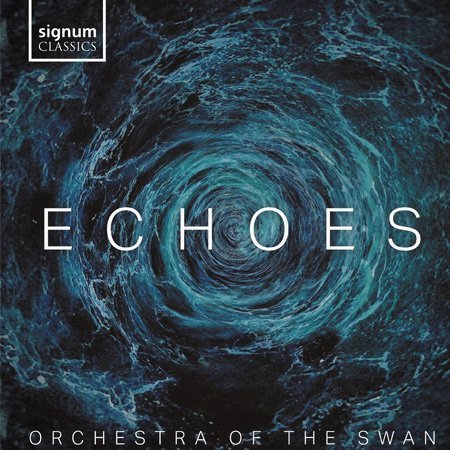
‘Echoes’ is the latest in Orchestra of the Swan’s ‘mixtape’ series, following on from ‘Timelapse’ and ‘Labyrinths’ (which has received over 8 million audio streams since 2021 and was shortlisted for Gramophone award in the Spatial Audio category).
As with their previous mixtape albums, ‘Echoes’ is an eclectic mix of music encompassing a variety of genres from Baroque to pop. The album features 14 tracks of arrangements of song by Frank Zappa, Adrian Utley (Portishead) and The Velvet Underground together with works by J S Bach, Delius, Max Richter, Philip Glass and Gerald Finzi.
David Le Page, violinist and Artistic Director of OOS, and arranger of many of the tracks, says of the album, “Although you can listen to each track in isolation Echoes is, first and foremost, a complete journey; the way a work ends and another begins is designed to create a frisson, a jolt of recognition or a feeling of surprise and satisfaction. Echoes explores landscape, light, water, dreams, birth and the slowly changing rhythm of the seasons; it also represents a callback to the days of vinyl when the act of listening to recordings was necessarily more involved and required all of your attention…. Despite the ongoing march of music technology and the death of various beloved formats the mixtape has somehow survived and adapted. It is unaccountably more popular than it has ever been.”
Echoes is a captivating and beautifully orchestrated collection of music that seamlessly blends old and new, the familiar and the lesser-known. It opens with a shimmering, luminous and utterly transporting performance of the Bach/Siloti Prelude in B minor, arranged for violin and orchestra by David Le Page. From the silken lines of Bach/Siloti we move into the joyousness of Max Richter’s “recomposed” Spring II from The Four Seasons and thence to the urgent energy of Buffalo Jump by Philip Sheppard. This is followed by the psychedelic, zany Peaches En Regalia by Frank Zappa in an arrangement redolent of the late 60s sound of the original with imaginative scoring for brass and Hammond organ.
After the high jinks of Zappa, a calmer interlude follows with Falla’s Nana, featuring Sally Harrop on clarinet who brings a haunting poignancy to the melody. The Sea of Time and Space by David Le Page is a an uplifting track inspired by the middle movement of Vivaldi’s L’inverno, the Romance from Britten’s Frank Bridge Variations and the second movement of Stravinsky’s Concerto in D for string orchestra, which takes its title from a painting by William Blake. A gentle bossa nova bass and pizzicato notes provide the backdrop over which two violins gracefully, sensuously glide in a silken soundworld. This segues perfectly into The Art of Dancing. V: Trance by Toby Young, a modern homage to the baroque dance suite where each movement hints at a different style of electro dance music. Trance is a nocturne, in part inspired by the stillness of the Adagietto from Mahler’s Fifth Symphony and the hypnotic ambiance of electronic dance music, all beautifully expressed by the muted trumpet solo played by Simon Debruslais.
Venus in Furs, an iconic, unsettling track by the Velvet Underground, is reworked by David Le Page. It retains the angular, ‘shrieking’ viola of the original, but Le Page’s austerely beautiful violin, replacing Lou Reed’s vocals, lends an unexpected tenderness to this track.
Glory Box, by British indie group Portishead, here arranged for voice and orchestra, is the highlight of the album for me. Strings slink and slide with Clara Sanabras’ potent, expressive and bluesy vocals. It’s very close to the original version – it retains that haunting string sample – but is magically reimagined by Le Page.
After the taut fragility of Glory Box, We played some open chords and rejoiced (A Winged Victory for the Sullen) provides another calming interlude: here, a simple chordal piano motif, played by Viv McLean, and shimmering strings and guitar create a beautiful soundscape, understated in its emotion yet replete with expression.
Starbust is a vibrant, colourful contrast, while Aquarelle 1 by Delius, arranged by Eric Fenby, is another demonstration of the warmth and elegance of the Orchestra of the Swan’s string section. A spacious tempo allows the listener to really appreciate Delius’ magical harmonies. Similarly, in Mishima – Closing from String Quartet No 3 by Philip Glass (arr. by David Le Page), the richness of OOTS’ strings piquantly highlights the shifting harmonies and textures of Glass’ music in a movement of shifting emotions and timelessness.
To close, The Salutation from Finzi’s Dies natalis, perhaps the most obviously “classical” piece on the album, and a quintessentially English piece too, its vocal line elegantly sung by Mark Le Brocq who really captures the poignancy of this music, written on the eve of the Second World War.
In ‘Echoes’, Orchestra of the Swan has once again delivered a genre-busting album that contains brilliant, unexpected juxtapositions and imaginative orchestrations. Like their previous mixtape albums, it’s ambitious, ingenious and unorthodox. The result is a stylish, sensitively curated album that is an enchanting, often intriguing and always engaging listening experience.
ECHOES is released on the Signum label and is also available via streaming
This site is free to access and ad-free, and takes many hours to research, write, and maintain. If you find joy and value in what I do, why not
at Wyke House, Wyke Champflower, Somerset BA10 0PW
Saturday 1st July from 6pm
Amy Carson, soprano
Emily Vine, soprano
Thomas Hobbs, tenor
Timothy Dickinson, bass-baritone
Sunset Sounds presents a semi-staged performance of Purcell’s The Fairy Queen with a live orchestral ensemble in the picturesque gardens of Wyke House, in the village of Wyke Champflower, Somerset.
The performance will be interspersed with poetry readings inspired by themes in the opera, and by ‘A Midsummer Night’s Dream’. Of course, ‘The Fairy Queen’ isn’t really an opera at all, rather a semi-opera, intended to be performed alongside a retelling of Shakespeare’s story. Essentially, the performers have made selections from Purcell’s music and created their own “libretto” with the readings.
Staged entirely outdoors, the performance will move between two different areas of the garden with a picnic interval. It is a chance to enjoy “country house opera” in an intimate, relaxed and informal setting surrounded by the beautiful Somerset countryside. Audience members are invited to bring a picnic, a blanket and a chair. Some straw bale seating will be provided. It promises to be a really magical evening, as performers and audience move from one space to another, and fire pits are lit as the sun goes down.
All four singers perform internationally and are based in Somerset, and the performance is intended to celebrate the many talented musicians who have made the South-West of England their home. The instrumental ensemble is Music for AWhile, led by Margaret Faultless, who is currently leading the Orchestra of the Age of Enlightenment in ‘Don Giovanni’ at Glyndebourne.
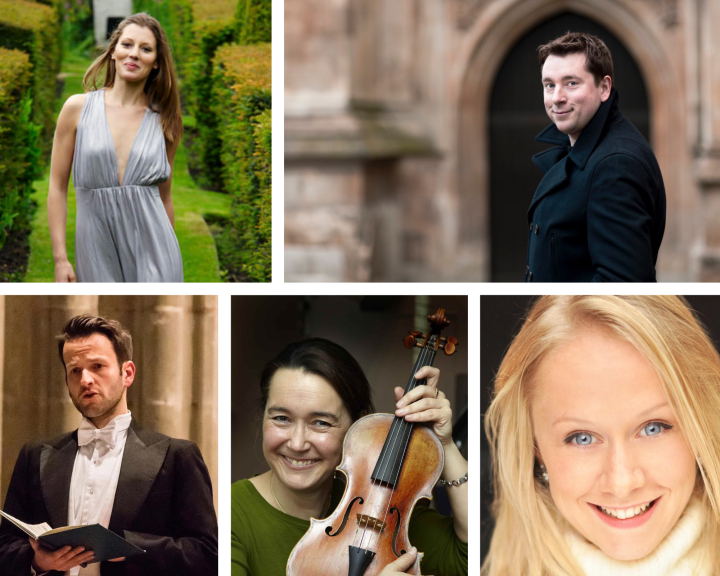
Clockwise from top left: Amy Carson, Thomas Hobbs, Emily Vine, Margaret Faultless, Timothy Dickinson
Wyke House is the home of Will and Poppy Tuke, who first opened the gardens to the public for Sunset Sounds Opera Gala in 2021. In 2022, the Tukes hosted two performances of ‘Acis & Galatea’ in a reduced edition featuring three soloists including tenor Hugo Hymas.
When I try to understand my life as a critic in the dazzling world of piano music, I am at a loss. We have inherited so much over 300 years that I feel overwhelmed. There is no obvious focal point. What is at the heart of piano world?
Personally, I could not make it through the day without the stimulation of piano performance. My home resounds with keyboards all my waking hours, constantly renewed from the thousand-odd CDs I have accumulated.
I know of no legal substance that can alter your mind like music, and it does so without a hangover. My moods are at the mercy of Haydn, Ravel, Debussy and many others.
Sheet music too is floating around the web for reprinting privately at home. I don’t mind that more and more paid subscriptions and other charges cropping up. Performers deserve a good slice of the pie.
To get a grip on this subject, I have opened my personal diary, beginning a typical day with two giants and continuing to bedtime with lullabies. Taken together, these choices demonstrate the power of the piano.
EARLY MORNING – My morning never starts until I flip on the CD player and rearrange the five discs it rotates. I need Bach and Mozart and a bit of Galuppi for chasing the cobwebs from my brain. Specifically, I probably put on Glenn Gould’s Goldberg Variations (1981 version) and Mozart’s wonderfully inventive piano sonatas played by Mitsuko Uchida. Galuppi’s sonata in C major, of course. Next, to lighten the atmosphere, I like to have 15 minutes of Erik Satie.
STARTING TO WORK – I spend most days writing and painting, with great music in the background to encourage the creative process. The trick is to find the right volume so it tweaks your nervous system but does not mess up your concentration. As I write this, Brahms’ Scherzo in E-flat minor Op. 4, quietly played by William Grant Naboré, is the best medicine I can find.
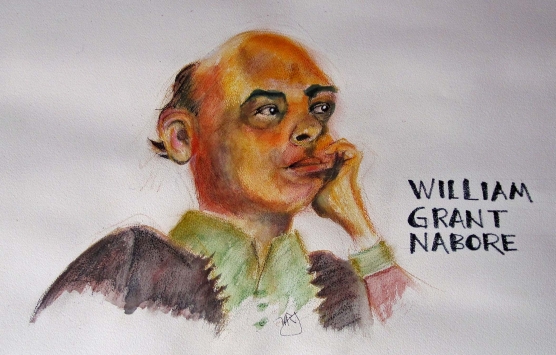
William Grant Naboré, a drawing by the author, Michael Johnson
FIRST COFFEE BREAK – Now I can turn up the volume and change my perspective with Prokofiev’s piano sonatas, preferably played by Murray McLachlan. It’s stirring music, dissonant, wild and avant-garde for the 1930s but a particularly shocking chord always catches my attention. At one point Sergei calls for the player to hit the keyboard “con pugno” (with fist). This is a cluster chord, a percussive whack on the piano that can be found scattered throughout the 20th century repertoire, notably in Charles Ives and bits of Sorabji, Messiaen, Louvier, Xenakis, Ligeti, and yes even Stockhausen. Someone has written that Prokofiev used it to frighten “the old ladies of both sexes” in the audience.
BACK TO WORK – Turning the volume down to moderately quiet, the I race through Franz Liszt’s La Campanella Grande Etude (Paganini) or Gnomenreigen, both melodic wonders and sunny virtuoso exercises. Thank you, Franz, for making me want to dance as I work. These pieces have defeated numerous pianists over the years but dozens of fine recordings are out there. Take your pick. As a listener, I know them by heart and hum along as they spin.
REVISIONS –At this point I look back, sometimes appalled, at my morning’s output, and attack it again. For this, I depend on the aggressive stimulation of Scriabin, ranging from his early Chopin derivatives to his later ground-breaking ideas. Recordings worth a visit are Ashkenazy, Berman, and Hamelin. I finish in a sweat, either from the music or my revisions, I’m never sure which.
LUNCHTIME RECITAL – I allow myself the freedom to wander around 300 years of music in small samples, creating my own DIY piano recital. Keeping the volume at medium so as not to annoy my wife, I go through some of Bach’s 1722 shimmering masterpiece Well-Tempered Clavier played by Sviatoslav Richter, to another collection of preludes and fugues by Rodion Shchedrin, to Messiaen’s solo piano, beginning with La Colombe (The Dove) which juxtaposes the dissonant and the consonant. And finally, as a dessert, the frightening Cziffra arrangement of “Flight of the Bumblebee” played by Georgy himself.
AFTERNOON – Following my relaxed and musical lunch, nothing gets me back to work like Rachmaninov’s little gem, the Prelude Op.23 No.5 in G-minor. My player here is one I am grateful to – the willowy Belgian-Russian Irina Lankova, a product of the great Gnessin School in Moscow and now a happy expat. She brings a driving momentum to the work, exactly what Rachmaninov desired. The piece leaves you panting for more but it ends peacefully at 3:43.
To complete my afternoon I will put on Schubert’s monumental sonata in C-minor, with its contrasting darks and lights, played Brendel. As Andras Schiff writes in his new book “Music Comes Out of Silence”, he knows where to expect “the proverbial goose pimples” in Schubert, and at the end of the first movement in the C-minor is a passage that reverberates in a different way – “terrifying me in the true sense of the word.” But he survives, and plays it to perfection.
TWILIGHT – I need some fun after a demanding day. One has to smile a bit, and Grieg’s “Wedding Day at Troldhaugen” provides it – a celebratory Norwegian dance number full of Peer Gynt allusions and Norwegian folklore, played with bouncing good humour by Garrick Ohlsson. Completing the day’s adventures is Chopin’s Berceuse in E-flat major, a quiet piece guaranteed to bring your mind back to total calm.
DINNER – In background as the table groans under a full French evening meal, I need some pep and vigour, and I find it in the Spanish themes of Enrique Granados delightfully played by French pianist Jean-Francois Dichamp. His CD programme marries Granados with Scarlatti, a pairing that came to him in an inspiration while on a solitary evening stroll in summertime Barcelona. He plays them alternately in recitals, convinced that the audience hears a piece differently when compared to the work that precedes it.
LIGHTS OUT – One of my favourite compositions in the repertoire is floating, lilting “Au Lac de Wallenstadt” performed by Wilhelm Kempf. I listen to it over and over with increasing emotion. It seems conceived for snuggling or sleeping or both. Still awake? Turn to Morton Feldman‘s Palais de Mari or all of Bertrand Chamayou CD “Good Night”.
It is with humility that I have made the piano a large part of my life, enriching and stimulating myself, and (as with Cziffra) amazing me.
Michael Johnson is a music critic with particular interest in piano.
Johnson worked as a reporter and editor in New York, Moscow, Paris and London over his journalism career. He covered European technology for Business Week for five years, and served nine years as chief editor of International Management magazine and was chief editor of the French technology weekly 01 Informatique. He also spent four years as Moscow correspondent of The Associated Press. He is the author of five books.
Michael Johnson is based in Bordeaux.
This site is free to access and ad-free, and takes many hours to research, write, and maintain. If you find joy and value in what I do, please consider making a donation to support the continuance of this site
The Cross-Eyed Pianist is free to access and ad-free, and takes many hours every month to research, write, and maintain.
If you find joy and value in what I do, please consider making a donation to support the continuance of the site

 ‘Echoes’ is the latest in Orchestra of the Swan’s ‘mixtape’ series, following on from ‘Timelapse’ and ‘Labyrinths’ (which has received over 8 million audio streams since 2021 and was shortlisted for Gramophone award in the Spatial Audio category).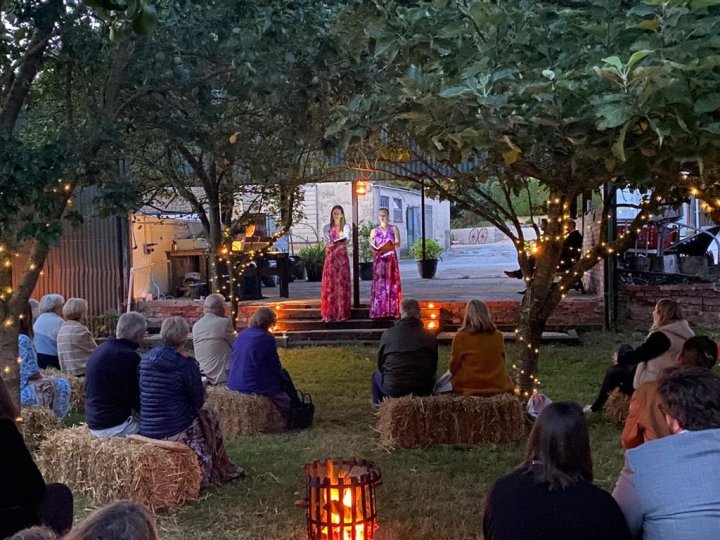





 The Cross-Eyed Pianist