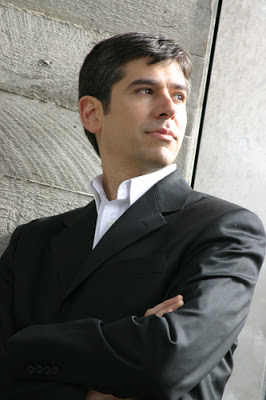
 Who or what inspired you to take up the piano and make it your career?
My father, who is a cellist and studied with Rostropovich. He wanted me and my sister to become musicians and pianists in particular – he always loved piano even more than cello, and declared: “I want my children to play the “Royal” instrument (in Russian grand piano is “Royal”)
Who or what are the most important influences on your playing?
Without any doubt, the representatives of the old Russian piano school: Rachmaninoff, Horowitz, Sofronitsky. It is very different from the “Soviet” school – it’s very vocal in its nature and its main characteristics are a deep, singing tone, exquisite phrasing, huge range of colour and the sense of perspective – well differentiated layers of sound. When the true masters like Rachmaninoff or Horowitz played, they operated not only on the level of volume, but also in space: the sounds can be placed near and far away, as in a good painting.
What have been the greatest challenges of your career so far?
Overcoming the lack of imagination, snobbery, commercialism and often incompetence of the gate-keepers in classical music industry. It is very narrow-minded, and I am convinced that if any other business were run like this, it would go bankrupt within months.
What are the particular challenges/excitements of working with an orchestra/ensemble?
The excitement is obviously making chamber music with the richest instrument of them all; the challenge is seeing eye to eye with a conductor and at times having to deal with certain dictatorial trends on his part. Also, having to come to terms with the idea that your concerto is not really what matters most to a conductor in that programme and will inevitably be under-rehearsed.
Which recordings are you most proud of?
I am only proud of some parts of my recordings. On a whole, I understand very well the film director Federico Fellini, who never watched his films once they were edited and released. When I listen, I am always painfully aware of what could have been done better. At times, the recording conditions are not at all conducive to creative music-making. The economic considerations prevail over the musical ones.
Do you have a favourite concert venue?
Not really – those are probably the ones I haven’t performed in yet.
Who are your favourite musicians?
There are many, but they are mostly in the past – not because there aren’t any talented artists out there right now, but because I enjoy hearing something that is lost nowadays, something unique. Here are just some of them: Feodor Chaliapin, Kathleen Ferrier, Maria Callas, Sergey Rachmaninoff, Vladimir Horowitz, Vladimir Sofronitsky, Ignaz Friedman, Gregor Piatigorsky, Glenn Gould; jazz musicians Ella Fitzgerald, Art Tatum, Oscar Peterson, Niels-Henning Ørsted Pedersen, Stephan Grapelli, Django Reinhardt, Michel Petrucciani, Michael Brecker, Keith Jarrett, Chick Corea, Dave Weckl; crooners Frank Sinatra, Sammy Davis Jnr, Charles Aznavour; not so many among rock musicians, but most certainly Beatles and Led Zeppelin; in fusion: bassist Jaco Pastorius; in pop music: Bee Gees, Earth Wind & Fire, George Benson, Michael Jackson, Sting, Jamiroquai, etc.
I don’t love absolutely everything these artists ever did without reservation, but they all achieved something truly unique and great in their field. And I don’t mention here the great composers, of course (apart from Rachmaninoff who is mentioned as a great pianist), as those are in a totally different league altogether.
What is your most memorable concert experience?
When I played Rachmaninoff’s 3rd Concerto for my dad’s 80th birthday – I knew I made at least one person really happy.
What is your favourite music to play?
Whatever I am working on at the moment – if it hadn’t excited me, I wouldn’t have picked it up in the first place. To listen to? See above re Favourite Musicians
What do you consider to be the most important ideas and concepts to impart to aspiring musicians/students?
That music is a language and so it’s not enough just to be able to speak it – you have to use it to say something that matters. Otherwise, it is similar to a verbal incontinence.
What are you working on at the moment?
JS Bach’s English Suite No. 3, Partita No. 2 and French Overture, Liszt’s Petrarca Sonnet No. 123, Mephisto Waltz and some Etudes, Rachmaninoff’s 1st Sonata and Patrick Jonathan’s Preludes dedicated to me.
What is your idea of perfect happiness?
Being in a happy, loving relationship; staying healthy; having enough time to live a balanced life, i.e. not only working non-stop, but also taking time to see a bigger picture, going out, travelling, reading, seeing friends, etc; keeping in good shape physically; and being able to earn my living doing what I love doing best – playing the piano.
Rustem Hayroudinoff performs at St John’s Smith Square, London on Saturday 13th April in a programme including works by Bach, Liszt and Rachmaninoff. Further details here
Described by London’s Classic FM Magazine as a “sensationally gifted” musician of “stunning artistry”, Rustem Hayroudinoff graduated from the Moscow Conservatory, where he studied with Lev Naumov, and received his postgraduate degree (DipRAM) at the Royal Academy of Music in London with Christopher Elton.
On hearing his performance, Lazar Berman praised him as “a serious artist and master, whose emergence in today’s atmosphere of pseudo-artistic and shallow music-making is specially valuable and welcome”.
His performances have been broadcast on most major classical radio stations around the world and he has appeared in the documentary “The Unknown Shostakovich” alongside Vladimir Ashkenazy, Valery Gergiev and Maxim Shostakovich.
Full biography here
www.hayroudinoff.co.uk






 The Cross-Eyed Pianist