Since graduating from the Royal College of Music in 2012, pianist Nicholas McCarthy has enjoyed a busy schedule of concerts, including performing with Charles Hazelwood’s Paraorchestra at the closing ceremony of the Paralympics last summer, and recitals in the UK, USA and beyond. For a young professional musician at just 24, this is pretty impressive. What is more remarkable is that Nicholas has only one hand.

Born without his right hand, he was the first left-handed pianist to graduate from the Royal College of Music, and is making a name for himself as a champion of left-handed piano repertoire, both well-known and less familiar. He has had music composed for him, and he writes his own transcriptions of works for two hands, including Chopin’s fearsome G minor Ballade, which, as anyone who has tried to play it will attest (myself included), is hard enough with both hands, let alone one! The Ballade was the closing piece in an interesting and engaging evening recital by Nicholas at the beautiful Wren church of St James’s Piccadilly.

Nicholas is no novelty act. He is a serious musician whose technique and musical understanding allow him to produce a wealth of sounds, colours and textures, from the most delicate pianissimos to full-bodied fortissimos. When I was privileged to hear him at his graduation recital last summer, I was particularly struck by the beauty of his cantabile playing: there is a sense of the fingers in constant contact with the keys, drawing out sound without undue pressure (an aspect of piano technique which is hard to master well).

There is plenty of repertoire for the left-hand alone. This is, in part, due to composers writing studies for the left-hand alone as technical exercises to enable two-handed pianists to develop their technique; and also a consequence of the First World War, when many men returned from the battlefields with arms missing. Most notable amongst these was Paul Wittgenstein (brother of the philosopher Ludwig), whose right arm was amputated after he was shot in the elbow, and who who commissioned many composers to write for him, notably Ravel, Britten, Prokofiev, and Martinu.

Nicholas opened his recital with a Fantasy in G minor by Bach, arranged by Liszt. Originally composed for the organ, Liszt’s transcription retains many of the colours and textures of the instrument, and Nicholas brought a Baroque richness and authoritative tone to his performance.

Scriabin’s Prelude and Nocturne Op 9 are some of the most well-known works for left-hand, and Nicholas introduced the pieces engagingly, explaining that these were special to him as they were the first works for left-hand he learnt. In the Nocturne in particular we were able to appreciate the elegance of Nicholas’s playing in this kind of romantic repertoire.

Adolfo Fumagalli

The programme also included a number of works transcribed for left-hand by Geza Zichy, a pupil of Liszt who had lost his right arm during a hunting accident in his youth. In Zichy’s transcriptions of Schubert’s Der Erlkönig and Chopin’s ‘Military’ Polonaise Op 40/1, both extremely physically challenging for the pianist, the sheer athleticism required to pull off such pieces was very evident: Nicholas’s playing is not confined to the lower part of the piano keyboard (my friend commented in the interval that Nicholas must have 10 fingers on his left hand to cope with such feats of virtuosity!). What was particularly evident in these pieces was the range of textures and depth of sound Nicholas was able to achieve: indeed, if one did not know he had only one hand, one would never know from the intense and varied soundworld he can create. Each piece was introduced by Nicholas in a friendly and interesting manner: the anecdote about Italian pianist Adolfo Fumagalli preferring to play with his left hand only so that he could smoke a cigar in his right was very funny.

I was very curious to hear Nicholas’s own transcription of Chopin’s G minor Ballade. Having attempted to learn this piece myself a few years ago, I am well aware of its pitfalls, its vertiginous virtuosity (rapid passages, double octaves). It is a test for even the most proficient pianist. Nicholas’s account combined a tender lyricism in the first theme with sparkling virtuoso passages and powerful emotional contrasts. It was a convincing performance and a fitting close to an impressive concert. His encore was perfectly judged: Earl Wilde’s transcription of Gershwin’s wistful The Man I Love.

Nicholas performs at St George’s Bristol on 24 October in a solo lunchtime concert, and on 16 November in Britten’s Diversions for piano left-hand and orchestra, a work which has barely been performed in public since Paul Wittgenstein played it at the Proms in 1950. Further information about all of Nicholas’s concerts here

Meet the Artist……Nicholas McCarthy

©Philip Mead
©Philip Mead

Who or what inspired you to take up the piano and make it your career? 

My father who was an amateur pianist, piano tuner, conductor and trumpet player

Who or what were the most important influences on your playing? 

Ruth Harte and Stephen Savage for piano

Stephen Rhys for general music

Hans Keller and Henry David Thoreau for philosophy.

What have been the greatest challenges of your career so far? 

Giving the first London performance of the Cowell Concerto with the BBC Symphony Orchestra at the Barbican in January 2004. The score is little more than a sketch.

Organising the first complete performance of the ‘Spectrum’ series of piano pieces with 144 pianists lasting 8 hours in 2008

Which performances/compositions/recordings are you most proud of? 

Complete Ives piano music on Metier

Do you have a favourite concert venue to perform in? 

St Augustine’s Church, Cambridge

Favourite pieces to perform? Listen to? 

Ives piano music

Who are your favourite musicians? 

The composer Horacio Vaggione.

What is your most memorable concert experience? 

The previously mentioned Cowell Piano Concerto premiere

What do you consider to be the most important ideas and concepts to impart to aspiring musicians? 

Find your own way of doing things.

As a teacher make yourself dispensible as soon as possible.

What are you working on at the moment? 

Ives Concord Sonata

Where would you like to be in 10 years’ time? 

Still alive

What is your idea of perfect happiness? 

A meal with my wife and children

What is your most treasured possession? 

My Boston Grand piano

What do you enjoy doing most?

Dreaming

What is your present state of mind? 

Contented

Philip Mead studied piano at the Royal Academy of Music, London, receiving numerous prizes and awards and a distinction in his final practical exam. Mead was a prize winner of the 1978 Gaudeamus International competition for Interpreters of Contemporary Music, and since then has been at the forefront of contemporary music in this country. He has performed virtually the entire piano music of Messiaen at London’s Southbank Centre, and given premieres by major composers such as Crumb and Stockhausen.

Philip Mead’s full biography

www.philipmead.com

British Contemporary Piano Competition 2013

280-warren-mailley-smith-980x360v1

Who or what inspired you to take up the piano, and make it your career?

I have played the piano for as long as I can remember and my earliest memories of the piano were being fascinated by the black and white keys and the delight of seeing and hearing my parents playing familiar melodies in front of me.  I was then lucky to have a very enthusiastic and encouraging first piano teacher from the age of 5 who certainly instilled in me a love for the instrument.

However, I didn’t set my sights on playing the piano full-time until I was at university studying law and soon found that I was skipping lectures and seminars to practise. The tipping point for me was a performance of Rachmaninov’s Second Piano Concerto in my second year and I remember thinking to myself “wow, this is what I really want to be doing!”

Who or what were the most important influences on your playing?

My teachers Alan Rowlands, John Barstow, Ronald Smith and Peter Feuchtwanger. Also, application of the Alexander Technique has been a very important influence on my playing.

What have been the greatest challenges of your career so far?

Fitting a grand piano in my front room! Striking the balance of coping with admin, making a living and practising sufficiently.

Which performances/recordings are you most proud of? 

To date, I am most proud of my most recent CD of Liszt: Depictions  (Sleeveless SLV1005), which was released in 2011, and I believe contains my best playing so far.   There isn’t really one performance of which I am most proud, although I will always have a warm glow about my solo recital debut at Birmingham Symphony Hall when I was 22.

Do you have a favourite concert venue to perform in? 

Wigmore Hall, for its piano(s), acoustic and audiences.

Favourite pieces to perform? Listen to? 

I adore playing Chopin, for the sensation that his music creates in the hand, and his wonderful combination of harmonic invention, breathtaking melody and virtuosity. I seem to find myself reaching more and more for symphonic music to listen to, for the ultimate range of colour and expression, which we pianists are constantly striving to conjour up from our solitary percussion instrument!

Who are your favourite musicians?

Horowitz, Rubenstein, Richter and Clara Haskill, Barenboim and Ashkenazy…   By sheer coincidence, they are all pianists.

What is your most memorable concert experience?

My RPO debut with Beethoven 5th piano concerto

What do you consider to be the most important ideas and concepts to impart to aspiring musicians?

After recently dispatching a wide-eyed pupil off into the profession, I gave him the following advice, (and I would do the same to anyone considering embarking on a career as a performer):

  • Aim to be the very best you can be.
  • Invite criticism and take it willingly!
  • Work (practise) hard and meet people,
  • Take every opportunity to perform and listen to others perform.
  • Play chamber music…
  • Teach!
  • Think creatively; create opportunities
  • Don’t wait to ‘be discovered’
  • Don’t leave a performing career to the lottery of international competitions alone…

Where would you like to be in 10 years’ time?

Performing… somewhere….

What is your idea of perfect happiness?

1 year with NOTHING to do but practise

What is your most treasured possession?

My fingers

What do you enjoy doing most?

Spending time with my wife,  playing the piano, listening to music, exercising, travelling, socialising………planning and executing successful projects!

What is your present state of mind?

Motivated, grateful and positive


Warren studied at the Royal College of Music where he won numerous postgraduate prizes including a Countess of Munster Award and the French Piano Music Prize.  He then took further private studies with Peter Feuchtwanger and the late Ronald Smith.

Warren’s solo career now sees him performing in festivals and concert venues across the UK, accepting invitations from further afield to perform in Europe and the US.  His concerto repertoire includes works by Rachmaninov, Beethoven, Chopin, Liszt, Mozart and Tchaikovsky and he works regularly with duo partners Rowena Calvert (cello), Susan Parkes (Soprano) and Matt Jones (violin).

Warren is currently in demand for his teaching expertise both privately and in masterclasses.

Warren’s full biography here

www.warrenmailley-smith.com

Interview published 19th September 2013

1234927_662015827144737_1804721049_n

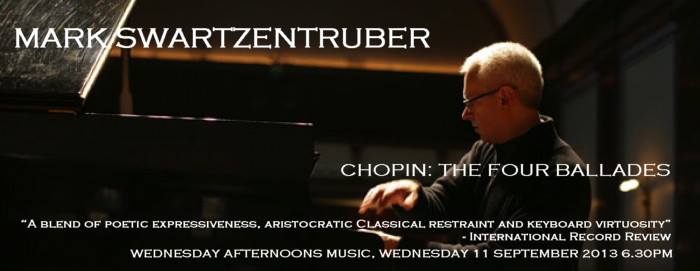
I can think of few better ways to spend a weekday evening than listening to a sensitive and skilled pianist such as Mark Swartzentruber playing Chopin’s Four Ballades – and on Wednesday evening I was afforded the opportunity to do just that, in the comfort of a private house in a quiet residential street in Chiswick, west London.

The house was the elegant home of Japanese pianist Rika Zayasu, founder and artistic director of Wednesday Afternoons Music, a non-profit organisation which hosts a series of concerts and workshops on Wednesday afternoons and early evenings. The format is very simple: a group of invited guests arrive at Rika’s home, where we are directed to the living room to enjoy a drink and socialising before the concert begins. Afterwards, there is more socialising and drinks, and an opportunity to meet the performer.

I love hearing music performed in a setting such as this. It brings one closer to music and performer, is highly accessible, friendly and informal, a shared experience which reminds us that the majority of music written before 1850 would have been performed in such a setting. Indeed, on Wednesday evening, with the light fading outside, and a group of friends and music lovers seated in a friendly semi-circle, we could have been in a nineteenth-century Parisian Salon.

Chopin’s Ballades are some of his most popular works for piano (pianist Mark Swartzentruber admitted that they were his favourite of all Chopin’s piano works), and are performed frequently, either as a set of four, singly, or in pairs. To hear all four consecutively in one concert is a fascinating and rewarding experience. Although each has its own individual character, there are connecting threads through all of them: the use of lilting rhythms, the sense of a narrative unfolding, the recapitulation of themes and motifs, high virtuosity and intricate fiorituras and cadenzas offset by passages of great beauty and lyricism. Taken together, the Ballades create a rich and absorbing programme, and Mark’s playing of them was thoughtful and eloquent.

After enthusiastic applause and “bravos!”, Mark played Chopin’s Barcarolle, a wistful, mellifluous piece whose rocking rhythms and ringing chords in thirds and sixths evoke the swell of the sea. It was a charming close to a highly enjoyable concert.

There was time to socialise afterwards, and I enjoyed talking to a number of the guests, including a young composer who has written some piano works for Rika, and of course to Rika, and to Mark (we discussed the merits – and otherwise – of using an iPad in performance, one’s attachment to paper scores, and the exigencies of practising, amongst other things).

Find Wednesday Afternoons Music on Facebook

www.rikazayasu.com

www.markswartzentruber.com