Harold Craxton

Craxton Studios, a unique house and ‘Atelier’ on Kidderpore Avenue in leafy Hampstead, north London, was designed and built in 1901 by the artist George Hillyard Swinstead for his family and as his art studio. The house was bought by eminent and much-loved pianist and teacher Harold Craxton and his wife Essie in 1945 after they and their family were bombed out of their home in St. John’s Wood during the Blitz. Their six children included the distinguished oboist Janet Craxton; the painter John Craxton R.A. (who illustrated Patrick Leigh Fermor’s books, amongst other things) and the BBC’s Royal events television director Antony Craxton C.V.O. Professor Harold Craxton O.B.E (Royal Academy of Music) lectured, taught and entertained at the house and accompanied some of the finest singers and musicians of the day. The house became a hub for music and the arts, and was frequented by such artistic luminaries as Dame Peggy Ashcroft, Sir Frederick Ashton, Vladimir Ashkenazy, Winifred Atwell, Dame Janet Baker, Sir John Barbirolli, Sir Lennox Berkeley, Sir John Betjeman, Pierre Boulez, Julian Bream, Benjamin Britten, Lord Kenneth Clarke, Johnny Dankworth, Sir Peter Maxwell Davis, Alfred Deller, Dietrich Fischer-Diskau, Dame Margot Fonteyn, Lucien Freud, Leon Goossens, Gerard Hoffnung, Witold Lutoslawski, Gian Carlo Menotti, Sir Yehudi Menuhin, Sir Henry Moore, Peter Pears, Mstislav Rostropovich, Elizabeth Schwarzkopf, Stephen Spender and Graham Sutherland. There are vestiges of these illustrious lives and times around the house in photographs, paintings, concert handbills and posters and other memorabilia. But the house is not a museum and still feels like a family home, which gives it a very unique and special atmosphere as a venue for concerts and other musical events.

For me, the name Harold Craxton will always be synonymous with certain ABRSM editions of piano music, and I still have my red cloth-bound three-volume edition of the Beethoven Piano Sonatas, edited by Harold Craxton and Donald Tovey, and a faded mauve paperback of Chopin’s Nocturnes, even though I have now graduated to dusky blue Henle urtext editions.

Visiting Craxton Studios for a Sunday afternoon recital by acclaimed British pianist Sarah Beth Briggs was like stepping back into another era: the antique Bluthner piano, the Arts & Crafts decor, the audience and even the generous high tea after the concert all created an atmosphere of “music for friends amongst friends”, and a reminder of how music was enjoyed over 100 years ago. The concert was in memory of pianist and teacher Denis Matthews, who died in 1988. He was good friends with the Craxton family and visited the house on Kidderpore Avenue many times.

Sarah Beth Briggs studied with Denis Matthews for many years and the concert was her personal tribute to an adored and inspirational teacher. All the pieces she played had a special connection for her with Dennis, and indeed the opening piece, Mozart’s Fantasy in C minor K475, was the first piece Sarah heard Denis perform in a concert in Newcastle, when she was still quite a young child. As she explained in her engaging introduction, it was also the piece that convinced her that Mozart could be as dramatic and colourful as Beethoven. It was a persuasive and authoritative opener and tied in neatly with Beethoven’s ‘Pathetique’ Sonata which followed it, the Beethoven highlighting many aspects of Mozart’s writing.

After such a dramatic first half, Sarah then played a Debussy Prelude, explaining that Denis loved the music of Claude Debussy, and she and he spent many hours working on the first book of Preludes together. Des pas sur la neige is a brief and icy excursion into a snowy landscape, the ascending figure in the left hand in the opening (and shared between the hands later in the piece) suggesting feet trudging through snow. This was followed by Chopin’s Fourth Ballade, prefaced by an introduction by Sarah in which she quoted the late John Ogdon’s description of the work: “it lasts only twelve minutes…..it contains the experience of a lifetime”. Sarah gave a passionate and engrossing account of this perhaps the most popular and complex of all of Chopin’s Ballades.

After the performance, Sarah explained that Denis had always felt it was inappropriate to follow Chopin’s Ballade with an encore, and in his spirit she simply thanked the audience for coming before taking a final curtain call. We were then directed into the dining room of the house where a magnificent high tea was laid out: tiny sandwiches and canapés, petit fours, and several different cakes (most of which were homemade). While the guests were filling their plates with delicacies, the organisers had cleared the studio of chairs and laid out tables with white cloths. Tea was served in the studio where the concert had taken place, providing a very civilised and quaintly old-fashioned end to a very enjoyable afternoon of music making, the pieces played with obvious affection and imbued with very special memories for the pianist. I was delighted to be a guest at such a gathering and to have the opportunity to talk to Sarah afterwards.

Craxton Studios

Craxton Memorial Trust

Sarah Beth Briggs

My review of Sarah’s new recording of Mozart, Beethoven and Schubert
Meet the Artist……Sarah Beth Briggs

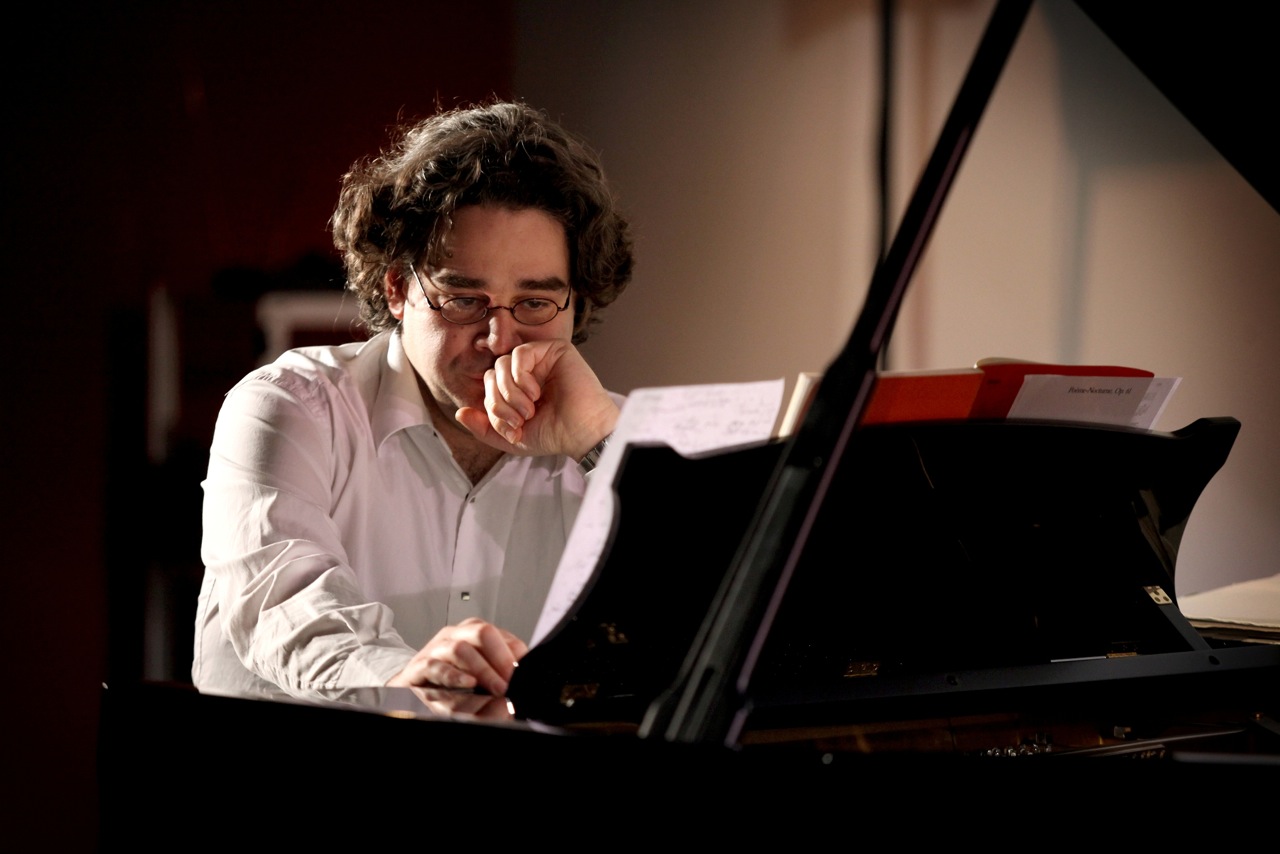
Pascal Amoyel (photo credit: Ludivine B)

Who or what inspired you to take up the piano, and pursue a career in music?

When I was 12, the caretaker of my block of flats listened to me practicing scales and told us that the pianist Georges Cziffra had lived in the same block and that he had just moved to create a foundation for young people. She also said “why don’t you meet him, that may be your destiny!”

She was right… I had the great privilege to meet a man with tremendous humanity and generosity, and thanks to him, I became a pianist. I worked with him for 8 years

Who or what were the most important influences on your musical life and career? 

Olivier Greif, Georges Cziffra, Krishnamurti, and silence.

What have been the greatest challenges of your career so far? 

To write a musical show, “The 50 fingers pianist”, that pays tribute to Cziffra, from the young 5 year old little pianist playing in the circus, to the escaped soldier, from the bar piano player playing jazz in seedy night clubs of Budapest suburbs, to being sentenced to hard labour for having tried to escape from Hungary. His life is a very moving epic.

Which performance/recordings are you most proud of?  

I wanted to record the complete Chopin Nocturnes by night. I was staying in a great French castle (Chambord) where I was alone. Deep in the night, I was closing it with a powerful cadence! This atmosphere out of time was favourable to the contemplation I wanted for this music.

Which particular works do you think you play best? 

I have a special affection for the works of Liszt. As well as being every pianist’s father, creator of the recital, he stopped his career at only 35, at the height of his fame, adulated by kings and emperors. Slowly aspirated by the silence, he finally decided to take refuge in a small cloister in Roma, to dedicate himself to composition and contemplation…… I also love playing Scriabin.
 
How do you make your repertoire choices from season to season? 

It’s sometimes hard to balance between what we would like to play and what the programmers sometimes ask, especially when their request are made a few years in advance! I think that the most important thing is to make no concession, to be faithful to our desire and to what inspires us, because only that will serve music.

Do you have a favourite concert venue to perform in and why? 

Playing in the mythic Berlin Philharmonie is one of my best souvenirs in my performing life.

Favourite pieces to perform? Listen to? 

Liszt Harmonies poétiques et religieuses

Chopin’s Nocturnes (by Rubinstein!)

Who are your favourite musicians? 

Edwin Fischer, Rubinstein, Sofronitsky, Pires.

What is your most memorable concert experience? 

The dramatized concert “Le Block 15, ou la musique en résistance”, in which the cellist Emmanuelle Bertrand and I pay a tribute to two survivors of Auschwitz camp, the cellist Anita Lasker-Wallfisch (who lives in London) and the pianist and composer Simon Laks. We are always very moved by sharing those testimonies.

What do you consider to be the most important ideas and concepts to impart to aspiring musicians? 

It is not the ideas that inspire music, but music that inspires ideas.

Intuition is Intelligence.

What are you working on at the moment? 

Actually, I am continuing my work about Charles-Valentin Alkan, a composer to whom I have dedicated a recording, including the Grande Sonate “Les 4 âges”. I am fascinated by this artist who is still not known enough, as well, generally speaking, by all those unconventional and out of fashion figures in the word History.

I am also starting, as a composer, to write a concerto for cello and string orchestra, for the cellist Emmanuelle Bertrand.

Where would you like to be in 10 years’ time?

A wise man.

What is your idea of perfect happiness?

The total acceptance of present time.

What is your most treasured possession? 

To realise that something can be owned is an illusion.

What do you enjoy doing most? 

Watching my children grow.

Pascal Amoyel performs works by Alkan, Chopin, and Liszt, and the world premiere of a new work by Nimrod Borenstein at Westminster Cathedral Hall on Sunday 8th December in a concert. Further details and tickets here

Voted “Solo Instrumental Discovery of the Year” at the Victoires de la Musique in 2005, Pascal Amoyel has established himself over the past few years as a significant personality on the musical scene. His recording of the complete ‘Nocturnes’ of Chopin by Pascal Amoyel has been awarded by the Warszawa Fryderyk Chopin Society within the context of the International Record Competition – Grand Prix du Disque Frédéric Chopin 2010 and in September 2009, the magazine Classica-Le Monde de la musique has considered his recording of the ‘Funérailles’ (Franz Liszt) as one of the 5 best ever.

As a teenager he was profoundly influenced by his encounter with György Cziffra, with whom he studied in France and Hungary for several years.

After receiving a Licence de Concert from the Ecole Normale de Musique in Paris, he was awarded Premiers Prix in piano and chamber music at the Conservatoire National Supérieur de Musique in the same city. He was awarded scholarships by the Menuhin and Cziffra Foundations, then won first prize in the Paris International competition for Young Pianists.

He appears as a recitalist and soloist with orchestra in Europe, the United States, Canada, Russia, Japan and China.

His recordings as a duet with Emmanuelle Bertrand or as a soloist have received the most prestigious awards.

Pascal Amoyel is also a composer, laureate 2010 of the Banque Populaire Foundation.

He use to work with Olivier Greif and gave the world première performance, and several works have been dedicated to him, including El Khoury’s Third Sonata and Lemeland’s Piano Concerto.

He is the artistic director of the festival Notes d’Automne, a meeting between Music and Literature, in Le Perreux sur Marne.

www.pascal-amoyel.com

It’s unusual to enter the auditorium of the QEH and see a small unassuming upright piano on the stage instead of the usual swaggering concert Steinway. In front of the piano, near the edge of the stage, flimsy sheets of  music were arranged on eight spindly stands. Overlooking the whole scene, a plaster bust of Beethoven, frowning down upon the proceedings.

A recital featuring the music of Hungarian composer and pedagogue George Kürtag is always going to be quirky, unusual and playful – and this concert was no exception.

Kurtag’s Hipartita for solo violin, a work composed for violinist Hiromi Kikuchi, who performed it at this concert. Combining the soloist’s name with the Baroque partita, a collection of pieces related to each other, the Hipartita contains movements dedicated to figures from Hungarian musical life, ancient Greece, Hungarian folk dances, including the Czardas, and even J S Bach himself. A curious work full of wails and squawks, skittish scurryings and glissandi, it was strangely haunting and witty all at once, and was presented with intense concentration and an aching beauty by Hiromi Kikuchi. At the end of the performance, Hiromi gestured into the audience, and after a pause György Kurtág himself, frail but smiling broadly, tottered onto the stage to receive applause alongside the soloist.

After the interval the piano had been shifted to centre stage, a duet bench set before it and another selection of flimsy pages on the music stand. Kurtág and his wife Márta walked slowly onto the stage, gently supporting one another. They were going to perform and selection of short pieces from Kurtág’s Játékok (Games), a series of works for children and beginner pianists, for which the model was Bartok’s Mikrokosmos. In Játékok, the focus is on movement and gestures rather than accuracy, thus drawing on the educational philosophy of Rudolph Steiner. These charming and idiosyncratic miniatures were interspersed with Kurtág’s own transcriptions of works by Bach, for four hands, and all played with great delicacy of tone and touch.

Here is the scene: Gyõrgy seated at the piano, Márta at his side quietly removing the pages, and joining him in duets of his own music and his Bach transcriptions, the practice pedal permanently depressed so that the sounds emerging from the piano are soft, gentle and intimate. Enhanced only slightly by amplification, the sound of the piano is domestic, homely. The Kurtágs lean towards one another as they play or mirror one another’s gestures, reaching across each other at the keyboard; sometimes they look tenderly at each other. It is as if we are peeping in on an afternoon of private music-making in their home.

This all-too brief yet exquisite and unassuming recital was met with a standing ovation, people rising to their feet not to applaud greatness but rather to share in the emotional spell this miniature music and its frail and deeply sensitive performers had cast upon us all. Many people were in tears, overcome with an emotion that was impossible to describe.

John Gilhooly took to the stage to present Maestro Kurtág with the RPS Gold Medal, in the presence of Beethoven (who himself was awarded the gold medal). In response to Gilhooly’s eulogy, Gyorgy Kurtág, as quietly-spoken as his music, said “I am not a man of words”, and then returned to the piano to play Mozart’s G major Variations with Márta.

An extraordinary and rare afternoon of music, curiously subversive by dint of the fact that it went against the grain of the traditional concert, and one many of us are unlikely to experience again.

Who or what inspired you to take up composing, and make it your career? 

I’ve always been interested in melody, and when I started to learn the piano at about 8 years old, as well as learning the standard repertoire, I was also fascinated by how melodies worked and wanted to compose my own tunes. It was much later, when I studied at music college, that I realised that I wanted it to be my career. Although I love playing the piano, I was much more interested in creating and composing my own music.

Who or what were the most significant influences on your musical life and career as a composer? 

There were two big influences. One was a music teacher at the Junior department at Trinity College of Music, Philip Colman, who instilled a passion for music-making and a love of inprovisation which I’ve taken through into my professional life. The second was my composition tutor at Guildhall School of Music & Drama, Buxton Orr, who was an inspiring and brilliant teacher.

What have been the greatest challenges of your career so far? 

Writing large scores in a very short space of time is always a challenge, but it’s something that I find much easier now than I did, say, 10 years ago. It’s a skill that is acquired with experience, and recently I scored a film called “The Whale” in just 3 weeks. The film had 45 minutes of orchestral music. My score for the film “Wilde” was written in just three and a half weeks, with around 60 minutes of orchestral music.

What are the special challenges/pleasures of working on a commissioned piece, and on film/tv scores? 

The great delight of working on a film is that the inspiration is right in front of you, on the screen. It’s also hugely rewarding to hear your music performed by the very best orchestral musicians, usually as the ink is still drying on the manuscript paper! The challenges are always the time constraints – everything is composed to a deadline, and the deadlines seem to be getting tighter and tighter!

What are the special challenges/pleasures of working with particular musicians, singers, ensembles and orchestras? 

We are so fortunate in London to have the most talented musicians to perform our music. I am constantly amazed by the professionalism, skill, and musicality of our session musicians and orchestras. I’ve worked with a vast array of brilliant session musicians, and I have also recorded many times with the Royal Philharmonic Orchestra.

Which works are you most proud of?  

I’m very proud of my score for the French film “Arsene Lupin”. It was an enormous challenge as there was over 2 hours of music in the film, and a huge variety of musical styles within the score too. We recorded over 3 days with the Royal Philharmonic Orchestra at Abbey Road Studios and it was wonderful hearing the score brought to life by the orchestra.

Do you have a favourite concert venue? 

I’ve been very fortunate to have conducted at both the Royal Albert Hall and Cadogan Hall and I love both venues! I have a concert coming up with the Royal Philharmonic Orchestra on December 8th at Cadogan Hall which is always great fun. Come along! (Details here)

Who are your favourite musicians/composers? 

I have many, but I do love the playing of Maxim Vengerov. He always tells a story with his performance which appeals to me as, when you’re composing for pictures, you are constantly aware of the story and the drama, and that the music must help the telling of the story.

What is your most memorable concert experience (as performer and/or as composer)? 

The last concert Christmas concert that I conducted at Cadogan Hall with the RPO was wonderful. The hall was packed and the audience were very responsive – we even had them clapping along during the encore!

What do you consider to be the most important ideas and concepts to impart to aspiring musicians? 

To be dedicated, hard-working and completely focussed on the music, whether playing it or writing it.

What do you enjoy doing most? 

I enjoy being at the piano, writing music. It never loses its wonder and magic.

Interview date: October 2013


