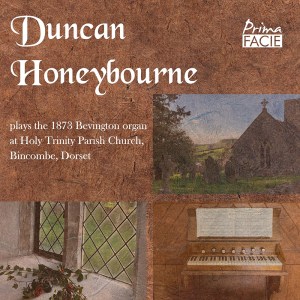
Duncan Honeybourne plays the 1873 Bevington organ at Holy Trinity parish church, Bincombe, Dorset (Prima Facie records PFCD220)
Bincombe is “a tiny place, comprising a few cottages, fields, farms and an ancient church nestled against a verdant hillside in sight of the sea. The lush meadows provide an inviting backdrop whilst, on the sightline, the English channel sparkles in the summer sunshine and shimmers mysteriously at night.” (Duncan Honeybourne). Part of the church dates from the twelfth century, with most of the remainder having been constructed in the fifteenth. The single manual organ was built by the London firm of Bevington and Sons in 1873 and supplied at a cost of £105 to the neighbouring parish of Broadwey. It was moved to Bincombe in 1903. (Bincombe is famous for its “bumps”, a cluster of round barrows which are visible from the Weymouth Relief Road.)
I was lucky enough to have a little preview of this album when Duncan gave a concert on the organ at All Saints’ church, Wyke Regis, in September. This album includes works by those masters of organ writing, Buxtehude and J S Bach, together with works by John Bull, William Byrd and Maurice Durufflé, as well as a nod to Wesssex composers, with works by Exeter-born Kate Boundy and Kate Loder of Bath. There is also a Dorset connection with Greville Cooke’s tranquil Threnody, recorded here for the first time. Cooke, a pianist, composer, poet, priest and professor at the Royal Academy, lived in north Dorset in his last years, although this piece was written during his time as Rector of Buxted, East Sussex. The album closes with John Joubert’s Short Preludes on English Hymn Tunes, composed for the new chamber organ at Peterborough Cathedral in 1990.
An enjoyable and highly varied disc which reveals the myriad colours, moods and warmth of the Bincombe organ. As a Dorset resident myself, I am particularly taken with the album’s connection to the local area near to where I live.
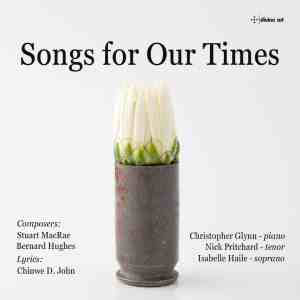
Songs for Our Times
Christopher Glynn (piano), Isabelle Haile (soprano), Nick Pritchard (tenor) Settings of lyrics by Chinwe D. John by Bernard Hughes and Stuart MacRae
(Divine Art Records DDX 21113)
I first encountered poet and lyricist Chinwe D John in spring 2022 when she contacted me about an EP of settings of her poetry (read my interview with her here).
This new release, like the previous EP, is an affirmation of Chinwe’s belief that in order to keep classical music thriving and to bring in a new audience, the work of present day composers needs to be supported. Commissioning contemporary day composers, to set music to lyrics directly reflective of our current times, is one way of accomplishing this. Chinwe herself sought out composers who shared her vision to set her words to music.
The album features two premiere recordings Kingdoms and Metropolis, whose stories will be familiar to many with their universal subjects, including the need for wisdom within the halls of power; transcendent love; an immigrant’s homesickness; the search for inner peace; all flow through the album evoking the spirit of our day and age. Despite our current turmoil, the overall tone of the album is a hopeful one, making it a welcome balm during our turbulent times.
With music by leading British composers Stuart McRae and Bernard Hughes, this is an intimate and ultimately uplifting album, with a wonderfully varied selection of very beautiful, arresting music.
During a practice rut that felt particularly more existential than others, I became obsessed with one question: ‘Can classical musicians ever graduate from their role as ‘craftsman/craftswoman onto that of creative artists? And if so, how may this be done?’
Turns out that this question was an urgent one and resonated with every strand of the classical music industry, from my student peers at London conservatoires to the musical stars of today. Famous pianist Kirill Gerstein posed this exact question to his guest, legendary artist Ai Wei Wei in one of his online seminars for the Krönberg Academy, where the latter had spoken at length about the responsibility of artists to shape the world through creation. I noticed a frustration amongst classical music interpreters of seemingly being some of the only artists deprived of the right to create. In reality of course they are not the only ones: classical actors, dancers, and interpreters of all types share this condition. The question is one of relevance: if classical performers are unable to create, how can they be instrumental in shaping culture and the world? How are they relevant as a cultural force?
For classical music performer, this inability to create in a poietic way (this means ‘to create something original’ as opposed to creating a variation on something that already exists, like an interpretation of a piece for example) is unhelpfully combined with a certain disdain of the profession towards behaviours that could bring attention to oneself, due to a conflation, in the minds of many people in the profession, of the presence or lack of interpretative integrity with certain onstage and offstage behaviours.
To be a classical performer is to be a professional interpreter. When interpreting a score, it is useful to forego one’s subjectivity and replace it by a more appropriate subjectivity instead in order to get closer to capturing what the composer had in mind. When we read Beethoven it is useful to park our most immediate instincts for a moment and try to figure out what Beethoven might have meant by his markings using not our contemporary understanding of the markings but a ‘historically informed’ (for lack of a better expression) reading of those same markings. In a way, at the point of exegesis of the musical text, this process is indeed one of – momentary – self-effacement. But in classical music, for some reason, we have collectively decided to performatively self-efface in a more general sense, ad absurdum, to show our audience just how committed we are to the process of conscientious interpretation.* Thus, anything that a performer does that might be considered to bring too much attention to themselves, such as flashy concert clothes or unconventional programming will elicit suspicion on their ability to sufficiently remove their ‘self’ when they sit to study a score. If you don’t believe that this is a common amalgamation, read this disturbing Norman Lebrecht article about how Yuja Wang would do herself a favour by dressing more soberly: people would then be able to recognise her for the true master that she is. If she were to do that, according to him, she ‘could be a sensation’ (!).
It’s difficult to say for sure whether classical musicians are generally less free to express themselves than classical actors or dancers. Take political views, for example. New York Times
journalist Zachary Woolfe describes pianist and activist Igor Levitt by contrasting him to the other ‘classical artists, [who] by and large, remain publicly reticent about their politics — this isn’t Hollywood’. Whilst actors are considered free, classical dancers seem to be in a similar situation to classical musicians: choreographers talk about things they care about aside from dance, but very few dancers do. The unfortunate consequence of classical music’s effacement ideal is that many classical music interpreters feel not only that they cannot create but also a frustration about not being able to express their full selves, on and offstage, or they might be thought less of.
As I ventured on this strange undertaking of combining Stand Up comedy with straight, serious classical piano performance, I found that talking to an audience about your quotidian as a classical musician in a funny way does much more than get them to feel more engaged. It makes them see you as a person. It means that people don’t just see you as the vehicle for a moving musical message, but they also see you: a partaker of the human condition, which I think has equal potential to move as ultimately we are all vulnerable little chickpeas trying to navigate the huge harira soup that is the world, and it is moving to see another person like us striving, trying, struggling. Just like classical music masterpieces have the power to tear us to pieces telling us things about ourselves that we didn’t even know (Robert Levin’s beautiful phrase), stand up comedy has the power to reveal aspects of ourselves, feelings and emotions that were a part of us all along but we had not noticed until now. It shows us that despite our differences, we are all moved or amused by the same things, and that many of the things we love and care about are the same. Laughing through difficulties gives us the strength to resist until we might see another happy day. Sublimation of pain is something that is very much shared between these two artforms.
On a separate note, breaking free of concert conventions for this show did make me feel like I was creating on a poietic level, and personally much more aligned with my work. I hope that the classical music world will become more open to making this kind of creation for available interpreters should they choose to (as opposed to reserving it for composers), as this will benefit both performers who will be able to be more fulfilled, and audiences who will benefit from the authenticity of these new exchanges. At the moment, it seems that the industry favours a model that seeks to create highly reproducible events so agents can rotate their roster artists from concert to concert without anyone noticing. It’s about time we recognise what we have to gain by granting performers more agency in how they present the pieces that they are interpreting.
*Musicologist Nicholas Cook talks about this in his book Music: A very short introduction (Oxford: 2000
Aïda Lahlou will be performing her Stand Up Comedy Meets Classical Piano and her Mirrors: A Recital with a Story shows in London this October as part of the Bloomsbury Festival (14/10 and 21/10 respectively). Tickets on sale here.
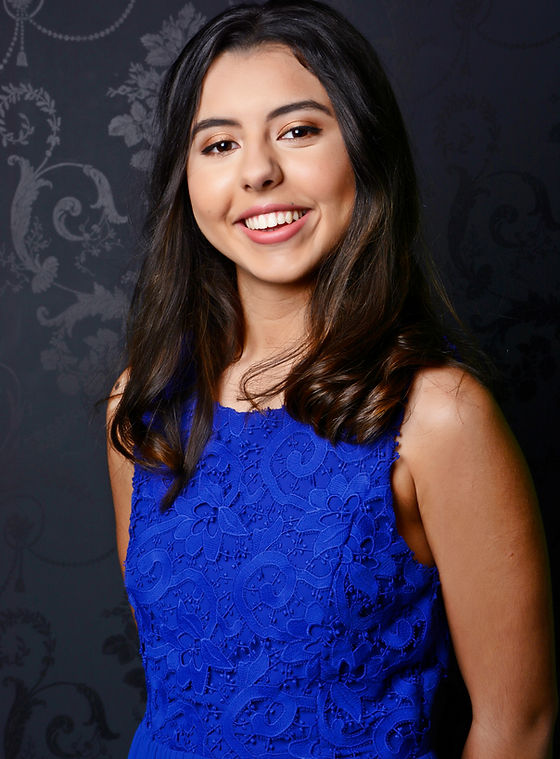
Aïda Lahlou is an up-and-coming Moroccan pianist and one of the most exciting talents of her generation.
Following a BA in Music at St John’s College, Cambridge, throughout which she studied with Caroline Palmer, Aïda is currently enrolled for a Masters in Piano Performance at the Guildhall School of Music and Drama, studying with Peter Bithell and Ronan O’Hora.
You are somehow there when Bach was composing this piece, and you are working with him, and then you forget everything that is around the area you are living in; you’re somehow there, with your hero, your mentor… I don’t want to play notes, like a robot, I want each note and each rhythm to mean something or, to like, touch someone’s heart.
Teddy Otieno, 2021, Nairobi
Arriving in Nairobi, Kenya, on New Year’s Day 2021 for six months of performing, masterclasses, filming a documentary, and escaping London lockdown with my young family, I had no idea what to expect of the pianistic landscape. I’d previously played Rachmaninov’s Paganini Variations with Nairobi Symphony Orchestra (a roughly equal mix of Kenyan and expat amateurs – Kenya has no professional orchestra) and given piano recitals in the city; this time I planned to work as much as possible with aspiring young pianists and learn a bit more about what provision there may be for advanced piano studies in Kenya. I was set up to work with the charities Ghetto Classics and Art of Music Foundation, and also had funding from the Royal Philharmonic Society’s Enterprise Fund to make a film about the young classical musicians I met there. I’m generally fascinated by other people’s lives, so I was excited to learn how the experience of aspiring Kenyan musicians might compare with my own.
It was a wonderful experience to make that film (available online – watch below). The musicians I worked with, mostly self-taught, made me feel inspired and quite naïve. We take so much for granted in Europe. We may complain about a lack of interest from the wider public but we nevertheless have a strong classical music infrastructure: institutions and established paths of support for talented youngsters. Benaars, who wanted to be a full-time pianist but was instead studying as an economist, told me with wonderful understatement “There are lots of people who want to study music but the financial prospects are rather grim, you know. The parents talk them down.” There was simply no money available in classical music in Kenya. The possibility of making a living as a performer, he said, “is really clearly out of the picture”, and because of that there is no-one able to guide younger students in the discipline and dedicated technical work required of a soloist. Benaars again: “I wish I’d just had that… someone not just challenging me, you know, but insisting.”
There is wonderful musical outreach work going on in Kenya, not least Ghetto Classics, which takes music and self-belief into the most underprivileged areas such as Korogocho slum in Nairobi. The ABRSM graded exams are also very popular and highly respected. Everyone I spoke to, though, agreed that there is little tuition available from the higher grades onwards, other than occasional masterclasses from visiting professionals such as myself. As a result, there is a lack of consistency and a lack of awareness as to what effective practice entails. David Ralak, a violinist then aged 28, explained “learning this instrument is really difficult if you don’t really meet a teacher face to face, because some things you hear them describing… it’s not as easy. You know, they describe them very easily because they do them very easily. But then, when you try and do it, there seems to be a whole layer of information missing. I knew what I had to do. It’s either I find money and go to Europe… or I just figure it out myself.” David is the one person I met who is just about managing to squeeze out a living as a musician: performing, coaching through various organisations, founding a string quartet (which plays at functions) and teaching privately a lot. After a fluke chance to attend a summer school in the UK a decade ago, he decided to devote himself to the violin and ‘figure it out himself’. But this is a very lonely path, every day is a struggle to survive, and it takes an incredibly unusual person to make it work. (Watch David’s story below)
In the first class I gave in Nairobi I had an inkling I’d found someone else quite unusual. Teddy Otieno (quoted above) was 19 and had come through the Ghetto Classics scheme in Korogocho, initially learning tuba because that was the instrument no-one else wanted to play. He had no piano, instead practising whenever he could at a community centre and teaching himself the piano using online videos. These were his first ever regular piano lessons, but I immediately noticed his natural musical instinct and passion, and astounding focus and determination to learn. Talking about his dream to perform as a soloist, he said “It makes me hopeless somehow, because there’s no-one to look up to in terms of that level right now… Because no-one is bothered on what to do. Like how much practice one needs to put in to the piano.” We worked together on Bach, Chopin and Debussy, and after my return to the UK he continued sending me videos of his playing for feedback and practice tips. I was excited to see his potential and his self-motivation. I persuaded Teddy to apply for conservatoire, just to see what would happen, and by the spring he had been accepted on a scholarship to study piano at the Royal Birmingham Conservatoire, something which he had never dreamed could be possible. After an immense effort to fundraise the remaining international fees, living costs and flights, he moved to Birmingham in September 2022 and is now starting his second year.
This summer I returned to Nairobi to continue teaching and performing, interested to see all these musicians again. There is a new express road in Nairobi which has improved daily life there no end. There were many more participants in the masterclasses now (42 registered to attend, giving me an enjoyably busy time), quite a few of them students of Benaars and Teddy. I also learnt about two new piano shops open in Nairobi.
What was really noticeable was the number of classical music events happening: during the time I was there the newly established (and self-run) Junior Chamber Orchestra gave two concerts, Mendelssohn’s Hymn of Praise was performed at the cathedral, and there was a concert called ‘The Opera Experience’, as well as the two concerts I gave. Violinist Ken Mwiti has, since my last visit to Nairobi, set up a flourishing musical booking agency, booking classical musicians for concerts as well as functions. Ken is studying music business as well as teaching violin, performing himself, and running his agency. I also heard word of plans for a new concert hall in Karen, a leafy area of Nairobi comparable to Richmond. I hope that however this hall is run will allow for budding musicians to perform more regularly in public, building their experience and their ambition for excellence.
It feels like a new era in the life of classical music in Kenya. A small number of Teddy’s generation, including his twin brother Lameck (viola), are currently embarking on musical studies in America, thanks to the support of sponsors in the States. A very eloquent and thoughtful friend of mine (Lemuel Agina, who was behind the camera for the documentary I made) told me it feels like Nairobi’s classical musicians have been working towards level 10 for a long time, and over the last year or two have had a real feeling of achievement and excitement at the way things are going – they’re finally at 10! But now it’s like starting again at 11, working towards 20… There is still, in some quarters, suspicion towards any kind of ‘instrumental music’ i.e. classical music, not surprisingly with some undertones of ‘colonial beef’, as Lemuel tactfully put it. There is certainly a lack of respect for classical performance – for example, the kind of quiet setting for a concert that we would take for granted in the UK – and familiar ideas of elitism. But Teddy for one is full of hope for the future and for what more he can learn this year, and next year, and the following year…
David, the violinist, has been following a hard path for many years now, with no support and little recognition. We performed together last month and his playing has deepened and matured to an extraordinary extent since I last played with him in 2021. However, even though the environment in Kenya is changing, he has felt frustrated by the lack of measurable progress, the lack of ‘give’ from the world he is trying to make his way in. He had been considering a move abroad to refresh his energies, which would be a real loss for Nairobi. But I was delighted to hear, when I spoke to him again last week, that a surprising number of concert opportunities have recently arisen (as well as a prestigious teaching position at an international school), and he is now feeling more hopeful about the viability of his performing career. Although it feels slow to those individuals making their way, he concedes that the public music scene is changing remarkably quickly. I feel confident that as the next serious young musicians like Teddy and David emerge, their paths will be that much smoother, and more encouraging – I am already excited about my next visit.
Teddy and Cordelia will be featured in a BBC Radio 4 documentary ‘How to Spot Potential’ every morning at 9.45am from 30 October.
Polish-Welsh-English pianist Cordelia Williams is recognised for the poetry, conviction and inner strength of her playing and the depth of her interpretations. She has performed all over the world, including concertos with the English Chamber Orchestra (in Mexico City), City of Birmingham Symphony Orchestra and Royal Philharmonic Orchestra (at Barbican Hall, London), as well as recitals at Wigmore Hall, Royal Festival Hall and Beijing Concert Hall. She broadcasts regularly for BBC Radio 3.
My ‘meet the composer’ project – June Armstrong’s Play for the Composer! – is now entering its fourth year. Originally created in 2021 to provide a much-needed performance opportunity for young pianists during lockdown, it has now become a platform for expression, not only of the music itself, but also the meaning behind the music, taking it to a higher level through visual representation, poetry and prose. Each performer makes a video of themselves performing their chosen piece. In return, they receive a certificate with feedback from myself and are included in a Celebration Video. They may opt to accompany the video with an artwork, a poem or prose piece representing the music they have chosen.
When a young person engages in this option, I feel that it enhances the performance, and when I receive an entry with artwork or prose, I always love to look at that first, before listening to the performance of the music. There is something so magical about the connection of the music to its visual representation or expression through words.
Firstly, of course, the music needs to be ‘learnt’. Secondly the music needs to be shaped and polished for performance. And then, the third dimension – taking the time to think about what the music is really saying, or expressing – adds to the understanding and to the performance itself. Knowing that the young performer has really thought about what the music is trying to express is just wonderful.
The concept of the melding of music and visual art and literature together is of course not new. “Music is no more the art of combining sounds to please the ear than painting is the art of combining colours to please the eye.” wrote Jean-Jacques Rousseau in his Essay. “More and more parallels between music and graphic art force themselves upon my consciousness” wrote Paul Klee in 1905, years after abandoning a promising musical career and dedicating himself to painting. The impressionist theories of Degas and Manet on the representation of light, found expression in music by Fauré, Debussy and Ravel, art and music forging an even stronger bond.
June Armstrong is a composer and piano teacher living in Belfast. She studied music at Queen’s University Belfast, graduating with a BMus and an MA.
June has had compositions included in all the major examination board syllabi and has received commissions from ABRSM, Red Leaf Pianoworks in Canada, Edition Musica Ferum, EVC Publishing and Hal Leonard in the USA. She specialises in composing music focusing on atmospheric playing, using colour, shape, and impressionistic sounds rather than traditional harmony.
She especially enjoys playing Bach, playing the violin, jazz, walking . . . and watching the sea.
The Cross-Eyed Pianist is free to access and ad-free, and takes many hours every month to research, write, and maintain.
If you find joy and value in what I do, please consider making a donation to support the continuance of the site

 Duncan Honeybourne plays the 1873 Bevington organ at Holy Trinity parish church, Bincombe, Dorset (Prima Facie records PFCD220)
 Songs for Our Times
 Aïda Lahlou is an up-and-coming Moroccan pianist and one of the most exciting talents of her generation.




 The Cross-Eyed Pianist