 Who or what inspired you to take up the piano and make it your career?
My older brother used to play the piano, so there was a piano in the house which I ended up spending more time with. I loved to imitate what I heard and to improvise. I went to study piano at conservatoire and even though music was my life-blood, I was interested in so many things – I studied maths, Italian literature, Latin and musicology at University, but in the end, the piano just stuck very naturally.
Who or what were the most important influences on your musical life and career?
The professor who had the strongest influence on me was undoubtedly Dominique Weber. He was taught by Eduardo Vercelli and Leon Fleisher, where he also served as an assistant at the Peabody Conservatory of Music in Baltimore. His instinct and his musical intelligence make him an extraordinary pianist and outstanding pedagogue. During the 4 years I studied with him, he helped me consolidate my technique and develop my sense of structure, rhythm and beauty of sound. He taught me the need to be engaged fully, to communicate and to search for my own sense of expression. He was an ideal professor. Dominique Weber’s recitals, which I am delighted to have listened to, have been unforgettable moments in my life as a musician.
I often played for Paul Badura-Skoda, the most illustrious representative of the Viennese tradition. With him, I had an opportunity to study works of Mozart, Haydn, Beethoven and Schubert on original instruments. His open-minded approach and broad interests enriched his understanding of art and this was a major source of inspiration to me.
I also have regularly taken classes with John Perry in Germany. John Perry is one of the most talented musicians I have met. His knowledge of the repertoire is impressive. He is a magnificent artist, able to move his audience as he sits at the piano. He can draw out the best out of each student while respecting their own personality.
What have been the greatest challenges of your career so far?
There have been so many. One recent example which springs to mind was recording two discs at the same time of Schumann Lieder and Haydn sonatas in four days.
Which performance/recordings are you most proud of?
Even if I would do everything again differently today, I still have a close recognition of those recordings and I don’t know which ones I prefer of the three for solo piano – Schumann, Schubert or Haydn. This is compounded by the different circumstances – all three in 3 different halls with 3 different pianos – so they all have their own personalities and reflect where I was at the time of playing them.
A challenge presented itself recently which I am particularly happy about. I was due to go to hear a concert at a festival an hour and a half away from home. I had bought the ticket online, and I was just walking out the door, when the festival director gave me a ring to say that the pianist due to perform that evening was ill and did I want to play instead. I went back inside to change and I arrived on the stage at the last minute. The strange thing is that probably if the director had phoned me the day before, I’d probably have turned it down, but the fact that the suggestion had come just at two hours notice, it was was so mad that I had gone ahead with it without thinking and chose the programme in the car on the way. The concert went very well and it was the first time that I had bought a ticket to my own recital.
Which particular works do you think you play best?
That’s something to ask the audience. I’m particularly drawn to the German repertoire, and audiences seem to find that I have a particular affinity for Schubert.
How do you make your repertoire choices from season to season?
There are promoters who ask me to perform certain works. If not, I try to find a balance between something new and pieces I already have in my repertoire.
Do you have a favourite concert venue to perform in and why?
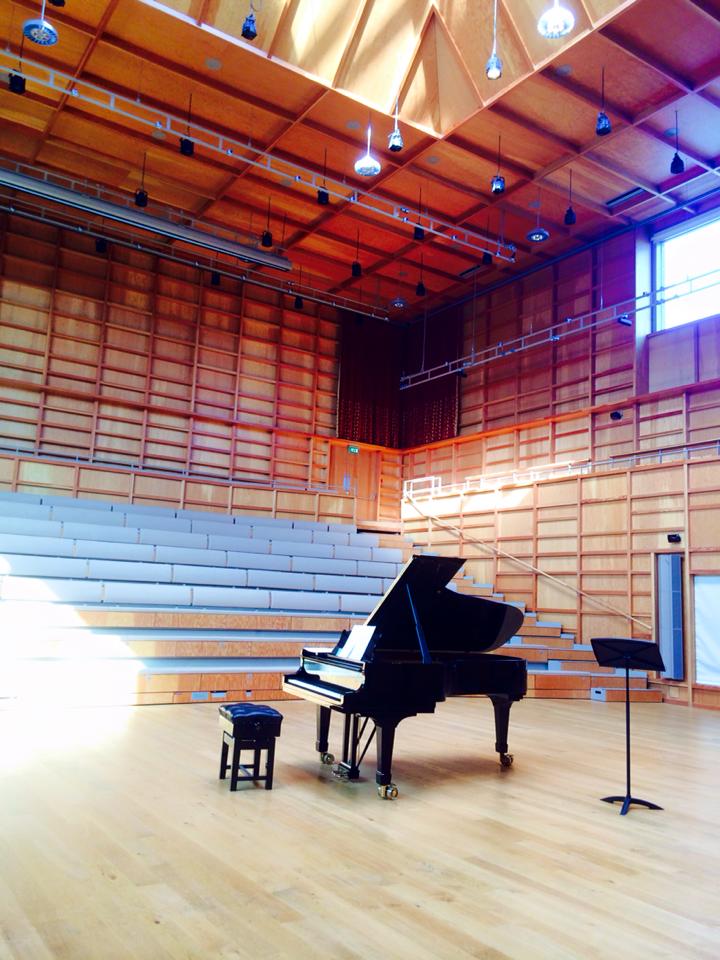
There are so many, but I am very happy to be returning in a couple of weeks time to Sala Mahler di Dobbiaco in Italy for the next recording of Bach (French Overture, 4th English Suite and the 1st Partita). The acoutic is fabulous, and I will be playing a very wonderful piano – a Steinway D which is called Rufus, prepared by my favourite technician.
Favourite pieces to perform? Listen to?
It’s always a pleasure to play Schubert, which is often requested by promoters. I often go to concerts, not only of classical music, and I seldom listen to piano discs. At home, I willingly listen to jazz, lieder and string quartets. A disc I particularly like is of pieces for lute by Bach played by Jakob Lindberg.
Who are your favourite musicians?
It’s difficult to make a complete list. I admire many pianists – Radu Lupu, Sergio Fiorentino, and amongst the musicians I have recently listened to live and which made a big impression, I’d mention Christoph Pregardien accompanied by the pianist Michael Gees, the Belcea Quartet, pianist Grigory Sokolov. And that’s without forgetting jazz musicians like Keith Jarrett, Brad Mehldau and Bill Evans….
What is your most memorable concert experience?
I don’t know what to say. I love playing solo in recital but I have experienced some magical moments on the stage with cellist Henri Demarquette or with the baritone Roman Trekel, a sensation of something truly unique, poetic and spontaneous.
What do you consider to be the most important ideas and concepts to impart to aspiring musicians?
From a performer, I expect musical honesty and respect for the work. The performer should always provide the musical structure intelligently and be able to communicate this fluently. One has to search to understand and to make understood what is hidden behind a musical score, all the things that the composer couldn’t write on a page. Sound is most important. It is the fundamental ingredient of everything.
What are you working on at the moment?
I’m currently studying works by Bach which I am about to record. Then also numerous concerts (recitals and chamber music) with works by Haydn, Mozart, Schubert, Schumann, Brahms, Janacek, Stravinsky, Britten and Kurtag.
Where would you like to be in 10 years’ time?
I’d like to be a lottery winner like everyone else so that I could construct a concert hall and record the complete works of Schubert in it! And if it happens in 10 weeks or 10 months, that’s fine too.
Fabrizio Chiovetta studied the piano and music theory at the Superior Conservatory of Geneva, his hometown. He obtained diplomas in piano and theory as well as the City of Geneva’s Adolphe Neumann Prize, an award bestowed upon particularly distinguished artists. He pursued his education with Dominique Weber at the Tibor Varga Academy in Sion until he obtained his Soloist Diploma in 2003 with the highest level of distinction. He has regularly worked with John Perry, Marc Durand and Paul Badura-Skoda – notably on the classical Viennese repertoire on original instruments – and has participated in the Master Classes of Gyorgy Sebok, Julian Martin, Yoheved Kaplinsky and Irwin Gage for the Lied. Recipient of the Göhner Foundation scholarship in 1999, he received the Audience Award at the Klaviersommer Festival (Cochem, Germany) in 2001 for his interpretation of Mozart. He has won the New Talents (Genoa, 2002) and the Orpheus (Zurich, 2003) competitions and has received the Honorary Mention Award of the Seventh International Web Concert Hall (USA, 2005). Fabrizio Chiovetta regularly gives concerts across Europe, North America, the Middle East ans Asia both in recitals and chamber music. His performing partners have included Henri Demarquette, Katia Trabé, Roman Trekel, Julian Bliss, Nicolas Gourbeix, Brigitte Fournier and Gérard Wyss. He has notably played under the direction of Gabor Takacs-Nagy and Ovidiu Balan and has accompanied Lady Jeanne’s and Sir James Galway’s Master Classes. His recordings include works from Honegger, Schumann and Schubert. His Schumann recording received the 5 Diapasons Award and Fanfare Magazine described his Waldszenen as “one of the best ever silver-disc’d”. Talented in improvisation, he performs with ensemble Piano Seven and with diverse musicians such as Anna Prucnal, Masako Hayashi, Levon and Gregoire.
Fabrizio Chiovetta’s new disc of Haydn Sonatas and Variations is available now on the Claves label

 On the 24 March Sir Neville Marriner will unveil a commemorative plaque in central London to celebrate the work of the composer Joseph Haydn.



 The music is



 The Cross-Eyed Pianist