What is your first memory of the piano?
Well, that depends if you mean playing or listening. Even at the age of 5 I was singing in school performances but I was always fascinated by the piano and how you could get such a large sound from one instrument. However I don’t think it was until secondary school that I really thought about it – as I began to be in a position to pay for lessons of my own. I remember meeting a boy at secondary school who was already around Grade 7 and being so in awe. I think having that achievement in view really helped me to drive towards my goal of becoming a pianist.
Who or what inspired you to start teaching?
Before studying music at Lancaster University in 2005 I did teach some beginner students for around two years. I always felt at school that what I didn’t want was a boring nine-to-five job with no creative outlet. Once I left school I had a 2 year gap which is when I began to explore teaching. As I was working on my Grade 8 piano at the time, along with singing, I felt that teaching piano would help me to develop all those skills. After entering my first student achieved a merit in his first exam, I definitely felt I had enjoyed the experience and considered other teaching work at that point. However I think it was probably my father who helped me to realise I should refocus on my main passion for music. Having left that office job I said I would never take, back in June 2011, in part to help look after my father who had been battling Parkinson’s for several years, I finally made the decision to focus full time on teaching and began working freelance by the end of that year. Sadly my father passed away the following January, having not seen me fully realise my ambition, but I think he was at least happy to see me doing what I loved and focussing on it full time.
Who or what are the most important influences on your teaching?
Definitely the most important musical influence is my long time tutor and mentor Daphne Sumbler who trained me as a singer and really helped me to reach my potential when I started secondary school, where she worked as Head of Music. Without her, I know I wouldn’t have pursued music with the same level of determination. She really helped me to see I could achieve something, even though at 12, I was very late starting. Certainly her ethos that students should enjoy music first and foremost has stayed with me and is at the core of my teaching practice.
Most memorable/significant teaching experiences?
So hard to pick one specific moment, one memory that stays with me is my first adult student, who I taught in the 2 years before going to university. I remember being fascinated that this gentleman, who was 67 at the time, who had great aspirations of composing and playing, but had not had much musical training to date. He had so much passion and enthusiasm for learning. It was great to see that at any age, at any point in your life, music can be such a powerful and positive influence.
What are the most exciting/challenging aspects of teaching beginners and advanced students and adults?
Teaching beginners is often the most interesting as it is a real opportunity to see what excites them musically. I always offer a free consultation so that we can explore ideas right from the very start and we always take 2 or 3 lessons to explore different repertoire before focussing on something longer term. Many parents say to me you must have lots of patience for beginners. I think this is probably true but often I find it very rewarding as it means I have to constantly be refining my teaching, in order to help a student overcome those initial hurdles.
Advanced students offer their own unique challenges. Again often uncertain of what to play, and still very critical of their own playing, they do at least have a sense of those basic elements so you can focus more on musicality and performance. I also make my advanced students work much harder to find answers themselves, rather than expect the answer directly from me.
Both adults and children have different learning styles and objectives. Whilst a child might often be uninhibited, willing to try and explore, and have the years in which to develop towards a specific goal, adult students often come with a much clearer sense of themselves and what they want to achieve, even if they are unsure just how to achieve it. I find adult students the most nervous and self critical, especially those who played when they were young. A common comment always being made to me is “I wish I had continued when I was a child”. It’s definitely wisdom I try to impart to my younger students so that they don’t regret not continuing learning music, in whatever capacity.
What are the most exciting/challenging aspects of teaching adult amateur pianists?
Adult amateurs are often very accomplished so they too often have a specific goal in mind. Often it is simply reassurance of a piece or their interpretation that is needed, or help and guidance with a particularly tricky section. They also tend to be much more knowledgeable about wider musical ideas, often attending concerts or having read about composers and performers. I think the greatest role I have to play is helping them to continue to play and to simply enjoy it, for whatever purpose.
What do you expect from your students?
Regardless of age or ability, I do ask that students are honest about their goals and aspirations and that they commit to practice, however much that might be, so that they continue to learn and develop as musicians. My aim has always been to get students to really understand and question their own reasons for playing, as this is often the key to inspiring and motivating them to practice.
What are your views on exams, festivals and competitions?
I think examinations and qualifications serve a certain purpose. However, in the larger scheme of things they aren’t something to overly worry about. Younger students will often work to examinations as they are used to this structured form of assessment, whereas adults often find this can be the reason they don’t want to learn! As much as possible though I do encourage playing for others, so this is often through my own student concerts, or local opportunities, festivals or competitions. All this experience will undoubtedly improve their playing so I think just go for it…what’s the worst that could happen!
What do you consider to be the most important concepts to impart to beginning students, and to advanced students?
A sense of self, their own wants and desires, and to realise that there is no limit to what can be achieved but the limit we put on ourselves.
What are your thoughts on the link between performance and teaching?
For me, I know my playing has drastically improved since teaching. I think it gives you such a great opportunity to reflect and to find better ways of doing things. I think it also helps to relax you at the keyboard. I found when I started teaching I was worried about if I made a slip in a piece that the parents might know and think I was a bad pianist. Now I just don’t worry and as a result I am much more confident, both in teaching and performing, and of course there are now fewer slips!
How do you approach the issue of performance anxiety/tension?
As someone who has really struggled with recital nerves, it is something I am very much aware of. Again I try to reflect on my own achievements and balance that with the negative “what if” moments that are often so consuming. The more experience you have, the easier it is to manage. However, I think I will always feel a little nervous but that it’s also a sign that you care enough about the performance to do as good a job as you can.
As far as teaching goes again I try to provide opportunities for my students to perform and to build on these positive experiences. We do explore elements of posture, hand position, arm weight and tension in the hand whenever it appears to become as issue that impacts on the sound. It’s about trying to be relaxed at the keyboard. As Bach famously said “It’s easy to play any musical instrument: all you have to do is touch the right key at the right time and the instrument will play itself.”
Who are your favourite pianists/pianist-teachers and why?
Having access to music and to performances by top music professionals is now easier than even and I always find that the internet is a constant source of opportunity to listen, learn and evaluate. Growing up it was friends, students and teachers who I looked to as my inspiration, trying to achieve what they had. However I think some of my favourites are people like Valentina Lisitsa, Horowitz, Zimerman, Rubinstein along with several fantastic teachers I have had the opportunity to study with, including Daphne Sumbler, Peter Noke, John Clegg and more recently Penelope Roskell. I will always be grateful to my tutors who have helped to inspire me to simply play, learn and enjoy making music.
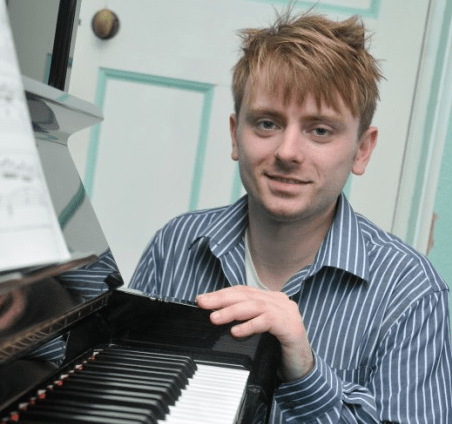
Richard began his musical studies late, and it was not until the age of 12, after taking the part of the young boy in Mendelssohn’s Oratorio Elijah at the Royal Northern College of Music, where he sang the part of the young treble, that he began to explore this potential. Having trained as a singer with Daphne Sumbler, Richard’s musical talents were given opportunity to flourish. Studying both singing and piano at that time, he worked tirelessly to complete his advanced training in both, ahead of university applications. Within 6 years Richard had achieved this goal and had completed his Grade 8 in singing and piano in 2003 & 2004 respectively.
After initially considering a career in musical theatre, following several successes with Daphne Sumbler in both local choirs and as a soloist, most notably taking part in a launch event at the RNCM for a musical centred around the Busby Babes and the tragic Munich airplane crash, Richard reconsidered his future prospects and decided to spend those years away from academic study to consider his future. By the Summer of 2004 Richard had secured a place as a first study singer at Huddersfield University but turned it down to study at Lancaster University as a pianist, fulfilling his life-long dream to study piano as his first study . Having studied initially with John Clegg, who was a student of Herbert Fryer’s, and then subsequently with Peter Noke, Richard completed his studies and in 2009 graduated with BA Combined honours in Music and German.
After graduating in 2009 Richard stepped away from music altogether to focus on his German studies. However, he returned to focus on music full time as a freelance musician in November 2011. The move back home, made in part by the deteriorating health of his father who had been battling with Parkinson’s Disease, helped Richard to re-evaluate his long term ambition of making music and he returned to reignite his passion and enthusiasm for piano.
Richard now works full time as a freelance musician and piano tutor in Manchester. Boasting a busy teaching portfolio and fantastic exam results for his students, along with his most recent success at receiving confirmation of one of his students to being accepted to attend Chetham’s School of Music, he’s now focussed on building a successful music career. Having undergone further study with Penelope Roskell, with an increase in both his freelance and local performance work, Richard is set to continue to prove that with enough self determination and drive, anything is possible.
For more information about Richard, along with teaching advice and upcoming performance dates, please visit his website at www.richarddinsmore.co.uk


 Programme for Wieniawski’s concert, 26 June 1891 ©Cambridge University Library



 The Cross-Eyed Pianist