Who or what inspired you to take up composing, and pursue a career in music?
Neither of my parents were musicians and we didn’t own a piano. Apparently I used to nip into the front room to play a piano on visits to my aunt when my parents were chatting. On the strength of what they heard they bought me a cheap piano and paid for lessons when I was four. This was a major struggle for a working class family at the time and I know they went without things in order to fund my musical efforts. I will forever be indebted to my parents for their faith in my abilities, their early support allowed me to realise my dream. Unfortunately Mum died when I was eleven and never got to hear my first TV and Radio broadcasts the following year, but she always loved to hear me play during her long illness at home and gave me so much encouragement.
As for composing, I think this is down to two things really, laziness and poor eyesight! Reading music was always a struggle for me so I relied on my ears. It was so much easier for me to make up my own music than to read the works of others!
Who or what were the most significant influences on your musical life and career as a composer?
Of the many old 78’s I used to listen to as a very young child, two in particular stand out for me; Rachmaninoff himself playing his Prelude in C# minor and Sidney Torch playing the organ of the Regal Edmonton, London. I think it is no coincidence that both are composers and both are telling stories through music. These recordings had a huge influence on me.
Up until about the age of eight or nine I was really totally immersed in classical music, I aspired to be a concert pianist. My brother (who was a few years older) had an eclectic taste and encyclopedic knowledge of rock and pop music. We lived on the East Coast and he encouraged me to listen to the Pirate radio stations such as Caroline and Radio North Sea International, my musical horizons were considerably broadened as a result! (Later when I studied with media composer Tim Souster it became apparent that this great diversity of musical influence could be a huge advantage if I wanted to write music for TV and Film) . I had never really considered composing as a career until I met Tim. He introduced me to my publisher De Wolfe Music. I studied with Roger Marsh and Peter Dickinson whilst at Keele University but one of the most significant influences was the visiting Professor, Cecil Lytle from the Juilliard, New York. It was he who introduced me to the works of John Coltrane and Miles Davis.
I had always had a keen interest in technology (my dad was a radio engineer in the RAF during the war), and I became involved with computers in the very early days of digital back in the 70’s. The studio technician at Keele was Cliff Bradbury (who later went on to engineer many of my recordings). He was very forward looking and introduced me to the world of computers and music. It was my work with the Fairlight CMI ( the world’s first computer sampling musical instrument) that was really my key to the media music industry.
What have been the greatest challenges of your career so far?
I suffer from perfectionism which is a huge disadvantage if you ever want to get any composition finished or recorded! However, hopefully professionalism and the practicalities of the real world take over and you have to always look forward. You have to learn from your mistakes and move on, not keep going back to revise. Total perfection in music composition/performance is not possible (except perhaps in the case of Bach!).
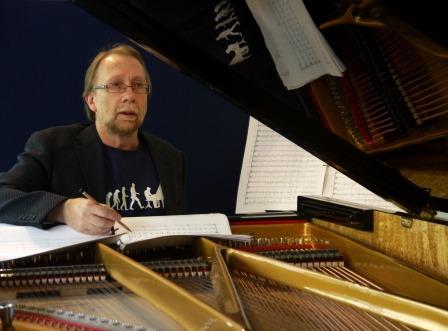
In practical terms, scoring was very hard for me, notation never came naturally to me. After my first few albums, my publisher asked if I would like to write and record a project for the US market with a large orchestra. When it turned out the orchestra was the RPO and I only had a few weeks to score, prepare parts etc. I was in a panic! Once again, computers came to my aid with a program, then in its infancy, called Sibelius. Many of the musicians told me it was the first time they had ever seen music printed with a dot-matrix printer! It was a steep learning curve but I am so glad I persevered. I have now worked with many of the UK’s finest recording orchestras, and it is so nice to get positive feedback from the players after a session. Rather strangely I now often like to work with a pencil and manuscript paper!
What are the special challenges/pleasures of working on a commissioned piece?
I have been so busy as a professional composer, and it was only with the release of my ‘ Two Toccatas for Piano’ (summer 2014) that I have had my first chance in over thirty years to work on something that wasn’t commissioned! I have been so lucky to have had such a wonderful, joy-filled life of music and to get paid for it!! I have now recorded something over 70 albums, every one a new and different challenge pushing my musical knowledge and abilities. There is always so much more to learn and music just keeps on giving!
You compose for film and tv. What are the special challenges/pleasures of working on film/tv scores?
I am not really the ideal film/TV composer as the first thing to understand is music is not the most important element in a production. It is just one part of the jigsaw of directing, script, casting, acting etc. that goes into making a great production. This goes against my nature as music is by far the most important thing from my perspective! However, building a good working relationship with a director is essential, and you learn that the music is not lessened just because it is only a part of the whole. It is there to serve a function just like say, sacred music or ballet music. The very best music both fulfils and transcends its function.
On a practical level, the hardest and yet most satisfying aspect is to listen and understand the language of a director. They often speak in visual terms; ‘Can the music be a little darker here?’ or ‘I need music to bring the vastness of the Himalayas into peoples sitting rooms on a small screen!’. Interpreting exactly what they mean and having empathy and sensitivity for their vision is paramount. When an artistic collaboration works well the sense of an emotional and intellectual bond is wonderful.
Which works are you most proud of?
I am both proud and embarrassed by all my work! Nothing is ever quite good enough, and yet I can honestly say I am proud that I have always done the best I can do at the time. My score for the short film ‘Dollar Night’ by Marco Antonio Martinez is a recent highlight. it is such a lovely, simple short story, I hope the music does it justice.
Probably my favourite album is ‘Childrens’ Magical World’ DWCD 0375. My youngest son was just a few years old when I wrote and recorded this double album of orchestral fantasy themes and was the inspiration for much of the music. This was a massive project involving orchestras, child choirs and many, many hours of hard work as I orchestrated it all. The dedication on the sleeve reads;
“This album is dedicated to my family. My wife Anne for her patience an support over the years, Laura for her inspiring beauty and elegance, James for his sheer enthusiasm, and little Jonathan who at 4 years old lets me join in and play, so that I can be a child again”.
Who are your favourite musicians/composers?
It is always so difficult to single out and I couldn’t just list a few. I admire and have had the great privilege to work with many of the world’s finest musicians. As for composers I guess it always comes back to Bach, although Debussy, Rachmaninov and Liszt are up there. My favourite band is Earth Wind and Fire!
How does your performing inform your composing, and vice versa?
Improvisation has always been central to my musical life both in composition and performance. I love the thrill of real-time composing and performing live, it is almost the antithesis of the studied and lengthy, lonely process of written composition and studio recording. The engagement with a live audience is a wonderful feeling and music is too much a living, evolving thing to be tied to closely to dots on a page or a fixed recording. These can represent the essence, or capture a moment in time, but can never replace the immediacy of real music making that happens at the moment of a live performance.
What do you consider to be the most important ideas and concepts to impart to aspiring musicians?
As I get older, and I don’t want to sound sentimental, it has become apparent to me that the great Bacharach and David song is right, what the world needs now is love! Love of the material world, love of life and people, and for a musician, love of your art and skill. Of course I am aware much great art and music is born out of suffering, however suffering is largely due to our love of things that can be taken or lost, our fear of the passing or loss of things we need, or hold to be dear and beautiful or desirable. The ephemeral, transient nature of music as art, bound up in its very essence with the passage of time, is inextricably linked to human life and love. Music can be a great intellectual exercise, one of the best in fact, but should never be approached with a cold heart!
Where would you like to be in 10 years’ time?
I don’t really mind where I am as long as I have my wife and family, my health and music and books.
What is your idea of perfect happiness?
There are so many kinds of happiness I’m not sure if any are perfect.
What is your most treasured possession?
In terms of material things, my Estonia concert grand piano.
What do you enjoy doing most?
Living, laughing, walking, thinking, reading and talking. Making and listening to music. Just being with family and friends, people are wonderful!
I am a keen badminton player, I have an interest in physics and astronomy and I love flying.
What is your present state of mind?
My wife would say, “what mind?!”
I am celebrating 50 years of playing the piano this year and so am probably in a slightly reflective state at the moment.
Andy Quin on SoundCloud
Born in London, Andy started playing the piano at the age of four and aspired to be a concert pianist. He had given his first radio and TV broadcasts by the age of eleven, however in his early teens, an interest in composition and recording sparked a change of direction and he started to develop his skills in rock, jazz and popular music. Having turned down a scholarship to the RCM, he studied at Keele University graduating with a degree in Music and Electronics. Andy studied composition and studio techniques with Tim Souster, Peter Dickinson and Roger Marsh. He also continued his classical piano studies with the acclaimed concert pianist Peter Seivewright whilst pursuing his interest in jazz with Professor Cecil Lytle from the Juilliard School of music. After graduating, Andy started writing for the De Wolfe Production Music Library. His first album ‘Mirage’ brought worldwide acclaim and he was soon sought after as a composer for TV and advertising. During the Eighties Andy composed music for many TV series and some of the UK’s best known advertising campaigns including the Oxo Family with Linda Bellingham, Websters Bitter with Cleo Rocos, Birds Eye Menu Masters, and the classic After Eight ad where Albert Einstein and Marilyn Monroe are entertained by Liberace. He worked with leading directors and producers such as Mike Figgis and Terence Donovan, on projects for clients including BA, Slazenger, Wimbledon LTA, Lynx, Volkswagen, Nissan, Hyundai, CIS and many others. Central Television made a short documentary film about Andy’s work at this time. After great success in the American TV and film market during the early Nineties Andy moved to the countryside and concentrated on production music at his purpose built private studio. However an interest in World Music saw him writing and producing a number of tracks for the international best selling album ‘One World’ which achieved No.3 in the UK charts. He has produced a great diversity of compositions such as Native American music for the Imax natural history Film Wolves, period music on the Academy Award nominated documentary feature My Architect, early jazz on Boardwalk Empire, the Mambo title music to the ITV comic outtake series It Shouldn’t Happen To A…., and a song on a top 20 album in Sweden. Recent commercials include; Scholl, Terry’s Chocolate Orange, Fairy cleaner, Britannia, Pedigree Chum and Setanta. Recent compositions include jazz on the Todd Solondz Film Dark Horse and the track Awakening, a finalist in the 2014 MAS awards for it’s use on the trailer to Terrence Malick’s To The Wonder. Currently working on his 70th album for De Wolfe Music, and with thousands of broadcasts every year in all continents, Andy is probably one of the most successful production music composers in the world. Andy is a virtuoso concert performer and still gives occasional recitals when time permits.







 The Cross-Eyed Pianist