Extraordinary, isn’t it? It’s a classical concert, so presumably the audience are there because they want to hear classical music – and yet the bar is playing “bad pop” (and those two words cover a multitude of sins!). This strikes me as a major “fail” on the part of the management of the venue – it’s also just plain dim.

plugears1

Music, often bad music, is everywhere these days. We used to make jokes about “lift music” (or muzak) or “hotel lobby music”, but now it is inescapable. It’s in shops, bars, cafes, restaurants – the noise often blaring from the invisible speakers so loud as to preclude intelligent or intelligible conversation. It’s leaking tinnily out of other people’s headphones on the tube and bus. And if you dare to ask to turn it down – as I do on occasion – you are met with looks of surprise, as if to say “you don’t like it?”. Or, worst case scenario, the chef gobs in your soup in revenge for your effrontery. I have had to leave certain establishments because the “background music” (ha!) made it impossible to have an audible conversation with the person I was meeting.

Most of this “music” is repetitive, musically simplistic (4 or 5 harmonies at most), and full of banal platitudes. But endure it we must, because it seems that some of us are afraid of silence. (Pause for a moment to consider the composer John Cage’s thoughts on “silence”…..)

Even the bank which I use on London’s High Street Kensington has been invaded by bad pop, the “music” regularly interrupted by the inane gabbling of some fifth-rate “DJ”. Why do we need such “noise” in the bank? Do those that select this noise think it will enhance our “banking experience”? In most cases, it makes me want to run screaming onto the busy street. It is a relief, therefore, to enter High Street Kensington tube station, where classical music plays, as background music, just audible enough to identify Beethoven’s Fourth Piano Concerto or a Handel aria as I make my way down to the westbound platform.

Most of the time I – and I suspect quite a few others – would happily go about my business uninterrupted by bad pop or “background music”. I don’t need a soundtrack to my transactions at the bank (though if one were to choose something appropriate, perhaps ‘Money’ by Pink Floyd, or Beethoven’s ‘Rage Over the Lost Penny’?); I’d like to enter a pub or cafe and hear the sound of other people talking, laughing. Going clothes shopping needn’t be like entering a discotheque (though I was pleased to have my street cred enhanced by correctly identifying ‘Golden Brown’ by The Stranglers in Top Shop recently – the (very young) assistant said “this is nice, what is it?”. Fortunately, I resisted the urge to sound like Michael Winner – “It’s from the 80s, dear”.

Don’t get me wrong: I love music, especially classical music, and most especially live classical music. I enjoy music in the right context and I’ll happily sit and listen to a radio broadcast, CD or live concert for several hours, uninterrupted, given half the chance. But out of context it can grate and intrude, especially when the music being played is someone else’s selection, a playlist made to someone else’s taste. Better in those circumstances to turn it off.

Because my main activity is playing the piano and teaching other people how to play the piano, when I am not engaged in that, I tend not to listen to the radio or music via CDs or a streaming service. Instead, I like to hear the sounds of my house quietly creaking and stretching, the cat mewing, the birds in the garden, the wind in the trees in my garden, the chatter of my neighbour’s grandchildren. These sounds are far more enjoyable and genuine that anything blaring out of a loudspeaker in a shop or cafe.

Pipe Down – the campaign for freedom from piped music

A Point of View: Why it’s time to turn the music off

Pop Music is Literally Ruining Our Brains


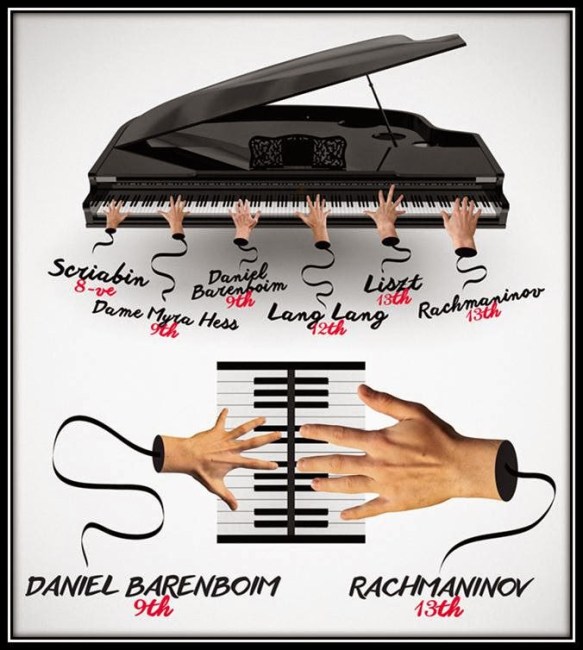
Hands

You can’t be a pianist without [at least one] (http://nicholasmccarthy.co.uk/). But what do you do if you are a small-handed pianist (barely an octave in the right hand, and that just at the edges of the keys) and want to play Chopin Op. 53 (the “Heroic” Polonaise”)? Your teacher looks at you with consternation, and then tells you that you must learn Chopin Études in a certain order, and that it will take a couple of years.

Fast forward two and a half years; my right hand span is now a centimetre longer than it was at the beginning of this saga. That single centimetre has been enough to allow me to play an octave right on top of the keys, enabling me to get a lot closer to the Op 53 ambition. I still can’t play the piece, but I can now play all the notes. It’s taken a lot of patience and trust in the sometimes non-intuitive ways of breaking down the Études; for example, I spent a couple of months practising the right hand of Chopin Op. 25 No. 9, shaking out my wrist after every half bar, to learn the feeling of playing octaves without stiffening my wrist.

I am well over the age that people stop growing, so the improvement is entirely down to the practise regimen. The increase in ability is not just down to the increase in span, but also increase in flexibility of all the fingers. When I play chords spanning an octave, I can now get the fingers out of the way that aren’t playing anything, avoiding hitting extraneous notes. I am not familiar with hand anatomy, but it feels as though the ligaments inside the palm have had to stretch the most.

As I progressed through the different exercises, I have felt my hands and arms up to the elbow ache in strange places. I am fortunately quite body-aware so have never done any damage; if the ache persists in the same place for a few days, I stop and work on something else until it goes away. (Incidentally, my typing speed has increased considerably, and I can now take dictation in almost real time.)

It’s tremendously motivating and every few months I take out a couple of octave heavy favourites to retry – every few months I am able to play big chords that bit more cleanly. There are no short cuts and this slow and steady progress feels more satisfying than if I were to magically be able to do it overnight, because I know that it is sustainable.

Mentally, it’s required the ability to trust that the practise will bear fruit, and to stop when it starts to hurt- not to push through to the point of damage (Probably a useful skill in any physical endeavour).

Obviously, my fingers aren’t going to grow any longer, but I hope that this will offer hope to other small-handed pianists. But a word of caution: It’s probably a bad idea to embark upon such a programme without the supervision of an experienced teacher, so as not to end up like Schumann.

Petra Chong
Petra Chong is a computer programmer as well as a pianist and so is perpetually bashing keyboards of one form or the other. She is a student of Marina Petrov

Who or what inspired you to take up the oboe and make it your career?

I was on my way home from school aged 7 when I heard the oboe on the car radio. As soon as I heard it I knew that was the instrument I really wanted to play. I pestered my parents until they let me start lessons. I have always loved music and playing the oboe but it was probably the summer I turned 19 that I decided that life as an oboist was something I wanted to commit everything to. I had just finished my first year of university when I travelled on to Banff Arts Centre in Canada for an intensive masterclass course there. I spent much of that summer taking extra lessons and practising as much as possible. I felt by the time I went back to university I couldn’t imagine being anything other than an musician.

Who or what were the most important influences on your musical life and career?

There have been so many influences to be honest. My teachers have always been fantastic to me and I feel lucky that I have been surrounded by such kind and generous mentors within the music world. I am hugely influenced from my time studying in Germany with Nicholas Daniel. He taught me repertoire I had never considered before and inspired me to work closely with composers. I remember asking him about why commissioning new oboe repertoire was important. The answer he gave me changed everything for me and working with composers to increase the oboe repertoire is something I care deeply about.

What have been the greatest challenges of your career so far?

I found the period in my early twenties very tough going. I knew I wanted to play the oboe for a living but let a fear of failing get in the way sometimes. I’ve always felt I need to turn every experience into something I can draw on so now I look back and think how important that time was for me.

Which performance/recordings are you most proud of?

Back in 2010, I gave a recital at Wigmore Hall and that was a very important concert to me that meant a considerable amount to me. It coincided with me finishing my studies and also releasing my first solo disc ‘Fierce Tears’.

Which particular works do you think you perform best?

I’ve found in the past few years I always end up gravitating towards contemporary British repertoire which I love performing. I think the feeling of discovering something new in the repertoire is something that always pushes me so this often informs my approach to programming. I want the audience to leave feeling like they’ve discovered some fantastic repertoire they never knew about before.

How do you make your repertoire choices from season to season?

I always programme each concert separately and try not to think in terms of a focus for one season. Inevitably I find I go through times where I play a piece several times in a row but generally I try to put together a recital that balances out and suits the particular venue and audience. I always try to include a contemporary piece and also an older piece that may be very rare but an absolute gem.

Do you have a favourite concert venue to perform in and why?

I don’t have a favourite venue but I enjoy venues like churches were the acoustic adds something to the atmosphere of the concert. When performing pieces like the Howells Oboe Sonata, having an interesting space with a good acoustic can make a big difference.

Favourite pieces to perform? Listen to?

I have a very strong affinity with Michael Berkeley’s Fierce Tears I & II. Every time I play that it feels very different and changes all the time for me. I also enjoy his Oboe Concerto as well as works like the Strauss Oboe Concerto which is a favourite of mine. I particularly love oboe repertoire by Rubbra, Bowen, Lutoslawski and Antal Dorati too. In terms of listening, I really enjoy lots of different things. Most recently I’m listening to a lot of electronic music but also love vocal recital discs. In particular Ian Bostridge and Julius Drake’s recording of ‘Silent Noon’ always has an incredible effect on me when I listen to it.

Who are your favourite musicians?

This is a tough question as I think there are so many to think of. For me, I tend to think in terms of favourite composers or favourite repertoire. At the moment I’m listening to a lot of Sibelius and Prokofiev amongst other things.

What is your most memorable concert experience?

It is a long time ago now but when I was 18 I performed in Mahler 8 with Simon Rattle at the Proms just before he started his post in Berlin. I’ve enjoyed plenty of memorable experiences in concert since but this contributed to me making the decision to become a musician so for that reason it is probably my most memorable.

What do you consider to be the most important ideas and concepts to impart to aspiring musicians?

The most important thing is to be very open to various opportunities. Take every experience as a positive one. There are inevitably times where you suffer what feels like a knock back but often these turn into catalysts for better things. My feeling is that you end up exactly where you want to be but usually by taking a completely unpredictable route to get there.

What are you working on at the moment?

I’m just putting the final touches on a disc that Champs Hill Records is releasing later in 2015. It is full of fantastic repertoire that I’ve really enjoyed recording. My next big project is establishing a new series of chamber music events with my group Ensemble Perpetuo. It is going to be my busiest year yet but also one I’m incredibly excited about.

What is your idea of perfect happiness?

My idea of happiness revolves around balance. It involves me being busy enough with music to feel fulfilled but also relaxed enough to spend time with my family.

What is your most treasured possession?

My answer should probably be my oboe but in reality is something far less poetic like my phone or laptop!

What do you enjoy doing most?

The thing that makes me tick is working on new projects. Sometimes it is a recording project, sometimes it is a new kind of recital programme. That feeling of limitless possibilities is what I find exciting and what makes me keep trying to move forward with my playing.

What is your present state of mind?

Really excited about the future but also slightly sleep deprived!

(Interview date: March 2015)


Described by The Independent as “a worthy champion” of contemporary oboe music, James has dedicated much of his performing life to promoting and extending the oboe repertoire. James has performed frequently throughout the UK and Europe including a solo recital at the Wigmore Hall in 2010. He has broadcast live on BBC Radio 3 and appeared as a soloist  in numerous UK festivals including Oxford, Leicester, Cambridge, Thaxted, Ryedale, Machynlleth, Swaledale and, King’s Lynn. James has released solo recordings for Champs Hill Records, Quartz Music and the ABRSM as well as featuring on a disc of Thea Musgrave’s works for Harmonia Mundi USA. Gramophone Magazine described his debut recital disc, Fierce Tears, as a “notable debut” and it was selected as the Editor’s Choice Recording by Classical Music Magazine.

James was seven when he began his oboe studies, learning with Irene Pragnell, Melanie Ragge, Celia Nicklin, Tess Miller and Chris Cowie. After gaining a First Class degree in music from Christ Church, Oxford University, James continued his oboe studies at the Royal Academy of Music and under Nicholas Daniel at Trossingen Musikhochschule in Germany, where he was awarded First Class for both his Artist and Soloist Diplomas.

James is deeply committed to expanding the oboe repertoire. He worked closely with Michael Berkeley, John Casken, Jonathan Dove, John Woolrich, Thea Musgrave and Tansy Davies on their compositions for oboe. Composers including Patrick Hawes, Thomas Hewitt Jones and Norbert Froehlich have also written for him. James has a keen interest in researching lost repertoire and bringing to new audiences works which have been rarely performed. In 2011 he worked closely with Christopher Hogwood on preparation for a new edition of Thomas Attwood Walmisley’s Sonatinas for oboe and piano.

James is an active chamber musician and is Artistic Director of Ensemble Perpetuo. Founded in 2013, Perpetuo is a chamber music collective that specialises in multi-art form collaborations and innovative ways of performing chamber music in new contexts. James has also performed with other chamber music ensembles including the Berkeley Ensemble and the Allegri String Quartet.

Aside from his performing interests, James is dedicated to broadening the appeal of the oboe and encouraging young people to learn the instrument. To this end, he has launched the website LearnToPlayTheOboe.com which now receives over a thousand new visitors every month from across the world. James also teaches at the Royal College of Music Junior Department and gives masterclasses across the UK.

James plays a Lorée Royal Oboe and Cor Anglais supplied by Crowthers of Canterbury. For more information about James and his playing, visit www.james-turnbull.com.

konstantin_scherbakov_fotos_-_oli_rust_fotograf_001

Who or what inspired you to take up piano and pursue a career in music? 

In my family, music was our everyday life, my father being an orchestral musician and a music teacher. Practising piano, learning music and going to symphony concerts and recitals every week was as a natural thing as going to school, skiing and skating, fishing, and biking around. I was therefore practically never given a choice to become or not to become a musician. Later the study became a passion, music turned into profession and a way of life.

Who or what have been the most important influences on your musical life and career? 

…My teacher Lev Naumov, the greatest artistic talent and musical encyclopaedist that I have ever encountered. The trace that this charismatic and extremely influential pedagogue left on my ideas about music was overwhelming.

Next, listening to music and sight-reading have been life-long passions. They always fed my appetite for musical discovery and set me on my path into the world of lesser-known music.

Winning prizes at competitions was another major contributor to my career. It helped establish my name. However, the most important influence on my career came from the labels with which I have been associated for more than twenty years: Marco Polo and Naxos. My first commercial recording (Lyapunov’s Twelve Transcendental Etudes, 1994) was not only the first step in my artistic journey; it also defined its direction.

What have been the greatest challenges of your career so far? 

The beginning of the project to record the complete works of Leopold Godowsky. The condition that Naxos set meant the project had to be finished in four sessions, I was supposed to record four CDs in each eight-day session, 16 CDs in total. The first session took place in Los Angeles in 1998 when we indeed recorded four CDs of Godowsky’s music in eight days!

Playing the 24 Preludes and Fugues by Shostakovich at the Salzburg Festival and breaking my right leg just two days before the performance (nobody noticed!).

Which performance/recordings are you most proud of?  

Rachmaninoff’s 3rd Piano Concerto with the Moscow Philharmonic under Yuri Simonov at Seoul Arts Center;

Strauss-Transcriptions (EMI);

12 Transcendental Studies by S. Lyapunov (Marco Polo);

24 Preludes and Fugues by Shostakovich (Naxos);

Sonatas by Scarlatti (Naxos).

Which particular works do you think you play best? 

From my very personal point of view it is the Russian repertoire and Beethoven.

How do you make your repertoire choices from season to season? 

There are a few factors that I take into consideration: my own repertoire preferences; wishes coming from concert organizers / orchestras; sometimes it is just the repertoire that is linked to current recording plans.

Do you have a favourite concert venue to perform in and why? 

Hard to say! I recall many wonderful halls which I thought were fantastic. Many British halls; the absolutely stunning Town Hall of Dunedin, the most southern city in New Zealand;  National Hall in Taipei, Tonhalle Zurich, the Great Hall of the Moscow Conservatory.

The acoustics and ambiance, a lively and enthusiastic audience, great piano – when brought together, all of this means a successful concert.

Good concerts stay in the memory and the concert hall where they took place is a huge part of that.

Favourite pieces to perform?  

Liszt’s transcriptions of the Beethoven Symphonies; Piano Concertos by Beethoven, Mozart, Rachmaninoff and Tchaikovsky; Anything by Chopin.  Listen to?

I can’t really name them all! I never sit and listen to a work that I would consider ‘my favourite’. Basically, I like whatever’s in my ear at a given time; it’s a very good critic.

If I had to choose, I’d say: Beethoven’s Symphonies and Quartets. Rachmaninoff’s 2nd Symphony; Brahms’s 3rd Symphony…

Who are your favourite musicians? 

There are many, various musicians at different times. Among pianists that have formed my idea of pianism (with this they are my all-time favourites) there are Vladimir Sofronitsky, Sviatoslav Richter, Vladimir Horowitz, George Cziffra, Emil Gilels; all pianists of the Golden Age.

What is your most memorable concert experience? 

A Beethoven recital in a small town some 70 km away from Krasnoyarsk, Siberia. Outside temperature -45°, in the hall – the most intense dialog with the audience. Unforgettable.

What do you consider to be the most important ideas and concepts to impart to aspiring musicians?

Practical advice: Practise a lot! Listen a lot! Sight-read! Every time you sit down at the piano think of the purpose of your practice!

General advice: next to playing, try to learn the profession. Every day ask yourself: what have I done today to be on stage in one – ten – fifty years’ time?

At all times try to answer the questions: Who am I? – Why do I play music? – What do I want to communicate? – Is my message clear?

Tell us about your new disc from your Godowsky collection: why did you decide to embark on this project to record 15 CDs?

As I said, the suggestion to undertake the project came from Naxos / Marco Polo. On the one hand it was my curiosity, my insatiable greed for new repertoire, the ability to learn fast; on the other hand, there were countless challenges involved – how could I resist?

You’re returning to Wigmore Hall on 26th November. How did you choose your programme for this concert? 

Given the concert’s length (an hour), my passion for Beethoven/Liszt’s Symphonies (I have played and recorded them all) and an intention to present an unusual and attractive program it seemed to be quite a natural choice. Moreover, I’ll be playing the Eroica Symphony many times this season, ending at the 2016 Beethovenfest in Bonn.

Besides, it is a sheer joy to play this marvel of musical genius, compositional beauty, and pianistic sophistication!

www.scherbakov.ch