The Pierrot Studio: Music. Art. Sound. Light. Performance. An exhibition supporting emerging artists and reaching new audiences
The Pierrot Studio
5 – 17 February 2016
Concert Opening: 4 February 2016
Performances begin at 18:30
Display Gallery, 26 Holborn Viaduct, London, EC1A 2AQ
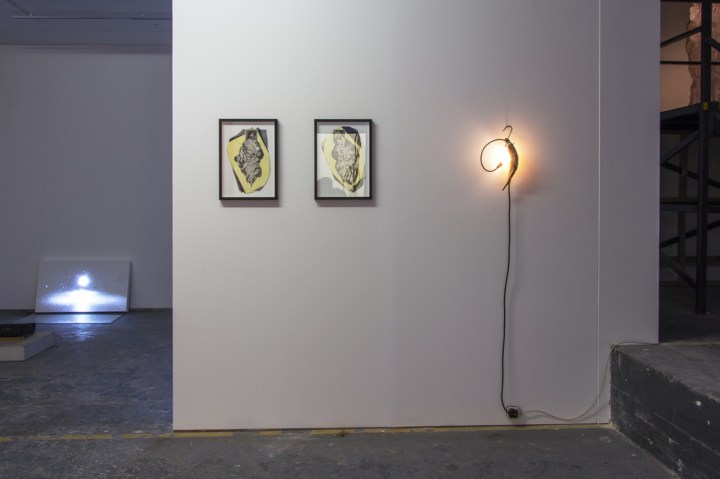
The Pierrot Studio brings together sculpture, cutting edge music, light, sound, strobe and performance into one harmonious space: an exhibition that allows the worlds of visual art and classical music to collide through a series of collaborative installations and concerts.
Three artists and three composers will work together to create visual/aural artworks inspired by 20th Century visionary Arnold Schönberg. Each pairing will explore thematic elements of Schönberg’s seminal song cycle ‘Pierrot Lunaire’. The Dr. K Sextet will perform the new compositions written for each installation at the opening of the exhibition.
Tim A Shaw and Ewan Campbell will take Schönberg’s study, or studio, as their starting point and will construct a skeleton, life size timber frame replica of this room, based upon photographs of the composer at work. Rather than presenting a stable or fixed piece of architecture, the installation will be much more akin to a psychic, virtual or imagined shell. The immersive room will include re-imaginings of Schönberg’s ‘musical’ sketches and painted self portraits.
Sara Naim and Chris Roe will create a poetic and transient rendering of Schönberg’s moonscape in ‘Pierrot Lunaire’. Roe’s composition will be amplified beneath a shallow vessel of milk. As the speakers reverberate with the varying tones and frequencies of the music, the liquid will begin to ripple and embody the sound through the various geometric patterns that appear in it. Naim will illuminate the milk with a strobe every 13 seconds in reference to Schönberg’s notorious triskaidekaphobia. She will create a series of frozen, sculptural moments, between which the audience will wait in darkness, absorbing the sound without vision.
Jörg Obergfell and Stef Conner will look specifically at the absurdist nature of Pierrot Lunaire and create a series of masks and musical motives around the various archetypal Pierrot characters. Conner’s compositions will be interwoven around a central, slowly developing theme of laughter. Obergfell will translate these characters into more or less abstract mask forms that draw inspiration from both folk costumes and modernist aesthetics.
The exhibition is programmed by The Pierrot Project, an arts collective that encourages interdisciplinary collaboration between artists, composers and musicians.
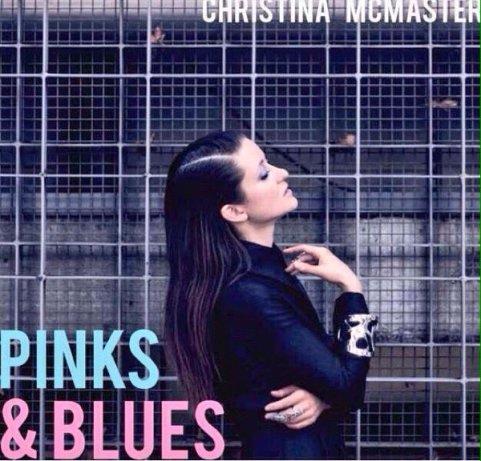
Pianist Christina McMaster certainly does not lack ambition, nor innovation. She created her own record label MC|MASTER Records in order to release her debut album Pinks& Blues, the sold out launch of which at St James’s Theatre included a performance by a rapper. This reflects Christina’s eclectic approach, vision and energy in her music making (she has previously collaborated with London Fashion Week and is now joining forces with graduates of Central St Martin’s School of Art & Design).
Pinks& Blues presents contrasting music from two key soundworlds in American music in the 20th century: the industrial, pioneering spirit and the rise of the teeming metropolis (demonstrated in works such as Samuel Barber’s ‘Excursions’ and Frederick Rzewski’s ‘Winsboro Cotton Mill Blues’), and Negro spirituals, Southern blues, smoky jazz clubs and the foot-stomping dance scene of New York City. The album also includes new commissions by two exciting young British composers, Freya Waley-Cohen and Richard Bullen, and on two tracks Christina is joined by Jay Phelps (trumpet), Sami Tammilehto (percussion) and Mark Lewandowski (double bass).
The album opens with the first of Barber’s ‘Excursions’, a work whose frenetic “perpetuum mobile” ostinato bassline suggests the fast-moving big city, replete with rattling metro trains, honking taxis and bustling crowds. But by track three, ‘Peace Piece’ by Bill Evans, we’re transported somewhere altogether more calm – the shady deck of a southern villa perhaps. There is a lightness of touch here which suggests both repose and an urging forward. The work is bookended by two Études by Ligeti which contain motifs redolent of Evans, also deftly played.
Richard Bullen’s ‘Scenes from a Deserted Jazz Club’ is highly atmospheric, at once smoochy and unsettling. It is followed by Frederick Rzewski’s ‘Winsboro Cotton Mill Blues’, another work of hypnotic, urgent energy immediately proceeded by the second of Barber’s Excursions, a languid blues number.
Freya Waley-Cohen’s ‘Southern Leaves’ opens with a figure reminiscent of a southern hymn tune which builds in intensity through increasingly plangent chords. It is meditative and dramatic, and provides a good foil for Gershwin’s ‘It Ain’t Necessarily So’ (from Porgy & Bess, which is of course set in the Deep South). Back to the urgency of the industrial city with Stephen Montague’s ‘Songs of Childhood’, while the album closes with another work by Montague’s, ‘Southern Lament: Nobody Knows the Troubles I’ve Seen’, the traditional spiritual given a contemporary twist with fanfare-like repeated figures, strumming and plucking the piano’s strings directly, and a restful hymnlike section to close.
This imaginative selection neatly reflects Christina’s personal musical tastes and her eclectic approach to programming. The American theme ehich runs through the entire album ties together tracks which in another’s hands may seem disparate, but such is Christina’s expertise in moving seamlessly between the percussive and agitated and the meditative and soulful, she achieves a very satisfying and enjoyable whole. The more bluesy numbers have the requisite sense of time standing still with sensitive use of rubato and elastic tempi, while the upbeat, more mechanical works are precise, sprightly and crisply articulated. This album promises much more to come from this exciting and stylish young pianist.
Who or what inspired you to take up piano and make it your career?
I don’t remember much about what made me decide to play the piano and make it my life’s dedication, I only know that I always knew that I wanted to become a concert pianist.
I do remember getting a cassette tape with Chopin ‘Heroic’ Polonaise played by Ashkenazy and couldn’t get around how somebody could write something so beautiful and full of life.
Who or what were the most important influences on your musical life and career?
When I was in high school I met a classical guitarist who had a sensitivity and honesty as an artist which I had not seen. We would listen and discuss wonderful pieces of art in which he showed me delicacy in colour, shape and space which I didn’t think were possible. I was raised in a small coastal town in the Netherlands and in this seemingly non-artistic environment he was somebody who gave me the confidence to pursue the search for beauty.
Steven Osborne has been a big influence in the last years. He has helped me a lot, not only by his occasional mentoring but also seeing him perform and his work in seeking expression, character and technical confidence.
What have been the greatest challenges of your career so far?
I think the greatest challenge is still to come in securing a career and being able to reach a large audience in a world where classical music is still understood by a small number of people and where the artist has to deal with big political and intercontinental power shifts.
Which performances/recordings are you most proud of?
I have recently recorded my first disc. The things I have heard sound really good in terms of clarity and expression. But most proud am I to have been able to work with an incredible team – producer Andrew Keener and engineer Aleksandar Obradovic.
Which particular works do you think you perform best?
This is very difficult to answer: as an artist I am constantly looking to understand style and the composer’s score more and more thoroughly. Sometimes I have a pretty clear feeling of a particular expression in a particular style but realise that it couldn’t be the composer’s intention. It is a long search in which we must take our own life and experiences into account.
How do you make your repertoire choices from season to season?
Depending to what certain halls and concert series have programmed and wish to listen to, I try to build a program in which I feel confident and in which the pieces have common ground in terms of expression and character.
Do you have a favourite concert venue to perform in and why?
Not so long ago I performed in the Concertgebouw in Amsterdam. The experience was truly wonderful because the hall and the acoustics worked together so beautifully. My concept of sound in certain passages was suddenly so much more achievable as the circumstances were perfect.
Favourite pieces to perform? Listen to?
I very much enjoy performing Schumann Allegro Opus 8. I love the tremendous drive and power of this particular piece. It brings so many questions to me which I don’t always know how to answer, and this is the beauty of it.
I am constantly return to listening to Buckner symphonies, they give me such a sense of space and structure. There something about these works that gives me clarity of mind in times when I need it.
Who are your favourite musicians?
There are a lot of musicians and artists in general whom I admire for their contribution to art and music. Each of them, in their personal view of music, has taught me things and changed or affected the way I see things nowadays.
What is your most memorable concert experience?
When I was living in Rotterdam the first concert I attended was Bach’s St Matthew Passion with the Rotterdam Philharmonic. The experience of such an incredibly powerful piece in a setting of a beautiful concert hall was something which has stayed with me.
What do you consider to be the most important ideas and concepts to impart to aspiring musicians?
I think the most important thing for young artists is to have a very clear idea of how to reach the younger generation, and to be able to show why art is a necessity for the well being of our internal life.
What is your idea of perfect happiness?
Hopefully that is when mind, body and spirit become one and there is complete peace of mind.
What is your present state of mind?
At the moment I consider myself having a clear state of mind as I am able to make deeply-felt artistic decisions. In a world which is captured by an economical crisis, political shifts, and is in need of a new vision towards our perception of how we experience art, I find myself sometimes overwhelmed by all the possibilities on the one hand and doubts on the other.
Cyrill Ibrahim performs at St James’s Piccadilly, London on 11th January at 1pm
Born in Rotterdam in The Netherlands, in 1984, Cyrill Ibrahim started playing the piano at the age of seven. One of his first mentors was Leonardo Palacios, a classical guitarist from Uruguay. He subsequently enrolled at the age of 18 at the Rotterdam Conservatory. He graduated as Bachelor of Music with Distinction.
During his studies, his tutors were Aquiles Delle Vigne, Barbara Grajewska and Marcus Baban. To his delight, Cyrill was loaned a grand piano by the Dutch Music Foundation during his studies in the Netherlands.
In 2009, the pianist Paolo Giacometti offered him a place at the Utrecht Conservatory to follow the Master of Music programme. He studied there for a year before moving to the United Kingdom.
Cyrill graduated from the Royal College of Music after undertaking the Master’s Degree in Performance under the tutelage of Professor Andrew Ball. The Dutch Government showed its faith in Cyrill’s skills as a pianist by offering him a full Huygen’s Scholarship for the entirety of his studies with the RCM.
He participated in the masterclass of the Portuguese pianist Maria Joao Pires at the Karma Ling Institute in France. In addition to this, he studied at the Birmingham Piano Academy, Chetham’s Summer School, the Lucca Estate and the Orchestral Conducting Course that is run by Antonio Ros Marba in Spain. Over the years, he has received tuition from, among others, Philip Fowke, Peter Donohoe, Ruth Nye, Matthias Kirschnereit, Dr. Robert Markham, Malcolm Wilson, John Humpreys and Katarzyna Popowa-Zydron.
He has performed both as soloist and a chamber recitalist on the national and international stage for such halls as the Berliner Philharmonie and Concertgebouw in Amsterdam.
Cyrill has had the privilege of working with the concert pianist Steven Osborne. In a magazine interview, he said of the pianist: “I recently met a talented young Dutch pianist called Cyrill Ibrahim, who has an intensity and openness that really impressed me. I think he could be someone really worth listening to.”
For the next four weeks, the Meet the Artist series will feature interviews with musicians who are supported by Talent Unlimited.
Talent Unlimited is a young charity that provides financial support to music students of exceptional talent but limited means. Talent, past performance and financial background are taken into consideration when assessing those who are selected for help.
Lack of funding leads many talented young individuals to abandon the field of music as it becomes impossible or at least cripplingly difficult to maintain their studies while working in various part-time jobs to survive. One has to have either rich parents or be incredibly lucky and resilient to flourish. Students have to pay exceptionally high fees when attending prestigious music schools and colleges in London and on many occasions by the time they reach post-graduate levels their resources have all but dried up. This is the point at which a charity like Talent Unlimited can be called upon for help.
Talent Unlimited, through its donations, concerts, conferences and other events aims at creating an environment conducive to the development of young musical talent.
The Cross-Eyed Pianist is free to access and ad-free, and takes many hours every month to research, write, and maintain.
If you find joy and value in what I do, please consider making a donation to support the continuance of the site



 Talent Unlimited is a young charity that provides financial support to music students of exceptional talent but limited means. Talent, past performance and financial background are taken into consideration when assessing those who are selected for help.



 The Cross-Eyed Pianist