
The Musician as Entrepreneur
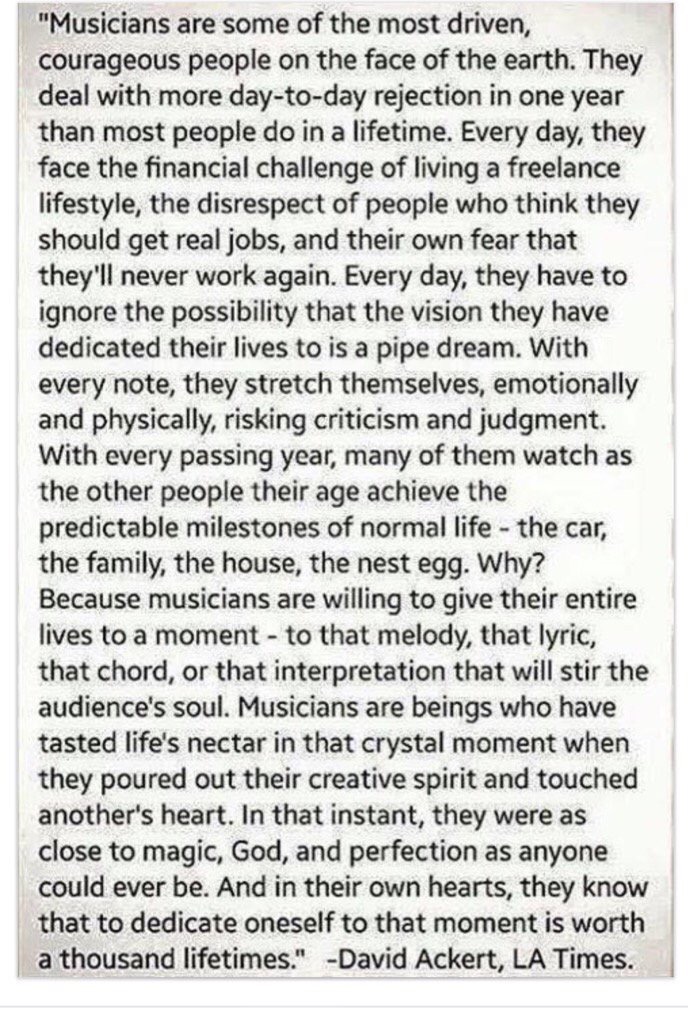
It’s very hard to carve a career as a musician, never more so in today’s fast-paced, highly competitive and image-driven world. The changes in the industry are unparalleled in history and therefore so are our roles. Today it’s not enough to aspire to be a virtuoso – it’s almost impossible to build a career out of simply playing concertos by Beethoven or Tchaikovsky. Now classical musicians need to be prepared to turn their hand to a variety of activities within the profession – performing, teaching, collaborating, promotion and more.
“Portfolio career” is an over-used term, but if you have imagination and passion, there’s plenty of scope to pursue a multi-layered career within the profession. Of course, it can be hard to know how to develop these skills when one’s specialist training focuses on performance to the exclusion – almost – of anything else. Some conservatoires now offer courses in entrepreneurship, which include aspects such as promotion and branding, building a website and using social media, but largely the narrow focus remains on the pursuit of excellence in performance at the expense of experimenting and developing skills relevant to today’s society. Thus, musicians may leave conservatoire or university ill-equipped to deal with the exigencies of modern life, with little practical knowledge on how to launch a career. Today’s musicians need to leave the ivory tower behind and enter the real world armed with talent, entrepreneurial instincts, a willingness to work hard, and a very thick skin.
As highly-trained individuals, musicians have skills and expertise which are easily transferable and which bring artistic, educational, social and economic value to society. Unfortunately, the prevailing attitude outside the profession (and occasionally within it), is that such people do not bring real, quantifiable (i.e. economic) value to society (a view which is regularly refuted by academics and economists): as a result our work is often classified as “not a proper job”. This means that musicians have to work harder than ever to earn respect, recognition, appropriate remuneration and status.
The concept of “entrepreneur” may seem at odds with the life of the musician, but in fact to the two roles are very alike, and there are strong historical precedents: composers like Bach, Haydn and Mozart were actively engaged in organising and promoting their own concerts, running and developing their own businesses. Beethoven complained that the need to be “half a businessman” encroached on the practice of his art.
Unless you are extraordinarily talented and have, preferably, won several prestigious international competitions, or are bankrolled by a generous patron, you are not likely to be picked up by one of the big artist agencies or promoters. Because the industry is so competitive, it is not acceptable to sit back and wait for the promoters to seek you out. You need to get out there, preferably before you leave college, and you need to adopt a flexible and open-minded attitude to work. Teaching, for example, should not be seen as a “second- or third- best” option if you are not getting as many performing engagements as you’d hoped for. (In fact, a teacher who is also a performer can bring unique insights to their teaching – something I have covered in an earlier article for the HelloStage blog.)
Today, your success is largely in your own hands (unless you are being “managed” by someone else), and many musicians choose to take responsibility themselves to retain control over their career and as a way of remaining flexible and open to opportunities as they present themselves. In addition, the notion that the business side of a career in music has to be handled by an agent or manager does not apply to musicians today.
Instead, musicians are creating opportunities for themselves and colleagues which engage a wide range of skills from planning and budgeting to collaboration with other musicians, writers, artists….. It’s important to find ways to explore your artistry outside of conventional contexts. Use contacts made at college and beyond and get into the habit of networking whenever the opportunity arises. Keep a notebook with you at all times and follow up on potential leads: work doesn’t come your way if you spend all your days in your practise room. Surround yourself with people who can help and support you, and be prepared to learn new skills such as simple graphic design to produce publicity material or how to use social media effectively. Be willing to delegate and don’t be shy about asking for help. And if you think a “big name” artist will attract a bigger audience, don’t be afraid to approach that person – often, such people are keen to support younger artists. Have a flexible attitude to work and be prepared to try new things or take risks. Be imaginative and professional in the way you approach everything from programming to involving audience to fundraising, from checking that concert flyers and listings are accurate to dealing courteously with venue managers or press contacts.
Allow yourself plenty of time for planning, and accept feedback after the event, learn from your mistakes and move on, armed with additional knowledge. Don’t undervalue yourself and maintain your artistic and professional integrity by refusing to take on “just anything”.
Above all, love what you do – your passion and commitment will carry you through.
I am grateful to contributions for this article from my friends and colleagues Emmanuel Vass (pianist), Heather Bird (double-bassist and founder of Classical Evolution) and Fenella Humphreys (violinist)
This article was first published on the HelloStage blog
Merry Christmas
and a Happy New Year to all my readers around the world.
Meet the Artist……Sally Whitwell, composer and pianist

Who or what inspired you to take up the piano and pursue a career in music?
When I was a kid, I lived in an extended family household i.e. my grandmother came to live with us. She brought her imposing beast of an instrument with her, a huge steel framed upright that she and I would play duets on, or sing songs together like Cockles and Mussels or The Wedding of the Painted Doll. I just felt drawn to the instrument. Maybe it was the bonding time with my grandmother? Maybe it was that it was the biggest toy in the house? I don’t know. I think it chose me rather than the other way around.
You are also a composer. Who or what inspired you to start composing?
My partner Glennda inspired me to start composing. At the time we met, we were both working strange hours. Musician hours are crazy at the best of times, and she worked rather unpredictable shift worker hours, so we found ourselves ‘dating’ at mostly odd hours of the night. I’ve always been a bit of a cheeseball and love Romantic period poetry, Shelley, Keats, Byron… Suddenly She Walks in Beauty Like the Night had great significance to me, so I wrote a choral setting of it and gifted her with the world premiere informal performance in our little shopfront studio we share (she’s a visual artist). My friend Michelle Leonard was at the performance and immediately asked if she could buy it for her community choir the Leichhardt Espresso Chorus. Thus my composing career was borne from love.
Who or what were the most important influences on your musical life and career, as both pianist and composer?
There are too many of those to list and I actually don’t like to single out someone over anyone else. I will tell you, however, what it is that these people have all done. They’ve made me feel capable of doing this crazy music thing. There is nothing so empowering and motivating as someone looking you in the eyes and saying “You can do this.” After that, it’s up to you to work hard at perfecting your skills and accumulating knowledge and experience that enables you to move people through your music making in whatever form that music making takes.
What have been the greatest challenges of your career so far?
Having the courage to attempt new things. For example, when I was approached by Universal/ABC Classics to record my first album of solo piano music (Mad Rush: solo piano music of Philip Glass) I hadn’t played a solo piano piece in public for 17 years. I’d been happily working as an accompanist and chamber musician all that time, thinking that any kind of career as a soloist was not a thing that I was good enough to do. But I got thinking about it and realised that they’d never have asked me if they didn’t think I could do it, so I did it.
Which performances/recordings/compositions are you most proud of?
I’m most proud of my latest album I Was Flying. It’s the first album I’ve recorded of all my own compositions, which is quite daunting but exciting too. What makes me particularly happy with it is the opportunity to invite a whole lot of my colleagues from the Sydney music scene to be a part of it, flautist Sally Walker, soprano Alexandra Oomens, violinist Kirsten Williams, the Acacia Quartet and VOX (the youth ensemble from Sydney Philharmonia Choirs). There’s just so much incredible talent here. It was rather emotionally overwhelming to be in the studio thinking to myself that at least 60 people were slogging their guts out to bring my little dots and squiggles to life. I had a few teary moments. Haha.
Which particular works do you think you perform best?
My own! Because they are all me. All of me, actually, and nobody knows me like I know me. Gosh, that’s a bit confronting.
How does your performing influence your composing, and vice versa?
Being a composer makes me increasingly aware of the value of detail on a musical score and how that manifests in terms of the dramatic shape of a piece of music. As a composer, I like to write with a considerable amount of detail in tempo and articulation, dynamic and phrasing, but I try not to make that detail stifling for a performer. They need some space for interpretation.
What are the particular challenges and pleasures of working on a commissioned piece? (if relevant)
Hoping that the composer gives you the score far enough in advance for you to have time to learn it properly, which is often not the case. Such timings aside, it’s quite a challenge to learn the particular language of a composer whose works you haven’t performed before. You might make some decisions about what you’re going to do, and then they don’t like your interpretation, so you end up having to make some huge changes at the last minute. Sometimes this gives you an edge in performance though, so that can be a positive thing. It’s just a bit scary! When the composer is open and communicative and willing to be flexible, it is a joy to work with them. When they are prescriptive about interpretation or inflexible in any way, it can become strained.
What are the particular challenges and pleasures of working with other musicians, ensembles etc, as both composer and pianist?
As a composer, I love hearing what different performers bring to my music. Playing my music with other performers is the best way to learn about writing for various instruments. It can be tricky if said performers are not forthcoming with advice, or if they are less than helpful with the advice they do give. It’s about communicating well and having the same goal which for me is always to communicate something to a listener, to make them feel something.
Do you have a favourite concert venue to perform in and why?
I’ve performed in concert halls and churches, convention centres and jazz bars, school halls and shearing sheds… none of them are better or worse, they’re all just different. What I find makes the difference is the connection with the audience. If the audience is in the right zone, it’s a great place to perform!
Favourite pieces to perform? Listen to?
I enjoy performing my own music the most, because it makes me feel that I’m really communicating something personal. Likewise I like to listen to people perform their own compositions because I feel I’m getting the whole of them as a person. It’s what continually draws me back to Philip Glass, Michael Nyman, Zoe Keating, Björk, Regina Spektor, Joni Mitchell, Rufus Wainright… I’m also listening to rather a lot of musical theatre at the moment ostensibly for research purposes, as I’ve just written my own musical Cog in the Machine. It’s interesting to explore the theatrical side of music making. I feel I may drift more and more in that direction. We’ll see!
Who are your favourite musicians?
It changes all the time, but at the moment I’m listening to lots of Björk, Agnes Obel and Olafur Arnalds. Being a performer/composer myself, it is particularly nice to see how others are doing at it.
What is your most memorable concert experience?
Too many to list! My most favourite recent concert was in a Steiner school here in Sydney. The kids there were genuinely curious and open to new experiences, the whole atmosphere of the school was really positive. The campus was like an enchanted glade, there was even a picturesque waterfall, and it appealed to me that I got to wait outside near the chicken coop in the sunshine prior to my lunchtime performance.
What do you consider to be the most important ideas and concepts to impart to aspiring musicians?
Do your theory homework. Seriously, I use those skills every single day of my life and I’m so thankful for them.
What is your idea of perfect happiness?
For myself, it’s connecting with people in all sorts of ways but primarily through my music. This world needs some joy and I try to provide that through what I create.
Award winning pianist Sally Whitwell maintains a busy freelance career as performer, conductor, composer and educator from her base in Sydney.
Sally’s album All Imperfect Things; solo piano music of Michael Nyman won the 2013 ARIA Award for Best Classical Album as well as Best Engineer for ABC Classics very own tonmeister Virginia Read, the first time that a woman has ever won this award. Additionally, her debut album Mad Rush: solo piano music of Philip Glass won her the 2011 ARIA for Best Classical Album. Her sophomore album The Good, the Bad and the Awkward is a truly unique compilation of film music where she played not only piano but toy piano, harpsichord, recorder and melodica. Sally’s fourth album I Was Flying is now available, featuring her own compositions in the art song, choral and chamber music genres.
Recent solo concert appearances for Sally have included the world premiere of the Philip Glass Complete Piano Etudes for Perth International Arts Festival and Ten Tiny Dancers, an all-singing-all-playing-all-dancing cabaret piano recital for the Famous Spiegeltent season at Arts Centre Melbourne. In 2014, Sally will travel to Los Angeles and New York City to perform again with Philip Glass. She will also be touring extensively within Australia, including shows for Adelaide Fringe Festival, concerts at Riversdale for the Bundanon Trust and various trips to regional centres on the NSW South Coast and Byron Bay. As a vocal advocate for classical music by women composers, Sally is currently curating a chamber music concert series in her home town Canberra. In Her Shoes features music by women creatives across the centuries, which she’ll be performing with Acacia Quartet, cellist Sally Maer and soprano Nadia Piave.
Sally other great love is choral music. Currently she is a staff conductor and pianist for Gondwana Choirs and Sydney Children’s Choir with whom she has performed throughout Australia and in Europe, Asia and the Americas. She has devised semi-theatrical choral shows for Sydney Philharmonia Choirs, Bel A Cappella and Door in the Wall, composed new works for (and with) Sydney Children’s Choir, Leichhardt Espresso Chorus, Woden Valley Youth Choir (ACT), St Ursula’s College Toowoomba (QLD) and had her choral works performed by Gondwana Choirs, Canberra Choral Society, Brisbane Birralee Voices, Moorambilla Voices, various ensembles from the Arts Unit of the NSW Department of Education and Kompactus – Canberra’s Compact Chorus. She’s looking forward to presenting workshops on collaborative composition at the 2014 Queensland Choral Conference presented by Australian National Choral Association.




 The Cross-Eyed Pianist