
A guest post by Charles Morgan Lines
“There are two components to conducting, expressiveness and exactness. These two components are in dialectical opposition to each other; in fact, they cancel each other out. A conductor must find the way to bring the two together.”
Ilya Aleksandrovich Musin, Conductor Maker
Ilya Musin (1906 to 1999) was a Russian conductor and renowned teacher of conductors. His identification of the paradox that lies at the heart of the art of conducting, the need to be both expressive and exact in one’s communication with the orchestra, is of immense significance, for not only conductors but also others who want to develop and utilise their skills to an exceptional level.
Exceptional performance within any sphere requires the ability to be both exact and expressive in our actions, to be technically reliable, accurate and consistent, and uniquely expressive, imaginative and creative. The best soccer players, golfers and tennis players can not only execute their skills perfectly time after time, but also combine and use them in new and unexpected ways that enhance their performance and surprise and delight their audiences. Think of Messi and his visionary passing, Ballesteros and his gift of recovery around the greens, Federer and his ability to wrong foot his opponents with unexpected shots and angles; they can not only execute their skills accurately and consistently but also find ways to express their personal style and uniqueness through their sport.
Many highly successful scientists are not only technically rigorous but also uniquely creative, imaginative and even playful in their approaches, again able to express their personal style and uniqueness through their vocation (Galileo and his imaginative and playful experiments, Einstein and his memorable and engaging thought experiments, and Richard Feynman and his creative and practical lectures).
So, how can we all work towards achieving and combining the exactness and expressiveness that leads to exceptional performance? The first thing to make clear is that it takes time and disciplined effort. For most of us it takes about ten years to achieve the fluency of thought and action that is an essential requirement for top level performance. Having said this, appreciating how the two dimensions of expressiveness and exactness interact with each other can act as a helpful springboard, providing the impetus for our initial and on-going efforts.
Exactness relates to our ability to execute our skills, apply our knowledge and use our experience. If we are low in exactness we will find it difficult to execute our skills, apply our knowledge and use our experience consistently, efficiently and effectively. If we are high in exactness we will more easily be able to execute our skills, apply our knowledge and use our experience consistently, efficiently and effectively.
Expressiveness relates to our ability to express our unique perceptions and preferences and demonstrate the blend of skills and attitudes that constitute our personal style. If we are low in expressiveness we will find it difficult to express our unique perceptions and preferences and demonstrate the blend of skills and attitudes that constitute our personal style. If we are high in expressiveness we will more easily be able to express our unique perceptions and preferences and demonstrate the blend of skills and attitudes that constitute our personal style.
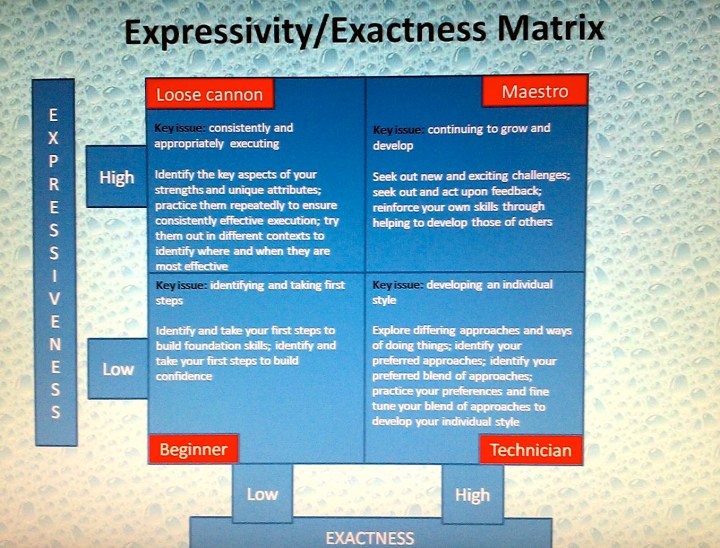
These two dimensions of exactness and expressiveness can be combined to create the above matrix, which can be used to inform and support the development of our skills and the personal style we use to deliver them.
The matrix consists of four quadrants:
The beginner quadrant is where we are at the beginning of our journey towards mastery of our skills and acquisition of our personal style. We are low in exactness and expressiveness. We do not have the skills, knowledge and experience we need and therefore lack the confidence to express ourselves and develop our personal style. Key to moving out of this quadrant is successfully identifying and taking those first few crucial steps that will help us begin to develop the skills and gain the knowledge, experience and confidence we need.
The loose cannon quadrant is where we are if expressing ourselves within our chosen field comes easily but reliable and consistent execution of its technicalities does not. We are high in expressiveness and low in exactness. We possess a personal style that needs to be polished; others commonly perceive us as possessing a ‘natural but raw talent’. We are capable of flashes of insight and brilliance but they are unpredictable and unreliable. We do not know how we succeed at things and so we find it hard to replicate those successes as and when needed. Key to moving out of this quadrant is to identify and focus on our key strengths and attributes, find out precisely why and how they work and then practise these aspects until we can call upon them at will, so ensuring consistent and effective execution. We also need to try out these aspects and approaches in different contexts to identify when they are most and least appropriate and/or effective.
The technician quadrant is where we are if we can execute our skills and apply our knowledge within our chosen field accurately, consistently and effectively, but whilst doing so we find it difficult to express ourselves individually, imaginatively and creatively. We are high in exactness and low in expressiveness. We need to identify and develop a personal style. We may be perceived as reliable and a ‘safe pair of hands’ but not a ‘star performer’ capable of delivering brilliant and unique ideas and performance. Key to moving out of this quadrant is moving away from our comfort zones and the usual or generally accepted ways of doing things. We need to explore differing approaches and ways of doing things and identify those that intrigue us, appeal to us and perhaps even positively challenge us the most. We then, through experiment and practice, need to fine tune and blend them to create our unique style, our unique way of going about our chosen work.
The maestro quadrant is where we are if we can execute our skills and apply our knowledge consistently and effectively and in doing so express ourselves individually, imaginatively and creatively. We are high in exactness and high in expressiveness. We possess a mature and evolving personal style. We are likely to be perceived as someone who can suggest different and insightful ways of looking at things and effectively implement innovative ways of doing things. We are the people organisations and businesses rely on to create their competitive edge and help them become acknowledged leaders in their fields. Key to staying in this quadrant is battling complacency. We need to continue growing and developing our skills, knowledge and experience. We need to seek out new and exciting challenges. We need to make a habit of seeking and acting upon feedback. Lastly, and arguably most importantly, we need to reinforce our own skills through helping to develop those of others.
 Journey
 The curious, often sensual and hypnotic soundworld of Alexander Scriabin is viewed through the lens of a three-piece jazz ensemble in the David Gordon Trio’s new album Alexander Scriabin’s Ragtime Band. Released at the close of the year marking the centenary of Russian composer Alexander Scriabin’s death, the album is a witty and imaginative take on Scriabin’s music, part reinterpretation, part hommage to the many elements and influences which make up this composer’s unusual oeuvre.




 The Cross-Eyed Pianist