NEWS RELEASE

Featuring a New Elegant Design, Wooden Keys, and Three Historic Grand Piano Sounds

Tokyo, April 7, 2016 — Casio Computer Co., Ltd., announced today that it will release the GP-400BK, a new elegantly designed digital piano model in its CELVIANO Grand Hybrid lineup. CELVIANO Grand Hybrid pianos combine the advantages of both digital and acoustic pianos while delivering the performance of a grand piano in tone, keyboard quality and playing comfort.

Casio previously released two pianos in this lineup in 2015—the GP-500BP and GP-300BK. Both were equipped with its AiR* Grand Sound Source, which reproduces the same beautiful sound and rich reverberation as a grand piano, and keys made from spruce, a wood used in grand piano keyboards. These models also featured piano tones jointly developed with the piano maker C. Bechstein. The natural Grand Hammer Action Keyboard has an action mechanism that faithfully simulates piano hammer movements, which have a significant impact on the playing response of a grand piano. These innovative hybrid pianos moved beyond the realm of the conventional digital piano, and gained a strong reputation among people who appreciate the nuanced sound and feel of a grand piano.

* Acoustic & Intelligent Resonator

The new GP-400BK comes with the three historically popular grand piano sounds featured in the GP-500BP and GP-300BK, as well as the same reliable key response and supple playing comfort. New with the GP-400BK is the design, which boasts a curved rear panel and thicker side panels and legs to capture the bold and refined image one expects of a high-quality piano. The height from the keyboard to the music stand has also been made the same as a conventional grand piano, for an experience even more like that of playing a grand piano. In addition, Casio used a black wood grain finish for the entire piano to give it a dignified look. All of these design features come together in this latest elegant model in the CELVIANO Grand Hybrid lineup. 

Thoroughly refined sound and reverberation reminiscent of a grand piano

■​The AiR Grand Sound Source reproduces the same beautiful sound and rich reverberation as a grand piano.

Multi-dimensional Morphing smoothly transforms sound waves, and realizes tonal changes based on both time passage and intensity. Even during a gradual crescendo from pianissimo to fortissimo, the technology allows even and natural tonal changes. 

Moreover, the String Resonance System, designed to deliver the string resonance of a grand piano, controls the amount and combination of resonance according to the playing situation. By producing reverberation that fits each of the 88 keys, the technology enables natural and comfortable performance.

By combining these two technologies, the new model offers the sounds of three grand piano styles. The Berlin Grand is known for its elegant clear sound and reverberation that gives each performance rich melodic color, while the Hamburg Grand delivers gorgeous power and strength with a lot of string resonance. The Vienna Grand provides calm bass with a solid feeling along with soft and beautiful sound.

■​Natural Grand Hammer Action Keyboard enables even more delicate expression

The GP-400BK features keys made from high-quality spruce, which is also used in grand piano keyboards. The keys are also finished in the same way as on a grand piano. Since this makes them more familiar to the pianist, fingers are less likely to slip or fatigue. The new model also boasts a new unique action mechanism that delivers the right hammer movement, which has a big impact on the playing response of a grand piano. The mechanism conveys delicate finger nuances more accurately, and enables dynamic touch to translate directly into expressive power.

■​Grand Acoustic System generates a space of three-dimensional sound

Casio has developed a Grand Acoustic System that faithfully represents the sound of a grand piano as it emanates from above and below the soundboard. Through careful positioning of six speakers and the creation of sound pathways, the system delivers three-dimensional sound with tonal elongation, expansion and depth.

Special playing experiences made possible by a digital piano

■​Scene feature enables pieces to be played with the optimal sound

The Scene feature consists of 15 preset types for different composers such as Chopin and Liszt, as well as musical genres such as jazz and easy listening. The presets combine the best optimal tones, reverberation, and effects for the type of piece being played. Users can also create and save their own presets.

■​Concert Play offers an experience like playing with an orchestra

The spectacular sound of a live orchestra is recorded in a high-quality digital format. By playing the piano together with the recorded orchestra, users can enjoy the feeling of performing at an orchestral concert. The technology can also be used in practice, as it allows the tempo to be slowed, and also features rewind, fast forward, and repeat playback of A-B sections. 

■​Hall Simulator provides the experience of performing in a special venue such as a concert hall

The Hall Simulator allows the pianist to enjoy the immersive sound found in different types of venues such as an Amsterdam church, or a classical concert hall in Berlin. Also, the GP-400BK enables users to switch between the Player’s Position, which provides a sense of playing a real grand piano, and three types of Listener’s Positions, which gives the pianist the effect of listening to the performance from the audience.

Source: press release
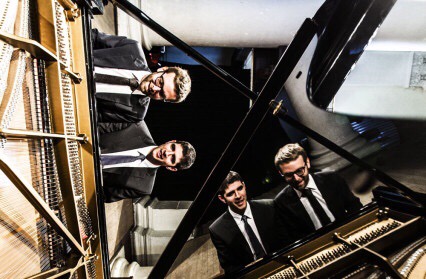
 

The Françoise-Green Duo at St John’s Smith Square, Thursday 31st March 2016


The five-concert residency at St John’s Smith Square by the Françoise-Green piano duo is exploring the music of Vienna’s musical landscape through its salon culture, from Mozart and Schubert to Schoenberg and the Second Viennese School. Vienna’s unique system of private and public patronage allowed composers such as Mozart to present their music to a select audience via the salon. For Schubert, who did not have the kind of patronage and support Mozart enjoyed, nor publishers eagerly clamouring for his music, performances within the privacy of his own circle of friends was the only way his audacious music found a truly receptive audience. This salon culture became even more pronounced at the turn of the twentieth century, when Schoenberg and his cohort broke away from the Vienna Tonkunstlerverein and built their own community for the performance of their music outside of the mainstream where much of their music was premiered through private performance societies. The Françoise-Green Duo pay a special hommage to this by performing new works which they have commissioned especially for their residency.

Music for piano duo is often, and mistakenly, regarded as “light” – music to be enjoyed at home amongst friends, and the enduring popularity of music for piano duo is testament to its appeal, variety and inventiveness. Both Mozart and Schubert wrote fine works for piano 4-hands, including the latter’s Fantasie in f minor, D940, arguably the most profound work ever written for this genre.

This particular concert, the third in the series, revealed the contrasting characters of Vienna, from the elegance and wit of Mozart through Schubert’s bittersweet Allegro in A minor ‘Lebenssturme’, D947, to the decadence and eroticism of fin de siecle Vienna of Alban Berg, reimagined by British composer Kenneth Hesketh in his Die letzten Augenblicken der Lulu, and the world premiere of ‘Fable’, a new work by Colin Alexander which was dedicated to the duo.

The Françoise-Green Duo are notable for their confident and convincing handling of contemporary repertoire – one has the sense of two musicians who actively relish the challenges, both technical and artistic, that this music presents – yet their opening piece, the Sonata in F K497, written at the end of Mozart’s life, proved them at home in more traditionally “classical” repertoire. In this sonata, the two pianists are equal players, sparking off one another, and creating witty dialogues interspersed with rich orchestral textures. In the softer dynamic range, the pianists brought a tenderness which immediately shrank the large space of St John’s Smith Square to an intimate salon.

Kenneth Hesketh’s work is both a redaction of Berg’s ‘Lulu Suite’ focusing on the main material in the suite, but also providing a flashback of Lulu’s life in the immediate moments before her death. Soprano Sarah Gabriel’s performance in this work was dramatic and vulnerable, and the combination of spoken word and vocal line, culminating in a full-throated scream signifying Lulu’s death at the hand of Jack the Ripper, was searing. The piano part created an unsettling undercurrent, increasing in urgency towards the tragic denouement.
After the interval came the world premiere of Colin Alexander’s ‘Fable’, a work which fully utilised the fine acoustic of St John’s Smith Square, the resonance of the Steinway D, and the duo’s technical assuredness. At times, the sounds emanating from the piano recalled bells, bassoons, horns and chanting, which built in intensity to create a hypnotic whole. It put me in mind of Somei Satoh’s mesmeric Incarnation II, which uses the resonance of the piano to similar effect.
It’s all too easy to ascribe a certain mindset or state of health to Schubert’s music: his illness, syphilis, and its disturbing and debilitating treatment and side effects are well-documented. Whatever the composer’s mental state in the final year of his life, there is no doubt that this was a period of fervent, boundary-breaking creativity. The ‘Lebenssturme’ (Life’s Storm – a title assigned by the publisher after Schubert’s death) opens with a dramatic motif of forte (check) chords which gives way to an ethereal second subject, which Antoine Françoise seemed to float across the upper register of the piano. It’s a substantial work whose structure hints that Schubert might have had something longer in mind and which demonstrates fully the breadth and daring of his creativity in the year of his life. 

For an encore, the duo played the opening movement of Mozart’s Sonata in C major, K19d (dropped from the original programme better to accommodate the new works) Written when the composer was still a boy, yet already bright with promise, witty, colourful, and elegantly turned by Robin Green and Antoine Françoise.

‘The Viennese Salon’ continues at St John’s Smith Square on 7 April with a rare opportunity to hear Mahler’s Symphony No. 6 arranged for piano four-hands by Alexander von Zemlinsky together with works by Mozart and the world premiere of a new piece by Alissa Firsova. Further information here

Recommended.

What advice would you give to your younger self as you took your first steps as a music college graduate?

Guest post by Kate Blackstone

This is the question I’m posing to music college graduates over the next six months, but when I began my PhD at the University of Leeds last October, all I knew was that I had three years ahead of me to explore the ways in which conservatoire graduates build their careers as young professional musicians. That’s the short explanation anyway, but it’s the way I tend to introduce my subject before unpacking what is a very complex situation.

Talk of musicians inevitably turns to the term ‘portfolio career,’ when describing the myriad activities of a musician’s day-to-day working life. The ‘portfolio’ of work that a musician may expect to undertake can include playing, teaching, arts admin, arts research, arts medicine… the list goes on. Even pulling apart the ‘playing’ bracket, many musicians play multiple instruments; not only on stage as soloists and ensemble members, but also undertake session work, accompanying exams and dance classes, and even recording YouTube videos. More than ever, today’s musicians are their own agents and promoters, displaying entrepreneurial tendencies as they run their own music businesses to make a fulfilling living. (For more about this, you certainly should read Frances Wilson’s article examining entrepreneurship and musicians’ careers, where she sums this up beautifully.)

As with many psychologists undertaking research in a field very close to their own lives, I found myself examining my own experiences as a music college graduate in order to explore the career building process. How much did the nature of the degree I was awarded affect my career choices after graduation? And how did I cope with this transitional point in my life: the part where I’d finally have to ‘go it alone?’ And how did my own experiences compare to those of my peers at the RNCM, and contemporaries at other music colleges in the UK and abroad?

I am a musician. When I’m not reading, writing, and wrestling with computers for my research degree, I’m playing the piano for students’ exams and recordings, teaching woodwind, coaching ensembles and arranging Justin Bieber songs for the flute. Oh, and playing the clarinet: the instrument in which I was awarded my music college degree back in 2011.

​My first year out of college wasn’t too easy: at least that wasn’t the way I saw it at the time. I had two days’ worth of teaching – mainly piano – at my old secondary school, a position I’d held as a peri teacher since 2008. I had four or five hours of private teaching – still mainly piano – back home near my parents’ place. I’d managed to land myself a day a week working for an old teacher at a music service fifty miles in the other direction…without a driving licence, let alone a car. On Wednesdays and Thursdays, I didn’t teach, and that was time where I would practise the clarinet. However, ‘clarinet practice’ was a term I used to describe the time when, in actual fact, I was sitting with my housemate (an oboist in a similar position to me), poking at some reeds, watching Big Bang Theory, bemoaning the lack of performance opportunities available to us and boiling the kettle for ‘one more brew.’

In numerous surveys of music graduates in Australia, Dawn Bennett (whose work continues to be the one of the best sources of statistics like these, albeit not from the UK) found that 97% of respondents hoped for a ‘portfolio’ career like the ones mentioned above, yet still based their views of musical success on a very narrow career aim. She describes this aim as ‘musotopia:’ “a place where performance ambitions are realised with an international career”, implying that anyone not earning money in this way, and this way alone, must be an unsuccessful musician.

Perhaps Dawn Bennett’s findings could explain a contributing factor to the situation I experienced in my first year out of college. On paper, I was by no means struggling. OK, I would never recommend music service work without a car, but I enjoyed the job, found it challenging, and it paid well. What’s more, I met one of my best friends through lift sharing, with whom I dreamt up my wackiest teaching ideas in the car! Building up a good reputation as a teacher meant I was beginning to turn down work, something that many of my contemporaries would not begin to experience until years later.

Why then, did I somehow feel like such a failure? My ‘musotopia’ wasn’t what was described above. I didn’t want to be an international soloist, and besides, I was never that type of player….and, admittedly, I didn’t fancy the practice regime that went with it. When people asked me what I was up to, I’d reply with a vague sort of ‘just teaching.’ Why now do I no longer feel like a failure? Not much has changed about my career since that first year, except myself and a few others did make a pact to retire the word ‘just’ – why diminish the good job that you do by devaluing it every time you mention it? Perhaps I play the piano a little more, for students’ exams. I certainly play the clarinet more, but most frequently amongst friends and ‘for myself,’ in addition to the odd paid gig. How and why did my vision of ‘musotopia’ change, and where did it come from in the first place?

In psychology, we use the word ‘transition’ to describe any period of major change in someone’s life. These transitions include marriage, starting a new job, moving home and, you guessed it, graduating from a degree. Although all these situations can present different challenges, all of them involve changes in roles, relationships and routines. Ultimately, these changes can lead to a renegotiation of identity. Does that mean that I experienced an identity crisis? Maybe, but does this happen to everyone, or was it just me? Above, I’ve shared some of my story, but the aim for my research is to find out what other people’s journeys into the music world were like.

I do have some predictions of what I might find in the first phase of my research, but I don’t want put words into anyone’s mouths, which is why I’m leaving my story hanging in mid-air above. Instead, I’d like my participants to tell their own stories, about what they wish they’d known when they had left music college: about themselves, the music business, about life in general. You might be wondering why this type of research is important, and what good it will do after publication. Current research suggests that graduation from a degree is a time fraught with uncertainty, not least for those in the creative industries, where career paths are less clear cut. A more thorough understanding of graduates’ journeys into the professional world could influence future curriculum design of music college degrees, as well as more generally aiding students themselves to achieve fulfilling careers upon graduation.

Whether or not you’d like to write for this project, please visit the website set up for contributions. Music college graduates are invited to write a letter to their younger self, and put in it the advice that they would have liked to have received when finishing their degree. The letters are being published anonymously online, and already the spread of responses that I’ve had has been very varied, ranging from pep talks (“you are awesome!”) to harsh truths (“you are thinking far too much about boys”). It is unusual to conduct what is a legitimate research project publicly through social media, but there seems to be a clear need for more discourse around the trials and tribulations of building a career as an ‘ordinary’ jobbing musician. Research into young people’s engagement with career advice suggests that stories from those at the very top of their game may not be what graduates and students need in the first instance, but rather, real down-to-earth honesty from more relatable peers and colleagues: ‘idols within touching distance.’ The data collected here will eventually contribute to my thesis, but by making it publicly accessible in the meantime I hope it will offer thought-provoking and informative reading for musicians and non-musicians alike.

If you’d like to read the letters already online, or contribute to the project, please visit http://letterstomyyoungmusicianself.tumblr.com. There is currently no deadline for submissions, and no letter is too long nor too short! Your anonymity will be protected. You may wish to follow the project on Twitter by visiting @2myyoungerself. If you have any questions or comments about the project, please tweet me using the handle above, or email me on letters2myyoungerself(at)gmail.com.

Kate Blackstone graduated from the University of Manchester in 2010, and the Royal Northern College of Music in 2011, from the demanding Joint Course. Since then she has forged a successful freelance career as a musician, combining a busy teaching schedule with frequent performances on both piano and clarinet, her principal instrument. From 2013 Kate undertook part-time study of an MMus degree in Applied Music Psychology at the University of Leeds, which she passed with distinction in 2015. She was delighted to return to Leeds as a full time PhD candidate in September, supported by the Stanley Burton Research Scholarship.

by Dr Michael Low

A second article on this giant of piano music 

According to all reliable accounts, Liszt was the first true celebrity pianist in the history of Western art music. He was the embodiment of the Romantic Era: the sublime and the ridiculous, the diabolical and the virtuous, the transcendental and the mediocre, and no other composer in the 19th century had as diverse a compositional output. Liszt’s physical beauty, musical gift and striking stage persona combined for an intoxicating cocktail of the visionary, genius, sex, lust, snobbery, vanity, religion and literature. In short, he was Faust, Mephisto, Casanova, Byron, Mazeppa and St Francis all in one. Had cyberspace and social media existed in the 19th century, the tagline for Liszt would probably have been #Sex #Drugs #Classical Music #FranzLiszt.

Liszt was the first musician to have the piano placed in profile, so that the audience would be able to see his facial expression. He was also the first pianist to perform from memory, flouting the traditional view that to perform without music is a sign of disrespect to the composer. As a composer, Liszt’s output consists of over one thousand works. And until today only the Australian pianist Leslie Howard has recorded all of Liszt’s piano works (for Hyperion). Liszt’s one-movement symphonic poems, as well as the late piano pieces, were seen by many as works which were to have significant influence on the next generation of composers. Some argued that Liszt’s experimental use of harmonies (in particular in the late works) was prophetic in its foreshadowing of atonality, paving the way for the works of Scriabin, Debussy and Schoenberg in the early part of the 20th century.

LisztLiszt’s life and music have been the subject of numerous film adaptations. On one hand, Charles Vidor’s Song Without End (1960) won an Academy Award for Best Musical Score, as well as a Golden Globe for Best Motion Picture. On the other hand, Ken Russell’s Lisztomania (1975), based on the novel Nélida, written by Liszt’s first important mistress, the Countess Marie d’Agoult, was notorious for its re-imagining of Wagner as a vampire (yes you read that correctly…) and its use of giant phalluses, reminiscent of Japan’s Shinto Kanamara Matsuri. One of the 20th century’s greatest pianist, Sviatoslav Richter, played the role of Franz Liszt in the 1952 Russian film entitled The Composer Glinka, while Liszt’s Second Hungarian Rhapsody in C Sharp Minor was immortalised by the evergreen animated duo of Tom and Jerry.



Recommended listening (all of which can be found on YouTube)

Années de Pèlerinage (Books 1 and 2): Lazar Berman

Vallée d’Obermann (from the 1st Book of Années de Pèlerinage): Claudio Arrau

Les jeux d’eaux à la Villa d’Este (from the 3rd Book of Années de Pèlerinage): Claudio Arrau

Bénédiction de Dieu dans la solitude (from Harmonies poétiques et religieuses): Claudio Arrau

Two Legends: St François d’Assise: La prédication aux oiseaux and St François de Paule marchant sur les flots: Alfred Brendel

Mephisto Waltz No. 1: Evgeny Kissin

Hungarian Rhapsody No. 2 in C Sharp Minor: Benno Moiseiwitsch

Hungarian Rhapsody No. 6 in D Flat Major: Martha Argerich

Liebestraume No. 3 in A flat Major: Frederic Lamond

Études de concert No. 2 in F Minor (La leggierezza): Martha Argerich

Études de concert No.3 in D Flat Major (Un sospiro): Frederic Lamond

6 Grandes Études de Paganini: Andre Watts (Live Recording from Japan 1988)

12 Études d’exécution trancendente: Lazar Berman (Live Recording from Milan 1976)

12 Études d’exécution trancendente: Boris Berezovsky (Live Recording from Roque d’Antheron 2002)

Études d’exécution trancendente No. 5 in B Flat Major (Feux Follet): Vladimir Ashkenazy

Ballade No.2 in B Minor: Vladimir Horowitz (Live Recording from The Met 1981)

Piano Sonata in B minor: Mikhail Pletnev

Piano Concerto No. 1 in E Flat Major: Martha Argerich

Piano Concerto No. 2 in A Major: Sviatoslav Richter

Piano Transcription of Beethoven’s An die Ferne Geliebte: Louis Lortie

Piano Transcription of Wagner’s Tannhäuser Overture: Jorge Bolet

Piano Transcription of Isolde’s Liebestod (from Wagner’s Tristan und Isolde): Michael Low


As a teenager, Michael Low studied piano under the guidance of Richard Frostick before enrolling in London’s prestigious Centre for Young Musicians, where he studied composition with the English composer Julian Grant, and piano with the internationally acclaimed pedagogue Graham Fitch. During his studies at Surrey University in England, Michael made his debut playing Tchaikovsky’s First Piano Concerto in the 1999 Guildford International Music Festival, before graduating with Honours under the tutelage of Clive Williamson. In 2000, Michael obtained his Masters in Music (also from Surrey University), specialising in music criticism, studio production and solo performance under Nils Franke. An international scholarship brought Michael to the University of Cape Town, where he resumed his studies with Graham Fitch. During this time, Michael was invited to perform Tchaikovsky’s First Piano Concerto for The Penang Governer’s Birthday Celebration Gala Concert. In 2009, Michael obtained his Doctorate in Music from the University of Cape Town under the supervision of Hendrik Hofmeyr. His thesis set out to explore the Influence of Romanticism on the Evolution of Liszt’s Transcendental Etudes. Michael has also worked with numerous eminent teachers and pianists, including Nina Svetlanova, Niel Immelman, Frank Heneghan, James Gibb, Phillip Fowke, Renna Kellaway, Carolina Oltsmann, Florian Uhlig, Gordon Fergus Thompson, Francois du Toit and Helena van Heerden.

Michael currently holds teaching positions in two of Cape Town’s exclusive education centres: Western Province Preparatory School and Herschel School for Girls. He is very much sought after as a passionate educator of young children.