2751c7d40-04b5-aae9-56825b8f0700ef0fWho or what inspired you to take up composing, and pursue a career in music? 

It was a slow process, with music growing into such a presence in my life that midway through college I realized it had taken over, so I switched from pre-med and never looked back.

Who or what were the most significant influences on your musical life and career as a composer? 

That has changed many times: As a teenager I tried to play piano like Erroll Garner, then more like Keith Jarrett. In college I fell in love with the music of Edgar Varese and Stefan Wolpe, but listened about as much to Bonnie Raitt and the Band. In more recent years my work in opera led me to Verdi and my work in ballet to Prokofiev. Next week I might mention different names, but just now these are the influences that spring to mind.

What have been the greatest challenges/frustrations of your career so far?  

My challenges are the same as those of most composers: almost all orchestras and opera houses pay lip service to the importance of new music but in practice consider it a risk to their box office. So our work as composers is marginalized, perhaps set apart as a prestige item; classical music as a whole is correspondingly impoverished. Wonderful music is being created and performed all over the world, but you wouldn’t know it from Lincoln Center or similar places.

What are the special challenges/pleasures of working on a commissioned piece? 

I find it most inspiring to be given very specific guidelines, such as “an oboe quartet of about 15 minutes, to be paired with the Mozart for the same ensemble.” Or “5 minutes of fight music that becomes a love duet, for changing numbers of dancers.” These are both challenges and pleasures.

What are the special challenges/pleasures of working with particular musicians, singers, ensembles and orchestras? 

For most of us this is the usual situation, and it’s a healthy one, because as a composer I don’t write for the audience – I write for the performer, who in turn shares the music with the audience. Performers can do that best if I can write effectively for them – show off what they do best, while giving them something a little unlike the rest of what they perform. I love tailoring the music in that way; it also offsets the essentially solitary nature of composing.

Of which works are you most proud?

My four operas, because I think the way I combine the various elements that make up opera (text setting, stage timing, vocal deployment, use of the orchestra) is not like anyone else’s, and works better than most. Each of my operas is full of the most radical music I could think of, and at the same time each one reaches out passionately to the largest possible audience of non-specialist listeners. I try to combine those goals with anything I write, but opera feels particularly congenial.

How would you characterise your compositional language? 

I’m a “notes and rhythms” kind of composer. There is lots of life left in traditional musical devices, in fact more life than there is in straining for extremes or following musical fashions of any kind. I enjoy inventing unusual melodic lines, finding surprising moments for traditional chords, and combining fairly simple rhythms in unexpected ways.

How do you work? 

It depends on the piece. If I have a text, that helps me to organize the music. A dance or film scenario gives me another kind of structure. A portrait done from life is a combination of meditation and improvisation. A tribute usually starts with some sort of core of pre-existing music around which I spin other notes and rhythms.

Who are your favourite musicians/composers? 

I return over and over to the music of a few composers of roughly my own generation. In no particular order: Judith Weir, Stephen Hartke, Lee Hyla, Arthur Levering, Poul Ruders, George Benjamin, Chen Yi, Scott Lindroth. I’ve also played and conducted music by most of these composers, and highly recommend any of them to listeners looking for a fresh musical experience.

What is your most memorable concert experience? 

Here are a few: Messiaen’s Turangalila Symphony when I first heard it live; Sibelius 6th symphony live; The Band in concert; the opportunity to conduct Ramifications by Ligeti and Corpus Cum Figuris by Poul Ruders.

What do you consider to be the most important ideas and concepts to impart to aspiring musicians? 

Composers should write what they actually want to hear; performers should play and sing what passionately inspires them; audiences should demand excitement, not settle for what the PR agents are peddling that month.

Where would you like to be in 10 years’ time? 

Writing more music, probably in New York.

What is your idea of perfect happiness?  

Coffee and composing in the morning, friends and a good meal in the evening.

What is your most treasured possession?  

Nothing physical – I treasure my family and friends.

What do you enjoy doing most? 

Besides composing? Playing tennis, I guess, if I could only find the time to do it more.

What is your present state of mind? 

Opening out to new possibilities.


Scott Wheeler’s new album ‘Portraits & Tributes’ (works for piano 1977-2014), performed by Donald Berman, is available now. Further information here
scottwheeler.org

Growing within our schools today is a disturbing trend; increasingly, music is viewed as an optional subject – something equivalent to a passion that merely runs parallel to ‘academic’ subjects – that leads to contempt for classical music borne out of an ignorance of all it contains.

This thoughtful and well-argued article appeared on the Gramophone website, an “insider’s” view of the way music is taught in UK state schools.

 Read the entire text here 

elite
noun
noun: elite; plural noun: elite
a select group that is superior in terms of ability or qualities to the rest of a group or society

The word “elite” has been frequently heard during the fortnight of the 2016 Olympic Games in Rio. Athletes and sportspeople at the top of their game are regularly described as “elite”, and afforded an elevated status. And rightly so: these people are at the peak of their fitness, they’ve trained long, hard and meticulously to prepare for the games, and the medals and approbation are the visible badges of their great achievements. They are truly “elite”. We have no problem in applying this word to our sporting champions and when we use it it is replete with respect, admiration and awe.

It’s a rather different scenario when the word is used in relation to classical music. In this case it suggests exclusivity, inaccessibility, snobbery, and describes an art form which is regarded as the preserve of the few not the many whose practitioners are aloof, stuffy and out of touch.

You wouldn’t say that about Jessica Ennis, Mo Farah or Bradley Wiggins would you?

But of course classical musicians are elite. Look at how they train, the meticulous way they approach preparation, fitness, mental attitude. The mindset and physical preparation of the musician is very similar to that of the athlete, and many comparisons can – and should – be drawn between sporting elite and musicians.

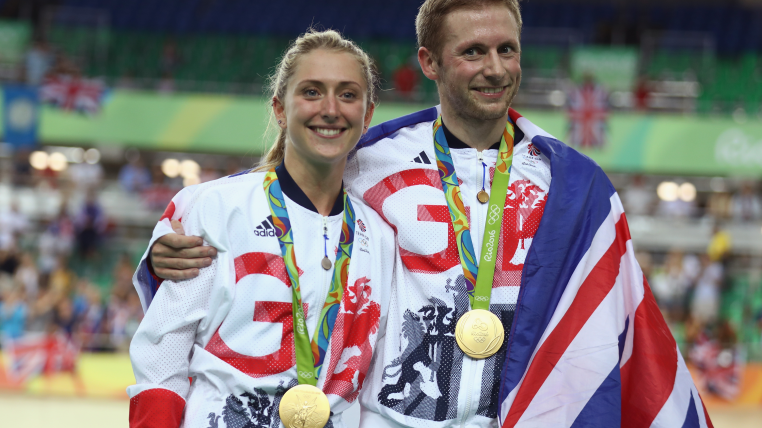
Multiple gold medal-winning British track cyclists Laura Trott & Jason Kenny (source: BritishCycling.org.uk)

These days many musicians look to sport and more specifically sports psychology to inform their musical training and preparation (cf The Inner Game of Music which came from “inner game” sports training which has been used successfully by top tennis players). Musicians, like sportspeople, require discipline, dedication and commitment to put in the many long hours of training to do what they do and do it well, and many make huge sacrifices to achieve this. And just like elite athletes, musicians undergo a very rigorous training which includes much repetitive physical activity (practising) and psychological conditioning. We admire our elite athletes for their physical prowess, their stamina, their grace and strength – and we praise them for their dedicated, meticulous training. And we should admire the same attributes in our musicians.

Musicians, unlike sportspeople, last longer: those who’ve been elevated to the dizzy heights of “elite” (aka “world class”, “internationally renowned”, “legendary” etc) can continue a career well into their 80s (Paul Badura Skoda, for example).  A few know when it’s time to step back to let the younger players through (notably, Alfred Brendel). Others cling on determinedly, even if their playing does not match their revered status.

Sportspeople, meanwhile, are judged more objectively by their results and they usually know when it’s the right time to quit. They retain their special status and enter the hall of fame for others to aspire to and emulate. The greatest sportspeople go out at the top of their career (Bradley Wiggins, for example, who eschewed the big salary to concentrate what he enjoys and does well – track cycling; also Sir Chris Hoy, Boris Becker and Victoria Pendleton). These people know that they have reached a point in their professional career where there is nothing left to add and that now is the time to stand down. This is partly because of the physical demands on the body, motivation, the punishing lifestyle, and the recognition that better, younger people are coming through. Many turn their attention to coaching, sharing their wisdom and experience to support and inspire the next generation of elites.

An elite pianist - Daniil Trifonov (source: Intermusica)
An elite musician – pianist Daniil Trifonov (source: Intermusica)
We want our musicians to be elite: by adopting a mindset and training regime akin to that of the elite athlete, musicians are able to produce performances which are consistently impressive, technically assured, absorbing, moving, exhilarating, inspiring…… These are the traits we admire in our elite musicians and for this reason we should celebrate their superhuman talents, in just the same way that we lionise our medal-winning athletes.


Stephen Hough’s recent comments about changing the length and format of classical music concerts by ditching the interval and perhaps starting concerts earlier or later in the evening has generated a lively discussion. And rightly so, because those of us who care about classical music should be concerned about keeping this wonderfully and incredibly varied art form alive and kicking. In his article for the Radio Times, Hough expresses his concerns about attracting a younger audience to classical music and notes that there is no one simple solution to attract more people to concerts.

It strikes me that whenever young people are mentioned in the context of classical music, a whole host of commentators immediately respond by saying that “it’s all about education“. They cite the woeful provision for music education in our state primary and secondary schools (true), the fact that music lessons are often the preserve of the better off (also generally true, sadly) and that our children need to be educated to understand and appreciate classical music.

As I’ve mentioned several times before on this site, I was fortunate in that I had a very good musical education as a child, initiated first by my parents, who were keen concert-goers and music lovers, and subsequently through excellent music provision and teachers at both primary and secondary school (both state schools). My enjoyment and interest in classical music was inculcated at a young age and has stayed with me: I have not, as one friend suggested, grown to love classical music as I’ve got older, only that my tastes change as I explore more repertoire. I was very very lucky – privileged, in fact – in my musical education.

The debate about music provision in our state schools is ongoing and no one seems to have the solution. Various musical celebrities such as Nicola Benedetti and James Rhodes have initiated projects to try and right this terrible wrong, and I applaud anyone who cares enough to encourage our children to enjoy classical music, in and out of school. And Stephen Hough’s ideas should not be dismissed out of hand, just because they might run counter to established ways of doing things in classical music.

But we need to be careful how we frame “educating young people to like/enjoy/appreciate classical music”. As a Twitter colleague of mine said in response to Stephen Hough’s article:

Too often, whenever people start saying “Education” is the important factor, it sounds coercive

We should not seek to “programme” people, whatever their age, to like classical music. Let us not forget that the word “teach” comes from the Old English tæcan which means to “show”, “present” or “point out”. As a music teacher, I agree with my colleague and fellow blogger Andrew Eales, who suggests in his post in response to Stephen Hough’s comments, “When it comes to generating enthusiasm for classical music (and any other genre for that matter) the responsibility truly lies with those who perform and teach it.”. Andrew then goes on to offer some simple and creative ways in which to engage young people with classical music and which do not involve sitting a bunch of 6 year olds in a classroom and force-feeding them Beethoven and Bach.

It’s very easy – and lazy – to blame the young for all the ills in our society, and debates such as music education are too often, in my experience, loaded with a sense of entitlement or superiority – that the role of educators is to produce people who think and do things our way, rather than exploring ways to engage young people. Maybe one of the first things we need to do is shift the vocabulary from “tell” to “show”, “present” or “point out”……

I don’t have all the answers either. But in my very small way as a private music teacher, and via this blog and my other musical activities, I hope I am making a contribution, albeit a tiny one…..

Further reading

No More Loo Breaks – Stephen Hough’s original article in the Radio Times magazine (PDF file)

Stephen Hough: no more loo breaks? – Article by Andrew Eales/Piano Dao

Nicola Benedetti: Every young person in Britain should be made to study classical music


