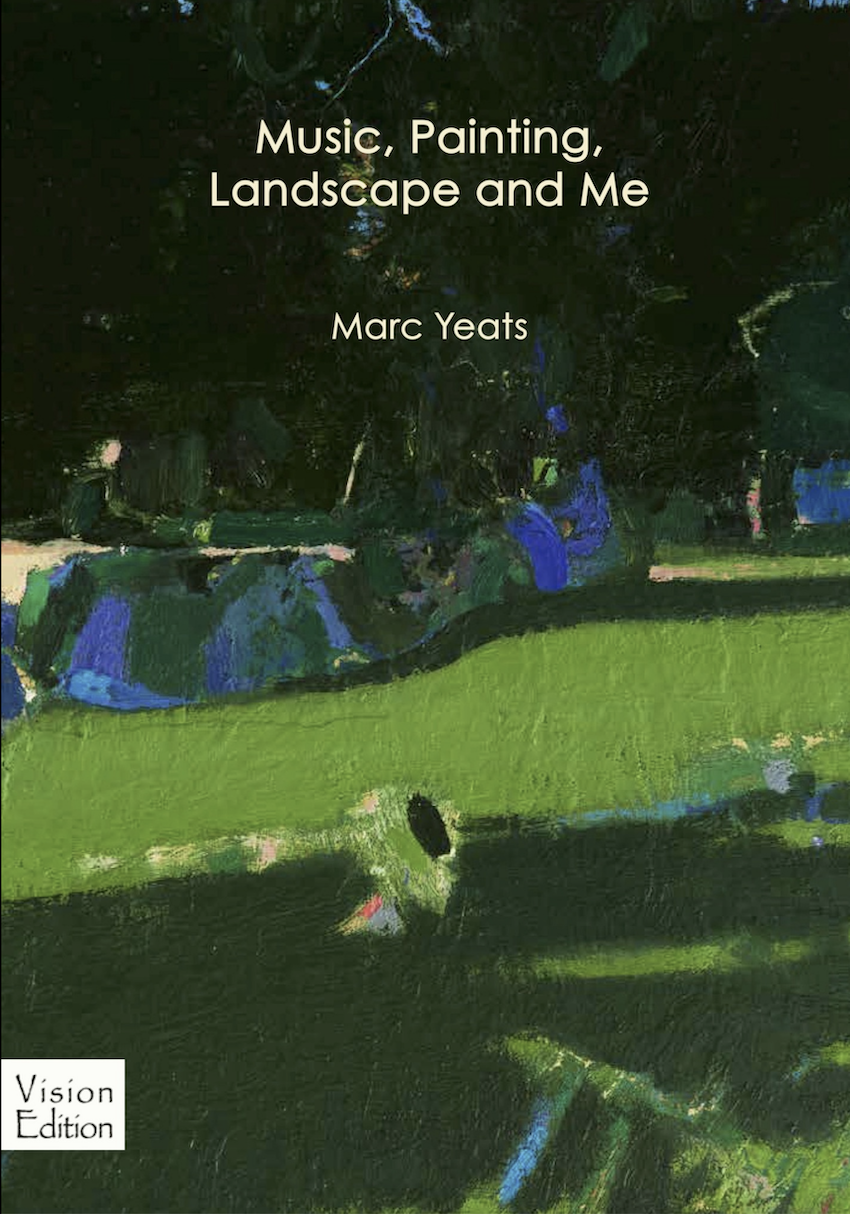
‘Music, Painting, Landscape, and Me’ by Marc Yeats
Publication date 1st April 2024
In this book, composer and landscape painter Marc Yeats embarks on an introspective journey, weaving together the symbolic realms of music and painting through the written word. This endeavour expands upon the immediacy of engagement with his compositions and paintings and what these artworks tell us, offering further understanding and dialogue concerning their interrelation. Yeats’s transformation of his inquiries and insights into text emerges from a conviction that the foundational questions—the ‘whys’ and ‘hows’ of being an artist and his creative exploration—resonate far beyond the confines of his personal experience, reaching out to a wider community of artists and those intrigued by the mechanisms of artistic expression.
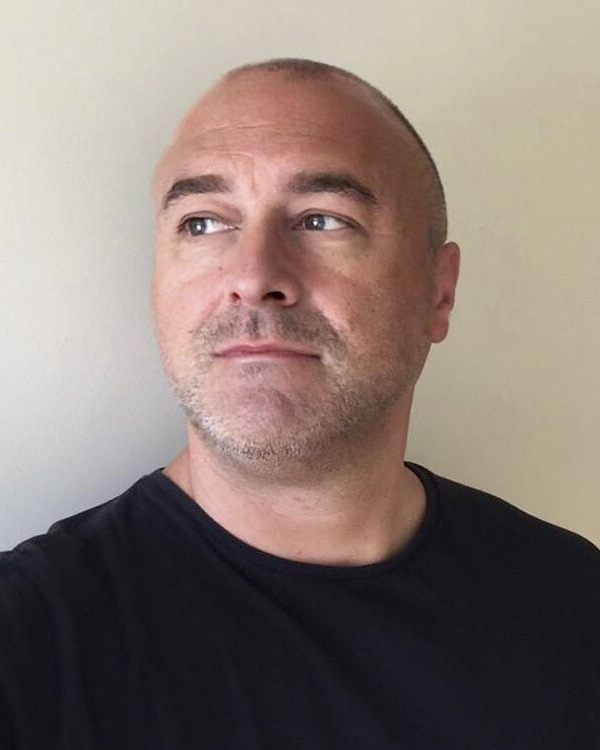
I have known Marc Yeats for some years now. We met ‘virtually’, initially, as is often the way these days, via Facebook and TwitterX, and then in real life when I moved to Dorset in 2018. We have become good friends and enjoy many stimulating conversations about creativity – and so much more! (I also own one of Marc’s wonderful landscape paintings.) For a flavour of our conversations, do watch this video
I was very flattered when Marc asked me to endorse his book
Music, Painting, Landscape and Me is a fascinating, detailed and honest journey into the endlessly curious, questioning and polymathic mind of landscape artist and composer Marc Yeats. Drawing on a diverse range of subjects – including quantum mechanics, metaphysics, philosophy, fuzzy logic, neuroscience and hermeneutics – this book offers the reader an extraordinary personal insight into the complex mechanisms of making art and music, and Yeats’ own intent, impulse, imagination and inspiration. Furthermore, it shines an important light on the ‘how and why’, not only of Yeats’ artistic practice, but that of creative individuals in general, and is an invaluable contribution to the understanding of the creative impulse and ‘what artists do all day’.
An interview with celebrated baritone Benjamin Appl ahead of his appearance at this year’s Leeds Lieder Festival
Who or what inspired you to pursue a career in music and who or what have been the most important influences on your musical life and career?
I started to sing when I was pretty young. Although no one in my family had trained as a professional musician, we sang a lot together while my mother accompanied us on the guitar. Aged ten I followed my two brothers and joined one of the most renowned boys choirs, called the Regensburger Domspatzen (which means the ‘cathedral sparrows of Regensburg’). Originally I wasn’t so fond of boys singing together – I disliked the sound and thought it sounded shrill – but after being part of this choir community and experiencing that amazing feeling of making music together on such a high level, I then really loved it. I think this was the moment when this addiction was first planted inside me, the feeling that life without music would not be the same.
Then, as a professional musician, of course it was my teacher and mentor Dietrich Fischer-Dieskau. To have had the privilege of working with him is one of the highlights of my career to date. He was a real mentor in many ways and taught me so much, not just vocal technique or interpretation but much more beyond this: he taught me the essence of being a musician, and the responsibilities with which that comes.
I was deeply impressed by his level of preparation, and the seriousness with which he achieved such a deep level of understanding of the music. Every time I went to his home he had prepared himself for our session, looking through the scores again, reading about the poetry and the background of the songs – doing all this even though he had already spent a lifetime on it. But this is also one of the most wonderful aspects of this profession: you never can be too well prepared.
What have been the greatest challenges of your career so far?
I think what’s important is to find a personal connection with the music and how to present it and how to communicate it to people. If you’re yourself and you try to find a good emotional connection and how to communicate it, then it can be fairly easy. Generally, though it’s quite a difficult job in that as a singer, you carry your instrument with you 24 hours a day! We can’t, like a pianist for example, leave the instrument at home for two hours in the evening and go to the pub. That’s also something else we have to live with regarding our instrument – we have to accept when it’s not working and to be kind to it. That does mean that it can be difficult not to become too self-centered and think only about ourselves. That is something very challenging and we have to find ways to cope with it.
Of which performances/recordings are you most proud?
Actually, it will be one of my forthcoming album releases, a project I have been involved with for quite some years now. Together with one of the greatest contemporary, living composers György Kurtág, I am recording some of his compositions as well as songs by Franz Schubert, where he, aged 97, plays the piano. The working process with him is incredibly detailed and challenging, but the rewards are at a level you normally never experience anywhere else.
Which particular composer do you think that you perform best?
I probably would say Franz Schubert. With him and his music I feel most at home, not only because I spent the most time with his music and learned around 400 of his songs by heart. There is something in his music which gets right into my heart – how he creates an environment, a beautifully carpeted pathway, for the poetry to speak directly to the listeners. There is no extraneous material or conceit; the musical textures ar. He is a composer who somehow stands with both feet on the ground. His music feels somehow deeply rooted inside me and I resonate with his sentiments in his music – and therefore I think I can transfer this connection the best also to the audience.
What do you do off stage that provides inspiration on stage?
Finding inspiration is a key element of our profession. We give so much on stage and every evening try to give what we can that we actually have make sure that we fulfil own our inner inspirations – to go to museums, to casually observe life passing by in the underground in how people move around and suddenly think “This is a character in this song.” I enjoy wonderful times with other inspiring people, listening to their stories, being curious, having every pore of your body open so as to find inspiration again a new way of interpreting songs. Also always questions about why we do it this way, why this tempo, why do we take time here, why is this word important for us etc so that we actually create and never just deliver.
How do you make your repertoire choices from season to season?
It really depends on the different kinds of inspiration I get from outside or from within myself. Often reflecting on processes lcan ead to a different direction which you didn’t plan on and then of course the choices also depend on the interesting offers which are given to you.
Do you have a favourite concert venue to perform in and why?
Of course there are certain parameters which are important in a venue. Mostly it’s about the acoustic, so that you as a singer have the feeling that the space is giving you something back, and enhancing the reverberation of your own voice. But just as important is an ambience which makes you feel welcomed and comfortable when you enter. A good piano for my accompanist doesn’t hurt either!
But what would even an ideal venue be without an open and attentive audience? Especially for song recitals which are in many ways presented as a dialogue: even though one party is usually silent, it is an exchange of emotions and very much a shared experience. So the ideal really is to have a wonderful audience who is willing to be taken by the hand to go on a journey together.
What is your most memorable concert experience?
There are a few. Of course someone now would expect me to name performances in the biggest, most prestigious halls around the globe. But for me very often these ‘stellar moments’ happen under different circumstances: music is a comfort for me in moments of solitude or sorrow, and exaggerates my happiness in joyful moments. Performances which stay with me forever are very often linked with big moments which happened in my private life at the same time, like the loss of my grandparents, when I had to go out on stage and sing songs about facing death or mourning the loss of beloved ones; but also when I fell so deeply and freshly in love.
As a musician, what is your definition of success?
Often I hear people say that art song is dead or that we cannot connect anymore to all those old texts and music. And I think exactly the opposite. All these songs are about emotions and feelings we carry very deeply in us, essentials like falling in love, being disappointed, loss of a beloved person or solitude – strong feelings we all can connect with and have experienced. I think within this art form there lie many opportunities and I am constantly searching for ways of combining it with other art forms or putting it in a current context. As a performer I experience very strongly that these songs make me understand myself and others better: My definition of success is when the same happens to my audience, that people connect with each other, go together on a journey and start a process of reflecting.
What advice would you give to young/aspiring musicians?
Find the right balance in life of the amount of performances, travel, working hours and try to have an interest or hobby outside music, which gives you the opportunity to put music aside for a moment and find pleasure and happiness somewhere else as well. It will only enrich your musicianship in the end.
What do you feel needs to be done to grow classical music’s audiences?
The field of Art Song is a bubble within the classical music world, which is a bubble in itself. So, I am very much aware that we will never have huge audiences or huge crowds and millions of people listening to us, but that is also fine to accept. I think that generally, elderly people who have more time in their lives, who don’t have to worry about small kids, or making a lot of money in their jobs, or having to learn a lot in schools etc have the luxury of time. And when you do some recitals, you have to focus fully on the music and the text. It’s not something which you can listen to on playlists or during to a fancy dinner. It really requires one’s full attention. And that’s challenging in the 21st century when everything’s very hectic and people have a short attention span. So that’s a reason why I think particularly people listening to song cycles are very often are in the second half of their lives.
I’m trying with my own programmes to go into schools and bring this Art Song to schoolchilren to try and make them curious about this music. It’s very important to plant the love I feel for this music into the hearts and ears of these young people so that at least they have the chance to encounter it at a young age and to see that other people are passionate about it.
What’s the one thing in the music industry we’re not talking about which you think we should be?
I think it’s wonderful that there are so many young people interested in studying singing or classical music. In colleges there are so many applications, like never before, so that’s something very positive. I find the lack of interest in politics and about people in the arts quite worrying. There are so many studies around the world which show the impact of music on human brains, on children such as how it makes them better human beings with better social skills, but also they learn other subjects faster, like languages etc. There is only good in it and I find it strange that no politicians really see the huge impact of music and how important it is. We have to plant music and art into the brains and hearts of young people. And even if they don’t like it in the beginning, I think it’s important that they have the chance to encounter it so that when they get older and listen to classical music they feel familiar with it. If they don’t get the chance from the very beginning it’s very hard later on to really understand this world which is so important in shaping for everyone. That’s something I feel very passionate about.
What’s next? Where would you like to be in 10 years?
There are so many ideas and interesting places to perform. I would love to perform song recitals for example like Schubert’s ‘Winter Journey’ in the Arctic. Pushing boundaries with other art forms, and strong collaborations. I have so many ideas in my mind that it’s sometimes overwhelming! I definitely have to write them all down, firstly not to forget them, but also to focus my mind on one idea. I have so many ideas all the time and would love to go in different directions, work with different people and never loose the joy and filfillment in performing. Just probing the horizon, being curious, not thinking in boxes but outside my box, and appreciating other people and their work and their love.
What is your idea of perfect happiness?
Despite the stress and demand of my life as a professional singer I always try to remember that it is a huge privilege to live this life. Sometimes I ask myself the question if there is anybody in this world with whom I would like to swap lives and I can always truly say that I am most happy and there is no one with whom I want to exchange life – as long as I can say that, I am very happy with this accomplishment.
What is your most treasured possession?
Due to my profession, I feel like I spend a huge amount of my time researching and booking transport and then travelling from one concert hall to the next. In work circumstances, I often have to prioritise speed as time can be tight and pressure is high. As an antidote to that, a few years ago I bought an old Volkswagen Beetle: a beautiful red convertible from 1974 which I love to drive around the beautiful Bavarian landscapes with their with mountains, lakes and castles. Driving my little car relieves all the stress I typically experience whilst travelling and it calms me in a wonderful way. Also when the roof is open, I get the feeling that I can appreciate the surrounding nature so much more.
What is your present state of mind?
I often ask myself how does doing the kind of work I am doing in the arts change me as a person and as a creator. In this process of reflection, we have to be open, we have to find inspiration and that’s something, of course, that has a huge influence on ourselves as musicians. As singers, if we change our daily routine, we have to be careful with our voice, we can’t have the wildest life before performances, and so on. And the curiosity we have as an artist influences us very much.
The way of reflecting about ourselves, that we try to become better and better, is also something which changes us. I think of course, the art and the voice are so dominant in our lives as singers and really leading our lives, that we have to follow the music and the voice as a person within our life.
Benjamin Appl appears at this year’s Leeds Lieder Festival which runs from 13 to 21 April 2024. Full details/tickets here
Non par je ne sais quelle prétention ou folie, mais plutôt par nécessité.
Quand on écoutait l’un de ses très nombreux enregistrements, quand on sortait de l’un de ses concerts.
Lorsqu’adolescent, on se préparait à une vie de musicien et que l’on écoutait Pollini jouer, une force, une énergie vitale prométhéenne – beethovenienne – s’emparait de chacun d’entre nous. Passée la sidération, voire l’incrédulité devant ce qu’il venait d’accomplir sur scène, c’est un sentiment volontariste qui s’emparait de nous. Pour ma part j’allais immédiatement travailler, lire de la musique, éberlué par les programmes que Pollini proposait au «grand public».
Quand on écoutait Gilels ou Richter on était renversé, quand on écoutait Radu (Lupu) on pleurait à chaudes larmes devant sa poésie désarmante et Brendel, avant qu’il ne renonce à se produire en public nous livrait les secrets de la beauté pure des classiques viennois comme on solutionne un rébus mystérieux.
Mais quand Pollini venait de jouer… on voulait être Pollini … Quand je l’entendis jouer la Hammerklavier je voulais immédiatement la travailler. Peu importait qu’elle fut inaccessible … j’ai fini par en faire 3 enregistrements et la jouer plus d’une centaine de fois … On voulait être Pollini!!!
Un soir à Pleyel en 1981 c’est le premier concerto de Bartok avec Baremboim à la baguette. « J’oblige »mes parents à braver les embouteillages de l’autoroute A13 et m’y emmener alors que mon père n’écoutait que du Chopin et du Rachmaninoff !! J’avais 11 ans…
Quelque temps plus tard, j’achète mon premier CD: Pollini justement dans les deux premiers concertos de Bartok avec son complice de toujours Claudio Abbado. Dès lors je n’eus de cesse que de jouer ces concertos et c’est ce qui arriva bien plus tard!
C’était cela la magie « Pollini » : il donnait envie de se surpasser; d’aller au-delà de ses capacités réelles, au-delà du répertoire conventionnel! Car ses programmes étaient, pour notre génération, une source d’inspiration EN SOI.
En 2004 je suis invité à jouer avec l’Orchestre de Paris au festival Musica de Strasbourg sous la direction d’Alexander Briger. Il s’agit du mal-aimé concerto de Schoenberg – mais que moi j’adore depuis que j’ai entendu le disque de Pollini – et que je cherche une occasion de jouer. Vient la question du complément car le concerto est court (et foudroyant!)je suggère la grande pièce de Luigi Nono «Come Una ola do fuerza y luz» avec piano principal. Frank Madlener le directeur artistique du festival me dit que Pollini a joué l’œuvre à Paris sous la direction d’Abbado en 1975 avec le concerto de Schoenberg !!!! Je voulais être Pollini, encore une fois!
Quand il interpréta le 25 janvier 2009 à la Salle Pleyel la deuxième sonate de Boulez, comme s’il s’agissait d’une ultime sonate de Beethoven récemment retrouvée dans une bibliothèque d’une obscure université, après la tempête et l’Appassionata, le public pourtant réputé conservateur à l’époque, salle Pleyel – et qui quittait souvent la salle après l’entracte si quelques dissonances apparaissaient dans les œuvres proposées, est resté silencieux quelques secondes – une éternité! – après que le Géant ait joué par cœur sans la moitié d’un quart de huitième d’erreur ce monument INATTEIGNABLE pour la plupart d’entre nous. Puis ce fut l’explosion jubilatoire, incontrôlable, libératrice des applaudissements avec douze rappels à la clé pour Boulez le compositeur-présent ce soir-là- et son interprète venu d’un autre monde. Les mots pour qualifier ce à quoi on venait d’assister oscillaient entre « que c’est beau » tout simplement, à « comment est-ce possible », « cela dépasse tout ce qu’on peut imaginer » et qu’on ne se méprenne pas: ce n’était pas juste la « performance ». Et ce n’était pas la « beauté » de la musique comme on l’entend habituellement – d’ailleurs ce chef d’œuvre organise presque le CHAOS de la beauté Traditionnelle et la PULVÉRISE. NON, ce qui était beau c’était POLLINI qui domptait le chaos, qui surpasse l’humain : Sur(passe)humain. Le sentiment d’assister à quelque chose qui nous dépasse, du domaine de la transcendance.
On me demandait il y a quelques heures quel disque de Pollini était le plus cher à mon cœur. Ce choix est tout simplement impossible pour moi (ce qui est rarissime !). Chacun de ses disques est immédiatement devenu une référence quel que soit le répertoire abordé! Je ne connais pas de disque de Pollini que je rejetterais.
Et c’est là qu’on réalise l’envergure de ce Seigneur. Son ambitus de répertoire laisse pantois, tout simplement. Comment choisir entre ses préludes de Chopin, la sonate en fa dièse de Schumann- qui n’a pas en tête l’entrée hautaine de l’introduction du premier mouvement, , subtilement, provoquant un choc émotionnel originel qui ne nous quittera pas de toute la sonate – ou alors la fantaisie de Schumann ou celle de Chopin(!), les sonates de Beethoven : les dernières? La Waldstein qu’il jouait comme personne à en donner le tournis? Les concertos? l’Empereur où il régnait en maître ? Ou bien les premiers avec Jochum, pétillant comme du Prosecco ? les Brahms ? Mais alors le 1er avec Karl Böhm (pas de second car Böhm décède), ou alors ceux avec Abbado? En live ou en studio? Petrouchka, la septième de Prokofiev ? Les œuvre solo des trois viennois? Ou le concerto du plus célèbre d’entre eux, Schoenberg ? Le 488 de Mozart avec Böhm encore?
À chaque parution que nous guettions (combien de discussions avec Nicholas Angelich!), c’était l’excitation maximale ! « Alors, les dernières sonates de Schubert? Sa Wanderer était tellement olympienne »….. ah oui, il jouait Schubert…aussi … et la sonate de Liszt ! Je viens d’écouter une Totentanz en concert. Je ne me souvenais pas qu’il ait jamais joué cette œuvre ! Époustouflant ! Et les polonaises de Chopin tout comme la première ballade qu’il jouait si souvent en Bis ! Et les études ! Au cinquième bis après la ballade, l’opus 90 entière et le premier opus 11 de Schoenberg, on attendait tous l’étude opus 25/11 de Chopin pour clôturer un nouvel événement musical qui allait nous tenir éveillés des jours entiers comme dopés à l’énergie Pollinienne!
Et, quelquefois, le Sur-homme, Übermensch, était tendu presque crispé devant le clavier, comme conscient de l’énormité de la tâche à accomplir, mais une conscience de sur- homme! Il plaçait tellement haut la barre de son exigence et celle de la musique qu’il interprétait, qu’il y avait curieusement des soirs difficiles où l’on s’accrochait à notre siège espérant qu’il « tienne le coup » comme dans ce deuxième concerto de Chopin avec Barenboim et l’Orchestre de Paris il y a si longtemps… et que j’avais piraté avec un Walkman !!! C’était cette fragilité momentanée qui le rendait humain et qui parlait à notre for intérieur, pétri d’angoisses de toutes sortes, de doutes, de folles espérances, à la veille d’embrasser la carrière de musicien.
Pour toutes ces raisons et mille autres encore, pour son incarnation musicale, son insatiable soif de défis, de découvertes, d’avant-garde, on voulait être Pollini !
Adieu au Géant, adieu au Maître, adieu au Seigneur du clavier.
Translation:
Yes. We wanted to be Pollini.
Not because of I don’t know what pretense or folly, but rather because of necessity.
When we listened to one of his many recordings, when we left one of his concerts. As teenagers, we were preparing for the life of a musician and listening to Pollini play, a strength, a Promethian – Beethovenian – vital energy seized from each of us. After the seduction, seeing the disbelief of what he had just accomplished on stage, it was a voluntary feeling that was overwhelming us.
For me, I immediately went to work, read music, amazed by the programmes Pollini proposed to the general public.
When we listened to Gilels or Richter we were knocked down, when we listened to Radu (Lupu) we cried hot tears in front of his disarming poetry and Brendel, before he gave up performing in public, delivered the secrets of the pure beauty of Viennese classics like solving a mysterious puzzle.
But when Pollini came to play… we wanted to be Pollini… When I heard him play the Hammerklavier I immediately wanted to work on it. Never mind that it was inaccessible… I ended up recording it three times and played it over a hundred times… We wanted to be Pollini!!!
One evening in the Salle Pleyel in 1981 – Bartok’s first concerto with Baremboim conducting. “Forcing” my parents to brave the A13 traffic and take me there when my dad only listened to Chopin and Rachmaninoff!! I was 11 years old…
Some time later, I buy my first CD: Pollini in the first two concertos of Bartok with his constant accomplice Claudio Abbado. From then on I never stopped playing these concertos, and that’s what happened much later!
This was the “Pollini” magic: he wanted to exceed himself; to go beyond his real abilities, beyond the conventional repertoire! Because his programmes were, for our generation, an inspiration IN ITSELF.
In 2004 I was invited to play with the Orchestre de Paris at the Musica de Strasbourg festival under the direction of Alexander Briger. It’s Schoenberg’s much-loved concerto – I’ve loved it since I heard Pollini’s CD – and I’m looking for a chance to play it. The question of the pieces to complement the programme comes up because the concerto is short (and lightning!). I suggest Luigi Nono’s great piece “Come Una ola do fuerza y luz” with principal piano. Frank Madlener, artistic director of the festival, tells me that Pollini played the work in Paris under Abbado’s direction in 1975 with the Schoenberg concerto!!!! I wanted to be Pollini, again!
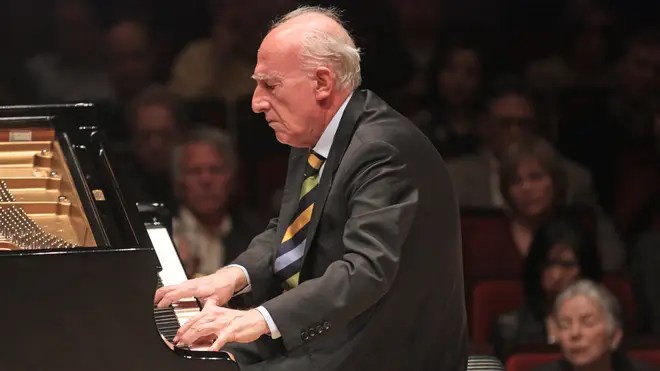
When he performed Boulez’s second sonata on January 25, 2009 at the Salle Pleyel, as if it were a final sonata by Beethoven recently found in a library of an obscure university, after the storm and the Appassionata, the audience, although considered conservative at the time – and who often left after the intermission if some dissonance appeared in the works performed – remained silent for a few seconds – an eternity! – after the Giant had played the Boulez from memory without half a quarter of an eighth of an error, this monument UNATTAINABLE for most of us. Then there was the jubilant, uncontrollable, liberating explosion of applause with twelve encores for Boulez, the composer – present that evening – and his interpreter from another world. The words to describe what we had just witnessed oscillated between “how beautiful it is” quite simply, to “how is this possible?”, “this goes beyond anything we can imagine”, and, make no mistake, it wasn’t just the “performance”. And it was not the “beauty” of music, as we usually hear it – in fact this masterpiece almost organizes the CHAOS of traditional beauty and PULVERIZES it. NO, what was beautiful was POLLINI who tamed chaos, who surpasses the human, sur(passes)human. The feeling of witnessing something beyond us, in the realm of transcendence.
I was asked a few hours ago which Pollini album was dearest to my heart. This choice is simply impossible for me (which is rare!) ). Each one of his albums immediately became a reference no matter what the repertoire presented! I don’t know of a Pollini album I would turn down.
And that’s when we realize the magnitude of this Lord. His breadth of repertoire simply leaves you speechless. How to choose between Chopin’s preludes, Schumann’s sonata in f minor – which does not have in mind the haughty entry of the introduction to the first movement, subtly, provoking an original emotional shock which will not leave us throughout the entire sonata – or Schumann’s fantasy or Chopin’s, Beethoven late Sonatas? The Waldstein that he played like a dizzy person? The concertos? The ‘Emperor’, where he reigned as a master? Or the first ones with Jochum, sparkling like Prosecco? Brahms? But then the first one with Karl Böhm (no second because Böhm dies), or the ones with Abbado? Live or Studio? Petrouchka, Prokofiev’s seventh? Solo work of the three Viennese? Or the concerto of the most famous of them all, Schoenberg? Mozart’s K488 with Böhm again…
With each release (so many chats with Nicholas Angelich!), it was maximum excitement! “So, Schubert’s last sonatas?”. “His Wanderer was so Olympian”… Ah yes, Schubert again…. and the Liszt sonata! Just heard Totentanz live. I don’t remember him ever playing this piece! Breathtaking! And Chopin’s polonaises, just like the first Ballade he played so often in encore! And the etudes! At the fifth encore after the Ballade, the whole Opus 90 and Schoenberg’s first opus 11, we were all waiting for Chopin’s opus 25/11 study to close a new musical event that would keep us awake all day as if we were drugged with Pollinian energy!
And, sometimes, the Superman, Übermensch, was tense in front of the keyboard, as if aware of the enormity of the task to be accomplished, but with a consciousness of superman! He set the bar so high for himself and that of the music he played, that there were curiously difficult evenings when we clung to our seat hoping he would “hold on”, like in the second Chopin concerto with Barenboim and the Orchestre de Paris so long ago … and I pirated it with a Walkman!!! It was this momentary fragility that made him human, and spoke to our inner strength, filled with all kinds of anguish, doubts, crazy hopes, on the eve of embracing the career of a musician.
For all these reasons and a thousand more, for his musical incarnation, his insatiable thirst for challenges, discoveries, the avant-garde, we wanted to be Pollini!
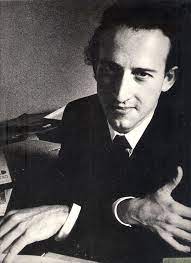
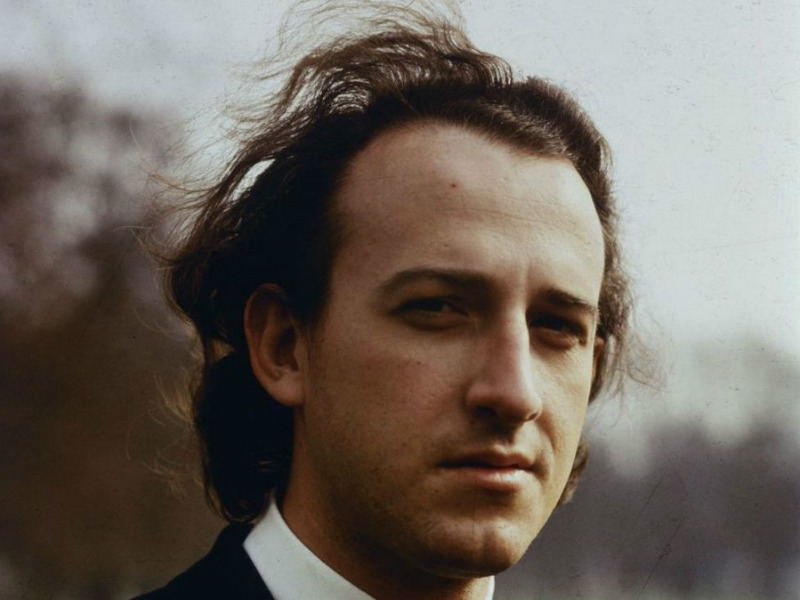
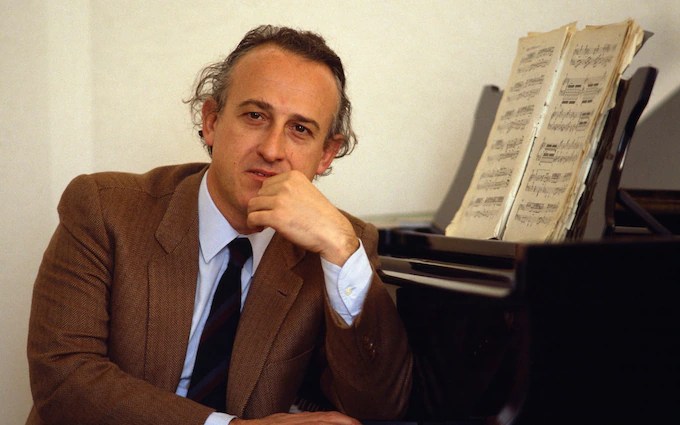
Farewell to the Giant, farewell to the Master, farewell to the Lord of the keyboard. Maurizio Pollini
This tribute first appeared on Facebook. Thank you to François-Frédéric for allowing me to reproduce it here
The Royal School of Church Music (RSCM) marks the centenary of Charles Villiers Stanford’s death with a series of special events
Charles Villiers Stanford, one of the great choral composers of the late 19th/early 20th century, died on 29 March 1924. As executors of the Stanford estate, the RSCM publishes a vast range of Stanford’s music, available from RSCM Music Direct. To mark the centenary of Stanford’s death, the RSCM is planning a number of special events.
An exclusive singing weekend in Stanford’s honour, to be held 12–14 July at Queens’ College Cambridge, where he was organ scholar. This is a unique opportunity to sing some of Stanford’s best known (and lesser known) works in glorious Cambridge surroundings, including Trinity College Chapel (where Stanford was organist) and Great St Mary’s Church. This course will particularly focus on the wonderful inheritance of Anglican Choral music, with RSCM Director Hugh Morris as conductor.
The RSCM holds a number of Stanford manuscripts, and there will be an exclusive session for members of the course to view them, along with an informative lecture on the life and works of the composer given by Stanford expert Jeremy Dibble (University of Durham) on the Saturday evening. On the Friday evening there will be a special, illustrated organ recital featuring Stanford organ works, given by Anthony Gritten.
There will also be meals to share social time together, as well as time to explore the delights of Cambridge in summer.
The course is suitable for experienced, adult (18+) choral singers working at or above RSCM Silver Award level or equivalent (which expects a reasonable level of music reading and independence as a singer); and places may be limited in some voice parts to ensure a balanced choir. Interactive learning resources will be available through the RSCM Choral Coach app, and a full set of music in a commemorative presentation folder will be available to all participants.
Illustrated organ recital by Anthon Gritten, Queens’ College chapel, Friday 12 July, 7.30pm
This illustrated recital will span Stanford’s entire compositional life, from an early work of c.1875 through to his final works of the 1920s. At the centre of the recital is one of his large-scale masterpieces for organ, the Sonata no. 4 in C minor ‘Celtica’ op. 153, written at the end of the First World War. In addition to complete performances of these five pieces, the event will discuss aspects of Stanford’s compositional language, including his use of hymn tunes, the impact of his Irish heritage, the shape of his sonata thinking, and the influence of other composers on his music.
Lecture with Jeremy Dibble, Queens’ College, Saturday 13 July, 7.30pm
Charles Villiers Stanford is justifiably renowned for his brilliantly original church music, but he is perhaps less well known for the extraordinary range of other work he composed across his highly creative life. This lecture will explore some of that repertoire, including extracts from his operas, symphonies, choral works, songs and partsongs, to offer a fresh appreciation of his unrivalled composition for the Anglican liturgy.
The Cross-Eyed Pianist is free to access and ad-free, and takes many hours every month to research, write, and maintain.
If you find joy and value in what I do, please consider making a donation to support the continuance of the site






 The Cross-Eyed Pianist