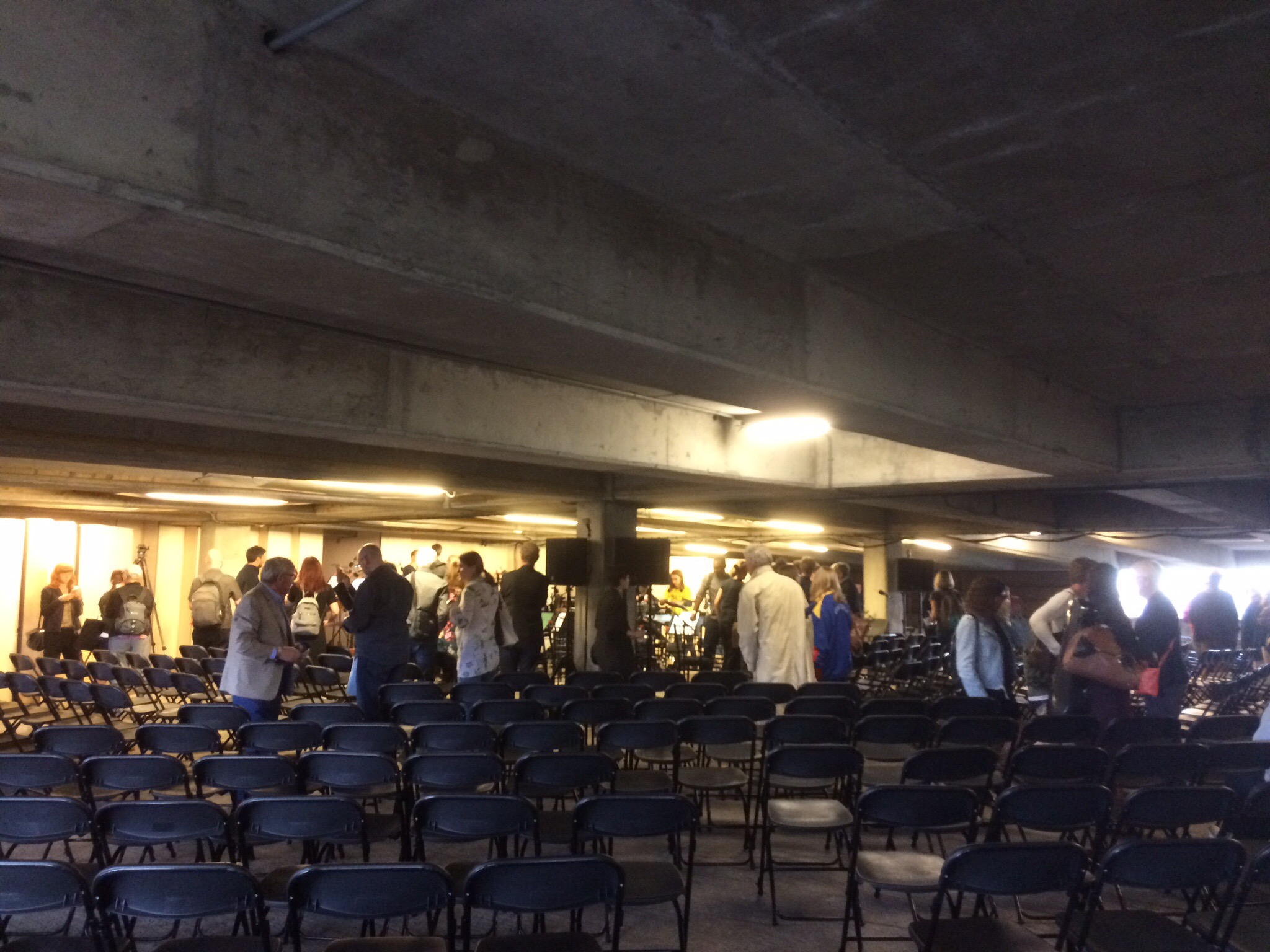
This weekend I headed off to “sarf-east” London for a rather unusual Prom featuring music by American minimalist composer Steve Reich who is 80 this year….

For those of us more used to the highly refined atmosphere of London’s finest chamber music venue, a brutalist concrete lump with low ceilings and unremittingly grey walls cannot possibly be a good place to hear music, whatever the genre. The acoustic should be appalling, a brisk wind slices through the performance space, riffling music, which is pegged to the music stands to stop it blowing away, and the music is regularly interrupted by rattling trains and the sounds of the street below….

Read my full review here

the venue
Multistory Orchestra conducted by Christopher Stark
part of the Derek Jarman garden at the Bold Tendencies multi-storey carpark
leaving the carpark after the concert

img2171sim-canetty-clarkecurated

7-9 October 2016, Kings Place, London

The London Piano Festival is a brand new celebration of the piano created by Katya Apekisheva and Charles Owen. These two highly-acclaimed pianists have enjoyed extensive performing careers both as soloists, chamber musicians and as a widely-admired duo partnership. Their shared love of the instrument has led them to curate this weekend especially for the city’s many piano lovers.

The festival – co-curated by Owen and Apekisheva – will include performances from some of the world’s leading pianists such as Kathryn Stott, Noriko Ogawa, Stephen Kovacevich and Julian Joseph in addition to a lecture on Liszt From Exuberance to Asceticism by Alfred Brendel. Owen and Apekisheva will perform the world premiere of a new work for two pianos written by American composer Nico Muhly.

“There is a lot of laughter in our rehearsals and we have created the London Piano Festival because we wanted to share our enjoyment of the repertoire with many of our friends.” Charles Owen

The duo has created the London Piano Festival to bring together their friends and colleagues for an entertaining and collaborative weekend of piano music. The festival begins with Alfred Brendel’s lecture on Liszt on 7 October, followed by a performance of Liszt’s piano sonata in B Minor by Hungarian pianist Dénes Várjon. On 8 October co-Artistic-Director Charles Owen performs a selection of Bach Partitas, Kathryn Stott performs a French recital of Fauré, Ravel, Messiaen and Dutilleux and co-Artistic-Director Katya Apekisheva performs a programme of Chopin, Scriabin and Fauré. The highlight of the London Piano Festival is the two piano gala on 8 October with Stephen Kovacevich, Katya Apekisheva, Ronan O’Hora, Charles Owen, Martin Roscoe, Kathryn Stott and Ashley Wass. The varied programme includes duets by Busoni, Debussy, Rachmaninoff, Ravel, Milhaud, Piazzolla and Grainger, in addition to the world premiere of Nico Muhly’s Fast Patterns – a rearrangement of an organ piece.

On Sunday 9 October, Japanese pianist Noriko Ogawa gives three children’s concerts with the theme of the magical world of the piano. Ogawa’s short 30-minute concerts are aimed at 2–5 year-olds followed by a 45-minute concert for children aged 6+. Pianist Lucy Parham joins actor Henry Goodman for Réverie – a composer portrait on Debussy combining his words and music. The 2016 London Piano Festival ends with a jazz recital by Julian Joseph, featuring a mixture of pieces including a selection of his own compositions and jazz standards by Gershwin, Ellington and Porter.

sophie_duner_buenos-aires3

Who or what inspired you to take up singing and pursue a career in music?

Elvis Presley – for his dynamics. However, my very first instrument was the piano and I wanted to be a `cocktail bar pianist´. Then I changed to voice. I had a short introductory period singing pop though, pretty soon coming to the realization that my artistic `mood´ was far too `serious´ and complicated for the task. I was looking for something more complex, artistically. That led me to enroll in jazz studies at Berklee College of Music (vocal performance & composition). Apart from the jazz studies, I also attended classes in classical singing as well as in contemporary classical composition.

Who or what were the most important influences on your musical life and career?

Igor Stravinsky, Charles Mingus, Kurt Weill, Paco de Lucía, Cathy Barberian, Björk. I was also very fond of all types of ethnic and dynamic singing, which was a big influence on my expression in jazz. When it comes to composers, I listened to a variety, spanning from jazz, world music to contemporary classical – I always needed all of them to feed my ears.

What have been the greatest challenges of your career so far?

To explain what type of music I do, finding the right people to work with and finding the right venues to perform at. Making my music sound the way it should. Achieving consistency in work opportunities & controlling and combining it with my mood.

Which performance/recordings are you most proud of?

My latest string quartet CD ‘The City of My Soul’ (produced by Michael Haas) and a track called “La Finadita” from the album ‘The Outsider’ by F. Tarrés and The Arida Conta Group. I am also very pleased with a performance I did with electric cello last year as well as some tracks from an upcoming vox & acoustic bass (jazz) CD. I also enjoyed a gig I did at `Festival O/Modernt’ in Stockholm (with a string orchestra among other combos.) A gig at `Festival de Música Cotemporánea de La Plata´ in Buenos Aires was also great – it was audiovisual as well.

Which particular works do you think you play best?

I love to sing music with angular melodies. With extreme highs and lows! That way, I can express varied vocal colours in my different vocal registers and vocal `placements´. I also love music with interesting rhythms and change of meter, and with a lot of energy and groove. I also like dissonance. And space, with dynamic attacks! Basically, anything that is vocally challenging is fun and stimulating.

How do you make your repertoire choices from season to season?

My choices are related to what type of gigs I have at the moment.  It´s also dependent on for whom I write and who I collaborate with. And where I am offered concerts and work – it’s all interrelated.

Do you have a favourite concert venue to perform in and why?

I like theatres. And I loved `Confidencen´at Ulriksdals Slott (where I recently performed) Another interesting venue to perform in was an ecological farm outside Zürich. Or a dusky jazz club. Circulo de Bellas Artes in Madrid. Basically, I like venues with a soul and which have their own personality.

Favourite pieces to perform? Listen to?

At the moment: to perform, `Caravan´ by Juan Tizol, `Weird Nightmare´ by Charles Mingus, `Addicted to Love´ by Sophie Dunér. To listen to:  the last part of `Petrushka by Stravinskij and track n° 2 from the CD “Bach por Flamenco” by Miriam Méndez, “Un amour de Swan” by Hans Werner Henze , “Weird Nightmare” by Mingus with singer Lorraine Cusson + “Cubana Be Cubana Bop” by Dizzy Gillespie.

Who are your favourite musicians?

Igor Stravinsky, Charles Mingus, George Antheil, Louis Andriessen, Thelonious Monk, Alberto Ginastera, Concha Buika, Paco de Lucía, Hans Werner Henze, Dizzy Gillespie, Heitor Villa-Lobos, Astor Piazzola, Bill Frisell, Erik Friedlander (to mention a few!)

What is your most memorable concert experience?

On a jazz jam session when the audience screamed after my solo and the one I did recently at Festival O/Modernt and PARMA Music Festival last summer.

What do you consider to be the most important ideas and concepts to impart to aspiring musicians?

Take risks – better to fall and then rise more interesting afterwards than to stay safe.

What are you working on at the moment?

My own new original (jazz), angular pieces with extreme highs and lows as well as with lots of energy, rhythm and time meter changes. I will record with the electric cellist Jeremy Harman in July in Boston (with whom I performed at the PARMA Music Festival last year.) 

Where would you like to be in 10 years’ time?

In a place where both mind and heart are combined and satisfied. What is your idea of perfect happiness?

What is your most treasured possession?

My imagination.

What do you enjoy doing most?

Composing, singing, painting, drawing, biking, hiking, photography, animals, cooking, comedy and have kids comment on my art and music.

What is your present state of mind?

Eager and unquiet.

Sophie Dunér is a singer, songwriter, composer, arranger and visual artist from Sweden who has lived and performed in the United States and Spain. Originally a jazz singer, her writing and performing have evolved into a unique style of wild, risky, passionate and exhilarating music for vocals and string quartet.

www.sophieduner.com

An earlier version of this article appeared on my sister blog http://www.franspianostudio.me

She can certainly play the 2015-16 [Grade 8] syllabus pieces A-C brilliantly……Can she play anything else? I’ll get back to you on that.

This is a quote from an article about graded music exams by journalist Rosie Millard, who, by her own admission, is “a pushy music parent” when it comes to her children’s music exams. In common with a number of my piano teaching friends and colleagues, this article made me angry and frustrated, primarily because Ms Millard seems to completely miss the point about taking music lessons and playing music.

1f557-abrsmexamMany students take graded music exams each year, and many students take pride and pleasure from the visible results of their dedication to the practising and study of their chosen instrument. Ms Millard notes this satisfaction in her article and reveals a degree of parental pride (and rightly so) in her children’s music exam successes. Unfortunately, some parents use these successes as “bragging rights” to be paraded before other parents and children in the school playground or used as bargaining tools when applying to a particular school.



Do these exam achievements make Ms Millard’s children “musicians”? I’m not so sure….. Admittedly, at no point in the article does Ms Millard mention musicianship or musicality: her focus is simply on her children’s accumulation of grades. I do applaud her, however, for submitting herself to Grade 5 piano, “to see just how terrifying taking a grade really was”, but she does not mention if she derived any actual pleasure or satisfaction in learning the repertoire or any of the musical or personal developmental benefits of taking a music exam. But at least she has a degree of insight into what she is putting her children through in insisting they take all their grade exams.

The memory of taking music exams can stay with us into adulthood, as the author of this article notes. I can’t tell you the number of people I’ve met who, on discovering I am a piano teacher, tell me “I wish I’d continued with the piano, but I really hated taking those exams!”. One of the reasons why I decided to take two performance diplomas in my late 40s was to erase the memory of my ABRSM Grade 8 piano exam, taken some 30 years earlier (yes, it really was that awful, despite the fact that I played well and achieved a decent pass). A different exam board (Trinity College London) and a different attitude to assessment (Trinity places emphasis musicality and musicianship) meant the diploma recitals were a pleasure instead of an uncomfortable, nerve-wracking chore, and I switched my students from Associated Board (ABRSM) exams to Trinity to ensure their exam experience was similarly enjoyable.

Graded music exams have their uses: the choice of repertoire in the syllabus offers students a chance to study a broad sweep of music from the Baroque to present-day; learning scales teaches students about keys and key-relationships, and provides important technical foundations which can be applied to pieces (something which wasn’t pointed out to me by my childhood piano teacher, so that scales were simply dull exercises to be got through as soon as possible in my practising); and the grade system provides a useful benchmark of a student’s attainment and progress. Preparing for and taking a music exam can inform children about the need for and benefits of regular, meaningful practising, and performing can breed confidence and self-esteem (but only if the student is well-prepared with support from a teacher who can advise on aspects such as stagecraft, presentation and managing anxiety). But an exam is only a snapshot of that student on a particular day – and may not indicate the student’s true abilities, especially if the student is nervous or under-prepared. Yes, it’s true that music exam successes look good on a CV as proof of extra-curricular activities, but any savvy interviewer is going to want to see evidence of broader music making, especially if the student is applying to conservatoire.

Box-ticking music-exams are utterly unhelpful, both to development of musicians and to those subjects that are lured into UCAS points-collecting.

Look at it this way: how many music teachers here would regard an A-level in biology as being indicative of a good future as a concert pianist?

A quote from a member of a music teachers’ online forum

Teachers love grades, because they reveal their prowess as a teacher.

Rosie Millard

No. What reveals one’s “prowess” as a teacher is the ability to motivate, encourage and guide young people (and adults too) to become well-rounded musicians, not exam automatons who reproduce by rote what they have been spoonfed simply to secure an exam pass. A good teacher should know the ability levels of all his/her students without the need for testing. And a good teacher does not live by his/her exam results, by how many students achieve a merit or a distinction, but rather by knowing each of his/her students’ strengths and weaknesses, what music makes them tick, and their individual personalities.

My students have the option to take grade exams if they wish. No one is forced to take an exam and some students simply wish to play music which they enjoy and which enables them to develop as musicians without the pressure of exams. Sometimes they opt to have their playing assessed by a teaching colleague of mine, to gain experience of playing for other people and useful feedback from another listener. Other students enjoy the challenge of studying for an exam, but this is always done within a broader focus (learning additional related repertoire, listening around the pieces, historical contexts etc).

I do not believe that taking graded music exams proves you are a “musician”. Being a well-rounded musician goes far beyond the ability to play three pieces, some scales and technical exercises, sight-read an unseen study and complete an aural test. Being a musician is about understanding the music, its structure and its meaning, intellectually, visually and aurally. It is about learning a wide variety of music, outside of the strict confines of the exam syllabus, to gain a broad understanding and appreciation of music and its different genres. It’s about listening, going to concerts, reading literature and poetry, going to the cinema or an art exhibition, to appreciate that composers do not create music in a vacuum, but that their creativity is informed by their personal experiences and observations of the world around them. It’s about the pleasure of a certain phrase or the feel of a particular chord under the fingers. It’s about making music with others, playing in concerts for parents, friends and family, and sharing the experience of music. In short, it is about enjoyment.

Our children are tested almost from the moment they enter school in the UK. Let’s not over-burden them with further testing in an activity which is meant to be enjoyable. By all means take a music exam, but don’t let it obscure the pleasure of music.

Further reading

Why take a music exam?

The curse of the pushy parent

The virtuoso parent