
 Volunteer
Guest post by Paulette Bochnig Sharkey
I am a volunteer pianist. For the past 12 years, I’ve brought music to residents of assisted living homes, memory-care centers, and retirement communities.
Before becoming a volunteer pianist at age 50, I had played classical music almost exclusively, along with Christmas carols and the occasional Broadway tune or popular movie theme. I love classical music; many of my elderly listeners do, too. They enjoy having piano performance students come from the local university to present practice recitals. Those students play classical music better than I ever could. I’m an amateur pianist, albeit a serious one.
So for my volunteer gigs I focus instead on standards from the 1920s through the 1940s. These songs—especially the ones popular during World War II—have deep emotional meaning for my audiences. When I play “As Time Goes By” or “Sentimental Journey,” my listeners feel a sense of ownership. “You play our music,” they tell me.
For my elderly audiences, this music stirs memories. I recognize the look of nostalgia in their eyes as they remember dancing with the spouse they’ve now lost, or longing for home while away serving in the military.
One hunchbacked octogenarian shuffled to the piano to tell me that his mother played when he was a little boy. Then he burst into tears and sobbed, “I miss her so much.” Sometimes a particular song will inspire a listener to tell me a story. Some are surprisingly personal. Upon hearing “Tenderly,” a rheumy-eyed man whispered in my ear, “That song was the cause of my five children.”
The power of music is never more evident to me than when I volunteer in a dementia unit. Patients arrive slumped mutely in wheelchairs, seeming unaware of their surroundings. But when I play a song like Irving Berlin’s “Always,” they raise their heads and begin singing. Unlocked by the music, the lyrics flow from their long-term memory.
Volunteering offers no monetary compensation. I am paid in kisses blown to me from across the room, in pats on the arm, in glasses of juice offered by shaky hands.
My work as a volunteer pianist is not all hearts and flowers. The pianos I play are often neglected and out of tune. Cell phones ring during my performances. I will always remember the man in my audience who answered his phone and told the caller, “No, I’m not busy, I can talk. I’m just listening to someone play the piano.”
I compete with the roar of vacuum cleaners, with the clattering of lunch dishes being cleared away in nearby dining rooms. On one memorable occasion, a
housekeeper dusted the piano while I was playing it. And then there was the time I got hit by a ball when an audience member decided to multi-task, listening to the piano music while he played a game of fetch with his dog.
I’ve run into a few curmudgeons over the years. One told me I was “no Liberace.” Another approached the piano, leaned in close, and snarled, “Why don’t you go play somewhere else?”
Still, I cannot imagine a more gratifying way to contribute to my community than by being a volunteer pianist. Not long ago, an elderly women slowly steered her walker to the piano as I packed up after a performance. “You have no idea how much sunshine you brought into this room with your music,” she told me. “We were all dancing in our hearts.”
That is my reward. Priceless.
Paulette Bochnig Sharkey, pianist and writer, blogs at https://volunteerpianist.wordpress.com/
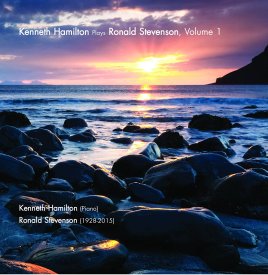 The Scottish composer Ronald Stevenson died in March 2015. He was one of the most important composers of our time, a composer-pianist in the grand tradition of Beethoven, Chopin, Liszt and Rachmaninov, probably best remembered for his monumental Passcaglia on DSCH, his tribute to Shostakovich composed in 1962. Stevenson has been compared to Liszt and Busoni: he transcribed many works for piano, and he was also a generous supporter of other musicians and students. His musical language is also redolent of these composers, as well Chopin and Alkan, but always with its own distinctive voice and an awareness of his adopted Scottish heritage.
 Anna Cavaliero has performed as a soloist in both Europe and the United States, though she is now based in her native London. An Ian Evans Lombe Scholar supported by a Helen Marjorie Tonks Award, Anna is currently studying for a Masters degree in Vocal Performance at the Royal College of Music under the tutelage of Rosa Mannion and Christopher Glynn. She spent 2014-15 in Salzburg, Austria, studying at the Universität Mozarteum, and at the Mozart Opern Institut. In 2012-13, Anna took courses at The Shepherd School of Music, Houston, Texas, having been awarded the C. D. Broad Scholarship to Rice University. She there met composer Daniel Knaggs, who has written several pieces specifically for her voice. Anna enjoys performing in opera, oratorio, and as a recitalist. She read English at Trinity College, University of Cambridge, where she was also a Choral Scholar under Stephen Layton (2010-14).



 The Cross-Eyed Pianist