Photo: Christian Hartlmeier

Who or what inspired you to take up composing, and pursue a career in music? 

I was taken by surprise – I had always enjoyed music and played the piano for quite a while, without becoming truly excellent. Then I was asked to play keyboards in a school band and suddenly found I enjoyed both playing and composing much more than I had thought. Soon I became absolutely obsessed, practicing 10 hours a day to make up for the lazy time before. And then I became increasingly frustrated with the limitations of band playing and veered more towards contemporary and classical music. I think that impressing the girls was also an extremely strong motivation. I was 15.

Who or what were the most significant influences on your musical life and career as a composer? 

I listened to a lot of classical music LP’s when I was a kid, also to more progressive pop music like Emerson, Lake and Palmer (which impressed the hell out of me back then). My mother is a theatre photographer, so I was confronted with long and boring operas from a very early age on. I guess I like them more now. My favourite record for 5 years was a recording of “Pictures at an Exhibition” played by Svjatoslav Richter, I played that record so often it completely wore out. I was distinctly aware that composing music was something magical and important, and I constantly heard my own music in my head but didn’t really know what to do about it. Later Erik Satie was the first composer I fanatically loved. I was always – and I still am – especially interested in the outsiders and eccentrics of music. Charles Ives was also very important. I was also lucky to have teachers who showed me interesting music and widened my horizon.

What have been the greatest challenges of your career so far? 

Realizing that not everyone will love what you do, regardless of how hard you try. And then having the constant courage to give a damn about it, to follow your own instincts, to follow your own intuition. Dealing with envy, your own and that of others. All of this is a constant challenge. Every morning I wake up and try to handle it a little better.

What are the special challenges/pleasures of working on a commissioned piece? 

I only work on commissioned pieces, so I don’t really know the difference anymore. But of course I remember a time when I didn’t have commissions at all, and back then it was much more difficult to focus and to work with discipline, as there was no real goal, no performance ahead. Dealing with deadlines is harsh, but it has made me a better composer. The secret is to not accept commissions for which you cannot find inspiration, or even better: to have ideas that actually create the commissions you want.

What are the special challenges/pleasures of working with particular musicians, singers, ensembles and orchestras? 

It is always an advantage knowing who will perform your music, especially in the case of singers. But then you should always write in a way that everybody can perform your music, at least in theory, so I try not to get too carried away if great virtuosos perform my music. Of course that doesn’t always work. An orchestra too can be like a person, either you get along well or you don’t. I write easier for an orchestra that I already know, that has already played my work. But it is not essential, I also had very positive experiences with performers who I didn’t know before at all.

Which works are you most proud of?

I try to not give anything to anybody that I am not proud of in a way. And then I actually also try to not be too proud, to not constantly look at what I have done. I never listen to old pieces and bask in my glory. But in general the things I am the most “proud” of are my operas, my songs, my orchestra music, my chamber music. Which is already a lot of different things. It would feel strange to single out something, which does of course not mean that everything is equally good. But I really do not contemplate my work, I’m too busy writing it.

Who are your favourite musicians/composers? 

Too many to list here. This is not a cop-out – I truly feel that music history (including the present) is so diverse and rich that singling out anybody feels strange. All the names we know from the past usually deserve to be known, which still doesn’t mean I’m a big admirer of Richard Wagner. But I also respect his work of course. I constantly discover new things, and I also change my mind about composers. I used to loathe Feldman, now I like him. I used to like Prokoffieff, now I find him a bit dull. I felt nothing for Mahler, now he is extremely dear to my heart. I loved the first piano sonata from Kabalevsky, now I feel it’s a horrible, vacuous piece. If there is one composer who I always greatly admired and have never felt any different about it is Schumann. But there are more like him!

What is your most memorable concert experience? 

Playing a mixed program of contemporary and classical music to an audience coming from a slum in Lomé, Togo (West Africa). They had been lured into the concert hall by free food and had never heard any piano music in their life. I think they were the most open-minded and enthusiastic audience I ever had. But there were other memorable experiences – like failing to play a concert in Tijuana, Mexico, because there was no piano chair to be found…anywhere. True story, but I’ll tell it another time.

What do you consider to be the most important ideas and concepts to impart to aspiring musicians? 

To never make the mistake to believe that anybody actually really knows what they are doing. To not listen to people who think they know what they are doing. To instead listen to people who are honest in their constant curiosity. To not listen if somebody says you shouldn’t do something, because then you should do it. In art – other than in life – it is really important to do the things that people do not expect from you. And this might also mean breaking rules that everybody thinks are set in stone. To realize that nothing is set in stone. To realize that all the music world is nothing but a big meaningless circus of vanities and to find the strength to believe in the musical truth that many don’t dare to confront because they take the easy way, because they are too scared. To acknowledge that the wonderful thing about music is that a lot of it is coming from a great unknown that we can (luckily) not map or fathom in its entirety. To be generous, to your friends and also to your colleagues. To absolutely believe in your own inspiration, no matter where it will take you. To take example in musicians and composers that you admire. To love. To write about what you love, not about what you think others might love.

Where would you like to be in 10 years’ time? 

At home with my family, working on a new opera.

What is your idea of perfect happiness? 

Being at home with my family, working on a new opera.

What is your most treasured possession? 

Sadly I have a collector’s heart and have many treasured possessions, among them a collection of 1500 board games, single malt whiskies, comics, films, books…sometimes it becomes too much. So I would probably answer that my single most treasured possession is my firm belief in the freedom and necessity of imagination.

What do you enjoy doing most?

Living and learning.

What is your present state of mind? 

Hoping that the idiots don’t succeed.

Moritz Eggert’s new CD was released on 13th April 2018 by NEOS. It features two new works, “Muzak” and “Number Nine VII: Masse”, premiered and recorded by the Bavarian Radio Symphony Orchestra, conducted by David Robertson (Muzak) and Peter Rundel (Number Nine VII: Masse)


Moritz Eggert was born 1965 in Heidelberg, Germany. After early piano studies he began his music education at Dr.Hoch’s Konservatorium in Frankfurt, first in piano (with Wolfgang Wagenhäuser) and theory, then in composition (with Claus Kuehnl). After finishing school he studied piano with Leonard Hokanson at the Musikhochschule Frankfurt. 1986 he moved to Munich to study composition with Wilhelm Killmayer at the Musikhochschule Muenchen. Later he continued his piano studies with Raymund Havenith in Frankfurt, and his composition studies with Hans-Jürgen von Bose in Munich.

In 1992 he spent a year in London as a post-graduate composition student with Robert Saxton at the Guildhall School for Music and Drama. His main duo partner is the cellist Sebastian Hess. In 1996 he presented the complete works for piano solo by Hans Werner Henze for the first time in one concert, a programme that he continues to play with great success. In 1989 he was a prizewinner at the International Gaudeamus Competition for Performers of Contemporary Music.

As a composer Moritz Eggert has been awarded with prizes like the composition prize of the Salzburger Osterfestspiele, the Schneider/Schott-prize, the “Ad Referendum”-prize in Montréal, the Siemens Förderpreis for young composers, and the Zemlinsky Prize. 1991 he founded – together with Sandeep Bhagwati – the A*Devantgarde festival for new music, which has taken place for the 6th time in June 2001. His concert-length cycle for piano solo, Haemmerklavier, has been a great international success with reviewers and audiences alike. Moritz Eggert has covered all genres in his work his oeuvre includes 5 large-scale operas, ballets, and works for dance and music theatre, often with unusual performance elements. 1997 German TV produced a feature-length film portrait about his music.

Among his more recent important works are the concert-length cycle for voice and piano Neue Dichter Lieben featuring 20 love poems by contemporary german authors, and the orchestra piece Scapa Flow. His next projects include the children’s opera Dr. Booger’s Scary Scheme for the opera Frankfurt (with Andrea Heuser) and the ongoing internet project Variations IV.XX for 21 composers and live musicians.

www.moritzeggert.de

(Photo: Christian Hartlmeier)

In June 2016, the Piano Dao blog published my interview with pianist and composer Tobin Mueller in which he speaks frankly, at times painfully so, about his chronic illness and its effect on his creative life. Now, in this guest post, Tobin Mueller discusses how the music of Chopin in particular has enabled him to transcend the limitations of his illness…..


Something unexpected happened on my way to the future: my body got older much faster than my brain. Yet, I can say with certainty, I am enjoying my life as much as ever, albeit with altered definitions for expressions like “work day”, “feeling good” and “ambition.”

My latest recording celebrates the transcendence of illness and limitations. “Of Two Minds: The Music of Frédéric Chopin and Tobin Mueller” is not just an homage to Chopin, but a tribute to music that transforms and aspires. Disc 1 is made up of jazz-inflected interpretations of Chopin; Disc 2 includes three original piano sonatas based on his Preludes. (It’s a double album.)

Most people sense in music an extension of themselves. Music both reminds us and inspires us. It reminds us of a glorious past while making us ponder our future potential. Chopin, however, does something more. He doesn’t just remind me how great music can be, but how the act of creating music can eclipse pain, weariness, melancholy and doubt.


My musical conversations with Chopin proved to be the most satisfying I’ve had in recent years. Perhaps it’s because his music incorporates jazz-like changes and a constant sense of improvisation. If I’m being honest, however, our shared history of health issues may have more to do with it.

As you know, Chopin suffered from tuberculosis his entire life. In addition, his sister contracted it at age 11 and died of it at age 15. I’ve often considered how his illnesses (he had more than one) affected his music. In my youth, I had every malady a child could contract, including 5 bouts of different measles, three of pneumonia, 7 weeks lost to mononucleosis [glandular fever], etc. Yet, instead of it being a burden, I loved those afternoons at home with my mother, not having to attend school. She let me drink soda when I had a fever, something not allowed otherwise. She’d talk in ways she never would when the family was around. Even hospital stays were more like spiritual retreats than impositions. (I had 6 collapsed lungs and several surgeries as a teenager.) Those moments apart from the “normal” world became nostalgic sanctuaries that fed my creative imagination.

Composers, writers and musicians need to spend a lot of time alone to nurture and perfect their craft. My illnesses provided me with a quiet space to practice productive solitude.

In addition, my sister died after a 10-year illness from A1AD complications. Seven years ago, I learned that I shared this same condition. I was 15 when she died. Her death affected my entire creative life. (Her dying wish was that I learn to play Joni Mitchell’s “River” and to understand the music theory behind it. This may seem peculiar, but ours was a very musical family and my sister tried to pass along as much of her musical expertise as she could.) Did the death of Chopin’s sister (again, from a shared illness) affect his creative life, as well?

On a conceptual level, almost all of my music tries to lend meaning to mortality. Mortality frames beauty, is an impetus to cherish, ironically opens the door to the sublime. The vast majority of my music celebrates substantive meaning: life is fragile, sharing life in an honest way is how to conjure joy. Even my fast songs tend to end softly, like an amen. Even my slow songs tend to have a discordant moment of unexpected drama tucked somewhere in the middle, as a reminder. I can’t help but find these same sentiments in Chopin’s music, these same celebrations.

Unlike Chopin, most of my adult life was conducted in good health. I had almost infinite energy, a huge reservoir of adrenaline. I viewed bouts of illness as mere interruptions. (Chopin probably felt the same way in his 20s.) There was an effortlessness to much of what I accomplished. But after 9/11, I began to develop omnipresent lung issues. I dismissed them as a result of volunteering at Ground Zero, recalling the old adage “No good deed goes unpunished.” By 2010, however, I coughed continually. I had to stop performing. When chest pains became too intrusive, when I had trouble simply breathing, my wife finally convinced me to go to a doctor. I was diagnosed with A1AD. The condition was exacerbated by 9/11 exposure, but it was a ticking time bomb, regardless.

The specialist who delivered the diagnosis gave me 8-12 years to live. I was 54.

Of course, old musicians never die, they just go bar to bar. Old composers just decompose. But, then again, some composers never die, they just become music.

A1AD (Alpha-1 Antitrypsin Deficiency) occurs because of a genetic mutation. This mutated gene results in a deficiency of proteins that mitigate swelling, bolster immunity, and do a whole host of other beneficial things. In place of these necessary proteins, my body creates mutated ones, some of which can be harmful. (These harmful proteins are what killed my sister 45 years ago. Her liver failed, over time, trying process them.) This was why I was always sick as a kid, why I’ve had a sinus infection for 30 years, why I am prone to flu and pneumonia. This is also why my lung tissue, joints and nerve fibers swell up (and fail to un-swell in a timely manner), triggered by stress, diet, or repetitive activities like playing the piano.

Stress is my main enemy. Here’s a good story to illustrate: I was asked to write a song about an Iraq War veteran. To get myself in the mood, I turned to my favorite Vietnam Era tune for inspiration: “Goodnight Saigon” by Billy Joel. (It’s a remarkable example of songwriting and creative production.) As the song reached its third verse, I quietly began crying, filled as I was with memories, loss, heartache. When the final chorus kicked in, what had been a happy drinking lyric transformed into a full-on comrades-in-arms oath of inevitable destruction, “And we all go down together”… Tears flowed from my eyes; my nose started to run. Suddenly, I could barely breath. My lungs had swollen so rapidly it was as if I had induced pneumonia in a matter of minutes. It was terrifying.

When I got to the doctors and explained what happened, he simply said, “Don’t cry anymore.” So, I avoid crying, along with many other things…

I avoid the stress of directing, live performance, traveling alone. I avoid staying up late, practicing too long, juggling too many thoughts at once. I avoid encounters with stressful people, stressful deadlines, stressful exercise. I avoid red wine, air that has particulates in it, sounds that are too loud.

In short, I’ve changed my entire life. I no longer live in Manhattan. I’m semi-retired. I plan my schedule to accommodate rest times, pill times, neti pot times. I reassessed every goal, every daily and long-term process in the context of short term health. My “work day” has decreased from 16 hours to 6, usually with a nap wedged in there somewhere. “Feeling good” now means managing pain so that it doesn’t suppress minimal activity. “Ambition” no longer includes dreams of mounting a show on Broadway or performing at The Garden; I just want to record as much as I can before I can’t.

Changing my life has not been a bad thing. On the contrary, creating an “Act 2” is like being able to live yet another life. I’ve already done the over-busy workaholic always-on-the-move social whirlwind thing. Having time to read again, to listen to other people’s music, to cook at leisure, all these are quality of life increases. I don’t mind having a “simplified” social calendar. I like being able to ignore Facebook guilt-free. I embrace going to bed early and maybe watching an old film. I love sitting in the yard and listening to songbirds…a healthy relaxation as opposed to an irresponsible use of time. I savor walking along Long Island Sound, breathing deeply the salt air, thinking this is exactly what the doctor ordered. When I am able to practice at the piano, I feel blessed, no longer compelled for reasons that have more to do with expectations than fulfillment.

The funny thing is, I’m as productive as ever. In many ways, having greater calm in my life has equipped me with the space to enjoy each new idea. Without rushing about, I am content to relish. And I am writing more music per year than I did twenty years ago.

Bending my life to consequences of illness has made my music more personal than before. It’s not just that I’m not writing for characters in a musical. I’m writing for myself in a different way, to become the music I imagine represents my spirit. It’s yet another reason I was drawn to Chopin.

His music is profoundly personal, even when it demonstrates virtuoso techniques. Everything he wrote comes across as private expression, an aural diary. There is a revolutionary amount of spontaneity in his music. Chopin provided me license to explore these aspects of my music without apology, with happy abandoned.

And then there is his relationship with George Sand.

The intersection of illness and music became more important as I read through the writings of George Sand. She, above everyone, understood Chopin’s frailty. She protected his genius by protecting his health. Although she was seen as “vulgar” and almost dangerously modern in her mannerisms and beliefs, Amantine-Lucile-Aurore Dupin (George Sand’s real name) proved to be his most nourishing friend and most influential love. He called her his “angel.” I consider my wife, Suzanne, to be my angel. Without question, her devotion to my health has nourished my music. I love this parallel with Chopin. George Sand not only nursed him, she cherished his innocent elegance (unique among the Bad Boys of the Romantics). Sand worried that “his sensibility is too finely wrought, too exquisite, too perfect to survive for long.” Suzanne has said very similar things about my innocence and openness, traits that become more precarious with age.

Chopin’s ‘shyness’ may well have been a mechanism required to preserve himself and, above all, protect his art. The reserve and distance Chopin maintained between himself and the world may well be explained within the context of his limited energy and worrisome health. His music is perfectly suited for intimate settings; small salon performances also suited his state of health. Indeed, my music has evolved since I’ve had to give up live performing. Recording alone in the darkened studio, often with an elbow or wrist brace to battle nerve pain, deters me from playing loud passages or extended runs. So, I simply avoid writing them.

I now play to an audience of one: the single listener whom I imagine is sitting in headphones. I write extremely personal music both because I find it most satisfying and because that is now my only mode of communication.

I always experience a sense of magic when I sit at the piano – a very old magic that, paradoxically, makes me feel very young. Adrenaline and serotonin may have something to do with it, but there truly seems to be a mystical element.  To be a part of the miracle of music-as-unbroken-mutual-inspiration is an ongoing thrill. Was it my imagination that Chopin sat next to me as I rearranged his work, balancing my eagerness to pay tribute with my desire for self-expression?

Interpreting Chopin was not just a privilege, but an opportunity to grow and commune. After “Of Two Minds,” I feel as if Chopin’s music has woven itself into my own, even as our lives are now somehow linked. I realize this is a surreal internal fiction, but it feels no less real. Above all, I hope you hear it in my music. The piano binds so many of us. Are not all musicians connected by a magic we cannot explain?

― Tobin Mueller, December 2016


Tobin Mueller


Tobin Mueller has composed and performed musical theatre, jazz, progressive rock, pop, classical, film scores and children’s music. He has written fiction, political essays, poetry, domestic humor and video games. He has worked with Dave Brubeck, Ron Carter, Michael Hedges, Donny McCaslin, Maynard Ferguson, Jon Anderson (from Yes) and Brian Welch (“Head” from Korn), among others. As a Dramatist Guild playwright and composer, he’s had six musicals produced in Manhattan. In 1994, he was inducted into the United Nations’ Global 500 Roll of Honor, in London, for his work with youths and the environment.


Mueller’s official website www.tobinmueller.com is an excellent resource to sample his music. His recordings are available on CDBaby, iTunes, Amazon and Spotify.


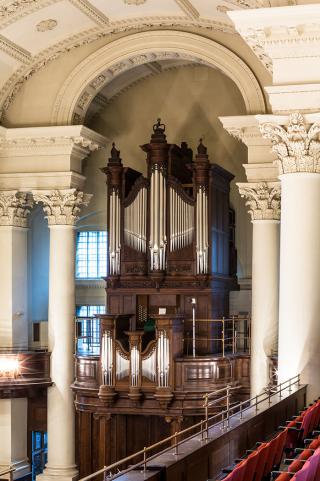
organ

The splendid venue that is St John’s Smith Square, a beautiful eighteenth century church nestled amongst government offices and ministries in the heart of Westminster, is fast becoming one of my favourite London concert spaces – not just for piano music but also chamber, orchestral and choral music. I’ve even performed there myself, albeit a mere “15 minutes of fame” as part of St John’s 24-hour Music Marathon! And since September, I’ve been attending the monthly lunchtime organ recitals through which I’ve discovered a real liking for organ music. This is in part down to a friend of mine who adores Bach’s magnificent Passacaglia in C minor, BWV582 (which we heard in November, performed by Peter Stevens), but who would probably never go to an organ concert without my instigation.

The organ at St John’s is not original, though the main organ case, built by Jordan, Byfield and Bridges in 1734 acquired from St George’s church in Great Yarmouth, compliments the wonderful Baroque interior. It was installed in St John’s in 1972, and a new, larger organ case was built to accommodate the new instrument, built by Orgelbau Klais Bonn, which offers an enormous range of musical colour and versatility, suitable for repertoire from the German Baroque to high romanticism and contemporary repertoire.

There’s something really special about hearing an organ being played in the grandeur of a ecclesiastical building such as St John’s Smith Square. Whatever one’s religious, or otherwise leanings, one cannot help but be uplifted and awestruck by the volume, range and variety of sounds, the way those deep base notes swell and vibrate in the pit of the stomach, and the soaring sounds of the upper registers.

The organ series at St John’s Smith Square, now in its fifth edition, offers a broad range of performers and music, including organ favourites such as Bach’s ‘Ein Feste Burg’ and works by the leading composers for organ, Louis Vierne and Olivier Messiaen. In fact, it was the concerts featuring works by Messiaen which first drew me to this series, and David Titterington’s profound, vibrant and intensely absorbing performance of ‘La Nativité du Seigneur’ on 15 December was an example of the exceptional quality of these concerts (David has also recorded this work for Hyperion). Earlier in the season, we enjoyed a wonderfully mixed programme of music by Mendelssohn, Bach, Wesley and Messiaen by Jennifer Bate (a world authority on the organ music of Messiaen). The concert also included a work by Jennifer Bate herself, her ‘Variations on a Gregorian Theme’.

Seating is unreserved in St John’s for these concerts so one can choose to sit almost beneath the instrument if one so desires. A camera in the organ loft projects onto a screen on the stage, offering a fascinating glimpse of the organist at work (I had no idea it was so energetic, with hands and feet engaged for much of the time!). From the point of view of the pianist’s technique, I found it particularly interesting to see how the organist achieves legato effects, given the technical demands and mechanics of the instrument. And the sheer physical sound of the instrument, its richness, textural variety and surprising delicacy, has been quite unexpected, and something I look forward to exploring further at future concerts.

Monthly lunchtime organ recitals continue at St John’s Smith Square until June. Full details here

Who or what inspired you to take up the piano and pursue a career in music?

My mother was the one to introduce me to the wonderful world of music. I grew up in communist Romania, where kids didn’t have piano lessons as an after school thing but my Mum saved up lots of money and bought a beautiful mahogany upright. I got into the specialist music school in Iasi age 7 and had my debut with an orchestra 2 years later with Mozart D major concerto. I remember walking on stage, surrounded by adults, tripping over, conductor panicking, music stands falling, scores flying all over the place. My mum freezing in the first row. But I stood up, smiling and loved every single second of that performance. I came out and said “I want to become a concert pianist!”. I feel blessed to have had very encouraging people in my life, who believed in me and gave me a chance. I learnt from a very early age that hard work will always take you a long way. I don’t come from a musical family, therefore I didn’t have any expectation on how things should go. I didn’t set myself a target, I simply followed my intuition, learning from every situation and felt grateful for every opportunity that came my way. And the same as my falling, I learnt I can always stand back up and keep going.

Who or what have been the most important influences on your musical life and career?

My teachers have had the greatest influence on me, starting with my high-school teachers in Romania, to the late Mark Ray, Nelson Goerner, Alexander Melnikov, Dina Parakhina, Ronan O’Hora, Andras Schiff and Imogen Cooper. I have been incredibly privileged to study with fantastic musicians, who taught me not just about music, but enriched my life through advice on staying true to myself and always discovering new things. The thirst of knowledge and curiosity is one of the most beautiful things in life.

What have been the greatest challenges of your career so far?

I believe we all find ourselves at crossroads at some point in our lives. The greatest challenge is to take the right path for you. I usually analyse and over-analyse and once I have taken a decision, that’s it! I try to never look back and believe in the power of instinct- after a lot of research has been done!

Which performance/recordings are you most proud of?

Every recording I have ever made is the result of hard work, a long time planning, creating a vision and sticking to a plan.This year saw the release of my concerto debut disc- Tchaikovsky Piano Concerto 1 with the Royal Philharmonic Orchestra on Signum Records coupled with the ‘Nutcracker Suite’ arranged by Pletnev. The joy of having my first concerto disc out is not easily put into words- honestly, a dream come true!

Which particular works do you think you play best?

I try to identify myself with whatever piece I am playing. I like reading about the story behind the music, I like to find out about the political situation of that time, where the composer was at the point in his life, what were his fears, his joys. The notes on the page are just the start of the journey.

How do you make your repertoire choices from season to season? 

I think long term. I like creating projects and putting programmes together that make sense. I am working on my Trilogy of Preludes at the moment, a project supported by the wonderful team at Champs Hill Records, who have very enthusiastically welcomed 3 CDs of complete preludes: vol I Chopin and Dutilleux, vol II Szymanowski and Shostakovich (both released) and vol III Fauré and Messiaen coming out next year. I enjoy introducing my audiences to new pieces, I like to challenge them with something they might not know they would love.

Do you have a favourite concert venue to perform in and why?

Every venue has its own personality, the same as pianos do. As a pianist, one has to adapt very quickly – I simply cannot describe how thrilling it is to step into a hall where so many of the great legends have played. There’s a huge pressure but in the same time there’s something humbling and magical about it.

Favourite pieces to perform? Listen to?

I love performing the Nutcracker Suite. I feel the versatility of the piano makes it possible to recreate the orchestral sound and it allows me to imagine all the magical world the story tells in a very intimate setting. I love listening to everything, from jazz to folk, pop to classical.

What is your most memorable concert experience?

Goodness me, where should I start?! Every concert is memorable, from a little hall in the middle of nowhere to the big giants. My first time at Carnegie Hall will always be the icing on the cake (and lots of the readers will know I love cake!). Getting a standing ovation at the Concertgebouw was quite something. My Buenos Aires concert in front of a packed 5000 seat hall (at lunchtime!) had me on my toes (I was told Beyoncé performed there the night before- make of that what you will!). Performing with youth orchestras is always truly rewarding- we all learn from each other and I always feel happy amongst them.

What do you consider to be the most important ideas and concepts to impart to aspiring musicians?

Always be true to yourself. Never give up. Always follow your dream- patience and perseverance will get you a long way. Never stop learning, from anyone and from every situation!

What is your idea of perfect happiness?

Being able to enjoy each moment as it comes, living in the present. Making a difference, standing up for what I believe in. Change lives through music!

What is your most treasured possession?

My piano.

What do you enjoy doing most?

Play my piano, communicate, bake, cycling with hubby, being with people.

What is your present state of mind?

I am truly grateful for everyone and everything I have around me. I feel blessed to be able to follow my dream.


From London’s Royal Albert Hall to Carnegie Hall in New York, the young Romanian pianist Alexandra Dariescu, recently named as one of 30 pianists under 30 destined for a spectacular career (International Piano Magazine), dazzles audiences worldwide with her effortless musicality and captivating stage presence.

Read more about Alexandra Dariescu here