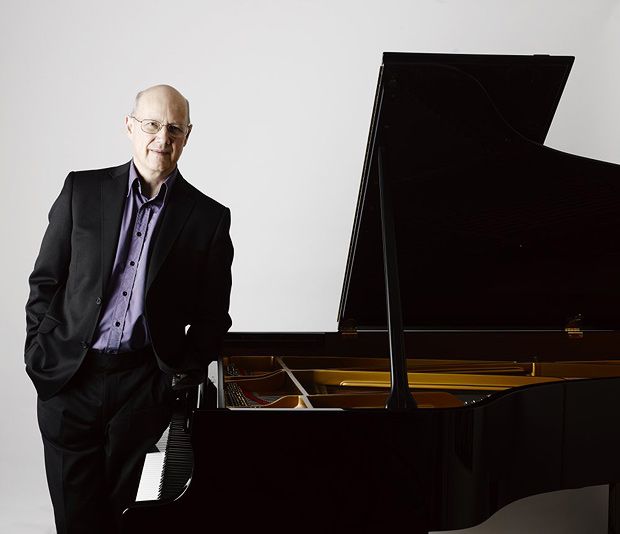
Who or what inspired you to take up composing, and pursue a career in music?

Since my earliest years, I’ve had an impulse to make up pieces at the piano, and that hasn’t really changed – except that eventually I learned to write them down, and nowadays often play virtual instruments via a keyboard. When enough people started asking me to write them something, it turned into a career.

Who or what were the most significant influences on your musical life and career as a composer?

Musicians and theatre-makers who asked me to write music for them, including dancer/choreographer Clare Whistler and director Jonathan Kent; and who listened, encouraged and offered constructive criticism, notably composers Stephen Oliver and Julian Grant, conductors David Parry and Brad Cohen, opera-directors Graham Vick and Richard Jones. Probably the most significant of all were two people at Glyndebourne, Katie Tearle and Anthony Whitworth-Jones, who commissioned my first published piece (the wind serenade Figures in the Garden), three community operas, and my first main-stage (and most widely produced) opera – Flight.

What have been the greatest challenges/frustrations of your career so far?

Trying to get the current piece to be as good as I believe it can be.

What are the special challenges/pleasures of working on a commissioned piece?

With a commission comes a deadline, without which I never finish a piece. More exciting, there is a date when you know certain musicians will be performing your piece in a particular place. The idea of these wonderful singers or instrumentalists is, in itself, inspiring.

How would you characterise your compositional language?

Pandiatonic, rhythmically driven, singable.

How do you work?

Dreamily and fitfully at first, as vague initial ideas start to emerge; then more continuously, as they gradually turn into stronger, more potent ideas. Mostly I work out pieces at the keyboard, but walking and cycling are also an important part of the process.

Who are your favourite musicians/composers?

Mozart, Stravinsky, John Adams

What do you consider to be the most important ideas and concepts to impart to aspiring musicians?

Write the music you want to hear.


Born in 1959 to architect parents, Jonathan Dove’s early musical experience came from playing the piano, organ and viola. Later he studied composition with Robin Holloway at Cambridge and, after graduation, worked as a freelance accompanist, repetiteur, animateur and arranger. His early professional experience gave him a deep understanding of singers and the complex mechanics of the opera house. Opera and the voice have been the central priorities in Dove’s output throughout his subsequent career.

Read Jonathan Dove’s full biography here

“What do you actually do?” and “What is your day job?” are all-too familiar questions to musicians. People are also endlessly fascinated about practising – “so how much practising do you actually do?” – and imagine we spend most of our days closeted inside grim practise rooms, cut off from the real world. Others believe we spend our days lying on a chaise-longue in a Lisztian salon, smoking cigars and pondering the higher things in life.

In reality, the musician’s life is busy, varied and by necessity very peripatetic. Musicians are masters of multi-tasking and the “portfolio career”, and many juggle several roles – performer, teacher, administrator, promoter….and some of us even have jobs outside the profession to supplement meagre teaching or performing fees. Few live by concertising alone and a very tiny handful enjoy celebrity status (deserved or otherwise) and the trappings and sponsorship deals which come with that.

Day-to-day, most of us follow a fairly similar regime of practising (which can occupy a large part of the day – four or five hours – but never done in a single session), teaching (and preparing for teaching), and admin, which can include the business of everyday life, contacting potential venues and promoters, marketing and social media, liaising with others, filling in forms to applying for funding and replying to fan mail. In addition, for those who work with ensembles and orchestras there is rehearsing and meetings with colleagues, publicists, promoters. In the evening there may be concerts or other rehearsals. Some teach in schools, universities and conservatoires, others run outreach and other educational programmes, courses and summer schools. All these activities need to be planned and prepared for, and therefore generate a lot of admin which consumes precious time. Email and the internet undoubtedly make these activities easier, but one still has to set aside time. Admin gets in the way of practising, which can set up feelings of resentment and frustration.

The sheer job of playing notes also tends to mitigate against further sitting at a [computer] keyboard – neither activity can be good for our health. 

The working hours can be very unsociable indeed: concerts generally take place in the evening and afterwards one may face a long trip home on a late night tube or train. More extensive traveling can be very tiring and interrupts both one’s normal working day and sleep pattern which can in turn have a detrimental effect on one’s health. To counteract this, most of the musicians I know make time to do exercise – from the pianist friend who regularly runs half-marathons to the bass player who meditates, this “time out” from the busy, sometimes punishing schedule is important for one’s physical and mental health.

What musicians certainly don’t do is exist in ivory towers, separated from real life. Many have families, mortgages or rent to pay, cars to be serviced and MOT’d, just like everyone else. But weekends are not like other people’s – many musicians work over the weekend, and there is often little differentiation between weekdays and Saturday and Sunday, when others may be enjoying time off.

hooray-its-friday-ohwait-im-a-musician-ae63b

That we do something highly artistic or creative does not make us immune to the exigencies of real life – nor ignorant of them. Many of us feel frustrated that our work is often not properly respected nor understood – the “what is your real job?” question comes up all too frequently, and explaining or justifying what we do to people outside the profession can feel like a Sisyphean task: how can doing something we love be regarded as “a proper job”?

To justify our existence, I feel we have a responsibility to ourselves and to our colleagues and others in the industry to conduct ourselves with professionalism at all times. If we do not respect ourselves we cannot expect respect from others and our professionalism demonstrates to others that we believe our role has value and importance in society, whether teaching small people Bach’s first Kleine Prelude or playing to a full house at Carnegie Hall.

There has been a lively response to this article in The Guardian and I was happy to add my name to a list of signatories on an open letter in response written by pianist and musicologist Ian Pace (who is still collecting names – as I write, I understand Sir Simon Rattle has asked to be added to the list).

I share the author of The Guardian article’s concerns about the provision – or lack thereof – of music education in the UK, particularly in the state sector, and I, along with many music teacher colleagues, are fearful that with cuts in funding, music education (along with art and drama) will become the exclusive preserve of the private sector.

Observing the gradual dismantling of music teaching in our state schools from my, admittedly privileged, position as a private piano teacher working in one of the most affluent suburbs of SW London, I’ve come to appreciate that my own introduction to and study of music in the state education system in the 1970s and 80s was truly exceptional – both in terms of provision and quality of teaching – and a lot of what I learnt then, specifically at O and A-level, remains useful in my day-to-day teaching activities. I was indeed very fortunate.

What has really upset many of us about The Guardian article is the author’s assertion that musical notation – the dots, lines and signs on the printed or handwritten page of a musical score – is “a cryptic, tricky language (…) that can only be read by a small number of people“. She infers that the ability to read music is elitist because notation is unintelligible except to those who are privately educated.

In fact, the ability to read music is no more elitist than the ability to read English or Spanish or comprehend simple HTML coding. All skills which can be taught, and taught well, so that students learn and absorb them. Music is a language, with its own grammar and punctuation marks, which can be and is taught in a way not dissimilar to the teaching of, say, French or Latin.

I can’t remember when I first learnt to read music. I must have been around 5 or 6, as that is when I first started piano lessons, and at that time (early 1970s) I was probably taught in a very traditional way (I did music theory homework every week alongside my piano practise). But the method clearly worked as by the time I reached Grade 5 at the age of about 10, I was sufficiently confident in my music reading to start exploring beyond the confines of the piano grade syllabus. I was also a proficient and voracious sight-reader (a skill which I have fortunately retained, but one which must be practised regularly). Being able to read well unlocked an amazing door into a world of adventure and exploration – just as being able to read and understand English well did too (well, hello Chaucer!). As my pianistic skills advanced, so did my reading and pretty soon great thickets of notes or music written across three staves (such as in Debussy’s Preludes – pieces I played regularly as a teenager) became something with which I could engage and enjoy.

The young people, and adults, whom I teach and have taught will all say that one of the primary motivations for learning the piano is also learning to read music. One of my students really put his finger on it recently when he said “I want to be able to read music well enough so that I can open a book of music and play anything I want to” (observe his piano teacher whooping inwardly for joy – because this is my aim too!). This student could appreciate that the ability to read music offers the possibility for independent learning and exploration.

Learning to read music really isn’t that difficult: musical notation certainly has fewer quirks and anomalies than the English language and its “rules” and “grammar” are largely unchanging, which makes it a language which is pretty universal, in my humble opinion. For example, last year, I worked with an orchestra made up of musicians from the former Yugoslavia. My Croatian language skills don’t extend much further than “Zdravo” (Hello, how are you?) or “Doviđenja” (Goodbye), picked up on an exchange trip to Zagreb in my O-level year, but I and the other musicians all had the same score (Bach’s Double Concerto) on the music desks and we were able to “converse” through that: the notes on the pages became our common language. This may sound rather romantic, but musical notation also allows us to transcribe – or translate, if you will – music from other cultures, thus giving us the opportunity to experience this music within a more familiar set of symbols and parameters.

Bachlut1As my experience with the No Borders Orchestra illustrates, notation is not pure “theory” – it’s practical. Those dots, squiggles and numbers on the page are the directions to us, the musicians, which enable us to translate the composer’s intentions into sounds. Notation is also an important tool in understanding the structure, architecture and narrative of the music. It means we can look at original scores by composers like Bach or Mozart and understand them. The ability to read music enables us to play together in orchestras and bands, sing in choirs, read a jazz lead sheet – and the end result is……music. It’s not elitist; it’s simply the way music works – and it’s an efficient system understood by many, used across genres from rock and pop to jazz and classical music.


notation is a beautiful thing in its own right, a way of communicating ideas based on a common understanding and not something just for the privileged (I use myself as the example here, being from a working class, south London background with a very incomplete education)

– Marc Yeats, composer

In teaching notation, I think we need to dispel “the myth of difficult” – that is, if we tell children or indeed adults that something is difficult before they begin, the difficulty is inculcated in them from the outset and the task seems that much more onerous/impossible. Many people can’t read music because they don’t believe they can, that it is simply too difficult for them to grasp: they have been peddled the idea that it is “difficult” by peers, parents, teachers and such a negative, defeatist attitude convinces them that they won’t be able to do it. But good, intelligent, and positive teaching can turn learning to read music into a valuable and practical tool which gives access to a common language, develops fully rounded musicians, and sets us on a wonderful voyage of discovery.

030036d5

Who or what inspired you to take up the piano and pursue a career in music?

Leonard Bernstein. I grew up with music; my mother was always singing or playing the piano, so it wasn’t until I was maybe 9 or 10 that I had my first revelatory experience with music. At the time Bernstein’s “Young Peoples’ Concerts” were being aired in syndication and it was through those concerts that I started to feel a passion for music.

Taking up the piano was more or less serendipity. We had a piano in the house and I would occasionally improvise little tone poems. Eventually, around age 11, my mother asked if I would want to take piano lessons. I said I did, and that was the start of it.

From the beginning I always saw it as a path to being a conductor. Then about half way through my undergraduate work I considered music history and even received a bachelor’s degree in it. Graduate school set my focus on piano, though not after much deliberation on other career paths.

Who or what have been the most important influences on your musical life and career?

This really comes down to the things that led to my decision to specialize, I think.

I visited a friend who was attending graduate school at Bowling Green University and had the opportunity to spend the weekend with composers and new music performers my own age (mid-twenties).

Around that time I also became friends with Paavali Jumppanen. In many ways he’s been a mentor throughout the years. He had a lot to do with my gravitating towards by niche, and he was the whole reason I first took up Boulez’s third piano sonata.

Reading John Cage’s “Silence” and engaging with the philosophy of aesthetics changed my understanding and the way I approach music generally.

This is, of course, at the exclusion of several professors, colleagues, and friends that have had no small part in me being who I am and doing what I’m doing. I owe a great deal to a great many people.

What have been the greatest challenges of your career so far?

As a pianist who’s never played in a competition, I would say just getting noticed (I’m not interested in music-as-sport). The wonders of the internet are making this easier, of course, and I owe my fledgling career to it.

Having started studying piano relatively late I might also say that I went through a period of intense technical insecurity—not that my technique was poor, but I felt that it was to the extent that I spent the better part of two years working mostly on technique.

It’s also no easy thing to be a specialist in 20th and 21st century music. As a performer the music itself is taxing. It’s also difficult to overcome the intensely visceral reactions people can have (the invective that can be deployed is occasionally overwhelming!).

When people aren’t reacting negatively there’s a bit of a challenge to being taken seriously—I can’t tell you how many time I hear some version of “no one call tell if you make mistakes.” I usually confess to whomever is saying it that I played some wrong notes and assure them that people who study this sort of music can tell the difference.

Which performance/recordings are you most proud of?

An audience member once told me that my performance of Brahms (op.117) made them cry—that’s pretty hard to top.

I’m proud of my debut album as it marks the culmination of some 6 years of work and research. I’m humbled that I had the privilege of being the first pianist to record Gilbert Amy’s rather obscure piano sonata and that I got to work (via correspondence) with the composer in preparation for the recording.

Which particular works do you think you play best?

I would say Webern’s Variations op.27 and Boulez’s Third Piano Sonata. These are both works I play frequently and have recorded, more importantly I feel they’re works I connect with—I understand them—and I think that comes out in my performances of them.

How do you make your repertoire choices from season to season?

It depends on what works I happen to be obsessed with at the time and whether I can build them around either continuity or contrast. That’s if I’m not playing a work that’s program-length like Feldman’s “For Bunita Marcus.”

Do you have a favourite concert venue to perform in and why?

At this point it would have to be the Calderwood Hall in the Isabella Stewart Gardner Museum. It makes you hear the piano in a completely different way.

Favourite pieces to perform? Listen to?

I’m crazy about Josquin. The motets are my Sunday listening. Also Hildegard von Bingen absolutely blows my mind.

One of my favourite pieces to perform is Stockhausen’s Klavierstück XI—famous for its variable form. Playing it is like discovering it. I’m always fascinated by the differences between the readings I give of it.

Who are your favourite musicians?

Geza Anda, I don’t think I ever truly heard Chopin until I heard his recordings. Anatol Ugorsk’s Scriabin is an absolute revelation and the care he gives to the balance and counterpoint is unmatched. Samson Francois—especially his Ravel—I don’t always agree with his interpretive choices, but I’m always convinced.

Barbara Hannigan, she’s such a compelling performer. I admire her daring (and find myself somewhat frustrated that classical music is so conservative that what she does can be seen as daring). Yuja Wang, not only for being an incredible pianist, but also giving-no-fucks about the onslaught of sexism she faces.

What is your most memorable concert experience?

Hearing Paavali Jumppanen play William Duckworth’s Time Curve Preludes at the composer’s retirement party is a concert I won’t soon forget.

What do you consider to be the most important ideas and concepts to impart to aspiring musicians?

Don’t take shortcuts. Playing the piano is hard, and shortcuts don’t make it any easier.

James Iman’s debut recording of music by works by Pierre Boulez, Gilbert Amy, Arnold Schoenberg and Anton Webern is released on 1 April 2017 on the ZeD Classics label.

American pianist James W. Iman has distinguished himself as a specialist in 20th and 21st century repertoire and frequently performs music of the Second Viennese, Darmstadt, and New York schools. His playing has been called “direct,” “incisive,” “thoughtful,” and “compelling.”

In 2015 he joined the artist roster of ZeD Classics and 2017 saw the release of his debut album which includes the World Premier Recording of Gilbert Amy’s Sonate pour Piano alongside Pierre Boulez’s Troisième Sonate, and works by Arnold Schoenberg and Anton Webern.

Mr. Iman has given World and United States Premieres, including the recent United States Premiere of Gilbert Amy’s labyrinthine Sonate pour Piano, collaborating with the composer in preparation for recording the work. In 2015 he commissioned a large-scale solo work from American composer Lowell Fuchs, to be premiered in 2017.

In June of 2015 he participated in the Summer Institute for Contemporary Performance Practice at Boston’s New England Conservatory where he studied with Steve Drury and performed in the Isabella Stewart Gardener Museum.

A graduate of Indiana University of Pennsylvania’s Department of Music, Mr. Iman holds an MA in Piano Performance and a BA in Music History and Piano Performance from the university. While at IUP he studied piano with Judith Radell and James Staples.

www.jameswiman.net

(Photo: Christopher Ruth)