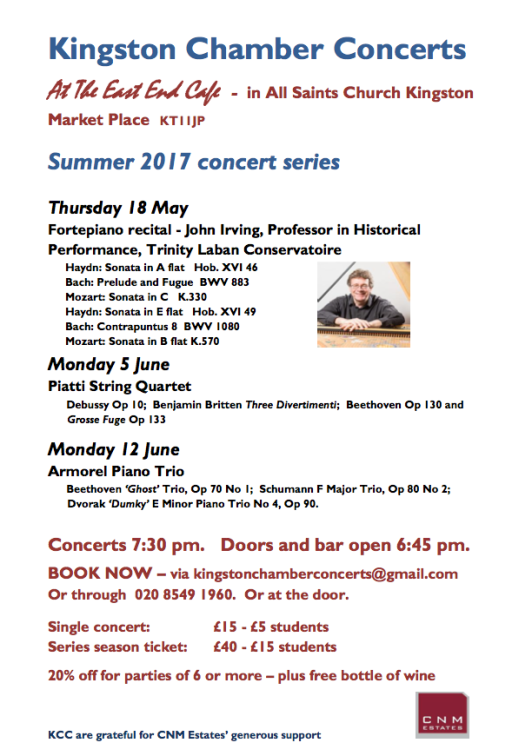
A new chamber music series launches in Kingston-upon-Thames on Thursday 18 May at All Saints Church, Kingston Marketplace.
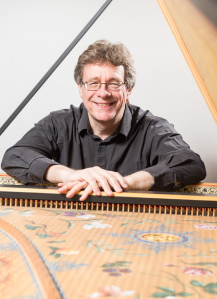
The opening concert features keyboard music by Haydn, Bach and Mozart performed on a replica fortepiano very like the type of instrument Haydn and Mozart would have known and played. The concert is given by John Irving, Professor of Historical Performance at Trinity-Laban Conservatoire in Greenwich.
Future concerts in the series include the Piatti String Quartet in music by Debussy, Britten and Beethoven, and the Armorel Piano Trio, who will perform Beethoven’s ‘Ghost’ Trio together with works by Schumann and Dvorak.
The concerts will have a relaxed format, with audience seated salon style around small tables to create a convivial atmosphere and as a reminder that chamber music was written to be enjoyed in this way.
Tickets cost £15 (students £5) for a single concert or £40 for the whole series.
Further information and booking via kingstonchamberconcerts@gmail.com / tel. 020 8549 1960
Venue: All Saints Church, Kingston Marketplace, Kingston-upon-Thames KT1 1JP
Who or what inspired you to take up the horn and pursue a career in music?
I started to play the cello at five years old as both my parents were professional string players and it seemed like the right thing to do. When I was six years old, I was diagnosed with the lung condition Bronchiectasis and this led to the decision that maybe taking up a brass instrument (with the added element of deep breathing!) would be a great way to strengthen my lungs. From there it was a case of playing in various orchestras, ensembles and listening to famous horn players which made me realise that pursuing a career in music was definitely the way forward for me.
Who or what have been the most important influences on your musical life and career?
My teacher at the Royal College of Music Junior Department, Sue Dent, was absolutely incredible for me in terms of developing as a musician both with and without the instrument. I studied with her for almost eight years before my idol, Radek Baborak, of whom I had listened to almost every recording and watched every YouTube video of, invited me to study with him in Berlin at the Barenboim-Said Academy. Aside from horn players, I was always very interested in the artistry of Rostropovich and listening to recordings made at a time before it was possible to edit them to perfection. This raw energy is something I really admire.
What have been the greatest challenges of your career so far?
I think an on-going challenge and a challenge I will have for the rest of my career is to convince first the management and organisational side to music, then the wonderful audiences that the horn should be held in high regard as a solo instrument!
Which performance/recordings are you most proud of?
Performing in the Brass Category Final of the BBC Young Musician Competition for me was the single most enjoyable musical experience of my life. I had dreamt about being on that stage for years and had really prepared every single note of my programme as well as physically possible. To be rewarded with such an incredible response from both the live audience and then the people watching at home was just amazing.
Which particular works do you think you play best?
I think when it comes to very technically difficult and abstract contemporary music, I really enjoy taking the time to figure out the puzzle and think that it is an area of music where I feel most at ease performing.
How do you make your repertoire choices from season to season?
As a young soloist, I tend to accept any invitation I get to play and more often than not, promoters already have a piece or programme in mind. Now and then it is possible to make requests and here I try and add concertos that people very rarely play and are most likely unknown to the audience.
Do you have a favourite concert venue to perform in and why?
I recently played in the KKL Concert Hall in Lucerne, Switzerland and before even stepping foot inside the unbelievable hall, had fallen in love with the town.
Favourite pieces to perform? Listen to?
One of my favourite pieces to perform is the Franz Strauss Nocturne for Horn and Piano. It is really quite cheesy but so satisfying to play and allows you to really express yourself to the audience. To listen to…will always be the Goldberg Variations by J.S Bach.
Who are your favourite musicians?
I have many favourite musicians both dead and alive! I think my teacher, Radek Baborak, is quite an extraordinary musician as is Daniel Barenboim and I am also fascinated by the wonderful percussionist Martin Grubinger.
What is your most memorable concert experience?
My debut at the Royal Albert Hall with the English Festival Orchestra was by far, for me, the most special concert I have ever been involved with. To walk out to a completely sold out RAH, with sound coming from all sides was just incredible. And then to see the audience’s faces light up with the Rondo of the third movement from Mozart’s 4th Horn Concerto was really special.
What do you consider to be the most important ideas and concepts to impart to aspiring musicians?
I think that something that is quite seriously overlooked in aspiring musicians and certainly something I overlooked is the simple fact that people should be in music and study music to enjoy it. The profession is too difficult anyway so at least enjoy making the music!
Where would you like to be in 10 years’ time?
Easier said than done but I would love to be in a position where I was performing concertos with orchestras all over the world!
Nominated by the Barbican as an ECHO Rising Star, during the 2021/22 season Ben gives recitals at major concert halls including the Concertgebouw, Musikverein, Elbphilharmonie and Köln Philharmonie, including an especially commissioned new work by Mark Simpson.
ELGAR’S REVELATORY PIANO TRANSCRIPTION OF THE ‘ENIGMA VARIATIONS’
in a new album with
RARE CHAMBER WORKS BY BRITISH 20TH-CENTURY COMPOSERS
ENIGMAS: Solo piano and chamber works
by Elgar, Leighton, Rubbra, Bowen and Sackman
Performed by acclaimed young artists:
ELSPETH WYLLIEpiano
solo and chamber recitalist, appearances at the Purcell Room, Fairfield Halls, and for BBC Radio Scotland
CLAIRE OVERBURY flute
guest player with Britten Sinfonia, the RPO, and the Hallé Orchestra
HETTI PRICE cello
appearances at the Southbank Centreand on BBC Radio 3 In Tune
ALEXA BEATTIEviola
guest player with Munich Chamber Orchestra, ensemble appearances with Lisa Batiashvili and Kim Kashkashian
CATHERINE BACKHOUSE mezzo-soprano
Britten Pears Young Artist 2015, solo appearances with Scottish Chamber Orchestra and Garsington Opera
To coincide with Elgar’s 160th birthday on 2nd of June 2017, Divine Art is releasing a recital recording of solo piano and chamber works, featuring Elgar’s own solo piano transcription of his much-loved Enigma Variations. Elgar originally extemporised and sketched out the music at the piano, and his transcription highlights the intimate nature of a work inspired by friends and acquaintances.
This is complemented by a varied collection of masterful repertoire by British composers. Edwin York Bowen’s Sonata for flute and piano is well-known to flautists and Kenneth Leighton’s Elegy is familiar to many cellists – both works deserve to be more widely-known as staples of post-romantic concert repertoire. Edmund Rubbra’s Two Sonnets by William Alabaster for trio are exquisite, essential listening, and this is the first modern-day recording with a mezzo – as Rubbra intended. Finally, a premiere recording of Nicholas Sackman’s Folio I for solo piano, a lively suite originally written for his family.
Gottschalk and Cuba is a journey through 150 years of music which started with a 19th-century American pianist-composer visiting Havana in Cuba and a 21st-century Cuban pianist who came to America telling the story……
New Orleans born Louis Moreau Gottschalk (1829-1869) was one of the most astonishing keyboard virtuosos in 19th-century America. But he was much more than that. He was America’s first important pianist-composer. He was an extraordinary traveler, bringing his virtuosity to Europe, to Central and South America and to the Caribbean, where he lived in Cuba for extended periods. As a composer, his unique style combined his Creole musical heritage with the American, Latin American and Afro-Caribbean influences he absorbed during his travels – all expressed within the boundaries of classical piano writing prevalent in the 19th century. Gottschalk made friends wherever he traveled and these far-reaching connections are the subject of Cuban pianist Antonio Itturioz‘s new project Gottschalk and Cuba, a CD containing a world premiere recording of the entire Nuit des Tropiques, Symphony Romantique, both movements, on one piano. The programme also features Antonio’s transcription for solo piano of the second movement (Fiesta Criolla) of Gottschalk’s monumental Nuit des Tropiques, (Night in the Tropics), a symphony Gottschalk wrote on the island of Martinique after living several years in Cuba. It is a historic work because it is the first symphony written by an American composer. After Gottschalk’s death, his friend Nicolas Ruiz Espadero published a two-piano version of this symphony which is the basis for Antonio’s transcription. In addition, the CD features piano music by well-known Cuban composers whose works all have connections to Gottschalk in one way or another.
The Cross-Eyed Pianist is free to access and ad-free, and takes many hours every month to research, write, and maintain.
If you find joy and value in what I do, please consider making a donation to support the continuance of the site



 New Orleans born Louis Moreau Gottschalk (1829-1869) was one of the most astonishing keyboard virtuosos in 19th-century America. But he was much more than that. He was America’s first important pianist-composer. He was an extraordinary traveler, bringing his virtuosity to Europe, to Central and South America and to the Caribbean, where he lived in Cuba for extended periods. As a composer, his unique style combined his Creole musical heritage with the American, Latin American and Afro-Caribbean influences he absorbed during his travels – all expressed within the boundaries of classical piano writing prevalent in the 19th century. Gottschalk made friends wherever he traveled and these far-reaching connections are the subject of Cuban pianist Antonio Itturioz‘s new project Gottschalk and Cuba, a CD containing a
 world premiere recording of the entire Nuit des Tropiques, Symphony Romantique, both movements, on one piano. The programme also features Antonio’s transcription for solo piano of the second movement (Fiesta Criolla) of Gottschalk’s monumental Nuit des Tropiques, (Night in the Tropics), a symphony Gottschalk wrote on the island of Martinique after living several years in Cuba. It is a historic work because it is the first symphony written by an American composer. After Gottschalk’s death, his friend Nicolas Ruiz Espadero published a two-piano version of this symphony which is the basis for Antonio’s transcription. In addition, the CD features piano music by well-known Cuban composers whose works all have connections to Gottschalk in one way or another.



 The Cross-Eyed Pianist