warwick-blair

Who or what inspired you to take up composing, and pursue a career in music?

My sisters used to play this track by Danny Kaye called ‘Thumbelina’, at 33 and a third, it was originally a 45 RPM recording, but they played it at a much slower speed, and consequently it used to freak me out, it used to scare me. I was only 3 or 4 years old, but it was the idea of the transformation of material. It remains very important to me and it marked a milestone, and if we’re talking a thread, that’s definitely one.

Who or what were the most significant influences on your musical life and career as a composer?

Although I have worked with Xenakis, and studied with Andriessen and Gilius Bergeijk; perhaps those composers can be viewed as more abstract.The fact that I was brought up in a household where Chopin’s music was revered, and played constantly, is a significant influence, resulting in an appreciation of lyricism and perhaps gesture. When I was living in London in the late 80s, I saw Dead Can Dance play at Sadler’s Wells, again a definite high point, showing me the possibilities of integrating pop cultural influences with a more classical music sound world. This shows itself in my practice today in the collision of styles, demonstrating a search for a deeper meaning, where eclectic diversity and temporal associations offer exceptional musical freedoms, where all sound is equally relevant and musical hierarchies are leveled, so that something more abstract, more universal, can emerge.

What have been the greatest challenges/frustrations of your career so far?

Although I am ambitious, being a New Zealander living in New Zealand, trying to bring my music to the world, via the UK. As I grow older and realise “who” I am; a composer, I will never stop writing music and that is the journey that I must accept and am on.

What are the special challenges/pleasures of working on a commissioned piece?

Apart from the obvious financial and emotional reward of being asked to write a commissioned work, there is no difference between a commissioned work and a non- commissioned work in terms of pleasure; they are equally pleasurable.

What are the special challenges/pleasures of working with particular musicians, singers, ensembles and orchestras?

The challenge of working with particular performers is an understanding of psychology (or sometimes psychiatry, ha ha). After all did not Ravel say performers are slaves?

Of which works are you most proud?

The work that I’m most proud of originates from 1985 called Dream State, an electronic work that is a precursor to Generative music, using the Japanese modular synthesizer, Roland System 700. I’m proud of it because it’s quite pioneering in a way. The instrumental work Electric (aka State of Being) is an opera dating from 2013, which had its world premiere at the Tête à Tête opera festival. The scene called ‘Love’, I find especially moving.

How would you characterise your compositional language?

My compositional language is quite eclectic, but broadly speaking folk or tonally influenced. There’s a sense of egalitarianism, as Louis Andriessen has said, I am working at a new kind of ‘world’ or ‘universal’ metaphysical musical language. Perhaps in a way, I’m trying to find the ‘truth’.

How do you work?

I use a variety of equipment to aid my compositional process, be it a computer, iPad, iPhone or pencil & paper. i use a lot of sampling techniques. there seems to be a conceptual approach that informs my technical processes.

Who are your favourite musicians/composers?

They tend to be mavericks, who exist outside an established or accepted system, but cross all styles, for instance whether it be pop, world or classical.

What is your most memorable concert experience?

Dead Can Dance 1988 at Sadler’s Wells.

What do you consider to be the most important ideas and concepts to impart to aspiring musicians?

Music should have a conceptual reason behind it, for instance we don’t need another string quartet to add to the canon and history of string quartets, but a work such as my Stars, a 24 hour work, could be said to have value from its very nature; it being unique, although inspired by (Gandharva music). To have something to say, to have a point of difference, not to follow the mainstream, and to listen to all sorts of music constantly. To never give up and keep going, and to share love with the world.

What is your present state of mind?
To share love with the world.


Warwick Blair Ensemble, featuring musicians from both UK and New Zealand, perform at Club Inégales (1 June), offering a unique insight into the work of the ‘enfant terrible’ of contemporary Antipodean music.

Hailing from New Zealand, Warwick Blair has a reputation of one of the most eminent composers New Zealand has produced in years. Having studied under Louis Andriessen and Iannis Xenakis, Blair’s music fuses classical and indigenous traditions with electronics in a mesmerizing minimalistic soundscape. In this London residency, he will examine the concept of memory, with the ability of the mind to retain certain information and yet reject other selective memories has fascinated the composer for many years. His performances will become his personal explorations of a musical palette that draws on various seemingly opposing genres or styles, creating a compelling and challenging soundscape.

The concerts will offer two his most eminent works, Melusine (2015) and Etuden (2014), both premiered last year during his Kingston University residency. While the former demonstrates the influence of Puccini’s lyrical melodies and Wagner’s pioneering chromaticism, but also draws on serialism, the avant-garde and contemporary songwriters, such as Lorde & Rowland S Howard, Etuden is a work that combines the influences of Chopin and Billie Holiday.

warwickblair.com

Guest post by Doug Thomas

“Music washes away from the soul the dust of everyday life.” 

This is what the German poet Berthold Auerbach might have answered had he been asked what the role of music was for him. To me, it seems plausible that music carries a significant meaning in most people’s life. Whether it is for a simple amateur, a true mélomane or a professional musician, it seems to always have a particular role, guiding people in their own existence.

In my experience, music has taken several aspects but three important ones prevail. Music has been part of my daily life for many years and wherever I go, whatever I do, it embellishes my world. It is also a great catharsis, and it is what allows me to compose and create on a regular basis. Most importantly, music is a source of intense pleasure which very few other forms of art have been able to provide me with.

Whenever I get tired of listening to silence, music comes to the rescue. I often see music in a similar way to the French composer Erik Satie – as furniture music. Music that is meant to decorate the environment or have a functional purpose. It is not necessarily music I pay much attention to. There are many situations were music sits in the background; at home on a lazy afternoon, during a dinner with friends or on a simple train journey.

I compose music for a living. In addition to fulfilling my need to create things, composing music acts as a sort of catharsis. It is a way to externalise my deepest feelings and emotions. Although I consider my music as somehow intellectual, the creative process often starts with a feeling. Whether it is the expression of happiness or deep sadness, or the simple appreciation of beauty. There is a splendid satisfaction once a piece of music is composed, a feeling of lightening, a burden which seems to go away.

Above all, I believe that music represents a fantastic source of pleasure. There are not many feelings comparable to the one I get when I hear a new piece of music that suits my tastes. Or the sensation I have when I hear one of my favourite piece performed live. Besides, there has been many scientific studies that have shown how music triggers emotional sensations in the brain.

On a daily basis, music decorates the important moments of my life as well as the most meaningless ones. When I create, music acts as a deliverer of pulses and inspirations. More significantly, when music is at its best, it is a source of intense pleasure which makes the hair on the arms stand up, and gives the sensation that time has stopped for just a few moments.

The British composer Max Richter once said that making art was a way to deal with the problem of being alive. If we perceive the arts as being a toolbox to dealing with life, then in my opinion music is perhaps the ultimate Swiss Army Knife.

Doug Thomas is a French composer and artist based in London.
 
Since founding NOOX in 2014, Doug has released numerous solo projects, including Short Stories, Vol. 1&2, Angles and Cassiopeia. His interest in multi-media collaboration has also led to engagements with choreographers, photographers and visual artists from around the world, including London, New York and Reykjavík.

Doug has studied at the Institute of Contemporary Music Performance in London, as well as with Berklee Online College of Music. Some of his mentors include Jérôme Bechet, Dylan Kay, Audrey Riley, Maurizio Malagnini, Enrica Sciandrone and Stefania Passamonte.

“Music allows me to express ideas and feelings in a unique way. Each piece I compose is an attempt in finding balance between interest and beauty, within the limits of my own language and experience. I like the idea that music can provide us with an alternative to our daily life, whether it completes it, or helps us take some distance from it.”

Doug Thomas appears in a future Meet the Artist interview at www.meettheartist.site

I don’t usually write about very personal things on this blog – except when they directly relate to my piano playing or music – but this morning we had to take the very difficult decision to have our beautiful Burmese cat Freddy put to sleep. Saying goodbye to a much-loved animal companion is never easy. Freddy had enjoyed a very long and happy life, but in the last few weeks he had become increasingly frail, could hardly stand and eventually stopped eating, and it was clear he was nearing the end of his life. As pet owners, we usually know when it is the right time to do the most humane thing (what a pity we are not at liberty to do the same to our human loved ones in similar circumstances…..). In his youth Freddy was a great wanderer, a fearless fighter and a slayer of squirrels, but he was also very companionable and he loved the company of humans.

My piano students, especially when they were young kids, loved Freddy and my other cat Poppy (who died in 2009), and Freddy would frequently “join in” with piano lessons, either by yowling loudly (he had a very distinctive miaow, a feature of his breed) while a child was playing or by jumping up on the piano, or sitting on the piano stool next to a student. Sometimes he would leap onto the keyboard and parade up and down – “Ooh look, he’s playing his scales!” the surprised and delighted student would exclaim. Once, when a pianist friend came to lunch, Freddy leapt onto the keyboard interrupting our conversation with what I claimed was “Stockhausen”. “That’s amazing!” my friend declared, rushing into my piano room to witness my cat playing “plinky plonky music”.

I’ve always lived with cats, and I’ve owned five cats (including three Burmese) during the course of my nearly 30 year-marriage. Cats strike me as good companions for pianists –  I know many pianist friends and colleagues who have cats. We both crave and often actively seek solitude and quiet, and a cat is an undemanding companion, unlike a dog who seeks attention and, rather like a toddler, cannot be left to its own devices for long. Cats are independent (something which non-cat people regard as a negative trait) and come and go as they please. Freddy would often wander into my piano room and sit under the piano, or join me on the piano bench, leaning gently against me as I played.

He will be much missed, as are all our cats, but I have a feeling we will not be without a cat for too long…..

Guest post by Benjamin Tassie

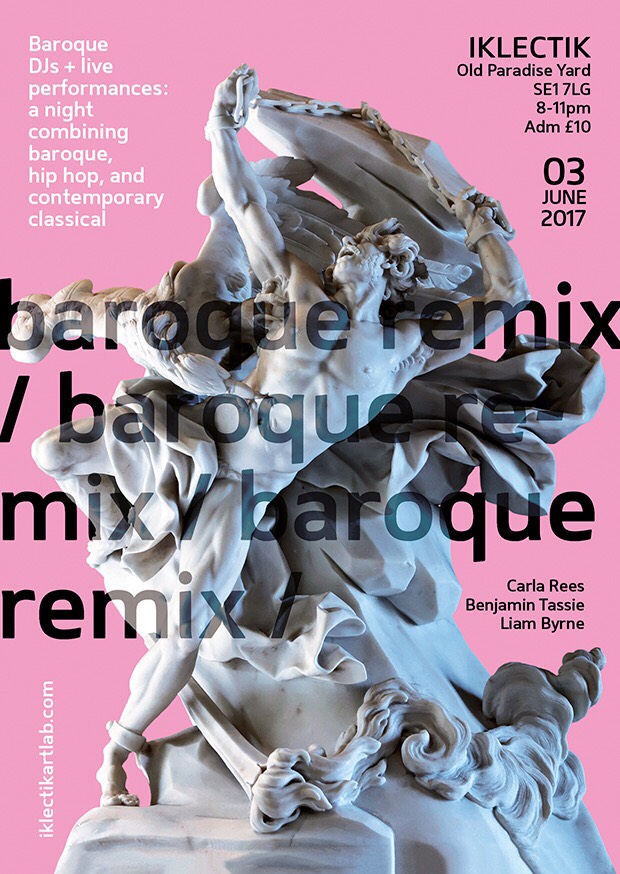
On June 3rd IKLECTIK’s performance space, bar and garden will exist between two worlds: that of the baroque dance parties of the 17th and 18th centuries, and the musical world of 21st-century London. The sound of the baroque flute and bass viol, the music of Byrd or Bach, will mix with music from across the centuries for Baroque Remix, the first full-scale incarnation of this new classical club night. Baroque DJs will ‘live remix’ baroque music, sampling Lauryn Hill or 2Pac alongside Pergolesi or Purcell. Combining the best of baroque, hip hop, R&B, and contemporary classical music, Baroque remix will reimagine baroque music with drum loops or through the synth-bach arrangements of Wendy Carlos (‘A Clockwork Orange’ soundtrack).

The evening will feature live sets from period instrumentalists Carla Rees (baroque flute) and Liam Byrne (viola da gamba) playing a mixture of old music and new, showcasing the diversity of these historic instruments. World class performances will present baroque music alongside pop arrangements and works by contemporary classical composers, in a series of small sets throughout the night that reframe these instruments for today’s new-music scene.

Previously performed at nights for the V&A (part of a museum late, opening the new Europe 1600-1815 galleries) and Royal Palaces (for ‘Queen James’, part of #PalacePride at Banqueting House), Baroque Remix on June 3rd will be the first full-scale club night, with IKLECTIK’s bar and garden the perfect informal setting for a night of unique and innovative music making.

Venue Details

IKLECTIK

Old Paradise Yard, SE1 7LG

www.iklectikartlab.com

Nearest Tube: Lambeth North / Westminster

Date and Time

03.06.2017 – 8-11pm

Tickets £10

Book tickets

IMG_4218