simon-vincent-c2a9-anna-agliardi-2015
]

Who or what inspired you to take up composing, and pursue a career in music?

When I was growing up, my parents and brothers always played records in the house, ranging from opera and instrumental classical music through to rock and blues. I listened to the charts regularly as well as all the things my family played and started buying my own records from when I was about 5 years old.

I would spend hours with my head between the speakers of the stereo, captivated by the production and ‘sound stage’ of the recordings, and I would spend just as much time recording soundtracks from the TV and things outdoors. Although I used to enjoy making short cassette tape constructions as well as exploring the pedals and strings of the piano we had at home, it occurred to me quite late that I should attempt to develop my ideas into something more compositional, or even try and notate them.

In 1986 I went to the University of East Anglia to study languages. Once there I discovered its wonderful music department and thought that this would be a ‘once in a lifetime’ opportunity to explore music further. Inspired, quite literally, by Dave Brubeck’s example, I changed to study music and have never looked back. I have the composer Denis Smalley, my then teacher, to thank for opening my ears to so many unknown musical worlds and for setting excellent standards in both composition and performance.

Who or what were the most significant influences on your musical life and career as a composer?

I am always influenced by the things around me, as I like to keep my ears and eyes open. I hope that that will never change and I still enjoy keeping up to date with pop music and other dance and club-oriented things, something I was able to pursue professionally as a DJ for a while. But my musical life has also been influenced by any explorations of structure, space and narrative (political, spiritual or otherwise) that I find interesting, ranging from the buildings of Zaha Hadid and Denys Lasdun, the poetry of Adrienne Rich and Seamus Heaney, to the speeches of Martin Luther King Jr. to name but a few.

Musically Dave Brubeck’s daring improvisations and the intensity of his voice have certainly been a big influence on me, as has, for example, Miles Davis’ stunningly adventurous conception of sound. Karlheinz Stockhausen has, however, been perhaps the biggest influence. The clarity, playfulness, and the human quality of his composed/improvised music is something I learned from enormously. I have a postcard from him on which he wrote “balance your music!”, after he listened to one of my compositions. That’s something I’ve tried to adhere to.

What have been the greatest challenges/frustrations of your career so far?

Of all the challenges I suppose finding new paths, being original (but never at the expense of the quality and intention of the work) and ‘remaining true to myself’ are the greatest. Of course, they could easily become frustrating but I always see them as something positive, something that helps me grow and learn.

Getting pieces heard can however be frustrating as can the sadly often conservative programming of so-called ‘experimental’ concerts and festivals. The musical landscape has changed dramatically in the last 20 years, and so the challenge to be open to new spaces, open to the development of new musical languages but at the same to be true to oneself and to produce works of quality certainly doesn’t diminish in importance.

What are the special challenges/pleasures of working on a commissioned piece?

I really like working on commissioned pieces for two reasons: Firstly, if the piece is either for myself to perform or simply for electro-acoustic playback, I enjoy having free reign to explore what I need to explore; secondly if the work is for someone else, I very much enjoy being influenced, even slightly, by the tastes, characteristics and abilities of the performer in question. That way, the work becomes tailor-made in some aspects. Mr Gee’s Magical Trombone Case, a suite of 3 electro-acoustic miniatures commissioned by Principal RPO trombonist Matthew Gee, contains for example many of his performance gestures and my reflections on his sense of humour. It is a lot of fun to work with him.

What are the special challenges/pleasures of working with particular musicians, singers, ensembles and orchestras?

I suppose very similar to the above. We are all humans and I love each player’s idiosyncrasies. Working with musicians in that way is a very human exchange and leads to an often unique experience and dynamic.

Of which works are you most proud?

‘Pride’ is a word I never use to describe my creative activities, or indeed myself as a whole. There are certainly compositions which I have feel have successfully reached the goal and expressed the message that I may have had in mind, and even though the very act of composition will sometimes take me in a new and surprising direction, I might still feel satisfied that some good work has been done, that the goal has been reached and the message successfully communicated. Such pieces might be 5 Portraits for Solo Piano (1992), Comma 02 (2006), Falling Man, Rising Woman (2015), and three very recent pieces from 2016 La Mia Coppa Trabocca for Piano & Electronics, Mr. Gee’s Magical Trombone Case and Stations of the Cross for Solo Piano.

How would you characterise your compositional language?

Searching, questioning.

How do you work?

Earlier in my career, I would compose 3-4 days per week, but now, I’m experiencing a flood of ideas that I have to get out. I can’t keep myself away from the studio or away from the piano, but I am organised and work methodically, even sometimes late into the night. I also like to work in isolation.

Who are your favourite musicians/composers?

There have been (and still are) so many but to name just a few: Dave Brubeck; Miles Davis; Karlheinz Stockhausen; Beethoven; Bartók; Haydn; Morton Feldman; Trevor Wishart; J.S. Bach (he scares me, in a good way); Mitsuko Uchida; Julius Drake; the very sound itself of acoustic and electro-acoustic instruments, which all have their own characteristics and personalities.

In my direct circle of friends, I would have to say Roland Fidezius and Rudi Fischerlehner, both members of The Occasional Trio. They are simply a joy and always an inspiration to work with. Also Tom Arthurs, who is without doubt one of the finest musicians I know. And finally Sophie Tassignon, an artist who uses her voice to create fantastic clouds of sound.

What is your most memorable concert experience?

Again, there have quite a few but to name two of them: A Brubeck concert in 1997 in Bath, where he took some breathtaking harmonic and rhythmic risks that I still remember clearly

to this day; Michael’s ‘Reise um die Erde’ from Stockhausen’s Donnerstag aus Licht which I saw performed in 2016 in Berlin. The music was so exquisite and touching, that I cried at the end of the concert and couldn’t speak for quite a few hours afterwards.

What do you consider to be the most important ideas and concepts to impart to aspiring musicians?

Explore, find your voice, and let no one stand in your way.

Where would you like to be in 10 years’ time?

Composing and performing.

What is your idea of perfect happiness?

Peace and tranquility, a moment’s rest from everything, to be able to sit and watch the world. A meal together with friends. To work at the piano or in the studio and be inspired.

What is your most treasured possession?

My soul. It guides me and I treasure it dearly.


Nominated in 2014 for a Paul Hamlyn Award for Artists, Simon Vincent is a performer and composer of acoustic and electronic music, who has been challenging the boundaries of genre and musical expression with a highly personal language since the early 1990’s.

“Visionary and expressive”, “rich and surprising”, “beautiful music”, “intelligent”, “delicate”, “impressionistic”, “fresh”, “incredibly individual”, “masterful compositions”, Simon’s music has attracted praise and radio play from critics as varied as Ben Watson, Julian Cowley, Nick Luscombe, Massimo Ricci, Gilles Peterson, Mr. Scruff, Fourtet, AtJazz, and has been reviewed internationally in many publications including The Wire, De:Bug, Knowledge Magazine, Dragon Jazz, Extranormal and Kudos.

Releasing work on Erstwhile Records, EMANEM, L’innomable, Good Looking Records, as well as  own label Vision of Sound, Simon’s unique work has led to appearances worldwide at the Glastonbury Festival, Rotterdam Film Festival, Akademie der Künste (Berlin), ICA London, London Fashion Week, Club Transmediale (Berlin), National Museum (Stockholm), Progression Sessions (London), Huddersfield Contemporary Music Festival, Internationale Ferienkurse für Neue Musik (Darmstadt), Q-02 (Brussels), Visiones  Sonoras (Mexico City), Making New Waves (Budapest), >Sync 2013, as well as on Resonance FM, BBC Radio 3, Ministry of Sound Radio, and FM4-Austria among many others.

He started Vision Of Sound Records & Publishing in 1997 to promote his contemporary classical and experimental music, and is currently recording selected solo piano compositions for release in April 2017, as well as composing new works for London-based trombonist Matthew Gee and Malmö-based pianist Jesper Olsson.

 
 (photo: ©Anna Agliardi)

What do you do when you read a concert review that you disagree with? Do you bristle with ripe indignation because the reviewer did not concur with your view of the concert and then fire off some harrumphy comments in response, informing the reviewer that they clearly need their hearing tested? (I’ve had a couple of comments like this in response to reviews on this blog – it does happen!) Or do you read the review in a considered way, accept that not everyone is going to agree with you, and be glad that it’s possible for people to express differing (sometimes wildly) opinions?

Nowadays, we live in a world where everyone is a critic: whether someone has seen one show or several thousand, they have an opinion about them and the means to broadcast them. But it is palpably false to say that all opinions are equal. Some people stand above the noise and clamour of the internet simply by virtue of the credibility their opinions have earned.

– Mark Shenton, The Stage

The internet has made us all “reviewers” to a greater or lesser extent: from “likes” on Facebook or Instagram to product reviews on Amazon to long articles on personal blogs and mainstream news sites, the medium allows us to express our thoughts and opinions like never before.
On one hand this can be wonderful: it adds variety to discussions and fuels debate; but the internet also seems to have created a place where every entrenched or polarised view is expressed without the nuance that comes from more considered or face-to-face interactions. People can be far more brutally frank or insensitive in the anonymity of the web than they would ever be to someone’s face. Sometimes when I read comments on concert reviews I see quite of lot of responses which suggest, none too subtly, that “if you don’t agree with me, you are wrong!”. Twitter is, sadly, one of the worst places for this – the brevity of the medium (140 characters) seems to encourage polarity and confrontation rather than nuanced discussion. The commentator might counter that “everyone is entitled to their opinion” but a sense of entitlement is not enough: as far as I’m concerned, you’re only entitled to an opinion if it’s an informed opinion….
 The problem with “I’m entitled to my opinion” is that, all too often, it’s used to shelter beliefs that should have been abandoned. It becomes shorthand for “I can say or think whatever I like” – and by extension, continuing to argue is somehow disrespectful. And this attitude feeds, I suggest, into the false equivalence between experts and non-experts that is an increasingly pernicious feature of our public discourse.
– Patrick Stokes
An example of this is the reaction online to a review in The Washington Post of a concert by pianist Sir Andras Schiff. A flurry of comments online in response to the review reveal an uncomfortable amount of entrenched or binary views rather than accepting the review as an informed, coherent write up offering one person’s opinion of the concert. Of course it doesn’t help that it’s a review of an artist whose statue borders on sacred and who is regarded by many as a high priest of the piano.
Many concert-goers, and even some critics and reviewers, feel a very special, personal connection to performers like Andras Schiff, or Martha Argerich, Maurizio Pollini, Yuja Wang, and many others. We seek out our favourite artists, enjoying the special magic they create for us personally in their performances and recordings (and never forget that music is a highly personal, subjective experience). Social media platforms like Twitter allow us to contact and interact with many of these artists directly, giving us an even greater personal connection with them. We place these people on pedestals for our personal worship and we’ll argue vociferously with those who do not share our reverence and admiration. And that’s fine – just so long as we’re able to accept that others have differing tastes and opinions.
But it troubles me when I come across comments which accuse the reviewer of being “wrong” or worse “stupid” simply for not appreciating a concert in the same way as the reader did. Reviews offer a record of an event and express one person’s opinion: it is neither right nor wrong, merely an opinion. In a well-written, coherent review, the reviewer should be able to write a record of the concert based on a degree of knowledge, to describe the music and performance, and explain why he/she liked or disliked aspects of the concert, in language which is intelligent, considered and fair, rather than just making bald unsubstantiated statements or, worse, hiding their lack of an opinion or knowledge in purple prose or jargon-ridden, high-falutin language.
The purpose of a review is to provide a record of what happened at a performance and to evaluate what happened, whether the reviewer heard greatness, horror, or mediocrity. Evaluation is what sets a reviewer or critic apart; a reviewer theoretically has enough knowledge and experience to support the opinions they form about a performance.
– Lisa Hirsch, Iron Tongue of Midnight
Some years ago, an acquaintance, who knows about my reviewing and blogging activities, wrote to inform me that he thought a certain international concert pianist, one whom I much admire and have reviewed several times in concert, was an example of “the emperor’s new clothes”. There was no further explanation as to why this person held this view of the pianist in question (and I suspect the comment was largely driven by professional jealousy). Now, if asked, I could give at least three coherent, considered reasons why I admire this particular pianist, or indeed any of the other musicians whom I admire, and I would expect – nay, welcome – someone who disagrees with me to be able to argue otherwise in a similarly coherent, substantiated way.
All of this reminds me of that quote attributed to Voltaire: “I disapprove of what you say, but I will defend to the death your right to say it.” In the curious and very noisy echo-chamber of the internet, it serves as an important reminder that we should take note of the opinions of others, to respect or accept them, to respond in a more nuanced way, and to agree to disagree.
707px-graham27s_hierarchy_of_disagreement-svg
 Hierarchy of disagreement (source: Wikipedia)

Who or what inspired you to take up the piano and pursue a career in music?

I came to the piano quite early – when still in my mother’s womb! She’s a piano teacher and when 5 months pregnant with me, she played her diploma recital from Berlin university, so I was quite close to the keys from the beginning. I started playing the piano before being able to speak (I was admittedly rather slow when it came to forming words), and there are pictures of me playing the piano as soon as I was tall enough to reach for the keys, high above my head.

Who or what were the most important influences on your musical life and career?

That would be my parents. My mother, the piano teacher, and my father who is a composer and architect. Mum introduced a lot of the classical and romantic repertoire to me, while dad brought 20th century music to my attention, relatively early on.

What have been the greatest challenges of your career so far?

Finding my way after my study years in New York, moving to Europe with practically no professional connections and nothing going for me. I wanted to build my career without doing piano competitions and realized that I needed to become my own teacher and find my own way once I had finished school. So I had a lot of time for self-study and focused especially on the works of J.S. Bach, started my own record company and later also started a music festival in Reykjavík, and gradually began to get more and more invitations to play concerts. But it wasn’t always easy. Getting a manager seemed very difficult early on, I sent some CD’s and letters to different people and never got answers. I felt the business was simply impossible, that no one was listening, regardless of how you played or what you did. But bit by bit things started to happen and it helped me quite a lot when Alfred Brendel reassured me in 2012 by telling me that “it takes 15 years to become famous overnight”. I think that holds true for the great majority of International performers, but not many people talk about it.

Which performance/recordings are you most proud of?

It’s easy to look at everything one has done and only see the things that one would have liked to do differently in the present. I think we have to embrace the different phases of our artistic development and often I find that peformances from the past are considerably better than I had imagined and worried.

I’m rather happy about my Bach-Chopin album from 2011 with Partitas No 2 and 5 and the 24 preludes, I can listen to that disc and enjoy it. For concert performances, I’ll mention my first Rach 3 performance, from 2007 with Iceland Symphony and Rumon Gamba (on Youtube). I was actually very unhappy with myself after the concert but today I don’t really understand why.

Which particular works do you think you perform best?

Not for me to say, but I do feel very comfortable in the works of J.S. Bach and Ludvig van Beethoven.

How do you make your repertoire choices from season to season?

I try to have a healthy balance of adding new concertos and recital works to my repertoire and to revisit works I’ve played before. I also try to commission and premiere a new Piano Concerto every 2-3 years. Right now, I’m actually more into revisiting works, but I’m still adding 3-4 piano concertos every season and probably 1-2 recital programmes.

Do you have a favourite concert venue to perform in and why? My favourite venue is Harpa in Reykjavík. I was honoured to perform the very first concert in the big hall in 2011, the Grieg Piano Concerto with Iceland Symphony and Vladimir Ashkenazy, and I still get this extra buzz of excitement when going on stage there. Besides, the acoustics are marvellous, the pianos great and backstage you have the view of the ocean and Mount Esja, my favourite mountain.

Who are your favourite musicians?

The ones who keep an open ear and never take anything for granted.

What is your most memorable concert experience?

The opening concert of Harpa Concert House in 2011.

What do you consider to be the most important ideas and concepts to impart to aspiring musicians?

I think the most important is to find a way to become your own teacher. For that you have to try to develop the skill to listen to yourself while you play as if you were sitting 15 meters away in the hall. Quite paradoxical. Nothing is better in this regard than recording yourself, whether at home or for an album release. But it can be painful and one always wants to practise just a little bit more before pressing the rec button and having to look in that musical mirror…

Where would you like to be in 10 years’ time?

Alive and playing great music!

What is your most treasured possession?

My Steinway B model Grand Piano from 2009 and my gorgeous Longman and Broderip Square Piano from 1785.

What is your present state of mind?

I’m on an airplane as I write these answers, heading to Iceland. It’s 25th February and somehow I’ve already played 12 concerts this month. I’m a bit tired and am so looking forward to having 10 days of break!


Possessing a rare combination of passionate musicality, explosive virtuosity and intellectual curiosity, Icelandic pianist Víkingur Ólafsson has won all the major prizes in his native country, including four Musician of the Year prizes at the Icelandic Music Awards as well as The Icelandic Optimism Prize.

Víkingur grew up in Iceland where he studied with Erla Stefánsdóttir and Peter Máté. He holds Bachelor’s and Master’s degrees from The Juilliard School, where he studied with Jerome Lowenthal and Robert McDonald.

Read Vikingur’s full biography

[Interview date: 25th February 2017}


(picture: Harrison Parrott)

“The loneliness doesn’t worry me……I spend most of my life alone, even backstage…….I’m there completely alone. I like the time alone….”

Stephen Hough, speaking on BBC Radio 4’s Desert Island Discs

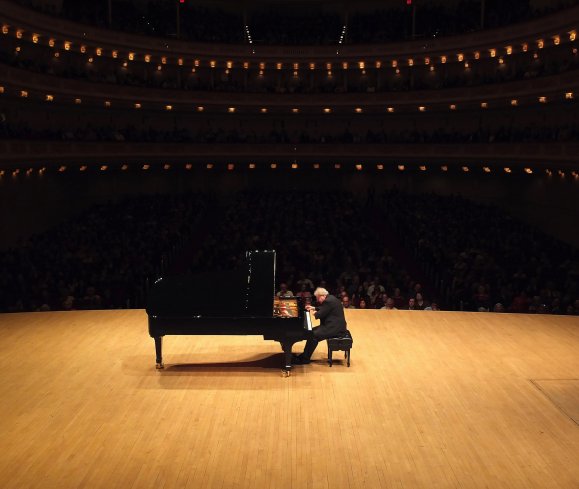
The pianist’s life is, by necessity, lonely. One of the main reasons pianists spend so much time alone is that we must practise more than other musicians because we have many more notes and symbols to decode, learn and upkeep. This prolonged solitary process may eventually result in a public performance, at which we exchange the loneliness of the practise room for the solitude of the concert platform.

Most of us do not choose the piano because we are loners – such decisions are usually based on our emotions, motor skills or the aural appeal of the instrument. For me, as a child – and an only child – the piano was a companion and a portal to a world of exploration, fantasy and storytelling. It remains a place to retreat to and time spent with the instrument and its literature can be therapeutic, rebalancing and uplifting. For many of us, being alone is the time when the sense of being at one with the instrument is strongest.

In addition, there is time alone spent listening to recordings – one’s own (for self-evaluation) and by others (for inspiration and ideas on interpretative possibilities, or purely for relaxation) – and time simply recovering from practising and refocusing in readiness for the next session. Many pianists tend to be loners – the career almost demands it and self-reliance is something one learns early on, as a musician – but that does not necessarily make pianists lonely or unsociable.

To me it’s always about connection – connecting with parts of myself, with the thoughts and feelings of the composer, and ultimately sharing with an audience. It’s travelling through time and space to experience other eras and cultures…..I can’t think of anything that makes me feel less lonely!

Stephen Marquiss, pianist & composer


The life of the concert soloist is a strange calling, yet many concert pianists accept the loneliness as part of the package, together with the other accessories of the trade. The concert pianist experiences a particular kind of solitude (as noted by Stephen Hough in the quote at the beginning of this article). The solitude of travelling alone – the monotony of airport lounges, the Sisyphean accumulation of airmiles, nights spent alone in faceless hotels. Dining alone, sleeping alone, breakfast alone, rising early to practise alone. And there is the concert itself: waiting backstage, alone, in the green room, and then the moment when you cross the stage, entirely alone….. The pianist Martha Argerich has described the “immense” space around the piano that has always made her feel alone on stage. But it is this aloneness, this separation, which the solo pianist exploits for the purpose of captivating and seducing the audience, drawing them into his or her own private world for the duration of the performance.

I suppose being an introvert in a ‘public performance’ profession has been my greatest challenge. It isn’t straightforward, of course – I seem to have a deep need to communicate music to an audience and get their reaction, and I love to be appreciated, but there are many other aspects of being ‘on show’ that don’t come naturally. I’m very interested in people, but I’m quite a private person and need lots of time to myself.

Susan Tomes, pianist and writer

The traditional positioning of the piano on stage, so that the pianist sits side on to the audience, heightens this sense of separation and aloneness. In a concert, the pianist must navigate a path between private, subjective feelings and public expression in a curious display of both isolation and exhibitionism. The power of performer, and performance, is this separateness from the mass of audience. Some performers may exploit this to create a sense of “us and them”, while others are adept at creating an intensity or intimacy of sound and gesture during which the audience may feel as if they have a private window onto the pianist’s unique world, in that moment.

emanuel-superjumbo

Up there on the stage, one can feel more alone than anyone would ever care to be, yet it can make one better than one thinks possible because one’s ego is constantly being tested when one plays. To meet a Beethoven sonata head on, for example, it stops being about you – how fast you can play, how technically accomplished you are. Instead it is about getting beyond oneself, becoming ego-less, humble in the face of this great music, developing a sense of one-ness with the composer…..

After the performance, when the greeting of the audience and CD signing is over, the pianist may happily retreat to his or her solitary practise room or studio. Many of us long for this special solitude and actively relish the time spent practising alone.

The internet and social media has, for many of us, been a huge support in relieving feelings of loneliness and separation. Facebook, Twitter and other social media platforms enable us to connect with pianists and other musicians around the world, allowing us to preserve our solitude, while also engaging meaningfully with others when required.

An earlier version of this article appeared on the Pianodao blog


(Picture: Emmanuel Ax in recital at Carnegie Hall, photo by The New York Times)


