Is it Chopin? Or Liszt? Or maybe Brahms? To the ingenue listener, Scriabin’s first piano sonata suggests all of these composers – Chopin’s long-spun lyricism, Liszt’s sweeping romanticism, Brahms’ plangent, orchestral textures, or maybe even Rachmaninov on a fantasy-frolic. But as Alexander Scriabin’s great friend, Leonid Sabaneyev said “he is not like Chopin. He is like Scriabin“.

Scriabin inhabits a distinctive, personal soundworld which is hard to define. It is the music of excess, ecstasy, tumult and passion. It is excessive, overripe, decadent, heavily perfumed, languorous and frenzied, lacking in structure and sometimes downright bizarre. The music of extremes, it is “hyper everything”, and as such it defies description or categorization. Its language is complex, often atonal and frequently almost impenetrable. For some listeners, and artists too, it is this “over-the-top-ness” that is off-putting; for others, myself included, it is this sense of excess and rapture that is so compelling. His personal life and outlook mirrored the excesses of his music: he was dissolute, he could be outrageous, he had high-falutin’ ideas of his own self-worth, and he believed music should be intimately connected to all of human experience. Perhaps this explains the breathless sensuality, the roaring passion and mystic spirituality of his music. All of human life is here, in all its ecstasy.

Scriabin was also a synaesthete, as I am, and it was his synaesthesia which initially drew me to his music.

…..he wrote and spoke of the colours of his music, of the constantly changing shapes that chords and rhythms and melodies could summon up, almost like a spiritualist at a séance. His scores bristle with detailed and evocative markings designed to help the performers imagine what the listeners see and feel.

– Gerard McBurney

The ten piano sonatas chart the course of Scriabin’s musical development more faithfully than any of his other music. The last sonatas hint at where his music was heading and offer a captivating glimpse into his adventures in atonality, while the early ones demonstrate his forays into late-nineteenth-century romanticism, the music of his compatriot Rachmaninov.

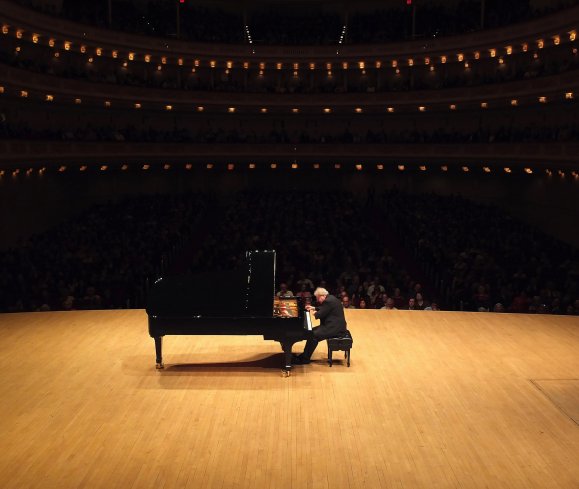
In presenting Scriabin’s ten piano sonatas in a single concert, British pianist Peter Donohoe amply demonstrated the variety of Scriabin’s writing for the piano – its rich textures, trembling filigree gestures, mystic perfumed harmonies, and ferocious virtuosity (Scriabin was a fine pianist himself). From the first youthful sonata, written a year after Scriabin left the Moscow Conservatoire and at a time when he was raging against a self-inflicted injury to his right hand, to the incense-laden mysticism of the ninth, the infamous “Black Mass”, Peter Donohoe plunged into the programme with relish. Never mind that there were still nine sonatas to go, the first was played with pulsating power and energy.

The programme was not presented entirely chronologically, and the middle section of the concert featured sonatas six, seven and eight, played in a single sequence without applause (as requested by the performer). At this point, one simply submitted to the music, to be drenched in myriad sounds and textures. Here Scriabin’s kaleidoscopic tonal palette, filigree figurations, perfumed sonorites and complex rhythms were magically brought to life by a pianist who totally “gets” this music. Hauntingly-lit piquant harmonies, ethereal accompaniments, jazz idioms, Peter Donohoe brought muscularity and featherlight delicacy to this ecstatic music.

The music was interspersed with engaging readings by Gerard McBurney, which illuminated the music and the man. These were accompanied by projections behind the piano, mostly grainy photographs of the composer and his friends, or abstract images which were supposed to suggest a synaesthete’s response to the music. For this synaesthete, it was rather awkward – and I suspect it may have been for Scriabin too: for him key of F was associated with deep red, while for me it is mauve, yet we were treated to blue during the first sonata (in F minor).

I was disappointed not to be able to stay for the final segment of the concert, but I have Peter’s recording of the complete Scriabin Piano Sonatas to enable me to complete this magnificent journey.

Who or what inspired you to take up viola and pursue a career in music?

Growing up, I was often the slightly withdrawn aesthete picking up beautifully coloured leaves on the football pitch rather than playing the game, so in a way I think I was just waiting to find the right creative outlet. The moment came when, aged 10, I decided to play the viola in my school orchestra. It became clear immediately that I had found the medium and instrument that sparked my imagination. Unusually, I never played the violin or indeed any other instrument before the viola – my first read notes of music were in the dreaded alto clef! It seemed that EVERYONE else wanted to play the violin, and my lanky limbs and desire to be different made the sultry viola a natural choice. My parents are not musicians but are great appreciators of music of all styles and so I always loved listening to (and dancing around to) music from an early age so was thrilled to finally be able to make it myself.

Who or what have been the most important influences on your musical life and career?

Throughout my musical development I have had a number of inspiring teachers and mentors. I grew up in Atlanta, Georgia, home of Marilyn Seelman, violist and pedagogue extraordinaire, and she completely changed the course of my musical life (and the flexibility of my bow hold), seeing a future brighter and bigger than I had ever envisioned for myself. I then went on to the New England Conservatory of Music in Boston where Carol Rodland taught me all about co-ordination, tension-free playing and musical abandon, Martha Katz guided me in the great art of chamber music playing and how to search for the perfect and most creative sound at any given moment, and Katarina Miljkovic opened my ears to and sparked my passion for the vast array of music written since 1950. I then finished my studies in London with the great David Takeno whose irrepressible enthusiasm about music and unbelievable work ethic continue to be a daily inspiration.

What have been the greatest challenges of your career so far?

Confidently forging my own musical path, trusting my instincts and not being afraid to take musical and career-related risks.

Which particular works do you think you play best?

I particularly relate to anything which showcases the extreme, beautiful and huge emotional/sonic range of the viola.

How do you make your repertoire choices from season to season?

Often these choices are made based on a number of logistical factors such as commission schedules, artist availability, etc., but one strategy I love to employ is to construct a programme around a single work that is particularly special to me. For example, the recital I have coming up in June, centred around Debussy’s Sonata for flute, viola and harp (with the wonderful Gabriella Dall’Olio and Anna Noakes). The Debussy has long been one of my favourite pieces of music and I’m particularly interested in placing canonical works of the past in dialogue with music of our time, in this case Saariaho’s stunning ‘Vent Nocturne’ for solo viola and electronics, Garth Knox’s duos with viola powerhouse and fellow Atlantan Jennifer Stumm and a new work for solo viola and sampled sounds by a student composer from Trinity Laban.

Do you have a favourite concert venue to perform in and why?

I’ve played in a wide variety of venues in recent years, from celebrated concert halls to clubs, basements and living rooms, and it would be hard to pick a favourite. Generally, I love playing anywhere with an excited and attentive audience. In terms of enthusiasm and energy, I remember being blown away by the audiences in Japan and Korea and for full houses of seasoned concert goers up for the most challenging of new music night after night, Vienna’s Konzerthaus.

Favourite pieces to perform? Listen to?

To perform: I love the quicksilver energy, vitality and youthful fearlessness of Mendelssohn’s chamber music, the beauty and power of Jonathan Harvey’s ensemble works and the primal pyrotechnics of Luciano Berio’s viola music (I’m looking at you, Sequenza!).

To listen to: Beethoven symphonies and violin concerto, Brahms chamber music (early Cleveland Quartet recordings particularly), Mozart Requiem

Who are your favourite musicians?

Gidon Kremer, Kim Kashkashian, Joseph Szigeti, Helmut Lachenmann, Whitney Houston, Little Dragon, Beyoncé Giselle Knowles-Carter

What do you consider to be the most important ideas and concepts to impart to aspiring musicians?

Try to understand why you are making music, what you want to say in your interpretations and to whom you want to say it. Without getting too fluffy, I really do think it’s also important to always remember what a privilege it is to make art professionally and to never take it for granted – the world needs more gratitude and we can start with being grateful for the enlightening task we as musicians have been set!


Since making his concerto debut at 17, violist Stephen Upshaw has played in prestigious halls (Carnegie Hall, Barbican, Wigmore Hall, Vienna’s Konzerthaus, Amsterdam’s Concertgebouw…) and festivals (Lucerne, Salzburg, Huddersfield, City of London, Aix-en-Provence…) around the world. A recognized interpreter of contemporary music, he has worked regularly with ensembles such as Klangforum Wien and Ensemble Modern, collaborating with composers such as Heinz Holliger, Julian Anderson, John Adams, Helmut Lachenmann and Michael Finnissy, who recently wrote a new solo piece for Stephen.

Stephen has a strong interest in synthesizing music with other fields and has helped realize collaborative projects with the Boston Architectural College, Transport Theatre Company, Hofesh Shechter Company, Rambert Dance Company and Parasol Unit Art Space. He is also the founder and Artistic Director of Sounding Motion, a company combining contemporary music and dance.

He holds a BMus(Hon) from the New England Conservatory of Music (Boston) and completed his Postgraduate studies in the class of David Takeno at the Guildhall School of Music and Drama. In 2016 he was awarded the Richard Carne Fellowship for solo artists at Trinity Laban.

www.stephenupshaw.com


 ENO’s 2017/18 season features four new productions and five revivals at the London Coliseum, supported by a number of projects in other venues

Daniel Kramer directs his first opera as ENO Artistic Director, a new production of La traviata starring Claudia Boyle in her role debut as Violetta

Martyn Brabbins begins his first full season as ENO Music Director, conducting performances of Marnie and The Marriage of Figaro

ENO presents the world premiere of Nico Muhly’s latest opera, Marnie, directed by Michael Mayer and conducted by Martyn Brabbins

A new production of Verdi’s Aida opens the 17/18 season, conducted by Keri-Lynn Wilson. After sell-out performances of his Olivier Award-winning Akhnaten, Phelim McDermott returns to direct

Cal McCrystal directs a new production of Gilbert and Sullivan’s Iolanthe, starring ENO Harewood Artist Samantha Price in the title role alongside ENO favourites Andrew Shore and Yvonne Howard

Regent’s Park Open Air Theatre and ENO present a new production of The Turn of the Screw, directed by multiple Olivier Award-winner and Artistic Director of the Open Air Theatre, Timothy Sheader. ENO Mackerras Fellow Toby Purser conducts

Revivals of audience favourites include Jonathan Miller’s The Barber of Seville, Richard Jones’s Rodelinda, Phelim McDermott’s Satyagraha, Robert Carsen’s A Midsummer Night’s Dream and Fiona Shaw’s The Marriage of Figaro

A raft of exciting British conductors new to ENO includes Leo McFall, Alexander Soddy and Hilary Griffiths. Keri-Lynn Wilson and Karen Kamensek return after acclaimed debuts in the 2014/15 and 2015/16 seasons respectively

Over 93% of cast and conductors in the 2017/18 season are British born, trained or resident. Rodelinda, Iolanthe and Satyagraha all feature casts that are entirely British born, trained or resident

More than 15 principal roles across the 17/18 season will be taken by current or former ENO Harewood Artists.

Over 39,500 tickets are available for £20 or less across the 17/18 season (500 for every performance)

ENO 2018/19

In November and December 2018 ENO will honour the 100th anniversary of the end of the First World War with a moving and contemplative interpretation of Benjamin Britten’s War Requiem. Directed by Daniel Kramer and conducted by Martyn Brabbins, ENO’s award-winning Chorus will be at the dramatic and musical heart of these performances of Britten’s masterpiece. The exceptional team of soloists comprise soprano Emma Bell, tenor David Butt Philip and baritone Roderick Williams.

Daniel Kramer and Martyn Brabbins will work together again for the final production of the 2018/19 season. ENO and Opera North will co-produce the world premiere of composer Iain Bell’s fourth opera, Jack the Ripper, with Rupert Charlesworth in the title role. A sympathetic exploration of womanhood in London’s East End, the central roles will be created by some of the UK’s finest singers including Josephine Barstow, Lesley Garrett, Susan Bullock, Janis Kelly and Marie McLaughlin.

www.eno.org
(Source: ENO press release)

william-howard-plays-sixteen-love-songs-for-piano-lst198567

Love, in its infinite variety, was in the air at Hoxton Hall on Wednesday evening for a concert of newly-written love songs for solo piano, performed by British pianist William Howard. The event was the first of three marking the culmination of William’s Love Song Project, which began with the release of William’s album of romantic songs without words, Sixteen Love Songs, in June 2016. Having commissioned and performed music by living composers throughout his career, William wanted to explore the possibility of creating a contemporary version of his Sixteen Love Songs, modern songs without words on the theme of love which would connect to the composers featured on the Sixteen Love Songs disc. From an idea discussed while hill-walking with composer Piers Hellawell, the Love Song Project came to be and was met with great enthusiasm by the composers whom William initially approached.  Alongside the commissioned pieces by leading British composers including Robert Saxton, Judith Weir, Bernard Hughes, Cheryl Frances-Hoad and Howard Skempton, William launched a composing competition which yielded 526 entries, of which we heard the first, second and third prize winners in the under 25 and over 25 categories.

The subject of love is, of course, the major preoccupation of pop songs and composers of the Romantic period, but has rather fallen out of favour amongst modern and contemporary composers whose focus seems to be more abstract or concerned with the big issues of the day such as climate change or political upheaval. In his introductory talk, William explained that this  “very indulgent” project had revealed a great variety of compositional languages, imagination, moods and character. Many of the works are very meaningful, or highly personal, are easy to relate to and travel far beyond the confines of the strictly defined genre of “classical music”. What the works share is their brevity, and “an overwhelming tenderness for the piano” (Piers Hellawell), and reveal the infinite lyricism and resonance of the piano.

Aside from the championing of contemporary composers, the project has produced a wonderful body of new repertoire for solo piano to suit all tastes.

The audience was invited to give feedback and select favourites from the programme of 12 pieces, but it would be hard to choose one stand-out piece from such a broad range of very fine music. The winning competition entries had clearly been selected with thought, the judges careful to avoid imposing their own stylistic agenda on the pieces, and these were interleaved with commissioned works to create a programme of great charm and variety. The works reflected the myriad facets of love – from tender pieces written for babies or children (‘Camille’ by Joby Talbot, ‘Daniel Josiah is Sleeping’ by Simon Mawhinney) or a partner (‘For Teresa’ by Robert Saxton, which quotes Beethoven’s ‘Fur Elise’, another love song for piano, and is redolent of Schumann’s heartfelt outpourings to Clara in its melodic lines and rich textures). Other works focussed on more abstract aspects of love, or love other than the human kind (‘Arbophillia’ (love of trees) by Samuel Cho Lik Heng, third prize winner in the under 25 category). The programme ended with Cheryl Frances-Hoad’s ‘Love Song for Dusty’, which pays homage to both Dusty Springfield (“a temporary obsession of mine when I discovered that other types of music existed other than ‘Classical’“) in its song structures (verses, choruses, bridges) and pop-infused harmonies, and also to the nineteenth century composers of sweepingly romantic piano solos and songs without words such as Mendelssohn and Liszt. It had a wonderful warmth suffused with wit and humour. William’s sensitive, graceful playing brought to the fore the individual characters of each piece, not an easy task when one is moving between very short pieces of contrasting mood and style.

This was a really delightful evening, made more so by the number of friends and supporters in the audience who together created a very friendly and convivial atmosphere: it felt like a concert for friends and amongst friends – the best kind of music making – and pianists can look forward to the opportunity to explore some wonderful new repertoire.

The Love Song Project concerts continues at Leighton House Museum and Cheltenham International Music Festival in May and June, and include music by Judith Weir, Howard Skempton and Nico Muhly. Details here