The day after the two-piano marathon, the climax of the 2017 London Piano Festival (LPF), my concert companion for the evening rang me to thank me for inviting him to join me at this feast of perfect pianism. “It was all superb! And I felt so inspired I’ve been playing the piano all day!” (This friend is working on Beethoven’s mighty Waldstein sonata). And the LPF truly was inspiring (I ordered the score of Ravel’s Miroirs after Melvyn Tan’s liquid and mercurial performance at one of the afternoon concerts). Earlier in the week, a well-known celebrity thespian type and amateur pianist released an album of piano miniatures which he claimed would inspire other people to play the piano. This dreary vanity project pales into insignificance in the face of the exceptional quality and variety of LPF – and rightly so. In common with many of my piano friends, I go to concerts in part to be inspired. We also go to hear our favourite artists in our favourite repertoire, and to discover new repertoire or artists. For those who love the piano the LPF fulfills all these desires, and more.

When I arrived at Kings Place, where the LPF makes its home for a long weekend in early October, a group of piano friends were chatting in the foyer, replete with the pleasure of hearing Lisa Smirnova in music by Scarlatti, Mozart and Handel. Melvyn Tan’s Dances and Mirrors, the 2pm concert, was jaw-dropppingly, heart-stoppingly remarkable, not least for the romantic raunchiness of Weber’s Invitation to the Dance, the perfumed sensuousness of Ravel’s Valses nobles et sentimentales, but also the premiere of Kevin Volan’s l’Africaine, a work which combined the vibrant, pulsing rhythms of Africa with the intricacy and delicacy of touch of the French claviciniste tradition. After such an extraordinary, and yes, hugely inspiring, offering, could things get any better than this? Well, yes of course they could!

Last year’s two piano marathon was incredible: two and a half hours of thrilling pianism, played by musicians at the top of their game who were also friends, thus bringing a wonderful sense of common purpose and shared pleasure to the event. This year a different group of friends, brought together by the festival’s indefatigable artistic directors, Charles Owen and Katya Apekisheva (who also perform in the festival): two  Steinways, as sleeks as super-cars, six pianists, twelve hands, not to mention two dedicated and very discreet page-turners took to the stage for an incredible evening which fully celebrated the piano, its myriad repertoire and those who play it. Piece after piece, composer after composer, we wondered if the quality and excitement could be sustained right to the end, but it was and this extraordinary evening rounded off with a hugely thrilling and very witty performance of Lutoslawski’s Variations on a Theme by Paganini, with Danny Driver and Melvyn Tan.

Charles Owen and Katya Apekisheva have created something very special in the LPF using a simple formula: bring together a group of superb performers, varied repertoire, new commissions and a friendly atmosphere. Add a fine venue and an enthusiastic audience and the end result is a near-perfect celebration of the piano and pianism.

Uplifting, joyous, communicative and wonderful collaborations

– Anne

Pianophiles can rest easy: the dates for the 2018 London Piano Festival have already been announced (4-7 October) and the festival line up will be announced early in the new year.

www.londonpianofestival.com

Who or what inspired you to take up the piano and pursue a career in music?

We had classical records at home. I loved to listen to them and dance around to them – it was a crucial growing up time for me, like a refuge And there was an old broken down spinet in the house and I loved to play on it. I had favourite albums growing up – the Saint-Saens organ concerto, Tchaikovsky Piano Concerto, oh and the Verdi love duet, that was one of my favourites, the one with Pavarotti. My parents were not musicians, though my father played the guitar, but they were music lovers.

Who or what have been the most important influences on your musical life and career?

György Sebők, the great Hungarian guru of the piano, whom I encountered at my last year at Oberlin Conservatory, sort of randomly when he gave a recital and a masterclass. He had a totally different value system and way of thinking about music. There were so many things about Sebők that were crucial to me, but one of them was this urge to find a kind of balletic parallel to phrases, to find a way to move at the piano that exactly mirrors the essence of the phrase. It was very important to him, as a Hungarian pianist, that notes that are up should be “up”, and notes that are down should be “down”, if that makes sense….there was a way that he used to demonstrate this. There was a naturalness and a simplicity that he was after that I really adored. He had a beautiful way with Mozart which really opened up the music up for me. I knew that I always loved Mozart but I didn’t really know why: he used to unpack the simplest phrases of Mozart, to find a tremendous sense of play, a sense of constant exchange, little surprises that had to be dealt with one way or another or reacted to. I could talk about Sebők for hours!

There was another teacher from that period, who was almost the opposite to Sebők. He was a ‘cello professor at Oberlin and one of things that he talked about was “inhabiting” the music, almost like method acting in theatre. He coached a friend of mine and I on the slow movement of Beethoven E-flat major ‘cello sonata. We loved to argue, as many young musicians do, and he made us meditate on separate things: he made my friend meditate on “filling out” each note right to the end. He made me think about the saddest thing I could imagine, which for me was the idea of not playing the piano. He had an incredible emotional investment in every moment of the music.

These two approaches were quite different, one was incredibly European, the other totally American, but they worked because they were both after the same things

What have been the greatest challenges of your career so far?

Trying to do too much! And balancing writing and playing. I would say the greatest challenge is just to play well night after night and to practice well. And having a life on top of all of that!

Which performance/recordings are you most proud of?

There is a quote from Vladimir Nabokov, when asked what was his favourite novel, he replied “the one I’m about to write”, which I think is the best answer to this question! When I did the Ligeti Etudes it was a very charged moment in my life, it was music I really believed in, and it was fun to work on that music that hadn’t been that much recorded at that time.

Which particular works do you think you play best?

I do a lot of Bach, a lot of Mozart and Beethoven, some Schumann. And I’ve been doing with a great deal of pleasure, especially for me, a lot of Renaissance keyboard music. And through Sebők I am a big Bartok person. And Ligeti and Ives too

How do you make your repertoire choices from season to season?

Each project comes from a kind of notion, for example with the music history programme, I felt we all know the story of Western classical music from classes at school, although in the classical world the focus tends to be between 1650 and 1950 and of course there are many hundreds of years that are shunted off to the side. And the story is longer than that and has many beautiful elements. To my mind it is like an epic story or an epic poem, and I felt it would be useful, as in a time lapse photo, to watch it go by and feel the pull of time and see all the new ways in which each new gain or vision of music is also a loss – an incredible cycle of destruction and creation. I tried to find a way to do it in an evening’s span. I was very constrained – in the selection of pieces and how long each piece should be, so it was kind of a mental exercise.

When I did Goldbergs Variations and Ligeti Etudes that was interesting – Ligeti is all about disorder and chaos, and a new mathematical order to the world, whereas Bach is the opposite: at the end of the Variations it is all about order and clarity

As a musician, what is your definition of success?

This is a rather complicated thing to say but the times when I have felt in the moment of the performance I have brought the notes on the page to life in a weird way which is outside of me – that is the kind of success that I am after

What do you consider to be the most important ideas and concepts to impart to aspiring musicians?

For pianists make sure that the left hand is not subservient to the right, that the harmonies get their due. One of the things that bothers me most about young musicians today is the sense of the metronome working behind everything with no sense of rubato. Without it the music just begins to sound like a diagram. But when you say rubato they always think you mean slowing down, but of course it also means speeding up.


Jeremy Denk begins an Artist Residency at Milton Court Concert Hall on October 12th. For further information and to book tickets please visit the Barbican’s website


Jeremy Denk is one of America’s foremost pianists. Winner of a MacArthur “Genius” Fellowship, the Avery Fisher Prize, and Musical America’s Instrumentalist of the Year award, Denk was also recently elected to the American Academy of Arts and Sciences. Denk returns frequently to Carnegie Hall and has recently performed with the Chicago Symphony, New York Philharmonic, Los Angeles Philharmonic, San Francisco Symphony, and Cleveland Orchestra, as well as on tour with Academy St. Martin in the Fields.

In 16-17, Denk toured extensively throughout the US, including returning to the National Symphony led by Sir Mark Elder, and performing with the St. Louis, Vancouver, and Milwaukee Symphonies. He also toured the UK in recital, including appearances in Perth, Southampton, the Bath Festival, and a return to Wigmore Hall. He returns to the BBC Proms this Summer playing Bartok 2 with the BBC Symphony. He has also recently appeared with the Britten Sinfonia, with whom he will perform at the Barbican next season–where he is artist-in-residence at Milton Court. Denk also recently made his debut at the Amsterdam Concertgebouw, the Philharmonie in Cologne, and Klavier-Festival Ruhr, and continues to appear extensively on tour in recital throughout the US, including, recently, Chicago, Washington, Boston, San Francisco, Miami, Philadelphia, and at New York’s Lincoln Center’s White Light Festival in a special program that included a journey through seven centuries of Western music. Next season, Denk returns to the San Francisco Symphony with Tilson Thomas, and Carnegie Hall with Orchestra St. Luke’s, and continues as Artistic Partner of The St. Paul Chamber Orchestra with multiple performances throughout the season, and a new piano concerto written for him by Hannah Lash. He also makes his debut on tour in Asia, including recitals in Hong Kong, Singapore, and Seoul. Future projects include re-uniting with Academy St. Martin in the Fields for a tour of the US.

Denk’s upcoming releases from Nonesuch Records include The Classical Style, with music by Haydn, Mozart, and Beethoven, and the complete Ives violins sonatas with Stefan Jackiw. He also joins his long-time musical partners, Joshua Bell and Steven Isserlis in a recording of Brahms’ Trio in B-major. His previous disc of the Goldberg Variations reached number one on Billboard’s Classical Chart.

In 2014 Denk served as Music Director of the Ojai Music Festival, for which, besides performing and curating, he wrote the libretto for a comic opera. The opera was later presented by Carnegie Hall and the Aspen Festival. Denk is known for his original and insightful writing on music, which Alex Ross praises for its “arresting sensitivity and wit.” The pianist’s writing has appeared in the New Yorker, the New Republic, The Guardian, and on the front page of the New York Times Book Review. One of his New Yorker contributions, “Every Good Boy Does Fine,” forms the basis of a book for future publication by Random House in the US, and Macmillan in the UK. Recounting his experiences of touring, performing, and practicing, his blog, Think Denk, was recently selected for inclusion in the Library of Congress web archives.

In 2012, Denk made his Nonesuch debut with a pairing of masterpieces old and new: Beethoven’s final Piano Sonata, Op. 111, and Ligeti’s Études. The album was named one of the best of 2012 by the New Yorker, NPR, and the Washington Post, and Denk’s account of the Beethoven sonata was selected by BBC Radio 3’s Building a Library as the best available version recorded on modern piano. Denk has a long-standing attachment to the music of American visionary Charles Ives, and his recording of Ives’s two piano sonatas featured in many “best of the year” lists.

Jeremy Denk graduated from Oberlin College, Indiana University, and the Juilliard School. He lives in New York City, and his web site and blog are at jeremydenk.net.

 

Immersive, visual and theatrical, John Landor’s ‘Music-in-Motion’ concept brings a bold new aesthetic approach to the traditional classical concert. Turning the auditorium into a ‘theatre of music’, the musicians become embodied channels of the musical drama, dissolving boundaries between performers and audience.

Following his ground-breaking staging of Janacek’s Kreutzer Sonata String Quartet at Conway Hall last May, John Landor returns on 28 and 31 October with the Gildas String Quartet and the newly-formed Music-in-Motion Ensemble of 13 string players to present an eclectic programme of music from Purcell to Pärt.

The audience will have the choice to sit on chairs or on the floor, to stand and move around the space, and even lie down (cushions and mats are provided). At the evening concerts, drinks can be brought in from the bar, and everyone is invited to the after-party where audience and performers can mingle.

Audience reactions:

I was totally riveted. I felt more involved, ‘inside’ the music. The body-language and facial expressions helped express the music – quite terrifying at times! It felt organic, alive, more resonant and with more depth and emotion.

Critical reactions:

The players’ positions and gestures responded to the drama and musical argument. The result was extremely vivid and engaging, creating a real sense of dramatic involvement in the piece. – Planet Hugill

A performance element helps to focus concentration in a way that is often lacking in conventional concerts. As the performers move within the performance space, the effect of the different relationships adds extra feeling and strengthens the impact – British Theatre Guide

Venue: Conway Hall, Red Lion Square, Holborn, London, WC1R 4RL   

Saturday 28 October 3.30 pm – 4.45 pm               

Saturday 28 October 7.30 pm – 9.00 pm

Tuesday 31 October 7.30 pm – 9.00 pm
Book Tickets

Saturday Matinée: £12, concessions £8

Evenings: £15, concessions £10

Programme:

Johann Sebastian Bach: Brandenburg Concerto No 3, 

Antonio Vivaldi: Sinfonia al Santo Sepolcro, 

Arvo Pärt: Fratres, 

Leos Janacek: String Quartet No 1 ‘The Kreutzer Sonata’,               

Henry Purcell: Chacony

Edward Elgar: Introduction and Allegro

The first of two guest posts by Jennifer Mackerras exploring the benefits of Alexander Technique for musicians

Injury to musicians: everyone knows it happens, but very few like to talk about it. For professional musicians, this is entirely understandable: nobody wants to endanger their career by being open about the pain they might be experiencing. And with amateur musicians, very often discomfort while playing becomes such a problem that they stop playing entirely – they vanish from their ensembles or music groups, and no one really questions why.

What distresses me, as a musician and an Alexander Technique teacher, is that so often the problems that cause musicians such distress are entirely preventable and treatable. It just takes a little time to find the cause, and find the right person to help you overcome it.

The clinician’s view

Christopher B. Wynn Parry’s 2004 article on ‘Managing the Physical Demands of Musical Performance’ makes for fascinating reading. He includes details of an analysis of musicians who attended clinics run by the British Association of Performing Arts Medicine (BAPAM) to that date. 48% had a clear-cut diagnosis of conditions like focal dystonia or tenosynovitis. But the other 52% had no specific diagnosis. Just over half of the musicians had non-structural performance-related problems.

That’s a shockingly large percentage!

We are talking about musicians who were struggling with symptoms that had no obvious clinical cause. They were problems caused by a coming together of over-practice, stress, muscle tension, poor posture, and insufficient technique. All of these problems are solvable. All of them.

There are lots of disciplines out there that can help you: your teachers, performance coaches, fitness instructors… Each has its own benefit. But I’m an Alexander Technique teacher, and I want to give you an overview of how Alexander Technique could help you avoid injury.

What Alexander Technique can do

Alexander Technique is taught in music schools and conservatoires precisely to combat and prevent the ‘non-specific’ symptoms that cause musicians to call for professional help. It isn’t about feeling nice – although that often happens. It won’t force you into ‘perfect posture’ – though other people will notice that you seem to sit and play more easily.

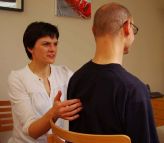
As an AT teacher and performance coach, I help people change their manner of using themselves in activity, so that they can truly fulfil their technical ability and achieve their artistic aims. My job is about helping you free yourself from a manner of using yourself (physically and mentally) that is getting in your way.

I see some common themes in the musicians I teach: too much tension while playing; effort put in the wrong places; and unhelpful ideas about practice and performing. I’ll explain what these are, and give you a hint about how to change things if you think you have this problem.

Too much tension

Do you bang your fingers down on the keyboard? Can you hear your fingers slapping the fingerboard on your cello, or on the wood of your recorder? Do your arms and shoulders feel tight and sore after playing? If so, you’re probably using too much muscular tension. In these cases, I give students the 50% less game: can you play with 50% less effort? This is best first attempted on easy pieces or scales. You may be astonished at how little effort you actually need to use to make a sound!

Effort in the wrong places

This can show up in attitude – 2, 3 or even 4 hour practice sessions with no breaks – or more physically. For example, have you ever thought about what joints you actually need to use to get your fingers to your keyboard? What muscles and joints raise the violin to your chin? It would astonish you how often I work with players who create a tremendous amount of unhelpful physical tension simply because they have never really thought about how to approach their instrument.

Before your next practice session, spend a couple of minutes thinking about the minimum number of joints you could use to achieve a playing position. If you don’t know where the joints are, there are really fantastic phone and tablet anatomy apps that can help you.

Unhelpful ideas

All of us, whether amateur or professional musicians, can sometimes have unhelpful ideas about practising and performing that can suck the joy from our music-making. Do you know anyone who has these ideas:

  • Needing to be perfect
  • Looking on the audience as an adversary
  • Focussing only on the mistakes in the performance, not the good things
  • Being afraid of ‘messing up’, to the point where you don’t want to perform
  • Fearing the audience ‘judging’ you
  • Believing that the only relevant practice time is on the instrument

Because we are a mind-body unity, the ideas that we have can have physical manifestations. If we believe in perfection, for example, we can begin to create a physical tightness as we try not to make mistakes. The physical tension then contributes to us making mistakes, the thing we most wanted to avoid! Try sitting down before your next performance or exam, and note down the ideas and feelings that you have about it. Can you find any twisty thinking going on?

Making music can be one of the most joyous and fulfilling of human activities. I know I’m biased, but I think that Alexander Technique is a great tool for helping musicians to rid themselves of the unhelpful ideas and physical traits that get in the way of musical expression. I hope that you give my ideas and games a try, and please do let me know how you get on. I wish you success!


Reference:

Christopher B. Wynn Parry, ‘Managing the Physical Demands of Musical Performance’ in Williamon, A., ed. (2004) Musical Excellence: Strategies and Techniques to Enhance Performance. Oxford: OUP. 41-60.


jen_working6Jennifer McKerras is a performance coach, musician and fully qualified and registered Alexander Technique teacher



activateyou.com