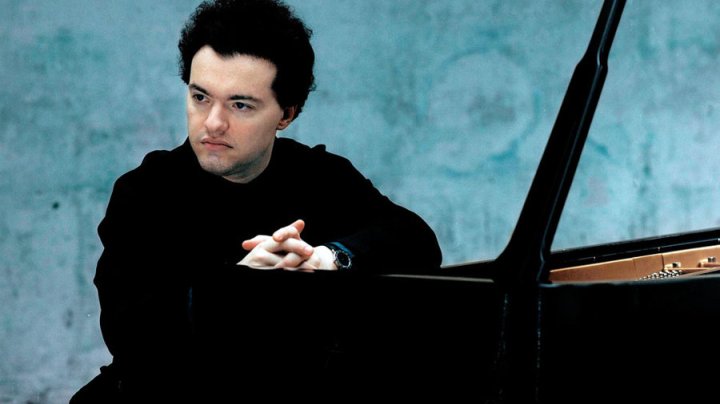
Who or what inspired you to take up the piano and pursue a career in music?

My mother wanted me to start studying piano. There was no professional musician in my family, and nobody was thinking about a professional career for me. But things went well, I was admitted to the Gnesins Special Musical School in Moscow and music as a profession started looking up as my future.

Who or what have been the most important influences on your musical life and career?

Of course, my teachers, first Zoia Grigorieva, and then the great Lev Oborin. However, many people with whom I was in contact during my professional life, most of them my chamber music partners, left a mark.

Among early influences, I can mention 3 artists whose recordings were revelations for me during my young years in Moscow: Walter Gieseking, Dieter Fischer-Dieskau, and Elisabeth Schwartzkopf. Their music making was so different from what I heard in Russia, different approach to the piano sound, to singing. I learned so much listening to these recordings.

What have been the greatest challenges of your career so far?

All my life I was resisting being pigeon-holed as a “specialist”. I always enjoyed doing different things in spite of all difficulties. On different stages of my life, the challenges were to balance my interest in piano and harpsichord; in early music, modern music, and mainstream repertoire; in performing and teaching.

Which performances/recordings are you most proud of?

I very seldom listen to my own recordings, and when I do I am usually not satisfied. My most recent recording of Debussy Preludes, Estampes and other pieces is, perhaps, the closest to what I tried to achieve.

Which particular works do you think you play best?

At different stages of my life, I felt close to music of different styles and periods. Now I feel to be most attuned to 2 very different composers, Debussy and Brahms.

How do you make your repertoire choices from season to season?

It is the combination between what I feel like playing and what the promoters request.

Do you have a favourite concert venue to perform in and why?

I have played in many great halls, some of them have a special aura, in addition to great acoustics. Among them, Carnegie Hall in New York, Concertgebouw in Amsterdam, the Great Hall of the Tchaikovsky Conservatory in Moscow.

Who are your favourite musicians?

There are many great musicians, but I am particularly drawn to music making of Radu Lupu and Murray Perahia. Alexei Lubimov, my friend of many years, is another musician whom I am always interested to hear.

As a musician, what is your definition of success?

I consider a successful performance to be one in which I feel that I touched people’s hearts. It may sound cheesy but at the end of the day this is the most important thing.

What do you consider to be the most important ideas and concepts to impart to aspiring musicians?

The performer must strive to understand the composer’s intentions and to bring them to the audience in the most engaging way.

Where would you like to be in 10 years’ time?

This year I am reaching my 70th birthday. In 10 years I hope to continue doing what I enjoy the most: playing the music I like and teaching as good students as those I have now at Yale School of Music.


The artistry of Boris Berman is well known to the audiences of nearly fifty countries on six continents. His highly acclaimed performances have included appearances with the Royal Concertgebouw Orchestra, the Gewandhaus Orchestra, The Philharmonia (London), the Toronto Symphony, Israel Philharmonic, Minnesota Orchestra, Detroit Symphony, Houston Symphony, Atlanta Symphony, St. Petersburg Philharmonic, and the Royal Scottish Orchestra. A frequent performer on major recital series, he has also appeared in important festivals, such as Marlboro, Bergen, Ravinia, Nohant, and Israel Festival, to name a few.

Born in Moscow in 1948, Boris Berman studied at Moscow Tchaikovsky Conservatory with the distinguished pianist Lev Oborin and graduated with distinction as both pianist and harpsichordist. He performed extensively throughout the Soviet Union as a recitalist and appeared as guest soloist with numerous orchestras, including the Moscow Philharmonic and the Moscow Chamber orchestras.

In 1973, Boris Berman left a flourishing career in the Soviet Union to immigrate to Israel. He quickly established himself as one of the most sought-after keyboard performers, as well as one of this country’s more influential musical personalities. Presently, he resides in USA.

Read Boris Berman’s full biography here

a40bd2e4-26ee-11e6-b3b6-bdf44ca17c9d_1280x720
British pianist Stephen Hough in concert

The psychological and emotional reasons why musicians perform and why we feel a need to connect and communicate with audiences is a broad and complex subject. For many musicians, performing is their raison d’être – the need, the will to play, to perform for others, in public, sometimes so overwhelming that it engages them entirely, body and soul.

Perhaps the primary motivation is the desire to share one’s music with others: in discussing the question “Why Perform?” with musician friends and colleagues, the majority of respondents cited “sharing the music” as a significant motivator. Sharing music in concert celebrates common cultural values (identity, history) and performing can be regarded as a “cultural gift”, a gift to oneself and a gift to those who love to listen to music. It brings pleasure to performer and to audience – both in terms of pure “entertainment” and also the pleasures of intellectual stimulation and challenge, or being emotionally moved. Alongside this, performing gives voice to the human condition and the meaning of life, and examines and confronts shared values in ways which transcend spoken language. Through sharing in a musical performance, we can celebrate togetherness and common purpose.

By performing the great works we share in something which is so much greater than ourselves, celebrating and appreciating brilliant human beings, like Mozart or Beethoven, Wagner or Mahler. Performing is a form of conservation or “curation”, by keeping these great works alive; it also looks after and inspires the next generation – musicians and concert goers.

On a more personal level performing satisfies an inner, more selfish need – the need to be valued and appreciated, the need to impress, to be loved even. It gives us something to live for and to work towards. Performing is a very special form of self-expression and fulfillment, creating experiences that only exist “in the moment” of the performance and then resonate in our individual and collective memories. A performance offers audience, and performer, a single, one-off interpretation of or “variation” on the piece, remembered and/or preserved only as that interpretation.

From a practical point of view, performing endorses and validates what we do in the practice room, and confirms that we have done our practising and preparation correctly. It holds the music up for scrutiny and offers insights about the music and the music-making process which simply cannot be obtained in the practice room, and keeps us in touch with that process from beginning to end. A successful performance demonstrates that we have practised deeply and thoughtfully, instead of simply note-bashing. Preparing music for performance teaches us how to complete a real task and to understand fully what is meant by “music making”. You never really demonstrate your technique properly until you can demonstrate it in a performance. Performing also teaches us how to communicate a sense of the music, to “tell the story”, and to understand what the composer is trying to say. It adds to our credibility and artistic integrity as musicians. And if you haven’t performed a piece, how can you say it is truly “finished”? 

Performances are unique occasions where we live in, and for, the moment. They should never be like rehearsals and for a succession of fleeting moments, the music lives beyond the written score. For those of us who perform, at whatever level, it is probably the most challenging, and satisfying, thing we will ever do.

making an audience feel something profound, moving or incredible never gets any less wonderful and it’s the best job in the worldHeather Bird, double bassist


evgenykissin_wide-9aa53798ae987906571102878d8a12936652197c-s900-c85You know you’re at a special concert when the social areas around the concert hall, the bars and cafés, are abuzz with a very tangible sense of excitement? “When did you last hear him?”  “I hear he is magnificent….. ” Add to that an audience populated by “important people” of the music world, including pianist Menahem Pressler (now in his 90’s and still playing) – it promised to be an exceptional evening.



It’s over 20 years since I last saw Evgeny Kissin live. That concert, the first solo piano recital in the history of the Proms, was legendary for all sorts of reasons – coruscating performances of works by Haydn, Liszt and Chopin and no less than seven encores to a record-breaking audience (over 6000). In the course of his career, he has been criticized by some for his rather cool manner, smooth perfectionism, and style over substance, but there’s never been any doubt about his consistent dedication to his art and artistry. Listen to his recording of Chopin’s Berceuse and you hear refinement in every opalescent note and multi-hued filigree passage: Kissin has musical intellect and, more importantly, he has soul.

No longer the shock-haired wunderkind, he is now a mature artist in his mid-40s; he has written a slim volume of thoughtful memoirs and has married his childhood sweetheart. He’s still got the phenomenal technique, but his stage presence is noticeably more relaxed (much smiling during his curtain calls). Yet his style and demeanour hark back to an earlier era, including the way he dresses (evening suit, black tie, even a cummerbund – a rarity at concerts these days): I think audiences really love this – despite attempts by other artists to break down the “us and them” barriers of the concert stage – because it reminds us of the huge sense of occasion a concert by a pianist of this calibre creates and preserves the mystique of the virtuoso performer.

In the programme notes, Kissin was described as a “titan among pianists”, suggesting both physical and metaphoric presence. In an article last year, The Economist billed him as “one of the world’s greatest living musicians”. Both statements are of course subjective – while also being true. He is “great”, in the sense of possessing an ineffable multi-faceted talent which makes the reviewer’s job so hard – for how can one truly describe what he does?

In keeping with his “old school” stage demeanor, he does not indulge in showy piano pyrotechnics nor flashy gesture for the sake of gesture. His mannerisms may be restrained but his playing is full of commitment and a passion which transcends romanticism: it burns with a hypnotic intensity.

Beethoven’s mightly Hammerklavier is one of the high Himalayan peaks of the repertoire, never undertaken lightly. In interviews Kissin has stated that he felt a certain maturity – which he now has – was necessary to tackle this monumental work (other, younger pianists are not so modest…..). It certainly gave full rein to Kissin’s magisterial powers, not just his technique but his musical intelligence too. He made the infamously difficult opening of the Hammerklavier – a rapid leap of an octave and a half taken in the left hand alone – look easy (and indeed the entire programme!) and launched into the first movement with a heroic commitment wrought in myriad sound. This work is so pianistic, its nickname a constant reminder that it must be played on a piano (and Beethoven was alert to rapid developments in piano design at the start of the nineteenth century: he knew a new instrument could produce the effects he demands in his score), yet also rich in orchestral textures and voicings, all revealed so clearly, so musically by Kissin. His pianistic attack may be direct, but his fortissimos never compromise on quality of sound, and his edges are smoothly honed. But above all of this, it was his pacing and natural rubato which captivated: a clear through-narrative combined with interpretative spontaneity gave this large-scale sonata a fantasy-like character, yet with a rigorous sense of the work’s overall architecture – even in the Adagio Sostentuto, where time was suspended for a movement played with an intense almost Schubertian harmonic trajectory and introspection, yet managed with all the improvisatory qualities of a Chopin Nocturne. Out of this other-worldly space came a finale of restless physicality and strikingly dramatic contrasts.

The second half was all Rachmaninov Preludes, a selection from Opp 23 and Op 32, works with which Kissin is fully at ease. As in the Beethoven structures were fully understood, while sound was sculpted, grand gestures deftly chiseled, delicate motifs etched in filigree touch and a gentle haze of sound. We felt the composer’s emotional depth, his yearning and nostalgia, without a hint of false sentiment or surface artifice.

Four encores afforded more pianistic marvels – a crepuscular, haunting étude by Scriabin (Op 2, No. 1), Kissin’s own vertiginously virtuosic Toccata (proof that he could have been an excellent boogie woogie pianist as well!), another favourite Rachmaninov Prelude (in C minor), played with as much energy as if he was beginning the concert, and Tchaikovsky’s Méditation. He probably would have played more, such was his eagerness to return to the piano at each curtain call, but regretfully many of us had last trains to catch.


(photo: FBroede/IMG Artists)

Social media, specifically Facebook, has been getting a lot of bad press recently, but the medium should not be regarded as wholly bad or evil.

I’ve had an “online presence” for nearly 10 years now. I found Twitter rather confusing when I first started using it and tended to only share links to my blog articles rather than actively engage with others. But I quickly got the hang of it and now largely prefer it to Facebook.

Many people think social media platforms such as Twitter are basically an advertising tool, which completely misses the point – the clue is in the word “social”. I like to view Twitter as an online version of the parish pump, or a busy cafe, where one meets others to converse, exchange news, share ideas and resources, or have a laugh.

In the midst of all the negativity surrounding social media at present, I’d like to put in a personal plea for the benefits of the medium. My online experiences have largely been very positive and have led to some very fruitful/interesting connections, freelance work and friendships, in cyberspace and In Real Life. Many of the connections I’ve forged via Twitter are, unsurprisingly, fellow bloggers; others are piano teachers or music educators; many more are the musicians and composers who have taken part in my Meet the Artist interview series. I greatly value the connections I’ve made, both personal and professional, and enjoy daily interactions with people whose tweets and discussions stimulate, enlighten, amuse, move, delight and more….. I’ve even made friends in Real Life with some of my ‘Twitterati’.

Call me naive, but I find my Twitter experience is greatly enhanced by the “tweet unto others as you would have them tweet unto you” rule. Be nice, be friendly, thank people for retweeting or sharing your stuff, don’t be an “ego-tweeter” (i.e. only sharing your own stuff or tweets in which you get a mention). In short, observe good “Twitterquette” and you get a lot back in terms of positive interactions with others using the platform.

So a big “thank you” to my friends and connections, online and in Real Life


Further reading

Classical Musicians and Social Media

The Curse – and Benefits – of Social Media