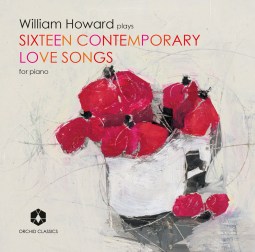
William Howard, piano Sixteen Contemporary Love Songs
Orchid Classics ORC100083
Love songs can be found in music across the world and across the centuries
– William Howard, pianist
Love in its infinite variety has been a major preoccupation for British pianist William Howard whose Love Songs project began in June 2016 with the release of Sixteen Love Songs, a selection of hauntingly beautiful 19th and early 20th-century song-like romantic works scored for solo piano. Sixteen Contemporary Love Songs is the companion disc to the original recording, and features new music for solo piano specially commissioned by William Howard by some of the leading composers active today, including Cheryl Frances-Hoad, Piers Hellawell, Nico Muhly, David Matthews, Judith Weir and Howard Skempton.
Having commissioned and performed music by living composer throughout my professional life, I was not far into this project before I started wondering what the contemporary equivalents to these romantic works would sound like.
– William Howard
In addition to the new commissions, a major part of the Love Songs project was an international competition for writing piano love songs. Running from June to October 2016, it received over 500 entrants aged between 13 and 90, from 61 different countries. The album features the two winning pieces from the competition – Chanson Perpétuelle by Chia-Ying Lin and Herz an Herz by Frederick Viner – and represents an important new contribution to the pianist’s repertoire.
Love is a universal theme and the aim of the album is to present contemporary piano music which will appeal to a wide range of listeners. The music reflects the myriad facets of love: tender pieces written for babies or children (‘Camille’ by Joby Talbot) or a partner (‘For Teresa’ by Robert Saxton, which quotes Beethoven’s ‘Fur Elise’, another love song for piano). Other works focus on more abstract aspects of love, or love other than the human kind. Each composer has contributed a brief programme note illuminating the inspiration or creative impulse for their piece.
It’s a rewarding disc of contrasting piano miniatures, from the simple Scottish folk idioms in Howard Skempton’s Solitary Highland Song to the poignant lyricism of Roses in a Box by Elena Kats-Chernin, the delicate Lisztian filigree of Joby Talbot’s Camille or the spareness of Judith Weir’s Fragile. The disc closes with Love Song for Dusty by Cheryl Frances-Hoad, a homage to Dusty Springfield, which combines jazz and pop-inspired harmonies with sweepingly romantic gestures redolent of Mendelssohn. The entire album reveals a wonderful variety of compositional languages, imagination, moods and character, and many of the works are very meaningful, or highly personal. All are easy to relate to and travel beyond the confines of the strictly defined genre of “classical music”. William Howard brings clarity, warmth, sensitivity and gracefulness to each piece and demonstrates his acute ability to shift between changing moods and styles to highlight the individual character of each piece.
The release of a new exam syllabus is usually a much-anticipated event by piano teachers who are keen to explore new music with their students. The new ABRSM piano syllabus (2019-2020) was released on 7 June. For the sake of transparency I should mention that I contributed to the teaching notes for the new syllabus, so my review will be a general overview of the new syllabus.
The format of the piano grade exams remains unchanged, with List A focusing on Baroque and early Classical (or similarly idiomatic) repertoire, List B on Romantic or expressive music, and List C “everything else”, from contemporary pieces to jazz and show tunes or popular songs. The classic “usual suspects” are there – Gurlitt, Swinstead, Carroll (and it does slightly depress me to see a piece by Felix Swinstead which I learnt c1972!), together with pieces by the perennially popular Pam Wedgwood and Christopher Norton. The ABRSM promises a “broader range of styles” in the latest syllabus and it is certainly good to see some contemporary composers represented, including Cheryl Frances-Hoad (Commuterland/Grade 7) and Timothy Salter (Shimmer/Grade 8). Female composers are also somewhat better represented than in previous years. As in previous years, there is a complete refreshment of repertoire and the ABRSM has sought, as always, to balance the familiar with the lesser-known or more unusual, while maintaining standards across the grades. The supporting tests remain unchanged, though there is talk of a revision to the scales and arpeggio requirements at the next syllabus review.
As usual, the very early grades (1-3) tend towards “child-friendly” pieces to appeal to young pianists, but adult learners will enjoy Bartok’s haunting Quasi Adagio (Grade 1) and Gillock’s A Memory of Paris (Grade 2). ‘Close Every Door’ from Joseph and The Amazing Technicolour Dream Coat by Andrew Lloyd Webber is bound to be popular with students of all ages in this attractive and expressive transcription (Grade 1), as is Leonard Cohen’s ‘Hallelujah’ (Grade 3). More unusual pieces include Bernard Desormieres’ Anatolian 08 (Grade 4, List C) and Bloch’s Dream: No 10 from Enfantines (Grade 5). For my money, the more imaginative pieces tend to reside in the alternative lists for each grade. As in previous years, the repertoire list for Grade 8 extends to 32 pieces (instead of 18 for the other grades), offering students and teachers a sufficiently broad range of pieces to create an interesting “mini programme”.
These days the ABRSM is very conscious of its reputation as the leading international exam board with strong competition now coming from both Trinity College London and the London College of Music (for which the current piano grade syllabus is, in my opinion, the most imaginative and varied of all the boards). Thus, it has sought to remain true to its core strength by offering a syllabus which combines rigour with a selection of music to appeal to a wide range of students around the world (I understand that the “core canon” of works by Bach, Haydn, Mozart and Beethoven remains very popular with teachers and students in the Far East and SE Asia), and I think this syllabus is the most successful of recent years.
The format of the exam books remains unchanged from previous years with clear, well-edited music engraving and short accompanying notes for each piece. The music extracts on the accompanying CDs are also better quality than in previous years and offer useful reference for teachers and students. The accompanying Teaching Notes offer guidance on context, technical aspects and performance. Meanwhile, the ABRSM’s Piano Practice Partner app, which allows a learner to play along with real musicians’ performances, exactly as recorded or at a reduced tempo, has now been updated with pieces from the new syllabus. Other supporting materials are available via the ABRSM website. The syllabus overlap period runs to 31 May 2019.
Who or what inspired you to take up the piano and pursue a career in music?
I don’t think I can give a definite answer but I remember an immediate fascination with the piano though it wasn’t really something I seriously pursued until the age of about 11. Having said this, I don’t think one really chooses to pursue music but, rather, that it is a calling.
Who or what have been the most important influences on your musical life and career?
I suppose, repertoire-wise, Marc-André Hamelin was the biggest influence – his recordings really opened the door to me as to what there was off the beaten track. Opera has also been quite important to me in recent years. Aside from these more obvious things, art and literature (contemporaneous to whichever music I’m studying) are generally of huge importance when it comes to cultivating an understanding of the music.
What have been the greatest challenges of your career so far?
I think most musicians, if they’re honest, will answer that earning a living is up there. In connection to this is the aspect of striking a healthy balance between teaching and playing together with whatever else we have to do.
Which performance/recordings are you most proud of?
There are some tracks I’m very proud of. I think all CD recordings I’ve made I’m proud of in different ways but, for me, I also think it’s more a sense of what each CD represents; what was going on in my life at the time and the memories connected with learning the works.
Which particular works do you think you play best?
At the moment I am especially drawn to the nineteenth century. I feel I have a particular flare for operatic fantasies but if you had told me that ten years ago I would have laughed in utter disbelief!
How do you make your repertoire choices from season to season?
At the moment, it tends to revolve around what I’m doing recording-wise but not exclusively so. There are also certain things I imagine I would like to play at certain times of the year – not quite sure why that is but the seasons do influence this.
Do you have a favourite concert venue to perform in and why?
I can’t say I do though there are places I enjoy playing and I do sometimes programme works specifically for the space and instrument if I feel it might be particularly gratifying.
Who are your favourite musicians?
Marc-André Hamelin, Myra Hess, Georges Cziffra, Raymond Lewenthal, Maria Callas and Richard Bonynge to mention but a few.
What is your most memorable concert experience?
Probably giving the Hellenic première of the Liszt Hexaméron in Athens, 2012.
As a musician, what is your definition of success?
Earning a living – the rest is an added bonus.
What do you consider to be the most important ideas and concepts to impart to aspiring musicians?
I think a sense of what our purpose is. It’s something so obvious it’s overlooked. The world will always need music – it comforts, enlightens and, above all, unites us. Sharing it I regard as a solemn duty and one of grave importance in these fractured and distorted times.
Mark Viner is recognized as one of the most exciting British concert pianists of his generation and is becoming increasingly well known for his bold championing of unfamiliar pianistic terrain. He studied at the Purcell School of Music and the Royal College where his principal teachers included Tessa Nicholson and Niel Immelman. Having won first prize at the C.V. Alkan – P. J. G. Zimmerman International Piano Competition in Athens in 2012, his international engagements have flourished, he has been broadcast on German Radio and been invited to the Oxford Lieder Festival, Cheltenham Music Festival, ProPiano Hamburg and Husum Rarities of Piano Music in Germany. Last year he was invited to play for the Prince of Wales’s visit to his hometown of Oxford. Due to his close association with unjustly neglected areas of the piano literature, he was recently elected Chairman of the Alkan Society.
His recent recording of Aklan’s 12 Études in the major keys Op. 35 was praised for ‘turning Alkan’s forbidding torrents of notes into real music’.
The concert pianist cuts a romantic, almost mysterious image: alone on the stage with only a shiny black minotaur of a concert grand for company, the pianist exists in a place other than ours, elevated – both physically and metaphorically – before us. We invest special heroic qualities in the pianist, knowing that he/she must convey supreme mastery and complete oneness with the music by playing from memory. Pianists are like Himalayan adventurers, scaling the highest peaks without a safety net: Triumph or fail, they do so in the very public sphere of the concert hall.
A concert is not called a “performance” – and its participants “performers” – for nothing. Like an actor inhabiting a character created by a playwright, so the musician takes on a special role for the duration of the concert. Like actors, they also wear special clothes for the occasion, which further defines their role, and the occasion occurs in a special building, often in darkness or semi-darkness. Thus the concert becomes an experience outside the realm of daily existence – for audience and performer.
Every physical act you do when you’re on stage is part of the drama of the performance. Playing a concert is theater. It’s one of the reasons I think we should have a different costume for playing a concert, as opposed to listening to a concert. It doesn’t have to be tails, but I think we need to emphasize that this is something that’s not of the everyday.
– Stephen Hough, concert pianist (from an interview with Pacific Standard
Milton Court, London after a concert by America pianist Jeremy DenkThe mystique of the performance begins as the house lights dim, the unspoken signal to the audience to fall silent. A palpable sense of expectancy permeates the concert hall, and the shared adventure of the performance begins as soon as the pianist crosses the stage. The applause, the audience’s way of greeting the performer, and, in return, a bow, the performer’s way of acknowledging the audience. There is no enmity: for the next few hours we are, to quote British pianist Stephen Hough, “all friends”, sharing in the experience, our many differences forgotten for the duration of the concert.
The moments before the performance begins resembles nothing else. One has a sense of the awesome formality of the occasion, the responsibility, the knowledge that, once begun, a performance cannot be withdrawn. Silent, poised at the piano, at that moment the pianist has complete control over our reactions:
I sit down, and I don’t move a muscle. I create a sense of emptiness within myself, and in my head I count up to thirty, very slowly. This causes panic in the audience: ‘What’s happening? Is he ill?’. Then and only then I play the G [of Liszt’s Sonata]. In this way, the note sounds totally unexpected, but in an intentional way. Clearly, there’s a sort of theatricality about this, but the theatrical element seems to me very important in music. It’s essential if you want to create a feeling of unexpectedness….
The unexpected, the unforeseen – it’s this that creates an impression
– Sviatoslav Richter (from Sviatoslav Richter: Notebooks and Conversations by Bruno Monsaingeon)
The best performers (and I don’t necessarily mean the most famous or technically assured) are the ones who take us into their confidence, creating an unspoken mutual connection through music. They weave stories for us, create magic, transport us to another place and allow us to forget ourselves and the tedious minutiae of our daily lives.
The pianist’s mystique and the ritual of the concert create a unique connection in time and place between the performer, the music and the audience.
Today, when presenting classical music seems to be all about “accessibility”, the mystique of performance can be lost in the desire to “connect” with the audience “extra-musically”, so to speak, by talking to the audience, for example, to break down barriers. It’s great to enjoy classical music in a more relaxed setting; it’s interesting when the performers introduce the programme, discuss their particular connection to the music, or why they selected it. This can work especially well in smaller venues where the audience and performer are in close proximity. But talking to the audience pre-concert in a big hall is problematic without proper amplification, and the big venues almost naturally lend themselves to a more formal, mystical concert experience. And I think audiences like performers to actively create a sense of mystique – because we know we are mere mortals in the face of such superhuman ability.
The most startling thing can be meeting a concert pianist “off duty”, so to speak. Years ago, long before I started writing this blog, I interviewed a concert pianist at his fairly modest home in leafy suburbia. I have always been fascinated by pianists (still am, as this blog testifies!) and I had an overly romantic image of the “concert pianist” (this was some years before I took up the piano again and learnt how to be a performer myself, which gave me an understanding of what goes on on stage during a concert and the curious psychology of performance). The mystique was dispelled the moment the pianist answered in the door. I remember he was was wearing navy socks of the type one can buy in M&S, and his piano room was not some Lisztian salon, as I had imagined it might be, all crimson swags and a bust of the composer for inspiration, or an ascetic monkish cell, but a tidy “office” equipped with the tools of his trade – a grand piano and a career’s worth of scores neatly lining one wall. The virtuoso at home. This person had kids, and a friendly cat, a mortgage to pay and a car to service: in truth, he was disappointingly ordinary. I had imagined something, someone, more esoteric, and his very ordinariness was a shock – he regarded the fine art of creating beautiful music for others to enjoy as nothing more than something he did day to day, nine to five, just like any other job. In fact, most of the musicians I have met via this blog and my Meet the Artist series, and of course after concerts, are normal people – and they “normalise” the incredibly artistic and highly intellectual thing that they do on stage in order to function day to day and get their work (practising) done. Because for them, music is their job. But of course what marks them out is their ability to transform the normal into the beautiful, the transcendent, the magical……and if we want to preserve that mystique, maybe it is better we don’t meet our pianistic heroes and heroines.
…the further a performance must travel to reach the origin of the music, the more the artist demonstrates the measure of both his conscience and his genius
The Cross-Eyed Pianist is free to access and ad-free, and takes many hours every month to research, write, and maintain.
If you find joy and value in what I do, please consider making a donation to support the continuance of the site

 William Howard, piano




 The Cross-Eyed Pianist