The Thoroughly Good Classical Music Podcast invites three people who play, listen or otherwise work in classical music to sit and discuss the subject they love. They’re unplanned conversations recorded as live, very nearly unedited, and more often than not take unexpected twists and turns.
In this the second Thoroughly Good Podcast to which I’ve contributed, Adam Gatehouse, co-Artistic Director of the Leeds International Piano Competition, outlines the changes the competition has undergone since the retirement of Dame Fanny Waterman (the competition’s founder), in addition to more general conversation about communication in performance and why the core canon of the piano repertoire is special.
Hugh Mather, the indefatigable director of concerts at St Mary’s Perivale in West London, introduces a major weekend festival of Chopin’s immortal piano music, and examines some of the rationale behind the festival.
We are holding the St Mary’s Perivale Chopin Festival from Friday 15th June to Sunday 17th. In summary, this comprises most of Chopin’s solo piano works played by 21 excellent pianists giving recitals of 24 to 44 minutes, providing about 12 hours piano music over a glorious weekend of piano-playing.
Firstly, it gives a chance to ‘show-case’ the amazing pianistic and musical skills of so many of our younger pianists. I currently have a shortlist of about 80 pianists who are certainly good enough to give a decent solo recital in my concerts, and the 21 playing in the festival include some of the best. In alphabetical order, they are Ashley Fripp, Artur Haftman, Tyler Hay, Dinara Klinton, Ilya Kondratiev, Renata Konyicska, Ke Ma, Viv McLean, Mikhail Shilyaev, Asagi Nakata, Luka Okros, Mengyang Pan, Mihai Ritivoiu, Tamila Salimdjanova, Colin Stone, Iyad Sughayer, Michal Szymanowski, Julian Trevelyan, Amit Yahav, Yuanfan Yang and Hao Zi Yoh. Most are young (aged below 30) and have won multiple awards in international competitions. Many pianists – possibly most – are at their peak when aged 25-30, after 15-20 years of excellent teaching, long hours of practice, sheer hard work, intense competition and financial support, with little need to divert their energies into piano teaching and other activities to provide an income. Our pianists come from all over the world, with different musical and pianistic backgrounds, and it will be endlessly fascinating to hear their varied approaches to Chopin. This is much preferable to hearing any single pianist – be it Perahia, Zimerman, Pollini or a re-incarnated Rubinstein or Cortot – playing through all this repertoire. I am always amazed to hear how the same piano can sound so different with successive pianists. It will be a heavenly weekend for all pianophiles.
Secondly, it provides an opportunity to hear much neglected Chopin piano music. In the concert hall, Chopin performances tend to be dominated by the same few ‘warhorses’ which most pianists feel obliged to learn and perform. I have undertaken an analysis of works played in over 700 concerts at St Mary’s Perivale in the past decade. Way out top is the ubiquitous G minor Ballade, which has been played 16 times, followed by the Barcarolle and 3rd Scherzo (11), the 3rd and 4th Ballades and Polonaise-Fantaisie (9), the F minor Fantasy, 2nd Scherzo and 3rd Sonata (7) and the 2nd Ballade, Polonaise Op 53 and 2nd sonata (6 times). By contrast, many of the smaller pieces are hardly ever programmed. When I assembled the programme, I asked all the pianists to list all the works they could offer, and it was instructive to see so many offering – yes, the G minor ballade – the A minor Mazurka Op 17 no 4 and the D flat Nocturne Op 27 no 2 , but surprisingly few other mazurkas or nocturnes. On CD, the situation is complicated by the almost universal practice of complete sets of nocturnes, polonaises, mazurkas and waltzes. Hearing all the mazurkas or waltzes in succession isn’t a satisfactory musical diet. Our festival provides a satisfying mix of all the different genres throughout the festival, and a chance to hear many under-performed works in concert. It comprises 12 hours of music, out of the approximately 16 hours in total of Chopin’s solo piano music, without any repetition of a single work. Some early works are omitted, such as the first sonata, and some early variations, but much gorgeous music which is rarely heard in concert will be included. This required a complicated jigsaw puzzle, and was achieved by asking all pianists to list works they could offer, and giving them a limit of one major work (sonata, scherzo or ballade etc), to ‘spread the jam’ evenly among all the musicians!
Thirdly, it is particularly appropriate to hold the festival this year, and in Ealing, which has the highest proportion of native Polish speakers in the UK. Many Polish soldiers who fought alongside British troops in the second world war settled in the borough after the conflict ended. Their numbers were boosted in subsequent waves – first, around the time martial law was imposed in Poland in the early 1980s, then at Poland’s accession to the EU in 2004. Chopin has, of course, always occupied a special place in Polish culture. And in this year, we mark the 100th anniversary of Poland regaining its independence in 1918. Our festival can be regarded as part of this celebration. It also marks the 170th anniversary of Chopin’s visit to London and Scotland in 1848, the year before his death. Our festival will commence with a short introductory lecture from Amit Yahav, entitled, ‘Chopin: A Polish Poet at the Piano in Paris’ to set the scene and to consider the main features of his life and the influences on his piano composition.
Inside St Mary’s PerivaleFourthly, it utilizes the special atmosphere of St Mary’s Perivale. This is a charming, small and intimate venue which has much more in common with the Paris salons of Chopin’s day than those other larger venues in Central London. It is a Grade 1-listed architectural jewel which is blessed with excellent acoustics and a glorious ambience. Its small size creates problems of its own, in that our church can only seat a maximum of 100 people, but we are confident that this will accommodate our audience. No tickets will be sold beforehand. All our pianists will be paid £200 for their performance, and we are charging £15 for admission to each long session. Since they contain between 3 and 6 piano recitals, we think that this is a reasonable charge, and compares well with those for piano recitals elsewhere. Please bring cash rather than cards or cheques.
In summary, this promises to be a very special weekend of exceptional piano-playing which should appeal to lovers of Chopin and the piano, in London and further afield. Come along to enjoy Chopin in Perivale!
St Mary’s Perivale Chopin Festival runs from 15 to 17 June 2018. Full details of all performers and programmes here
Lauren Zhang (16) has won the 2018 edition of BBC Young Musician with a coruscating performance of Prokofiev’s 2nd Piano Concerto. A pianist of quiet poise, the Prokofiev was a bold choice, but Lauren owned it from the very first bars, revealing not only exceptional technically mastery but also acute musical intelligence and insight in a work of striking contrasts, substance and depth. At only 16, Lauren already seems fully formed as a musician, and throughout the competition she has displayed a level of artistry and musical maturity commensurate with a professional performer at least twice her age. Even viewed on television, it was clear Lauren has a special presence, displaying phenomenal power and control but with no loss of clarity or quality of sound. At times it was almost as if she was playing the music for herself only, free of unnecessary gestures or pianistic histrionics, and with an exceptional economy of movement, given the muscularity of Prokofiev’s writing. Thus the music could fully speak, communicate, and touch us. I can only imagine the electric intensity of that presence in Symphony Hall during her live performance.
Lauren was joined in the competition final by two other exceptional young musicians. Cellist Maxim Calver’s performance of Tchaikovsky’s Rococo Variations was rich in witty interplay between him and the orchestra, elegant intonation, and an infectious sense that he was thoroughly enjoying this music. The third finalist was Rob Burton, the second consecutive saxophonist to reach the final of the competition (Jess Gillam, a wonderfully positive ambassador for the instrument and music making in general, was a finalist in 2016). His performance of Paul Creston’s Saxophone Concerto was vibrant, colourful and expressive. All three finalists were worthy winners in a contest where, ultimately, music triumphs.
Maxim Calver, Rob Burton and Lauren Zhang
On the day when previous BBCYM winners, including oboist Nicholas Daniel and violinist Nicola Benedetti, published an impassioned plea in a national newspaper to give all schoolchildren the opportunity to engage with music and learn a musical instrument, it is worth noting that this year’s BBCYM finalists all attend independent or specialist music schools. I know I’m not alone in fearing that with erosion of music provision in UK state schools, music is in serious danger of becoming the preserve of the privileged – either in fee-paying schools or via families who can afford private music lessons for their children.
Whatever one may feel about music competitions (and I tend to agree with Bartok’s view), BBCYM is a wonderful celebration of young people’s music making and should be an inspiration to all.
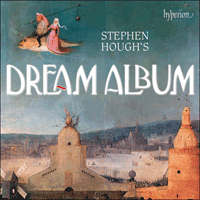
Conductor, recording producer and Artistic Director of the Hertfordshire Festival of Music Tom Hammond interviews Stephen Hough CBE, who this year is the Festival’s Principal Artist and Featured Living Composer – plus a cycle of his oil paintings will be on display at Hertford Theatre during the duration of the Festival (June 10-16).
Stephen, have you ever done an interview about your paintings that hasn’t referenced music, or the piano?
No I haven’t. In fact I’ve very rarely spoken about my painting, in speech or in print.
Do you remember a day when you put paint onto a canvas for the first time, and thought “Now, I’m a painter”?
I haven’t really thought in those terms. My painting is something very private, partly because it’s the most sensual thing I do artistically. Playing the piano is sounds in the air, writing music or words is marks on a page, but painting is dirty, physical, earthy – and tangible/present. I can look at what I’ve done and show it to someone. It exists. And it can be destroyed … gone for ever.
Can you describe your processes? What sort of paints, canvases, brush techniques, textures, etc.?
I’ve used mainly acrylics in the past but recently I’ve fallen in love with domestic gloss paint. Its liquidity and the vibrancy of the colours. I like to mix other things in with the paint – grit, sand, shredded paper etc. I use a palette knife mostly but also brushes. And fingers, but with surgical gloves!
When a painting is framed and/or hung, do you step back and think ‘finished’, or do you look at a canvas later and think ‘wish I’d done something slightly differently’?
I think with abstract art in particular it’s never finished. That’s one of its fascinations. It’s an improvisation like jazz. When is a riff or a solo finished?
Will you be nervous about people’s reaction to seeing one of your paintings?
The first time was hard – like taking off my clothes in front of strangers! And any time when someone else is in a position of judgement it is an emotional risk …
Is the process of painting cathartic, or stressful?
Mainly cathartic, though not relaxing. I get very excited and energized when I paint.
You’ve probably collected more air miles than Phileas Fogg; do you take paintings with you when you’re working in, Asia, Australia, South America…..?
In the past I tried doing small pieces in hotel rooms. But it’s pretty frustrating, and now I’m painting bigger works it’s impossible.
What was the last painting or other purely visual art that you saw that spiritually moved you, and can you explain why?
I loved the recent show at Tate Britain – All Too Human. I’m moved spiritually by the fragility of human life portrayed in art, not by angels and altarpieces. Christ in glory doesn’t move me; Christ as everyman suffering does.
In one hundred years time, would you like to be remembered for your paintings?
I honestly can’t think about that. But the indestructibility of paint perhaps means that when CDs are faded the globs on canvas which have avoided the landfill might still be hanging in there somewhere.
Stephen Hough will be in residence and involved in four events on June 10 and 11 at this year’s Hertfordshire Festival of Music. Book online, by telephone or in person. Full details here
The Cross-Eyed Pianist is free to access and ad-free, and takes many hours every month to research, write, and maintain.
If you find joy and value in what I do, please consider making a donation to support the continuance of the site