Guest post by Elaine Chew

As a child, having supra-ventricular tachycardia meant that, due to extra electrical pathways in my heart, a simple trigger such as an early heartbeat could double my heart rate at any time. The early beat is often hard to feel, but the delayed beat that follows was unmistakeable—a big thump! that would jump start the doppio movimento. (For an example of doppio movimento, Professor John Rink has kindly suggested the beginning of Chopin’s Piano Sonata No. 2 in B-flat minor, Op. 35; see a performance by Ivo Pogerelich.) Another thump would end the tachycardia episode as abruptly as it began, which was as likely to be three seconds, thirty minutes, or three hours later.

Doubling the heart rate is fine and good when one is at rest, say seated and reading; twice 60 beats per minute (bpm) would only be 120 bpm, still within a normal range. But rate doubling can be problematic when exercising, like when swimming, where doubling the heart rate of 120 bpm results in a breathless 240 beats per minute and seeing stars if standing upright, the only recourse at this point being lying horizontal and waiting for the episode to pass.

This non-deadly but troublesome arrhythmia was cured through a minimally invasive procedure called radio frequency ablation, which burns the dysfunctional tissue in the heart. The scar tissue that forms can no longer conduct electricity, and the circuit is thus broken. For a long time afterwards, every skipped heartbeat would still cause my muscles to tense and my breathing to pause in anticipation of tachycardia that never materialised, making me realise how unconsciously arrhythmia had impacted my life. I was thus blissfully arrhythmia free until atrial fibrillation hit.

The rhythms of tachycardia were rapid and regular, but atrial fibrillation was irregular in both musical rhythm and pacing. It is also associated with increased risks of mortality if allowed to progress unchecked. My heart started making its own funky rhythms like the following:
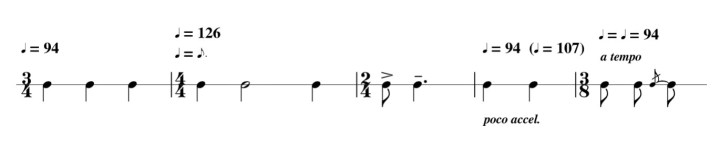
which was meticulously transcribed from the inter-beat intervals in the electrocardiogram (ECG) recording from a Holter monitor:

This is not unlike the kinds of rhythms musicians are used to reading. A minor adjustment to the well-known Siciliano, the middle movement from the Flute Sonata in E-flat major (BWV 1031) by J. S. Bach, readily produces an exact fit to the transcribed rhythm:

See the video with audio playback of the modified Bach Siciliano. Readers interested in the gnarly details of the transcription process and its precision can refer to this Music & Science article on notating temporal deviations in music and arrhythmia.

AF is a fast growing global epidemic; statistics show that the condition afflicts over two million people in the UK alone. The inefficient blood flow through the heart in AF increases the risk of blood clots that can lead to stroke. Many people with AF are unaware that they have the condition, but I was amongst those doctors euphemistically describe as very symptomatic. Another ablation procedure—this time with freezing balloons (cryo-ablation)—created barriers in my heart, rings of scar tissue around the pulmonary veins, to contain the errant electrical activity, thus curing the condition.

When the consultant cardiologist came by the ward to ask if I had any questions, I asked for ECG data that I could use for musical analysis and experimentation. This has led to a number of computational projects, mostly scientific in nature, but the first of these was a growing set of piano pieces called the Arrhythmia Suite. With the help of three research partners at the Radcliffe Institute for Advanced Study at Harvard, the inter-beat durations were extracted from the ECG traces and the rhythms carefully transcribed. I then cannibalised existing music to make collage pieces based on these rhythms. See the video on the making of the Arrhythmia Suite. When performed, the pieces make visceral the rhythmic experience of arrhythmia.

On Tuesday, 20 November 2018, at 1pm, I will perform these pieces in Heart & Music at the Octagon (Queen’s Building, 327 Mile End Road, London E1 4NS) at Queen Mary University of London, as part of the Being Human Festival. The concert programme will feature music made from stolen rhythms, including the ones taken from ECG traces of cardiac arrhythmias. Professor Pier Lambiase, the consultant cardiologist who led the clinical team on both ablation procedures, will give a short introduction to arrhythmia research at the Barts Heart Centre before the performance. Admissions to Heart & Music, which kicks off the all-day Keyboard Evolutions event is free, but booking is recommended.

Other pieces on the recital programme include Cheryl Frances-Hoad’s Haydn’s Stolen Rhythm (2009), in which the composer assigns new pitches to the third movement (Finale) of Haydn’s Sonata in E-flat, Hob XVI:45, keeping intact Haydn’s original rhythms; Practicing Haydn (2013) is a transcription of my sight-reading of the same Haydn sonata movement complete with hesitations and repetitions—this was a collaboration with composer Peter Child and conceptual artist Lina Viste Grønli that premiered at the grand opening of the Kunsthall Stavanger; Intermezzo (2015) was written by Jonathan Berger for pianist Pedja Muzijevic’s Haydn Dialogues; and, compositions based on J. S. Bach’s A Little Notebook for Anna Magdalena and Kabelevsky’s 30 and 24 Pieces for Children (2016) were created by a computer programme called MorpheuS, written by Dorien Herremans as part of her Marie Skłodowska-Curie Fellowship in my lab.

Following the concert, at 2:30pm, an interactive workshop will enable free-form Q&A with Profs. Lambiase, Peter Taggart, and myself on the preceding presentations as well as our ongoing study on cardiac response to live music performance. Abnormal heart rhythms can often be linked to strong emotions or mental stress. Because music is a powerful idiom through which to evoke strong emotions, this study uses music to induce mild tension in patient volunteers with biventricular pacemakers or ICDs to better understand the connections between emotion response and heart rhythms.


Elaine Chew is Professor of Digital Media at Queen Mary University of London, where she is affiliated with the Centre for Digital Music. She is recent recipient of a European Research Council Advanced Grant for the project COSMOS: Computational Shaping and Modeling of Musical Structures, which will start in January 2019. COSMOS aims to study musical structures as they are created in performance and in recordings of cardiac arrhythmias.

About COSMOS — https://erc-adg-cosmos.blogspot.com

About Elaine’s research — https://elainechew-research.blogspot.com

About Elaine’s piano activities — https://elainechew-piano.blogspot.com

About the Music, Performance and Expressivity lab — https://mupae.blogspot.com
On April 20, 1993, sixteen-year-old Cassie watches her world burn to the ground. A week later—far from Waco, TX and the Branch Davidean fire that claimed her family, friends, savior, and the only life she had ever known—Cassie enters a new life—a strange new ‘normal’ life after being ripped from a cult and forced to function in routine society with little knowledge of how to navigate reality.

Cassie has just two goals: to play the piano and to learn how to be normal. Her love of music, especially the music of J.S Bach, is her only thread to a past she buries under her “normal” façade, the thread that holds her together where therapy and religion fail. But Cassie’s habit of using music to hide from her emotions fails her and she must grieve the truth about losing her family and her world in the Waco fire and begin to let time, and Bach, heal her. And only through Bach’s music can she dare to feel the loss of her parents.

When US authorities raided cult-leader David Khoresh’s compound in February 1993, it led to 10 deaths and a 51-day standoff that ended when a fire killed more than 70 men, women, and children. Those who survived Waco were forced to confront the dark things Khoresh did: narcissistic and abusive, he was deeply controlling yet charismatic and personable.

This well-crafted and sensitively-written novel by American pianist Rhonda Rizzo does not shy away from presenting Khoresh and his cult in unsentimental terms, but rather than offer long descriptions, small disturbing details are slipped into the narrative in the form of flashbacks by Cassie, the protagonist, as she tries to come to terms what has happened to her and her family, and comprehend her parents’ life choices. The complex story of Cassie’s struggle to process the trauma of Waco and resulting PTSD, and the extraordinarily closed world of a religious cult, is told in unsentimental, vividly realistic terms, and Rhonda Rizzo’s own musical background brings an authenticity and authority to the descriptions of the music, including the experience of studying and performing music, the hot house, competitive atmosphere of music college, and the special pleasures (and difficulties) of playing with other musicians.

This is as much a coming-of-age novel as a book about recovery and renewal, and Cassie’s naive, tentative entry into a normal teenage girl’s life of fashion, boys and alcohol is presented in bold, believable terms: her relationships are not always straightforward and her attempts to fit in, despite her unusual background, are familiar to anyone who has felt like an outsider.

In one of those serendipitous encounters which sometimes happen via my blog, the author contacted me out of the blue to ask if I would review her book. I’m so glad I agreed, as I found The Waco Variations a real page-turner, and, ultimately, a wonderful celebration of the restorative powers of music. The novel offers a universal message – that music has the power to touch our souls, to heal and calm, and so much more…..

Recommended

The Waco Variations

Meet the Artist interview with Rhonda Rizzo

rhonda2bheadshot2bpiano
Rhonda Rizzo


This musical and theatrical collaboration between multi-award-winning actress Dame Patricia Routledge and international concert pianist Piers Lane tells the extraordinary, inspiring story of Myra Hess and her famous wartime National Gallery concerts.

Compiled from her press and radio interviews during World War II by Myra’s great-nephew, composer Nigel Hess, ‘Admission: One Shilling’ is Myra in her own words: redoubtable, courageous and inspiring. This acclaimed show has toured for almost a decade yet these 17 November performances at Bishopsgate Institute will mark the first occasion that the pieces are played on Dame Myra Hess’s very own Steinway & Sons piano.

Patricia-Routledge-and-Piers-Lane-photograph-3

Through spoken word performance taken from letters, books and interviews given by Myra, interspersed with short piano pieces by Schubert, Schumann, Brahms, Beethoven and JS Bach, hear, how the ‘great adventure’ of these lunchtime concerts began, and how they continued while bombs rained down on London.

It will be a powerful and poignant experience, for both Piers and myself, to be telling the story, through words and music, of Dame Myra Hess’s unique and inspired contribution to the nation, during the anxious years of the Second World War. That our performance is to take place at the Bishopsgate Institute in the company of one of the instruments Dame Myra Hess actually played will, I am sure, make for a significant experience for all of us.

– Dame Patricia Routledge

I am delighted that ‘Admission: One Shilling’, a piece about my great-aunt Dame Myra Hess is being performed at Bishopsgate Institute. These performances will be particularly special as Piers Lane will be playing on the piano given to Myra by Steinway which has been at the Institute for several years and has recently been extensively refurbished in Steinway’s Hamburg workshop. To hear Myra’s own piano telling her own story in this way will be an unique experience, both for her family and, I am sure, for the audience as well

– Nigel Hess


Admission: One Shilling
Sat 17 November | 14.00 & 19.00
Price: £21, no concessions
Address: Bishopsgate Institute, 230 Bishopsgate, London. EC2M 4QH

Further information / book tickets


Photo: ©Gussie Welch

An initial approach via this blog in March 2017  led me this week to St George’s Bristol for a lunchtime concert by the sparkling Piano 4 Hands duo (Waka Hasegawa and Joseph Tong).

Last year Josie Dixon emailed me to ask if I might feature her mother, the composer Ailsa Dixon, in my Meet the Artist series. One of Ailsa’s choral works was receiving its premiere as part of the Oriana Choir’s Five15 project. This was rather special because, as Josie explained, her mother had rather “hidden her light under a bushel for the majority of her lifetime”. Ailsa’s interview was published on my Meet the Artist site in July 2017, to coincide with the premiere of her anthem These things shall be, a setting of verses by John Addington Symonds. Around the same time, Josie contacted me again to ask if I knew a piano duo who might be interested in giving Ailsa’s piano sonata ‘Airs of the Seasons’ its first performance. Knowing their fondness for contemporary repertoire for piano duo, I immediately suggested Waka Hasegawa and Joseph Tong (Piano 4 Hands), and was delighted to hear from Josie that they had enthusiastically taken up the piano sonata.

Sadly, Ailsa died in August 2017, just short of her 85th birthday.

In April this year, as I was in the throes of preparing to move from London to the West Country, Josie contacted me again to tell me that Waka and Joseph would be premiering Ailsa’s piano sonata in Bristol on 8 November. As I’d never visited St George’s (considered by many of my musician friends and colleagues to possess the UK’s finest acoustic), nor heard Waka and Joseph together as a duo, I was delighted to join Josie and her family and friends to celebrate the premiere of her mother’s piano sonata.

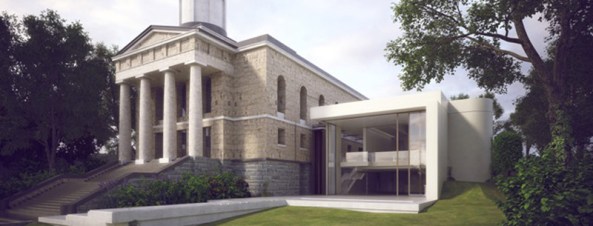
St George’s, a former church in the graceful, well-proportioned Greek Revival style of the early 1820s, is a really fine venue, and a handsome new extension has added a contemporary bar and social area which perfectly complements the building’s clean neo-classical lines. The concert hall itself retains the columns and balcony of the original church, together with a fine altarpiece. A small illuminated star in the ceiling indicates where a bomb fell through the roof during the Second World War but did not explode. At just shy of 600 seats, St George’s is about the same size as London’s Wigmore Hall.

view-from-great-george-street-for-webbanner
St George’s Bristol with its new extension

The purity of St George’s acoustic combined with Waka and Joseph’s split-second precision, supreme technical assuredness and musical sensitivity brought wonderful clarity and contrasting shading to Mozart’s Andante with Variations KV 501, which opened the concert. This linked neatly to David Matthews’ Variations on a theme by Haydn, which was written for Waka and Joseph. The unsually chromatic theme from the opening of Haydn’s last string quartet is the starting point for this set of 12 variations which initially remain close to the originally theme before moving into wider musical territory, including a tango (Var. 5), a blues variation (Var. 7) and a moto perpetuo (Var. 10). The work has a delightful sense of fantasy suffused with romanticism and musical wit, and ends with a humorous exchange between the two players which Haydn would surely have appreciated. It was evident from the performance that Waka and Joseph really relish this kind of repertoire, which proves that the piano duet is not confined to small-scale salon works.

Ailsa Dixon’s Airs of the Seasons was composed in the early 1990s and is her only substantial work for piano. Its four brief movements are each prefaced by a short poem, evoking in turn the magical stillness after a winter snowfall, the first stirrings of spring, a dragonfly darting over the water in summer, and finally amid the turning leaves of autumn, a retrospective mood which recalls the earlier seasons and ends with the hope of transcendence in ‘Man’s yearning to see beyond death’. The opening chords of the first movement are reminiscent of Debussy and Britten in their timbres, and the entire work has a distinctly impressionistic flavour. Ailsa’s admiration of Fauré for his “harmonic suppleness” is also evident in her harmonic language, while the idioms of English folksong and hymns, and melodic motifs redolent of John Ireland and the English Romantics remind us that this is most definitely a work by a British composer with an original musical vision. The entire work, although quite short, is really delightful and inventive. Rich in imagination, moods and expression, the musical evocation of each season is distinct and characterful – Summer, for example, is not all sunshine as a brief but dramatic storm interrupts the warmth and serenity, while Autumn contains flashes of music from earlier movements to underline its reflective, retrospective mood. From a pianistic point of view, the textures of the music are carefully conceived to bring a range of colours and voicings imaginatively shared between the two players.

Mme Debussy deemed her husband’s La Mer unplayable in its piano four-hands version, but Waka and Joseph made impressively light work of this masterful evocation of water, light and wind (and reminded me of my coastal home in Dorset, currently in the grip of gale force autumnal winds!). Their brilliant pianism complemented by total synergy at the keyboard brought this work to life with vivid drama and passion, and was a thrilling close to an absorbing and varied programme.

img_2202
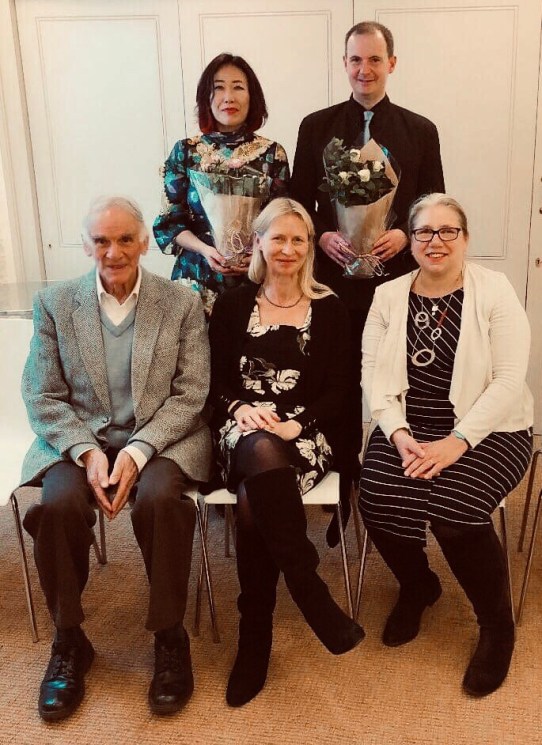
back row: pianists Waka Hasegawa & Joseph Tong; front row from L to R – Brian Dixon (Ailsa’s husband), Josie Dixon (Ailsa’s daughter) and Frances Wilson (The Cross-Eyed Pianist)

Meet the Artist interview with Ailsa Dixon

More about Ailsa Dixon