Who or what inspired you to take up your chosen instrument, and pursue a career in music?

I remember being fascinated by the piano in my grandmother’s house, and this led to my mother teaching me to read music at the age of three. I do not remember, as a child, hearing much music, none of my friends played an instrument, but I remember my grandmother played by ear, and sang music-hall songs to me, which I loved. They must have embedded themselves deep in my memory, as I still remember many of these, including all the words!

One strange memory stands out. My mother, before her marriage, had worked in the office of a local chemist, a Mr. Lester, of whom she spoke occasionally, with the greatest respect and admiration. I had never met this gentleman before, but on one memorable occasion I was taken, by my mother, to visit him at his home. He possessed a fine gramophone, and played me some of his precious 78rpm records. I was about 6 years old at the time. Two recordings stand out in my memory. One was the Grieg piano concerto, which I was hearing for the first time. It made a tremendous impression on me, and I determined that I would one day perform it,(which I did.) The second recording was an odd choice to play to a child, but I was overwhelmed. It was Kirsten Flagstad singing Sibelius songs, and it was one of the most powerful musical experiences of my life. I had never heard anything like it, the powerful intensity of this magnificent voice, and the vivid colours of this unfamiliar music made a huge impression on me. I never saw Mr. Lester again, but he brought magic into my life.

And when I gave my first public performance, at the age of seven, the feeling of engaging with an audience, and sharing this magical world of music was so exhilarating, that I knew, without a doubt, that I wanted to be a pianist.

Further motivation and inspiration came from my repeated reading of ‘Prelude’,a book based on the early life of Eileen Joyce, who was arguably the most famous concert pianist at that time in Britain. I was captivated by this highly romanticised account of a child from a very ordinary background being swept into the extraordinary and exciting world of music. I devoured the stories of her inspiring lessons with eminent European teachers, and the manic regimes of practising, which all culminated in a dazzling career. It was heady stuff, and I became even more determined to enter this fascinating world myself one day.

I was taken to hear Eileen Joyce play on one  occasion by a family friend, who took me backstage afterwards to meet this glamorous superstar of the classical music world. I remember her gorgeous frocks, and, in marked contrast, her workmanlike hands. As she shook my hand, I remember being struck by their immense power.

Who or what have been the most important influences on your musical life and career?

The first time I heard a great pianist in recital was in my early teens, when I I attended a Sunday afternoon concert given by Artur Rubinstein at the Royal Festival Hall. I was mesmerised by the sheer joy and freedom of his playing. This represented the ideal of piano playing that I would, from then on, aspire to.

At the age of seventeen I began my studies at the Royal Academy of Music, where my teacher was Vivian Langrish, who had been a student of Tobias Mattay, alongside Myra Hess. He taught me the importance of sound quality and variety of colour, and greatly expanded my tonal range. Also, while a student, I played for many singers, and was hugely influenced by the great singing teacher, Flora Nielsen, who first revealed the wonders of French song to me, opening the door to the exquisite music of Debussy and Faure in particular.

But I think the greatest inspiration and influence on my playing came from two violinists, the remarkable Hungarian violin professor, Bela Katona, and the legendary violinist Nathan Milstein.

Bela had the most extraordinary ability to reveal the inner life and structure of the music, while at the same time demanding a meticulous attention to detail.

One of the greatest experiences of my life was playing with Nathan Milstein. Every rehearsal was a lesson with a great master. He would demonstrate on the violin what he wanted me to do on the piano. I learnt so much just trying to develop my touch to match his attack on the string, and the freedom of his bow arm to make the gestures of the music. It was awe-inspiring. And throughout, there was always his insistence on the vital importance of the bass line. I learned to focus my attention on a fully independent and fully present and vital bass line, which underpins everything.

Finally, I must acknowledge the influence of jazz, in particular, great jazz pianists, most notably Oscar Peterson Bill Evans and Erroll Garner. From first hearing jazz in my early teens, I knew that I wanted to play classical music with the freedom, spontaneity and immediacy of these artists. This is still my ideal.

What have been the greatest challenges of your life so far?

One’s life as a musician is a continuous, never-ending series of challenges, and it is in meeting these challenges that one develops. But two huge personal challenges stand out for me.

The first was a very serious illness at the age of 28, when , quite suddenly, all my joints, right down to fingers and toes, seized up, and I became completely immobilised. I spent some weeks in hospital, where the doctors were completely baffled, and considered that I would never walk again, and certainly never play the piano. Eventually, however, slowly and painfully, movement returned, curiously, one joint at a time. The fingers were the last to return, taking several months. I gradually eased back into playing again, finding my way back gently into professional work by doing a little accompanying, and then duo playing and chamber music, as my strength returned. I did not return to solo playing in public, as, due to my illness, I had developed severe anxiety about performing from memory. I was now teaching at the Royal Academy of Music, and was also invited to teach at Trinity College, and to establish an ensemble class there. Thus I found myself enjoying a thriving and fulfilling career, performing and teaching, which continued over the following three decades.

And then, shortly after my 60th birthday, came my second huge challenge, when I lost most of my sight, due to haemorages behind the retinas of both eyes. It was extraordinary timing, as, just four years earlier, I had begun training in NLP, ( Neuro-Linguistic-Programming), during which, using one of the very powerful processes we were being taught, I succeeded in eliminating my memory anxiety. I had been looking forward to performing solo again when this new catastrophe struck. Recitals had already been booked, and these, of course, now had to be postponed, while I adjusted to a new, and frightening reality, but I knew that, although I had to give up all ensemble playing due to my severely impaired sight, I would be able to perform solo, from memory. Now there were new challenges, but my desire to continue to play carried me through, and again, I rebuilt my strength and my career, with the support of my wonderful husband Ian, and an amazingly loyal and devoted group of ex-students, who had become wonderful friends over the years.

Which performances/recordings are you most proud of?

My last CD , of solo piano music by Fauré, and the previously-released disc of music by Saint-Saens.

Which particular works do you think you play best?

I think that is for others to express their opinions. During the past few years I have felt a particular affinity with the music of Chopin, Fauré, Debussy and Ravel.

How do you make your repertoire choices from season to season?

I allow ideas, or the desire to play particular works, to come to me, and then I play around with them, experimenting, until they come together to form programmes. It’s a creative process.

Do you have a favourite concert venue to perform in and why?

The Holywell Music Room, Oxford. It has special personal memories for me, and I love its intimacy and unique history.

Who are your favourite musicians?

Gyorgy Cziffra, Dinu Lipatti, Clara Haskil, Vladimir Horowitz, Claudio Arrau, Emil Gilels, Artur Rubinstein, Martha Argerich, Nathan Milstein, the Beaux Arts Trio.

Jazz pianists: Erroll Garner, Oscar Peterson, Bill Evans.

What is your most memorable concert experience?

My most memorable concert experience was when I performed in the Memorial concert for John Bingham in 2005, at Blackheath Halls in London. John was a wonderful pianist and a very special colleague and friend. We had met at Harold Craxton’s studio when we were both 16 years old, and entered the Royal Academy of Music together the following year as scholarship students. We resumed our friendship later when we were both teaching at Trinity College of Music.

At the same time as John was suffering his final illness, leading to his tragic and untimely death, I also had been ill, and had lost most of my sight. Despite my extreme physical weakness at that time, I felt compelled to volunteer to play at John’s memorial concert, such was the bond between us. I knew exactly what I should play— the Fourth Ballade of Chopin, a work which had been special to both of us since our student days.

This would be a momentous experience for me for another reason. As I have related earlier, I had not performed solo in public since a previous illness three decades earlier had left me unable to perform from memory in public. I also described how I had cured this anxiety, and was able to resume performing solo again. This performance at John’ s concert was to be my first solo appearance for more than thirty years. As the date for the concert drew near,  I became apprehensive, thinking how crazy I had been to volunteer, when I knew that, not only would I be performing alongside some very eminent musicians, but that the hall would be packed with many distinguished pianists and other highly respected members of the music profession.

The little sight I had left was also highly distorted at that time, so, on the day, before the concert, I practised finding my way to the piano, which, fortunately, was at ground level, with no treacherous stairs to negotiate.

When the time came for my entrance, the doors opened, and then the most extraordinary thing happened. As I tentatively began to walk forward, I found myself following the figure of a woman, who I instinctively knew was another version of myself. She was taller than me, with hair much darker and longer than mine, but I had no doubts as to her identity. And I suddenly felt quite confident, knowing that she would lead me safely to the piano. As I sat down on the stool, I sensed her sitting down by my side, ( although there was no actual chair there.) I felt entirely at ease, and as I played the opening bars I felt her gradually drift away. I felt inspired, with a sense that all was well, and the music seemed to play itself. Afterwards I received a wonderful ovation from the audience, and I knew that this  was a turning point in my life. I have no explanation to offer, but assumed that my mysterious guide must have been a kind of doppelgänger.

As a musician, what is hour definition of success?

For me, success is when I experience the sense of being ‘in the flow’ in a performance, truly in the moment, being at one with myself, with the music and the audience, in a kind of ‘magic loop’. The music seems to play itself. One cannot make this happen. One can only prepare meticulously, and in a way which creates the greatest potential for this to happen. Then, miraculously, sometimes the gods will smile on us!

What do you consider the most important ideas and concepts to impart to aspiring musicians?

Be curious, allow yourself to experiment.

Ask the question How?

Be kind to yourself.

Embrace uncertainty.

Do not strive for perfection, but follow your dreams, and move step by step towards your goals. Enjoy the journey. Remember that we ‘play’ a musical instrument!

What is your most treasured possession?

I have two. My beloved Steinway piano, and my beautiful Cornish Rex cat, Leo.

What is your present state of mind?

Curious.
Christine Croshaw’s recording of piano music by Gabriel Fauré is available now


Christine Croshaw has enjoyed a long and successful career as a solo pianist, accompanist and chamber music player.

Her concert engagements have taken her to most major venues around the U.K., including many appearances at the Wigmore Hall, Queen Elizabeth Hall and Purcell Room.

She has performed across the Continent in France, Germany, Austria, Spain, Portugal, Italy, Malta, Norway and Denmark, Finland, Poland and Switzerland, and also in North America. Festival appearances include Cheltenham, Lichfield, Kensington and Chelsea, Ludlow, Chichester, Lisbon, Bermuda and Taomina.
Read more

La and Leo – Christine’s Croshaw’s blog

Who or what inspired you to take up your chosen instrument, and pursue a career in music?

I remember being fascinated by the piano in my grandmother’s house, and this led to my mother teaching me to read music at the age of three.I do not remember,as a child, hearing much music, none of my friends played an instrument, but I remember my grandmother played by ear, and sang music-hall songs to me, which I loved. They must have embedded themselves deep in my memory, as I still remember many of these, including all the words!

One strange memory stands out. My mother, before her marriage, had worked in the office of a local chemist, a Mr. Lester, of whom she spoke occasionally, with the greatest respect and admiration. I had never met this gentleman before, but on one memorable occasion I was taken, by my mother, to visit him at his home. He possessed a fine gramophone, and played me some of his precious 78rpm records. I was about 6 years old at the time. Two recordings stand out in my memory. One was the Grieg piano concerto, which I was hearing for the first time. It made a tremendous impression on me, and I determined that I would one day perform it,(which I did.) The second recording was an odd choice to play to a child, but I was overwhelmed. It was Kirsten Flagstad singing Sibelius songs, and it was one of the most powerful musical experiences of my life. I had never heard anything like it, the powerful intensity of this magnificent voice, and the vivid colours of this unfamiliar music made a huge impression on me. I never saw Mr. Lester again, but he brought magic into my life.

And when I gave my first public performance, at the age of seven, the feeling of engaging with an audience , and sharing  this magical world of music was so exhilarating,that I knew, without a doubt, that I wanted to be a pianist.

Further motivation and inspiration came from my repeated reading of ‘Prelude’,a book based on the early life of Eileen Joyce, who was arguably the most famous concert pianist at that time in Britain. I was captivated by this highly romanticised account of a child from a very ordinary background being swept into the extraordinary and exciting world of music. I devoured the stories of her inspiring lessons with eminent European teachers, and the manic regimes of practising, which all culminated in a dazzling career. It was heady stuff, and I became even more determined to enter this fascinating world myself one day.

I was taken to hear Eileen Joyce play on one  occasion by a family friend, who took me backstage afterwards to meet this glamorous superstar of the classical music world. I remember her gorgeous frocks, and, in marked contrast, her workmanlike hands. As she shook my hand, I remember being struck by their immense power.

Who or what have been the most important influences on your musical life and career?

The first time I heard a great pianist in recital was in my early teens, when I I attended a Sunday afternoon concert given by Artur Rubinstein at the Royal Festival Hall. I was mesmerised by the sheer joy and freedom of his playing. This represented the ideal of piano playing that I would, from then on, aspire to.

At the age of seventeen I began my studies at the Royal Academy of Music, where my teacher was Vivian Langrish, who had been a student of Tobias Mattay, alongside Myra Hess. He taught me the importance of sound quality and variety of colour, and greatly expanded my tonal range. Also, while a student, I played for many singers, and was hugely influenced by the great singing teacher, Flora Nielsen, who first revealed the wonders of French song to me, opening the door to the exquisite music of Debussy and Faure in particular.

But I think the greatest inspiration and influence on my playing came from two violinists, the remarkable Hungarian violin professor, Bela Katona, and the legendary violinist Nathan Milstein.

Bela had the most extraordinary ability to reveal the inner life and structure of the music, while at the same time demanding a meticulous attention to detail.

One of the greatest experiences of my life was playing with Nathan Milstein. Every rehearsal was a lesson with a great master. He would demonstrate on the violin what he wanted me to do on the piano. I learnt so much just trying to develop my touch to match his attack on the string, and the freedom of his bow arm to make the gestures of the music. It was awe-inspiring. And throughout, there was always his insistence on the vital importance of the bass line. I learned to focus my attention on a fully independent and fully present and vital bass line, which underpins everything.

Finally, I must acknowledge the influence of jazz, in particular, great jazz pianists, most notably Oscar Peterson Bill Evans and Erroll Garner. From first hearing jazz in my early teens, I knew that I wanted to play classical music with the freedom, spontaneity and immediacy of these artists. This is still my ideal.

What have been the greatest challenges of your life so far?

One’s life as a musician is a continuous, never-ending series of challenges, and it is in meeting these challenges that one develops. But two huge personal challenges stand out for me.

The first was a very serious illness at the age of 28, when , quite suddenly, all my joints, right down to fingers and toes, seized up, and I became completely immobilised. I spent some weeks in hospital, where the doctors were completely baffled, and considered that I would never walk again, and certainly never play the piano. Eventually, however, slowly and painfully, movement returned, curiously, one joint at a time. The fingers were the last to return, taking several months. I gradually eased back into playing again, finding my way back gently into professional work by doing a little accompanying, and then duo playing and chamber music, as my strength returned. I did not return to solo playing in public, as, due to my illness, I had developed severe anxiety about performing from memory. I was now teaching at the Royal Academy of Music, and was also invited to teach at TrinityCollege, and to establish an ensemble class there. Thus I found myself enjoying a thriving and fulfilling career, performing and teaching, which continued over the following three decades.

And then, shortly after my 60th birthday, came my second huge challenge, when I lost most of my sight, due to haemorages behind the retinas of both eyes. It was extraordinary timing, as, just four years earlier, I had begun training in NLP, ( Neuro-Linguistic-Programming), during which, using one of the very powerful processes we were being taught, I succeeded in eliminating my memory anxiety. I had been looking forward to performing solo again when this new catastrophe struck. Recitals had already been booked, and these, of course, now had to be postponed, while I adjusted to a new, and frightening reality, but I knew that, although I had to give up all ensemble playing due to my severely impaired sight, I would be able to perform solo, from memory. Now there were new challenges, but my desire to continue to play carried me through, and again, I rebuilt my strength and my career, with the support of my wonderful husband Ian, and an amazingly loyal and devoted group of ex-students, who had become wonderful friends over the years.

Which performances/recordings are you most proud of?

My last CD , of solo piano music by Fauré, and the previously-released disc of music by Saint-Saens.

Which particular works do you think you play best?

I think that is for others to express their opinions. During the past few years I have felt a particular affinity with the music of Chopin, Fauré, Debussy and Ravel.

How do you make your repertoire choices from season to season?

I allow ideas, or the desire to play particular works, to come to me, and then I play around with them, experimenting, until they come together to form programmes. It’s a creative process.

Do you have a favourite concert venue to perform in and why?

The Holywell Music Room, Oxford. It has special personal memories for me, and I love its intimacy and unique history.

Who are your favourite musicians?

Gyorgy Cziffra, Dinu Lipatti, Clara Haskil, Vladimir Horowitz, Claudio Arrau, Emil Gilles, Artur Rubinstein, Marta Argerich, Nathan Milstein, Beaux Arts Trio.

Jazz pianists, Erroll Garner, Oscar Peterson, Bill Evans.

What is your most memorable concert experience?

My most memorable concert experience was when I performed in the Memorial concert for John Bingham In 2005, at Blackheath Halls in London.

John was a wonderful pianist and a very special colleague and friend. We had met at Harold Craxton’s studio when we were both 16 years old, and entered the Royal Academy of Music together the following year as scholarship students. We resumed our friendship later when we were both teaching at Trinity College of Music.

At the same time as John was suffering his final illness, leading to his tragic and untimely death, I also had been ill, and had lost most of my sight. Despite my extreme physical weakness at that time, I felt compelled to volunteer to play at John’s memorial concert, such was the bond between us. I knew exactly what I should play— the Fourth Ballade of Chopin, a work which had been special to both of us since our student days.

This would be a momentous experience for me for another reason. As I have related earlier, I had not performed solo in public since a previous illness three decades earlier had left me unable to perform from memory in public. I also described how I had cured this anxiety, and was able to resume performing solo again. This performance at John’ s concert was to be my first solo appearance for more than thirty years. As the date for the concert drew near,  I became apprehensive, thinking how crazy I had been to volunteer, when I knew that, not only would I be performing alongside some very eminent musicians, but that the hall would be packed with many distinguished pianists and other highly respected members of the music profession.

The little sight I had left was also highly distorted at that time, so, on the day, before the concert, I practised finding my way to the piano, which, fortunately, was at ground level, with no treacherous stairs to negotiate.

When the time came for my entrance, the doors opened, and then the most extraordinary thing happened. As I tentatively began to walk forward, I found myself following the figure of a woman, who I instinctively knew was another version of myself. She was taller than me, with hair much darker and longer than mine, but I had no doubts as to her identity. And I suddenly felt quite confident, knowing that she would lead me safely to the piano. As I sat down on the stool, I sensed her sitting down by my side, ( although there was no actual chair there.) I felt entirely at ease, and as I played the opening bars I felt her gradually drift away. I felt inspired, with a sense that all was well, and the music seemed to play itself. Afterwards I received a wonderful ovation from the audience, and I knew that this  was a turning point in my life. I have no explanation to offer, but assumed that my mysterious guide must have been a kind of doppelgänger.

As a musician, what is hour definition of success?

For me, success is when I experience the sense of being ‘in the flow’ in a performance, truly in the moment, being at one with myself, with the music and the audience, in a kind of ‘magic loop’. The music seems to play itself. One cannot make this happen. One can only prepare meticulously, and in a way which creates the greatest potential for this to happen. Then, miraculously, sometimes the gods will smile on us!

What do you consider the most important ideas and concepts to impart to aspiring musicians?

Be curious, allow yourself to experiment.

Ask the question How?

Be kind to yourself.

Embrace uncertainty.

Do not strive for perfection, but follow your dreams, and move step by step towards your goals. Enjoy the journey. Remember that we ‘play’ a musical instrument!

What is your most treasured possession?

I have two. My beloved Steinway piano, and my beautiful Cornish Rex cat, Leo.

What is your present state of mind?

Curious.
Christine Croshaw’s recording of piano music by Gabriel Fauré is available now


Christine Croshaw has enjoyed a long and successful career as a solo pianist, accompanist and chamber music player.

Her concert engagements have taken her to most major venues around the U.K., including many appearances at the Wigmore Hall, Queen Elizabeth Hall and Purcell Room.

She has performed across the Continent in France, Germany, Austria, Spain, Portugal, Italy, Malta, Norway and Denmark, Finland, Poland and Switzerland, and also in North America. Festival appearances include Cheltenham, Lichfield, Kensington and Chelsea, Ludlow, Chichester, Lisbon, Bermuda and Taomina.

Read more

La and Leo – Christine’s Croshaw’s blog

Long read guest post by Dr Michael Low

Regardless of where you stand (or perhaps more appropriately, sit, as that is our general default position when it comes to using electronic devices such as tablets, chrome books and laptops) on the subject of social media, there is no doubt that websites and applications such as Facebook, YouTube, Instagram and Twitter play a huge part in our everyday lives. Apart from the countless hilarious sports memes, adorable pet videos, spiritual (and lifestyle) citations, cooking tips, political news bulletins, relationship status updates and narcissistic selfies, they also provides the ideal podium for a talented artist or an upcoming entrepreneur to showcase their ability. Furthermore, even if these aspiring individuals don’t have the ability to ‘make the cut’, there is a certain sense of satisfaction when one’s social media post generates hundreds and thousands of views and ‘likes’. Perhaps it says something about the world that we live in that being noticed counts just as much as having the ability to do something unique.

However, social media can also be a very unforgiving and ugly platform where humanity’s flaws and imperfections are ridiculed and unfairly judged. Someone recently likened social media to that of the cyber age colosseum, its members the mob, often out for blood and entertainment. A similar parallel can be drawn from the words of Derek Jacobi’s Gracchus in Gladiator (2000) directed by Ridley Scott:

The beating heart of Rome, is not the marvel of the senate, but the sound of the colosseum. He [Ceasar] will bring them death, and they will love him for it.

There is something very distasteful and perverse about that part of human nature where we want to see those directly in competition with us crash and burn. Perhaps this is one the (many) reasons behind the success of prime-time television shows such as Idols, Dragon’s Den and The Weakest Link, where members of the jury (or in Anne Robinson’s case, juror) are known for their ability to outrightly dismiss the contestant with cutting remarks.

Just as an aside, the Hong Kong version of The Weakest Link sets out to replicate the British series in all its full glory. However, the Chinese viewers did not understand or appreciate Carol Cheng’s imitation of Anne Robinson (let’s face it, who can?) and soon vent their anger at broadcast company, resulting in Cheng’s much changed and likeable demeanour. Which I thought completely missed the point: the reason why audiences tune into The Weakest Link is for Anne Robinson sarcasm and her trademark parting shot: ‘You are the weakest link – goodbye! Furthermore, it is also known that (as well as the prize money) some contestants go on the show because they are keen to experience what it is like to be dismissed by Robinson on television. The shift in Hong Kong’s presentation perhaps owes more to what the East perceived as acceptable behaviour on television as the Orientals are not known for their sarcasm and dry sense of humour.

As a golf enthusiast, it saddens me to say that the 1999 Open Championship in Carnoustie will always be remembered for Jean van de Velde’s implosion on the final hole, rather than Paul Lawrie’s performance during the playoff. (Van de Velde’s entourage will point to the fact that he got what is arguably one of the most bizarre ricochets in sports when his second shot bounced off the railing of the grandstand, onto the top of the stonewall before nesting itself in the deep rough. At the same time, critics will argue that it was Frenchman’s combination of flair and dire decision-making that resulted in his precarious second shot). Tennis fans will recall Jana Novotna’s unfortunate collapse (and her tears on the Duchess of Kent’s shoulder) rather than Steffi Graf’s heroic comeback during the 1993 Wimbledon Ladies Final. The 2013-14 English Premier League football season will forever be synonymous with the image of Steven Gerard’s slip which handed the initiative back to Manchester City, who became the eventual champions. Finally, we all knew what happened in the most recent US Open Ladies final between Naomi Osaka and Serena Williams.

One of the subjects that generates the most interest on social media is that of the musical prodigy: an infant with the technical ability and (at times) musical maturity equal to an adult musician. However, before I proceed with the rest of this article I just want to clarify the following points:

  • The article is a based upon my own experience as a human being, an educator and a musician.
  • This is Not (notice the capital N) Dr Michael Low’s How Not to be An @rs3hole Piano Teacher or D1ckhead Parent 101.
  • I am not a parent.

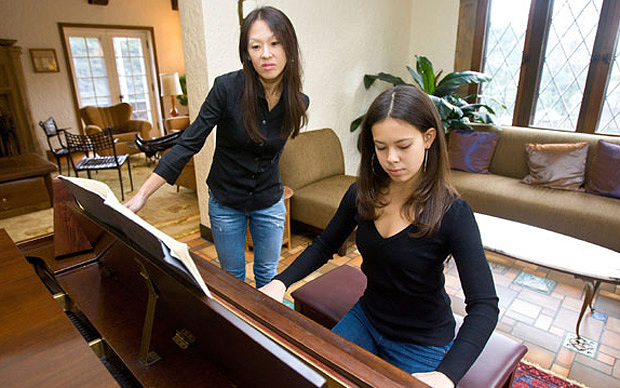
There is a general (and much overstated) adage that behind every successful child prodigy stands (at least) one Tiger Parent – an overbearing individual who set the highest standard of achievement for their children by authoritarian means. The term Tiger Mother or Tiger Mom (老虎妈妈) is synonymous with Amy Chua’s controversial 2011 Memoir Battle Hymn of the Tiger Mother, where the author detailed her stringent and at times ferocious parenting regime. Though it is not explicit, the book also argues in favour of such parental methodology as well as the superiority of Chinese as opposed to Western culture.

mum-and-daughter_3605514b
Amy Chua watches her daughter Sophia Chua-Rubenfeld practise the piano in her home in New Haven, Connecticut

I know a number of parents who have read Battle Hymn of the Tiger Mother and hated every single paragraph, as it goes against what they believe to be good parenting. On the other hand, I interpreted the book as an outright parody of the Chinese culture (much like Jon Chu’s movie adaptation of Kevin Kwan’s 2013 novel Crazy Rich Asians) and found the author’s writing immensely entertaining (I read the entire book – given to me as a Christmas present by the parent of a student – en route to London and it actually made me love my mum [herself also a Tiger Mom during her heyday] even more when I saw her). Regardless of what you think of Amy Chua, there is one thing that is clear: no matter how badly a parent wants a child to succeed, the final application has to come from the child him/herself. Chua openly confesses that despite her intense style of parenting (which bore fruit with her eldest daughter, Sophia), she has to admit defeat and eat a considerable portion of humble pie when her youngest daughter, Lulu, refuses to emulate Sophia’s musical achievement. Of all the very talented children I have had the privilege to have worked with, and there are just about (at least) two or three in every corner of Asia, none of them gave me the impression that they are playing the piano for their parents (the counter-argument here is that the less musically interested child would not have to seek out another teacher’s opinion in the first place). The feeling I get from working with these talented youngsters is that they would not achieved such a level of technical attainment if they do not firstly, believe in themselves (needless to say, this is supported unwaveringly by their parents and teacher) and secondly, enjoy what they do. Critics of Tiger parenting often point out that one run the risk of forsaking one’s soul if you ‘demand a child to practise an instrument until they hate it’ – presumably seeing practising as the outdated, dry, and monotonous act which is often associate with strict parenting. Being an avid practiser myself, I can tell you that I won’t even last five minutes, let alone four hours, doing this sort of practising! However, if a child can be taught how to practise intelligently, creatively and at the same time being able to enjoy the process of slowly working through a new piece of music before eventually having the satisfaction of playing the composition up to speed, why shouldn’t they practise for hours on end? Some may argue that musical intensity at this young age will come at the expense of the infant’s childhood, leaving the individual susceptible to various psychological and emotional scars later on in life. But then again, just how many of us are actually ‘normal’ in every sense of the word? We seek an expression in art (and especially music) because part of us (for whatever reason) is looking for an alternate form of human expression. And in today’s world, the only way for one to have any chance of success in music, be in performance or otherwise, is to really love what we do. The eminent piano pedagogue Maria Curcio recalled that her teacher, Artur Schnabel, once told her that in art, there is no such thing as a compromise. This is a statement that resonates with me on most levels (notice I say most, not all), because I have always maintained that the best people are those who can maintain a sense of balance and perspective in their life (which is not often easy when you are a child or a teenager, as there is a tendency to be impatient wanting to live for the moment).

It is the lack of social distraction, coupled with the ever-rapid ability to grasp the basic, along with many hours of discipline, that propels a musically talented child into the status of a prodigy. Universally admired by their peers, lauded by parents and immortalised by social media, the prodigy is much like a meteor or a ‘shooting star’, incandescence on their journey and leaving behind a streak of light in their quest for world recognition. Unfortunately, meteors also have the tendency to fall back down to earth: with every advancing year, the musical prodigy relinquishes a certain amount of his/hers prodigious status. I would argue that it is the technical ability – much more than the interpretive vision – that is the contributing factor behind the prodigy’s success (a certain Wow factor such as: ‘Did you see that six-year-old with such tiny hands play the Hammerklavier Sonata?’). And when a musical prodigy reaches the awkward age of the late teens and early twenties, no longer will he/she be judged on their technical prowess (which is now taken for granted) but their artistic vision. I use the term ‘awkward’ because this is the alleged stage when a musician ‘comes of age’ (which is absolutely nonsense in my not so humble opinion because studying music is a lifetime of work, and every artist matures at a different age). This, along with the human propensity to always be looking for the next best thing, meant that the prodigy has a life-span akin to that of a sportsman, although the former probably doesn’t earn as much. Conversely, I would imagine that if a child is used to performing in front of a packed house, as well as to an audience who is easily wowed by the performer’s technical prowess, he or she will probably find it very difficult to settle for anything less later on in life. These are some of the contributing factors towards why many musical prodigies have not catapulted themselves onto a successful musical career despite their remarkable promise.

It is the teacher’s job to see the best in our student, and with that, help them to realise their potential. In our line of work, we often work very closely with the parents of our students, and this has both its advantages and disadvantages. Unfortunately for us, we also live in a results-driven culture where marks and validation on a piece of paper counts more than anything else, and this is especially evident in some of the more driven, first-world countries in the East. In such cultures, it is not unusual for the parents to have Tiger-like tendencies: imagine being part of a lifestyle similar to that of a fast-moving train, in a society where every parent will do anything (within reasons and financial means) to hurl their own children on board in the fear that they will either come second or miss out. In these societies, it must be very difficult not to get caught up with what everyone else is doing. Even if there are parents who feel that being part of such a competitive environment is not entirely suitable for their children, are they willing to jeopardise their child’s future by not participating? The question becomes infinitely more complicated when the child exhibits potential or show glimpses of ability to attain – and in some cases exceed – the standard set by his/hers teachers and peers. Realistically, how many parents have the financial means as well as the mind-set to even consider the possibility of emigration and starting life in a different country?

While we are on the subject of achievement, it is my humble opinion that parents have every right to feel proud when their child produces a brilliant musical performance, and the same can be said for us teachers. Let’s not be coy for a second here, there is always a tremendous sense of satisfaction and reward when one of our students perform well in either an exam, festival or competition (and sometimes all three!). As a teenager, I recall attending my sister’s ABRSM High Scorer’s Concert (which took place in the RAM’s Duke’s Hall) and said to myself, ‘It must be such an honour for any teacher and their student to take part in these occasions.’ Such feelings became reality a few years ago when one of my Grade 8 piano student was invited to perform in such a concert here in Cape Town. However, I have also seen the CV of several high-profile piano teachers (this is much more apparent in the East, where piano playing is seen as an achievement rather than an artistic expression), who littered their website with names of prize-winners whom they have taught or worked with (the irony here is that most, if not all of these competitions are relatively unknown, or perhaps I am just not that knowledgeable when it comes to competitions). While the business part of me understands such a marketing ploy, the cynical side of me seems to have other reservations. Afterall, I have always believed that the greatest teachers are those who let their students do the talking, or playing, in this case.

In the perfect world, no piano teacher would have to sit through their student’s mediocre performance, nor should we have to deal with tears and disappointment when exam marks and competition juries don’t see eye to eye with our candidate. One of the hardest thing for any teacher to endure is to allow our student to make their own mistake knowing full well this is the only way they will learn their lesson. I will never forget teaching a very talented student who, despite her tremendous musical temperament and ability, didn’t quite have the patience or mindset to practise slowly (for this student it is the case of ‘playing through’ a piece of music hoping that it will eventually come right). In spite my best efforts in trying to reason, encourage, and motivate her to be more disciplined in her practising, she was adamant that things will continue as they were. Afterall, why should anything change? She has gotten to where she is by doing what comes naturally to her (the superstitious side of me tells me that this is karma at its bitchiest best, the perfect payback for all those times in the past when I did not listen to my piano teachers). Heartless though it may seem, I eventually realised that the only way forward is to let her play the exam on her own terms, and this lead to the following afterwards: ‘Dr Low, I am so sorry… I fu(k3d up so badly…I have let you down…’ followed by loud sobs (for those interested, this student actually ended up passing her exam, despite the assumption that she ‘fu(k3d up’ her own performance). This incident made me realise one thing: if allowing your student to play out her own mistake isn’t heartbreakingly enough, it must be (at least) twenty times worse for a parent to let their child do the same (I can say with a degree of certainty that no parents want to see their children hurt, physically or emotionally). Unfortunately such is life that sometimes the only way for a child to grow is for them to make their own mistake, and this is in spite of their parent’s best intervention – conversely, interventions can sometimes end up pushing the child further away from their parents. It is not often easy to develop a sense of objectivity when we work closely with our student. However, I strongly believe that not every single piano teacher is completely responsible for how their student performs, just as not every parent is entirely liable for the adult their children become.

Parenting is perhaps the hardest job in the world. Children are conceived not only for the purpose of genetic immortality, but also to provide an opportunity for a parent to play the all-important role in shaping an infant’s life. I have often heard the following numerous times: ‘Michael, I don’t want my son to give up the piano because it was a decision that I regret taking when I was his age.’ To which I answer: ‘It is never too late for you to start having lessons again.’ Interesting that this is often followed by: ‘I just want him (the child) to be able to sit down and play!’ As teachers and musicians, all of us recognise that ‘to be able to sit down and play’ is far from straightforward, as it requires not only many hours of practising, but also a considerable amount of performing experience. Imagine just ‘chilling out’ playing the Rachmaninoff D minor Piano Concerto or Bach’s Goldberg Variations! I will never forget almost incurring the wrath of one of my piano teachers when I asked him to perform Beethoven’s ‘Waldstein’ Sonata during one of our lessons! (I did ask nicely just in case any of you guys are wondering!) It is my humble opinion that no parent raises their children with the intention of deliberately messing them up (psychologically or otherwise). Parents will always make the decisions based on what they know best when a situation arises, but unfortunately (or fortunately, depending on how you see things), hindsight is such a beautiful thing and will always have the last word. I do not believe that there is a right or a wrong way to bring up a child; parents are human beings after all, and no matter which approach a parent decides to take, whether it is the Tiger Mother/Dragon Father combination, or the converse, Mother Hen/Father Owl mindset, somewhere down the line, mistakes will occur, and the child will be better or worse off because of that. No self-respecting parent raises their children hoping that they will become billionaire owners of football clubs, along with their corrupt Russian Oligarch associates. Nor do any parents wish their kids to turn into some sort of pathological animal lovers who give candy bars to golden retriever pups. I can say (with a degree of confidence) that every parents raises their children in the hope that they will one day become courageous, compassionate, intelligent and respectable human beings; to be able see the beauty in this cold and (at times) objective world that we live in, to love another whole-heartedly, to live a life of integrity and perhaps, just perhaps, also be able to find the extraordinary in our ordinary life. Similarly, a piano teacher should not harbour the unrealistic expectation in hoping that our student will be the next celebrity performer akin to Khatia Buniatishvilli, Lang Lang, Ivo Pogorelich or Wang Yuja. We teach piano and because we want to convey the passion and love of music to our students, and in learning a musical instrument, a student will hopefully be able to grasp a set of important life skills and ethics such as discipline, integrity, honesty, hard work and communication. At the end of the day, if any of my students can apply to their life what they have learnt from their piano lessons, then I will be quite content.


As a teenager, Michael studied piano under the guidance of Richard Frostick before enrolling in London’s prestigious Centre for Young Musicians, where he studied composition with the English composer Julian Grant, and piano with the internationally acclaimed pedagogue Graham Fitch. During his studies at Surrey University in England, Michael made his debut playing Tchaikovsky’s First Piano Concerto in the 1999 Guildford International Music Festival, before graduating with Honours under the tutelage of Clive Williamson. In 2000, Michael obtained his Masters in Music (also from Surrey University), specialising in music criticism, studio production and solo performance under Nils Franke. An international scholarship brought Michael to the University of Cape Town, where he resumed his studies with Graham Fitch. During this time, Michael was invited to perform Tchaikovsky’s First Piano Concerto for The Penang Governer’s Birthday Celebration Gala Concert. In 2009, Michael obtained his Doctorate in Music from the University of Cape Town under the supervision of South Africa’s greatest living composer, Hendrik Hofmeyr. His thesis set out to explore the Influence of Romanticism on the Evolution of Liszt’s Transcendental Etudes.Michael has also worked with numerous eminent teachers and pianists, including Nina Svetlanova, Niel Immelman, Frank Heneghan, James Gibb, Phillip Fowke, Renna Kellaway, Carolina Oltsmann, Florian Uhlig, Gordon Fergus Thompson, Francois du Toit and Helena van Heerden.

Michael currently holds teaching positions in two of Cape Town’s exclusive education centres: Western Province Preparatory School and Herschel School for Girls. He is very much sought after as a passionate educator of young children.

slider-10-e1426539438442

michaellow.co.za

Guest post by Michael Johnson

The Stakhanovite work ethic among young piano students in China shows no sign of fading as their tiny fingers fly up and down the keyboard ten or twelve hours a day. Competitions are welcoming the new Asian talent and European concert halls tend to fill with admiring fans. Some of us (including me) don’t quite know what to make of it.

It’s not all about Lang Lang, Yuja Wang or Yundi Li. Potential new superstars are emerging each year. Brace yourself for more in the years ahead. Some 20 million Chinese are said to be practicing madly as our European and American kids play with their smart phones and iPads.

Two contrasting Chinese women have caught my eye (no, not like that …) recently and promise to leave indelible marks. They both have worked hard to get noticed and – contrary to myth — they are capable of absorbing and mastering the Western canon.

Ran Jia, the Shanghai-born daughter of an established composer, has become a recognised Schubert interpreter. And Zhu Xiao-Mei has adopted the Goldberg Variations as virtually her own. Music without borders is no longer a cliché.

Elegant, poised and deeply musical, Ran Jia has brought a new freshness to Schubert, a phenomenal achievement considering how often the piano sonatas have been performed by the greatest pianists of the past 75 years. The music press in Germany, where she played all eleven works in a four-day marathon last year, christened her “the challenger”.

And Xiao Mei, a battered survivor of five years in the labour camps of Mao’s China, recovered her piano training and managed to escape, first to Hong Kong, then Los Angeles, then Boston, and finally Paris. It’s difficult to read her book “The Secret Piano” without welling up.

In one passage, she describes the beginning of her career at Beijing Conservatory.

We worked at the piano like galley slaves, in little closed rooms whose doors were fitted with a small, round window (for monitors to check up on students)… The school’s leaders encouraged rivalry between students. The best pupils not only had the right to more classes but also to better food.

Living conditions were Spartan. “At night, forty of us slept in the same dormitory hall. Bunk beds were placed next to each other so closely there was just enough space to move about the room. The atmosphere was suffocating.”

And her first serious teacher, Pan Yiming, was “unrelenting”, she recalls. He ran her through the Hanon virtuoso book plus the main volumes of Czerny, Cramer, Moszkowski and Brahms, plus Bach’s “Inventions” and the Well-Tempered Clavier”. He told her, “I want you to play all this by heart. From now on, for each lesson, you must play a piece by Bach and two etudes from memory with no mistakes.”

By a circuitous route she ended up at the New England Conservatory in Boston, studying under Gabriel Chodos who had trained under a student of Arthur Schnabel. “Professor Chodos was forbidding. With him, it was a life-or-death struggle. After every class, I wanted to quit the piano.

When he assigned the Schumann “Davidsbüldlertänze”, he warned her it would be the “ultimate test … Once again, he was right.”

She saves her greatest enthusiasm for the Goldbergs, which she says “took over my existence – it contained all one needed to live.” The variations, she says, “are all about flow … this is what makes Bach’s music so soothing for its listeners.”

Her mastery is evident in this sample of her Goldbergs:

Ms. Jia rejects talk of competitive striving among the Chinese. “My dream is simple,” she told me in an interview, “to share my musical inspiration deep down in my heart with the audience …” To her, Schubert’s music “dances between our world and heaven”.

Her modest persona comes as a welcome change in the face of the flamboyance of other young Asian players seeking to distinguish themselves through hair-styles or performance antics. She may well be the next Chinese superstar, a versatile player who thoroughly understands her music and performs it for us without excesses.

One American critic noted that onstage she simply and calmly “looked as though she were thoroughly enjoying herself, frequently smiling at Schubert’s more engaging nuances”.

I asked her about the growing criticism of young pianists who place technique above musicality. Not wishing to join the polemic, she agreed however that “music is not only related to the physical action but also the knowledge, emotion and the depth of the spirit behind it”. She brings all these crucial elements to her playing.

I have spent the past few days listening attentively to her latest CD (Ran Jia Schubert, Sony Music) a pairing of Sonata No. 19 in C Minor and Sonata No. 16 in A Minor. As a bonus, she includes “Three Preludes for Solo Piano” by her well-known composer-father (also an accomplished painter), Jia Daqun.

In this video she discusses her love of Schubert and demonstrates her exquisite playing.

Ms. Jia has already built the foundations of a long-lasting career, with debuts at the Shanghai Conservatory of Music and Alice Tully Hall, Lincoln Center, New York. As she explains in our interview (below) she became a multicultural musician by growing up in a musical household. Her father is Senior Professor of Composition and Theory at Shanghai Conservatory. He is regarded as China’s leading composer and has worked in various musical styles, including traditional Chinese music.

A bonus on the new CD is the world premiere recording of his Preludes. Most captivating is his variation swirling around Schubert’s A Minor sonata and placing it very much in the 21st century. After absorbing his daughter’s pure Schubert, this contrast is chillingly beautiful.

INTERVIEW WITH RAN JIA

Q. Your four-recital cycle of Schubert the eleven piano sonatas in Germany last year left critics in awe. They called you an “astonishing” artist, a “piano poet”. How has that success changed you?

A. I would say it changed me as a pianist. After this almost impossible mission, I suddenly found peace and freedom in myself as a musician.

Q. You are in very good company, devoting so much of your musical talent to Schubert. The competition could not be stronger – Brendel, Schiff, Perahia, Kempf, Lupu, Richter, Barenboim, among others. What drew you into this stratosphere?

A. Schubert has been my favorite composer since I was a teenager. Ever since I played his music the first time, I have felt a unique connection. All his music has become my mission in my musical life. I don’t feel there should be any competition between the interpreters as you mentioned in the question. For me, my dream is simple, to share my musical inspiration deep down in my heart with the audience, and to diligently dig into Schubert’s music as much I can.

Q. Will you really spend the rest of your life discovering Schubert’s “spiritual delicacy and profoundness”, as you have written? Is your ambition to become the definitive interpreter of Schubert?

A. Of course I will spend the rest of my life discovering Schubert’s music. For more than a decade I have continuously studied his pieces. I feel his music is still underrated compare to his genius — he is so much more than just a songwriter (even though the songs are amazing!) The boldness of his harmony is absolutely stunning and he uses music to express his philosophy of life.

Q. You have said that you moved from your native China to Europe to better understand the Germanic culture of Schubert. In what way did this help your interpretations?

A. The language, the culture, the atmosphere, those are the foundations for better understanding his background.

Q. What is Schubert’s secret in drawing the tragic and painful strains from major rather than minor keys?

A. True, major brings a brighter feeling than minor, but Schubert’s use of the key changes make me feel that major is more sad than minor because of the way he uses the major sounds seem like a beautiful dream that will never come true.

Q. What are you preparing now in repertoire? Do you plan more ensemble work?

A. I am at the moment preparing a lot of repertoire. I have some interesting projects, for example all the Beethoven concertos, and a Schubert cycle in China in the second half of the year and some trio concerts (mainly transcriptions) with piano, saxophone and violin.

Q. Your father, the distinguished Professor Jia Daqun, is perhaps the ultimate cross-over East-West composer, combining some Chinese traditions with vigorous Western-style contemporary music, as he does in “Melodies from Sichuan Opera” on your new CD. Has his musical culture always combined a balance of the two?

A. Yes, he wrote a lot of interesting chamber works with the combination of Chinese folk melody and Western modern composition technique. He has recently been commissioned by Yo-Yo Ma for a string quartet for the Silk Road Project.

Q. In your own musical life, did you have to move from the Asian pentatonic to the Western heptatonic scales? If so, did you make this adjustment gradually?

A. I never had to move because music of all kinds was always just naturally there with me. I started studying piano when I was three and half years old. Because of my father, I heard a lot of music in different periods, of course including Chinese folk music. I didn’t need to change anything.

Q. Are you still interested in Chinese music or have you definitively crossed over?

A. I don’t think you can speak of crossing over in this context. It is not a question of interest in Chinese music, because this music is a part of me. I am Chinese :).

Q. How should we understand the current explosion of popularity of Western music in China? Some observers think it has become a status symbol to love Western music, like the “Gucci shoes of the music world”, as one pianist has called it. How true is this?

A. First of all, there are a lot of Chinese, so it might seem like it’s an explosion of popularity of western music. Second, the competition in the schools in China is enormous, the teenagers usually have to have several interests besides their normal subjects of study. And music became very popular because it can cultivate one’s feelings.

Q. What drives Asian children to over-practice, sometimes 12 hours a day ? Don’t their results sometimes favor technique at the expense of musical understanding? Are Asian piano students more driven to succeed or are Western children going soft?

A. Asian children work very hard and they want to be good in any area they study, whether in music or other subjects. It’s important that at a certain age they build up a good technique through a lot of practice, but in my opinion, it has become very critical because music is not only related to the physical action but also the knowledge, emotion and the depth of the spirit behind it. I think we should not see a music career as ‘succeeding’ but rather as ‘devoting’ and ‘growing’, or we lose the essence of being a musician.


Michael Johnson is a music critic with particular interest in piano. He worked as a reporter and editor in New York, Moscow, Paris and London over his writing career. He is the author of five books and divides his time between Boston and Bordeaux.

Illustrations by Michael Johnson


