Guest post by Rhonda Rizzo

In the caress of notes, Cassie knew nothing of fire, death, loss, or fear, just love plucked from Bach’s hands, to Eric’s, to her own—spoken in a language too deep for words.

—excerpt, The Waco Variations

Writing about music is like dancing about architecture. And while I can’t speak to dancing or architecture, this cliché sums up the problem of using words to describe what is fundamentally an experience, not a concept. Whether listener or performer, we enter into the world of the notes and receive and respond to the music through the lens of personal experience and understanding. And, because everyone’s experience and taste is different, how does a writer capture in words the sensation of sinking one’s hands into the piano keys, or the eerie magic of “one mind” that occurs when musicians perform together?

Write what you know. It’s another accurate cliché. As a lifelong pianist, I know music. I know the experience of making music, and of listening deeply to others. As a writer, I know my character, Cassie, and how she falls in love to Bach and allows herself to grieve through the music of Rachmaninoff and Liszt. I write the common ground between what I know, what Cassie knows, and the human truths that connect all of this to music.

Show, don’t tell. A writer’s cliché. If I tell the reader that Cassie and her boyfriend Eric, had a good performance of a Bach double concerto, it’s dull boring. Showing makes it tactile. It makes it real. It makes it matter.

In the second movement, Cassie stopped being aware of any reality beyond the music. The competition, the judges, her hair, her dress—none of it existed. The notes defined her universe. And as she and Eric passed the sensuous lines back and forth, she dissolved into them. She was the piano, and the piano was her. She was Eric, Eric was her. And Bach was what held everything together. There were no mental pictures and no stories. Just the music, and Eric, and the piano, which seemed to grow out of her fingertips.

—excerpt, The Waco Variations

Make me care, I used to tell my piano students. Don’t just press the notes. No matter how beautifully you phrase a line, if you don’t have anything interesting to say, you’re just speaking phonetic music. Writing requires the same because readers deserve entry into all aspects of the moment, not just a description. In both art forms, if the notes or the words don’t communicate something beyond themselves, everything comes out flat and lifeless.

Another quote: the visible is the invisible written down. As musicians and writers, we use what’s concrete (notes, words) to point to intangibles: love, joy, loss, hope, and a myriad of other human emotions. It’s an internal landscape we all share, and because of this common ground, music—and writing about music—is about bringing the listener or reader into a new world through our shared emotional doorways. We don’t need to know why a piece of music moves us to tears, or how a paragraph conjures up an entire world. We experience it. We feel Cassie’s struggle with an unfamiliar piano and we know her belief that somehow she can communicate with her deceased parents through the notes of Liszt’s Sposalizio.

Taking a deep breath, she put her hands on the keys, closed her eyes a second, and then played the opening lines. The muted upper register hampered her attempt to get a bell-like tone in her first right-hand arpeggio section. She tried to play through it, thinking of each note as being wrapped in thick velvet. Perhaps the clarity was there, at the center of all that velvet? What the piano took away from the upper register it gave back in the middle; when Cassie started what she always thought of as the prayer-like section—the one where she sensed she needed to breathe the notes rather than just play them—the velvet tone gave the notes a warmth she had never before been able to achieve on any other piano. The sounds matched the one she had been hearing in her mind, and the magic of reality matching the ideal was so strong that she could feel the hair on her arms bristling. Normal life fell away, and for those breathless moments she sensed that the notes were getting through and that somehow, someone was on the other side, hearing all the love and loss she poured into each pitch.

—excerpt, The Waco Variations

Writing about music is, ultimately, writing about humanity because that’s where power of the best music and literature resides. The form—the architecture—only points to the bedrock truths we all share. We love, we grieve, we celebrate, we mourn, and we seek (and sometimes find) meaning in the most unexpected places.


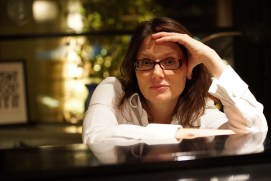
rhonda2bheadshot2bpianoRhonda (Ringering) Rizzo is the author of The Waco Variations. She has crafted a career as a performing and recording pianist and a writer. A specialist in music that borrows from both classical and jazz traditions, Rizzo has released four CDs, Made in America, Oregon Impressions: the Piano Music of Dave Deason, 2 to Tango: Music for Piano Duet, and A Spin on It.  As both a soloist and a collaborative artist, her performances include several allclassical.org live international radio broadcasts, Water Music Festival, Central Oregon Symphony, Oregon Chamber Players, Aladdin Theatre, Coaster Theatre, Ernst Bloch Music Festival, Bloedel Reserve, Newport Performing Arts Center, Skamania Performing Arts Series. In addition to her work as half of the Rizzo/Wheeler Duo, with pianist Molly Wheeler (www.rizzowheelerduo.com), Rizzo records and writes about the music of living composers on her blog, www.nodeadguys.com

Her numerous articles have appeared in national and international music magazines, including American Music Teacher, Clavier, Piano & Keyboard, and Flute Talk. Her novel, The Waco Variations, was released in the summer of 2018 and can be found on www.amazon.com.  

Rhonda Rizzo earned her undergraduate degree from Walla Walla University and her Master’s degree from Boston University.

Guest post by Rhonda Rizzo

In the caress of notes, Cassie knew nothing of fire, death, loss, or fear, just love plucked from Bach’s hands, to Eric’s, to her own—spoken in a language too deep for words.

—excerpt, The Waco Variations

Writing about music is like dancing about architecture. And while I can’t speak to dancing or architecture, this cliché sums up the problem of using words to describe what is fundamentally an experience, not a concept. Whether listener or performer, we enter into the world of the notes and receive and respond to the music through the lens of personal experience and understanding. And, because everyone’s experience and taste is different, how does a writer capture in words the sensation of sinking one’s hands into the piano keys, or the eerie magic of “one mind” that occurs when musicians perform together?

Write what you know. It’s another accurate cliché. As a lifelong pianist, I know music. I know the experience of making music, and of listening deeply to others. As a writer, I know my character, Cassie, and how she falls in love to Bach and allows herself to grieve through the music of Rachmaninoff and Liszt. I write the common ground between what I know, what Cassie knows, and the human truths that connect all of this to music.

Show, don’t tell. A writer’s cliché. If I tell the reader that Cassie and her boyfriend Eric, had a good performance of a Bach double concerto, it’s dull boring. Showing makes it tactile. It makes it real. It makes it matter.

In the second movement, Cassie stopped being aware of any reality beyond the music. The competition, the judges, her hair, her dress—none of it existed. The notes defined her universe. And as she and Eric passed the sensuous lines back and forth, she dissolved into them. She was the piano, and the piano was her. She was Eric, Eric was her. And Bach was what held everything together. There were no mental pictures and no stories. Just the music, and Eric, and the piano, which seemed to grow out of her fingertips.

—excerpt, The Waco Variations

Make me care, I used to tell my piano students. Don’t just press the notes. No matter how beautifully you phrase a line, if you don’t have anything interesting to say, you’re just speaking phonetic music. Writing requires the same because readers deserve entry into all aspects of the moment, not just a description. In both art forms, if the notes or the words don’t communicate something beyond themselves, everything comes out flat and lifeless.

Another quote: the visible is the invisible written down. As musicians and writers, we use what’s concrete (notes, words) to point to intangibles: love, joy, loss, hope, and a myriad of other human emotions. It’s an internal landscape we all share, and because of this common ground, music—and writing about music—is about bringing the listener or reader into a new world through our shared emotional doorways. We don’t need to know why a piece of music moves us to tears, or how a paragraph conjures up an entire world. We experience it. We feel Cassie’s struggle with an unfamiliar piano and we know her belief that somehow she can communicate with her deceased parents through the notes of Liszt’s Sposalizio.

Taking a deep breath, she put her hands on the keys, closed her eyes a second, and then played the opening lines. The muted upper register hampered her attempt to get a bell-like tone in her first right-hand arpeggio section. She tried to play through it, thinking of each note as being wrapped in thick velvet. Perhaps the clarity was there, at the center of all that velvet? What the piano took away from the upper register it gave back in the middle; when Cassie started what she always thought of as the prayer-like section—the one where she sensed she needed to breathe the notes rather than just play them—the velvet tone gave the notes a warmth she had never before been able to achieve on any other piano. The sounds matched the one she had been hearing in her mind, and the magic of reality matching the ideal was so strong that she could feel the hair on her arms bristling. Normal life fell away, and for those breathless moments she sensed that the notes were getting through and that somehow, someone was on the other side, hearing all the love and loss she poured into each pitch.

—excerpt, The Waco Variations

Writing about music is, ultimately, writing about humanity because that’s where power of the best music and literature resides. The form—the architecture—only points to the bedrock truths we all share. We love, we grieve, we celebrate, we mourn, and we seek (and sometimes find) meaning in the most unexpected places.


rhonda2bheadshot2bpianoRhonda (Ringering) Rizzo is the author of The Waco Variations. She has crafted a career as a performing and recording pianist and a writer. A specialist in music that borrows from both classical and jazz traditions, Rizzo has released four CDs, Made in America, Oregon Impressions: the Piano Music of Dave Deason, 2 to Tango: Music for Piano Duet, and A Spin on It.  As both a soloist and a collaborative artist, her performances include several allclassical.org live international radio broadcasts, Water Music Festival, Central Oregon Symphony, Oregon Chamber Players, Aladdin Theatre, Coaster Theatre, Ernst Bloch Music Festival, Bloedel Reserve, Newport Performing Arts Center, Skamania Performing Arts Series. In addition to her work as half of the Rizzo/Wheeler Duo, with pianist Molly Wheeler (www.rizzowheelerduo.com), Rizzo records and writes about the music of living composers on her blog, www.nodeadguys.com

Her numerous articles have appeared in national and international music magazines, including American Music Teacher, Clavier, Piano & Keyboard, and Flute Talk. Her novel, The Waco Variations, was released in the summer of 2018 and can be found on www.amazon.com.  

Rhonda Rizzo earned her undergraduate degree from Walla Walla University and her Master’s degree from Boston University.

Who or what inspired you to take up your chosen instrument, and pursue a career in music?

I remember being fascinated by the piano in my grandmother’s house, and this led to my mother teaching me to read music at the age of three. I do not remember, as a child, hearing much music, none of my friends played an instrument, but I remember my grandmother played by ear, and sang music-hall songs to me, which I loved. They must have embedded themselves deep in my memory, as I still remember many of these, including all the words!

One strange memory stands out. My mother, before her marriage, had worked in the office of a local chemist, a Mr. Lester, of whom she spoke occasionally, with the greatest respect and admiration. I had never met this gentleman before, but on one memorable occasion I was taken, by my mother, to visit him at his home. He possessed a fine gramophone, and played me some of his precious 78rpm records. I was about 6 years old at the time. Two recordings stand out in my memory. One was the Grieg piano concerto, which I was hearing for the first time. It made a tremendous impression on me, and I determined that I would one day perform it,(which I did.) The second recording was an odd choice to play to a child, but I was overwhelmed. It was Kirsten Flagstad singing Sibelius songs, and it was one of the most powerful musical experiences of my life. I had never heard anything like it, the powerful intensity of this magnificent voice, and the vivid colours of this unfamiliar music made a huge impression on me. I never saw Mr. Lester again, but he brought magic into my life.

And when I gave my first public performance, at the age of seven, the feeling of engaging with an audience, and sharing this magical world of music was so exhilarating, that I knew, without a doubt, that I wanted to be a pianist.

Further motivation and inspiration came from my repeated reading of ‘Prelude’,a book based on the early life of Eileen Joyce, who was arguably the most famous concert pianist at that time in Britain. I was captivated by this highly romanticised account of a child from a very ordinary background being swept into the extraordinary and exciting world of music. I devoured the stories of her inspiring lessons with eminent European teachers, and the manic regimes of practising, which all culminated in a dazzling career. It was heady stuff, and I became even more determined to enter this fascinating world myself one day.

I was taken to hear Eileen Joyce play on one  occasion by a family friend, who took me backstage afterwards to meet this glamorous superstar of the classical music world. I remember her gorgeous frocks, and, in marked contrast, her workmanlike hands. As she shook my hand, I remember being struck by their immense power.

Who or what have been the most important influences on your musical life and career?

The first time I heard a great pianist in recital was in my early teens, when I I attended a Sunday afternoon concert given by Artur Rubinstein at the Royal Festival Hall. I was mesmerised by the sheer joy and freedom of his playing. This represented the ideal of piano playing that I would, from then on, aspire to.

At the age of seventeen I began my studies at the Royal Academy of Music, where my teacher was Vivian Langrish, who had been a student of Tobias Mattay, alongside Myra Hess. He taught me the importance of sound quality and variety of colour, and greatly expanded my tonal range. Also, while a student, I played for many singers, and was hugely influenced by the great singing teacher, Flora Nielsen, who first revealed the wonders of French song to me, opening the door to the exquisite music of Debussy and Faure in particular.

But I think the greatest inspiration and influence on my playing came from two violinists, the remarkable Hungarian violin professor, Bela Katona, and the legendary violinist Nathan Milstein.

Bela had the most extraordinary ability to reveal the inner life and structure of the music, while at the same time demanding a meticulous attention to detail.

One of the greatest experiences of my life was playing with Nathan Milstein. Every rehearsal was a lesson with a great master. He would demonstrate on the violin what he wanted me to do on the piano. I learnt so much just trying to develop my touch to match his attack on the string, and the freedom of his bow arm to make the gestures of the music. It was awe-inspiring. And throughout, there was always his insistence on the vital importance of the bass line. I learned to focus my attention on a fully independent and fully present and vital bass line, which underpins everything.

Finally, I must acknowledge the influence of jazz, in particular, great jazz pianists, most notably Oscar Peterson Bill Evans and Erroll Garner. From first hearing jazz in my early teens, I knew that I wanted to play classical music with the freedom, spontaneity and immediacy of these artists. This is still my ideal.

What have been the greatest challenges of your life so far?

One’s life as a musician is a continuous, never-ending series of challenges, and it is in meeting these challenges that one develops. But two huge personal challenges stand out for me.

The first was a very serious illness at the age of 28, when , quite suddenly, all my joints, right down to fingers and toes, seized up, and I became completely immobilised. I spent some weeks in hospital, where the doctors were completely baffled, and considered that I would never walk again, and certainly never play the piano. Eventually, however, slowly and painfully, movement returned, curiously, one joint at a time. The fingers were the last to return, taking several months. I gradually eased back into playing again, finding my way back gently into professional work by doing a little accompanying, and then duo playing and chamber music, as my strength returned. I did not return to solo playing in public, as, due to my illness, I had developed severe anxiety about performing from memory. I was now teaching at the Royal Academy of Music, and was also invited to teach at Trinity College, and to establish an ensemble class there. Thus I found myself enjoying a thriving and fulfilling career, performing and teaching, which continued over the following three decades.

And then, shortly after my 60th birthday, came my second huge challenge, when I lost most of my sight, due to haemorages behind the retinas of both eyes. It was extraordinary timing, as, just four years earlier, I had begun training in NLP, ( Neuro-Linguistic-Programming), during which, using one of the very powerful processes we were being taught, I succeeded in eliminating my memory anxiety. I had been looking forward to performing solo again when this new catastrophe struck. Recitals had already been booked, and these, of course, now had to be postponed, while I adjusted to a new, and frightening reality, but I knew that, although I had to give up all ensemble playing due to my severely impaired sight, I would be able to perform solo, from memory. Now there were new challenges, but my desire to continue to play carried me through, and again, I rebuilt my strength and my career, with the support of my wonderful husband Ian, and an amazingly loyal and devoted group of ex-students, who had become wonderful friends over the years.

Which performances/recordings are you most proud of?

My last CD , of solo piano music by Fauré, and the previously-released disc of music by Saint-Saens.

Which particular works do you think you play best?

I think that is for others to express their opinions. During the past few years I have felt a particular affinity with the music of Chopin, Fauré, Debussy and Ravel.

How do you make your repertoire choices from season to season?

I allow ideas, or the desire to play particular works, to come to me, and then I play around with them, experimenting, until they come together to form programmes. It’s a creative process.

Do you have a favourite concert venue to perform in and why?

The Holywell Music Room, Oxford. It has special personal memories for me, and I love its intimacy and unique history.

Who are your favourite musicians?

Gyorgy Cziffra, Dinu Lipatti, Clara Haskil, Vladimir Horowitz, Claudio Arrau, Emil Gilels, Artur Rubinstein, Martha Argerich, Nathan Milstein, the Beaux Arts Trio.

Jazz pianists: Erroll Garner, Oscar Peterson, Bill Evans.

What is your most memorable concert experience?

My most memorable concert experience was when I performed in the Memorial concert for John Bingham in 2005, at Blackheath Halls in London. John was a wonderful pianist and a very special colleague and friend. We had met at Harold Craxton’s studio when we were both 16 years old, and entered the Royal Academy of Music together the following year as scholarship students. We resumed our friendship later when we were both teaching at Trinity College of Music.

At the same time as John was suffering his final illness, leading to his tragic and untimely death, I also had been ill, and had lost most of my sight. Despite my extreme physical weakness at that time, I felt compelled to volunteer to play at John’s memorial concert, such was the bond between us. I knew exactly what I should play— the Fourth Ballade of Chopin, a work which had been special to both of us since our student days.

This would be a momentous experience for me for another reason. As I have related earlier, I had not performed solo in public since a previous illness three decades earlier had left me unable to perform from memory in public. I also described how I had cured this anxiety, and was able to resume performing solo again. This performance at John’ s concert was to be my first solo appearance for more than thirty years. As the date for the concert drew near,  I became apprehensive, thinking how crazy I had been to volunteer, when I knew that, not only would I be performing alongside some very eminent musicians, but that the hall would be packed with many distinguished pianists and other highly respected members of the music profession.

The little sight I had left was also highly distorted at that time, so, on the day, before the concert, I practised finding my way to the piano, which, fortunately, was at ground level, with no treacherous stairs to negotiate.

When the time came for my entrance, the doors opened, and then the most extraordinary thing happened. As I tentatively began to walk forward, I found myself following the figure of a woman, who I instinctively knew was another version of myself. She was taller than me, with hair much darker and longer than mine, but I had no doubts as to her identity. And I suddenly felt quite confident, knowing that she would lead me safely to the piano. As I sat down on the stool, I sensed her sitting down by my side, ( although there was no actual chair there.) I felt entirely at ease, and as I played the opening bars I felt her gradually drift away. I felt inspired, with a sense that all was well, and the music seemed to play itself. Afterwards I received a wonderful ovation from the audience, and I knew that this  was a turning point in my life. I have no explanation to offer, but assumed that my mysterious guide must have been a kind of doppelgänger.

As a musician, what is hour definition of success?

For me, success is when I experience the sense of being ‘in the flow’ in a performance, truly in the moment, being at one with myself, with the music and the audience, in a kind of ‘magic loop’. The music seems to play itself. One cannot make this happen. One can only prepare meticulously, and in a way which creates the greatest potential for this to happen. Then, miraculously, sometimes the gods will smile on us!

What do you consider the most important ideas and concepts to impart to aspiring musicians?

Be curious, allow yourself to experiment.

Ask the question How?

Be kind to yourself.

Embrace uncertainty.

Do not strive for perfection, but follow your dreams, and move step by step towards your goals. Enjoy the journey. Remember that we ‘play’ a musical instrument!

What is your most treasured possession?

I have two. My beloved Steinway piano, and my beautiful Cornish Rex cat, Leo.

What is your present state of mind?

Curious.
Christine Croshaw’s recording of piano music by Gabriel Fauré is available now


Christine Croshaw has enjoyed a long and successful career as a solo pianist, accompanist and chamber music player.

Her concert engagements have taken her to most major venues around the U.K., including many appearances at the Wigmore Hall, Queen Elizabeth Hall and Purcell Room.

She has performed across the Continent in France, Germany, Austria, Spain, Portugal, Italy, Malta, Norway and Denmark, Finland, Poland and Switzerland, and also in North America. Festival appearances include Cheltenham, Lichfield, Kensington and Chelsea, Ludlow, Chichester, Lisbon, Bermuda and Taomina.

Read more

La and Leo – Christine’s Croshaw’s blog

Who or what inspired you to take up your chosen instrument, and pursue a career in music?

I remember being fascinated by the piano in my grandmother’s house, and this led to my mother teaching me to read music at the age of three.I do not remember,as a child, hearing much music, none of my friends played an instrument, but I remember my grandmother played by ear, and sang music-hall songs to me, which I loved. They must have embedded themselves deep in my memory, as I still remember many of these, including all the words!

One strange memory stands out. My mother, before her marriage, had worked in the office of a local chemist, a Mr. Lester, of whom she spoke occasionally, with the greatest respect and admiration. I had never met this gentleman before, but on one memorable occasion I was taken, by my mother, to visit him at his home. He possessed a fine gramophone, and played me some of his precious 78rpm records. I was about 6 years old at the time. Two recordings stand out in my memory. One was the Grieg piano concerto, which I was hearing for the first time. It made a tremendous impression on me, and I determined that I would one day perform it,(which I did.) The second recording was an odd choice to play to a child, but I was overwhelmed. It was Kirsten Flagstad singing Sibelius songs, and it was one of the most powerful musical experiences of my life. I had never heard anything like it, the powerful intensity of this magnificent voice, and the vivid colours of this unfamiliar music made a huge impression on me. I never saw Mr. Lester again, but he brought magic into my life.

And when I gave my first public performance, at the age of seven, the feeling of engaging with an audience , and sharing  this magical world of music was so exhilarating,that I knew, without a doubt, that I wanted to be a pianist.

Further motivation and inspiration came from my repeated reading of ‘Prelude’,a book based on the early life of Eileen Joyce, who was arguably the most famous concert pianist at that time in Britain. I was captivated by this highly romanticised account of a child from a very ordinary background being swept into the extraordinary and exciting world of music. I devoured the stories of her inspiring lessons with eminent European teachers, and the manic regimes of practising, which all culminated in a dazzling career. It was heady stuff, and I became even more determined to enter this fascinating world myself one day.

I was taken to hear Eileen Joyce play on one  occasion by a family friend, who took me backstage afterwards to meet this glamorous superstar of the classical music world. I remember her gorgeous frocks, and, in marked contrast, her workmanlike hands. As she shook my hand, I remember being struck by their immense power.

Who or what have been the most important influences on your musical life and career?

The first time I heard a great pianist in recital was in my early teens, when I I attended a Sunday afternoon concert given by Artur Rubinstein at the Royal Festival Hall. I was mesmerised by the sheer joy and freedom of his playing. This represented the ideal of piano playing that I would, from then on, aspire to.

At the age of seventeen I began my studies at the Royal Academy of Music, where my teacher was Vivian Langrish, who had been a student of Tobias Mattay, alongside Myra Hess. He taught me the importance of sound quality and variety of colour, and greatly expanded my tonal range. Also, while a student, I played for many singers, and was hugely influenced by the great singing teacher, Flora Nielsen, who first revealed the wonders of French song to me, opening the door to the exquisite music of Debussy and Faure in particular.

But I think the greatest inspiration and influence on my playing came from two violinists, the remarkable Hungarian violin professor, Bela Katona, and the legendary violinist Nathan Milstein.

Bela had the most extraordinary ability to reveal the inner life and structure of the music, while at the same time demanding a meticulous attention to detail.

One of the greatest experiences of my life was playing with Nathan Milstein. Every rehearsal was a lesson with a great master. He would demonstrate on the violin what he wanted me to do on the piano. I learnt so much just trying to develop my touch to match his attack on the string, and the freedom of his bow arm to make the gestures of the music. It was awe-inspiring. And throughout, there was always his insistence on the vital importance of the bass line. I learned to focus my attention on a fully independent and fully present and vital bass line, which underpins everything.

Finally, I must acknowledge the influence of jazz, in particular, great jazz pianists, most notably Oscar Peterson Bill Evans and Erroll Garner. From first hearing jazz in my early teens, I knew that I wanted to play classical music with the freedom, spontaneity and immediacy of these artists. This is still my ideal.

What have been the greatest challenges of your life so far?

One’s life as a musician is a continuous, never-ending series of challenges, and it is in meeting these challenges that one develops. But two huge personal challenges stand out for me.

The first was a very serious illness at the age of 28, when , quite suddenly, all my joints, right down to fingers and toes, seized up, and I became completely immobilised. I spent some weeks in hospital, where the doctors were completely baffled, and considered that I would never walk again, and certainly never play the piano. Eventually, however, slowly and painfully, movement returned, curiously, one joint at a time. The fingers were the last to return, taking several months. I gradually eased back into playing again, finding my way back gently into professional work by doing a little accompanying, and then duo playing and chamber music, as my strength returned. I did not return to solo playing in public, as, due to my illness, I had developed severe anxiety about performing from memory. I was now teaching at the Royal Academy of Music, and was also invited to teach at TrinityCollege, and to establish an ensemble class there. Thus I found myself enjoying a thriving and fulfilling career, performing and teaching, which continued over the following three decades.

And then, shortly after my 60th birthday, came my second huge challenge, when I lost most of my sight, due to haemorages behind the retinas of both eyes. It was extraordinary timing, as, just four years earlier, I had begun training in NLP, ( Neuro-Linguistic-Programming), during which, using one of the very powerful processes we were being taught, I succeeded in eliminating my memory anxiety. I had been looking forward to performing solo again when this new catastrophe struck. Recitals had already been booked, and these, of course, now had to be postponed, while I adjusted to a new, and frightening reality, but I knew that, although I had to give up all ensemble playing due to my severely impaired sight, I would be able to perform solo, from memory. Now there were new challenges, but my desire to continue to play carried me through, and again, I rebuilt my strength and my career, with the support of my wonderful husband Ian, and an amazingly loyal and devoted group of ex-students, who had become wonderful friends over the years.

Which performances/recordings are you most proud of?

My last CD , of solo piano music by Fauré, and the previously-released disc of music by Saint-Saens.

Which particular works do you think you play best?

I think that is for others to express their opinions. During the past few years I have felt a particular affinity with the music of Chopin, Fauré, Debussy and Ravel.

How do you make your repertoire choices from season to season?

I allow ideas, or the desire to play particular works, to come to me, and then I play around with them, experimenting, until they come together to form programmes. It’s a creative process.

Do you have a favourite concert venue to perform in and why?

The Holywell Music Room, Oxford. It has special personal memories for me, and I love its intimacy and unique history.

Who are your favourite musicians?

Gyorgy Cziffra, Dinu Lipatti, Clara Haskil, Vladimir Horowitz, Claudio Arrau, Emil Gilles, Artur Rubinstein, Marta Argerich, Nathan Milstein, Beaux Arts Trio.

Jazz pianists, Erroll Garner, Oscar Peterson, Bill Evans.

What is your most memorable concert experience?

My most memorable concert experience was when I performed in the Memorial concert for John Bingham In 2005, at Blackheath Halls in London.

John was a wonderful pianist and a very special colleague and friend. We had met at Harold Craxton’s studio when we were both 16 years old, and entered the Royal Academy of Music together the following year as scholarship students. We resumed our friendship later when we were both teaching at Trinity College of Music.

At the same time as John was suffering his final illness, leading to his tragic and untimely death, I also had been ill, and had lost most of my sight. Despite my extreme physical weakness at that time, I felt compelled to volunteer to play at John’s memorial concert, such was the bond between us. I knew exactly what I should play— the Fourth Ballade of Chopin, a work which had been special to both of us since our student days.

This would be a momentous experience for me for another reason. As I have related earlier, I had not performed solo in public since a previous illness three decades earlier had left me unable to perform from memory in public. I also described how I had cured this anxiety, and was able to resume performing solo again. This performance at John’ s concert was to be my first solo appearance for more than thirty years. As the date for the concert drew near,  I became apprehensive, thinking how crazy I had been to volunteer, when I knew that, not only would I be performing alongside some very eminent musicians, but that the hall would be packed with many distinguished pianists and other highly respected members of the music profession.

The little sight I had left was also highly distorted at that time, so, on the day, before the concert, I practised finding my way to the piano, which, fortunately, was at ground level, with no treacherous stairs to negotiate.

When the time came for my entrance, the doors opened, and then the most extraordinary thing happened. As I tentatively began to walk forward, I found myself following the figure of a woman, who I instinctively knew was another version of myself. She was taller than me, with hair much darker and longer than mine, but I had no doubts as to her identity. And I suddenly felt quite confident, knowing that she would lead me safely to the piano. As I sat down on the stool, I sensed her sitting down by my side, ( although there was no actual chair there.) I felt entirely at ease, and as I played the opening bars I felt her gradually drift away. I felt inspired, with a sense that all was well, and the music seemed to play itself. Afterwards I received a wonderful ovation from the audience, and I knew that this  was a turning point in my life. I have no explanation to offer, but assumed that my mysterious guide must have been a kind of doppelgänger.

As a musician, what is hour definition of success?

For me, success is when I experience the sense of being ‘in the flow’ in a performance, truly in the moment, being at one with myself, with the music and the audience, in a kind of ‘magic loop’. The music seems to play itself. One cannot make this happen. One can only prepare meticulously, and in a way which creates the greatest potential for this to happen. Then, miraculously, sometimes the gods will smile on us!

What do you consider the most important ideas and concepts to impart to aspiring musicians?

Be curious, allow yourself to experiment.

Ask the question How?

Be kind to yourself.

Embrace uncertainty.

Do not strive for perfection, but follow your dreams, and move step by step towards your goals. Enjoy the journey. Remember that we ‘play’ a musical instrument!

What is your most treasured possession?

I have two. My beloved Steinway piano, and my beautiful Cornish Rex cat, Leo.

What is your present state of mind?

Curious.
Christine Croshaw’s recording of piano music by Gabriel Fauré is available now


Christine Croshaw has enjoyed a long and successful career as a solo pianist, accompanist and chamber music player.

Her concert engagements have taken her to most major venues around the U.K., including many appearances at the Wigmore Hall, Queen Elizabeth Hall and Purcell Room.

She has performed across the Continent in France, Germany, Austria, Spain, Portugal, Italy, Malta, Norway and Denmark, Finland, Poland and Switzerland, and also in North America. Festival appearances include Cheltenham, Lichfield, Kensington and Chelsea, Ludlow, Chichester, Lisbon, Bermuda and Taomina.

Read more

La and Leo – Christine’s Croshaw’s blog