I hate to say it, but classical music still suffers from an image problem; an image crisis in fact. Despite the best efforts of performers, promoters, venues and music lovers, the artform is perceived by many as elitist and only accessible to the few, not the many. It wasn’t always like this: when I was growing up in the UK in the 1960s and 70s, there seemed to be classical music everywhere – on the radio and tv (including live broadcasts of orchestral concerts and wonderful programmes presented by André Previn), in tv adverts and in shops.

Now if you mention you are a fan of classical music, people may look at you slightly askance. Or, as has happened to me on several occasions, ask, “did you come to like classical music as you got older?” – because, yes, the demographic for classical music is generally in the over 50 bracket. (I’ve always liked classical music, ever since I was a little girl.)

Yet venues and promoters obsess about capturing that elusive (and often not especially interested) “younger/youth audience”, at the risk of alienating their core audience/demographic. One particularly depressing current example of this is London’s Southbank Centre, which is “leaning more heavily on describing classical music with a different language. Well-meant pieces to camera demystify the genre for this untapped, cynical and supposedly disinterested audience, the word ‘bangers’ used to describe popular works and sundry other nerve-jangling scores.” (Thoroughly Good blog). Alongside this, the venue has launched a classical music podcast for which “you don’t need a PhD to listen to”.

It has never been necessary to hold a PhD to enjoy classical music – or indeed any genre of music (though I might make an exception for jazz, which I find far more esoteric,  exclusive and mystifying than classical music – but that’s just me!). Which is why I am drawn to this phrase “audience needed – no experience necessary” (borrowed from this image):

The phrase “audience needed – no experience required” reframes classical music from something exclusive and intimidating into something open, welcoming, and participatory. It signals that listeners don’t need prior knowledge, training, or cultural “credentials” to belong – only curiosity and willingness to listen. Added to that, it doesn’t patronise or use “trendy” language. It tells newcomers that their lack of expertise isn’t a disadvantage but rather an asset, a starting point for discovery.

Musicians can use the message to bridge the gap between performer and audience. It frames them not as distant experts, but as fellow explorers eager to share something beautiful and immediate.

And instead of focusing on technicalities (composers, historical context, musical analysis), this kind of marketing can tap into the emotional and sensory appeal of live performance – the sound, the atmosphere, the shared moment. The phrase evokes a sense of adventure and discovery.

It also connects with modern cultural values. Today’s audiences respond to inclusivity, authenticity, and accessibility. “No experience required” aligns with those values, suggesting classical music is for everyone – not a rarefied art form, but a living, breathing experience.

This site is free to access and advert-free, and takes many hours each month to compile and edit. If you find value and joy in this site, please consider making a donation to support its continuance:
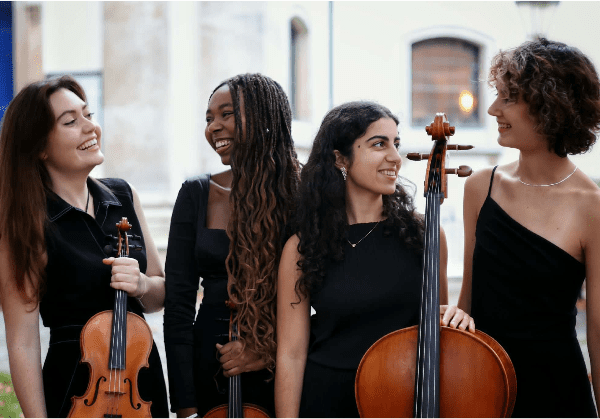
Woolf String Quartet & Duncan Honeybourne, Chamber Music Weymouth lunchtime concert, Wednesday 25 February 2026

Woolf Quartet are: Zosia Herlihy-O’Brien (violin), Emily Harrison (violin), Beatrice Slocumbe (viola) and Hoda Jahanpour (cello)

When the audience comes out of a concert with words like “incredible!”, “brilliant” and “that was absolutely superb”, you know the musicians, and the music, has touched them. And that is what happened on Wednesday, 25 February, when the Woolf Quartet returned to Weymouth to impress the lunchtime concert audience once again. This London-based string quartet was formed at the Royal Academy of Music, and they take their name from author Virginia Woolf, as they often rehearse in Bloomsbury, close to where she lived.

They made their Chamber Music Weymouth debut in 2025 and wowed the audience with an engaging programme that featured Debussy and a piece by the quartet’s cellist, Hoda Jahanpour. This time they were joined by pianist and CMW Artistic Director Duncan Honeybourne to perform just one piece – Brahms’ Piano Quintet in f minor. A big-boned work of symphonic textures and narrative breadth, it has the expansiveness of Schubert in its four movements, and is one of the most challenging and important works in the chamber music repertoire. It asks of all the musicians virtuosity, stamina and cohesion, and an ability to navigate many modulations, complex rhythmic shifts, and fugal passages. It’s a monumental work, emotionally intense and physically demanding, and a challenge for any ensemble – and one which the Woolf Quartet rose to with commitment, maturity and musical insight.

It’s rare to feel a thread of concentrated energy through an entire concert – not an easy feat for musicians to achieve – but the Woolf Quartet, with Duncan Honeybourne, succeeded in doing just this. It’s a credit to them – and a mark of the infectiousness of their concentration – that the audience was almost completely silent for the entirety of the concert, listening intently to Brahms’ shifting soundworld and the emotions it suggests.

The Woolf Quartet, both individually and together, brought much colour and nuance to the music. Brahms’ writing gives each player a chance to shine. The ensemble playing was precise and committed, amply matched by Duncan Honeybourne, who made light of Brahms’ rather unforgiving piano textures. Most engaging, though, was that the musicians clearly enjoyed themselves. It’s always a pleasure to see performers truly immerse themselves in music that they love.

Catch the Woolf Quartet if you can – you won’t regret it! They will be at London’s Wigmore Hall on Saturday, 2 May, where, I’m told, they will be performing a piece they have written together, as well as music by Shostakovich.

Chamber Music Weymouth’s lunchtime series continues on Wednesday 11 March with a recital by distinguished pianist Margarat Fingerhut. Find out more

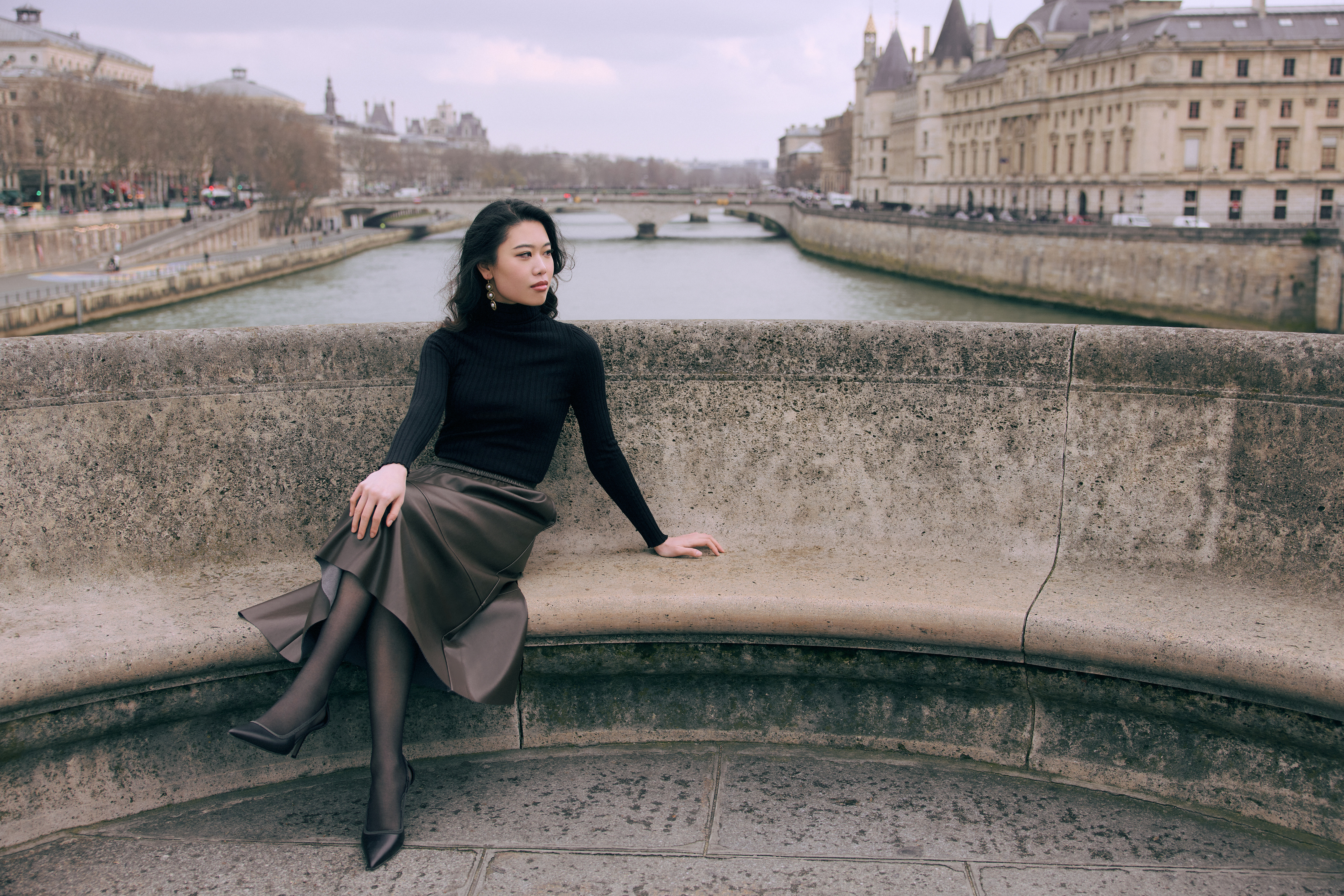
London-based Chinese pianist Siqian Li announces her debut recording, Voyage among Fragments. Described as a ‘meditation on movement and memory’, the album serves as an artistic mosaic, gathering ‘shards of experience’ from Li’s life and career into a single, unified ‘language of sensitivity and refinement’.

The title reflects how my artistic identity has been shaped by many small but powerful moments rather than a single narrative. These “fragments” are memories, emotions, and cultural influences that have stayed with me – my Chinese roots, the elegance and sensitivity of French culture, and the free spirits and boldness I discovered during the years in America.

Siqian Li

Featuring transcriptions by virtuoso pianists such as Ignaz Friedmann and György Cziffra, the pieces ‘allow familiar voices to be rediscovered through the piano, inviting audiences to hear them with fresh intimacy and perspective’ (Siqian Li).

The repertoire charts Li’s development across three distinct cultural landscapes – China, France, and the United States – reflecting moments and encounters that have shaped her artistic identity.

Her native musical language is explored through Chu Wanghua’s Jasmine Flowers Fantasy, a piece that transforms a beloved Chinese folk melody into a timeless work, providing the pianist with a ‘profound sense of home’. Her years of study at the New England Conservatory in the USA are captured through the energy of the city and the spontaneity of jazz found in George Gershwin’s Rhapsody in Blue. This American experience also includes the ‘first spark of inspiration’ for the album: Maurice Ravel’s La valse. Performed in a transcription by her teacher, the Georgian pianist Alexander Korsantia, the work represents a turning point for Li, marking a period of ‘boldness and fearless expression’.

The French spirit is woven throughout the recording, particularly in Alexis Weissenberg’s evocative transcriptions of Charles Trenet’s songs. These pieces recall Li’s first major recital outside of China at the Festival d’Auvers-sur-Oise, evoking memories of ‘floral Parisian streets’ and a ‘carefree spirit’. Other works, such as Dalayrac’s Romance and Cziffra’s arrangement of Vecsey’s Valse triste, explore bittersweet beauty and the sincerity of human connection.

The album’s voyage concludes in a state of serenity with Gounod’s Meditation on Bach’s Prelude in C Major. A prayer amidst the constant noise of our time, the final track invites the listener to ‘listen inward’ and find ‘truth in simplicity’.

Siqian Li regards this album as a personal reflection on her artistic life so far – a collection of ‘moments of courage, tenderness, discovery, and transformation’. As Li says: ‘May this music remind us all that beauty often lives in the most fleeting, delicate moments between what was and what is’.

Voyage Among Fragments is released in early March on the Sagitta Musica label, an independent record label, created by Siqian Li, devoted to artistic storytelling and the infinite horizons of emotion. Drawn by the inspiring arrow of sound, it is a space where stories unfold and music flows beyond – where classical roots meet imagination, sensitivity and freedom.

Siqian Li says,‘Through this debut, I wanted to highlight a pianistic personality rooted in curiosity, sensitivity, and emotional honesty. In curating the programme, I consciously moved away from a traditional idea of how a classical album should sound, allowing contrast, variety, and intuition to guide my choices. Rather than focusing on virtuosity for its own sake, my aim was to let imagination, colour, and inner listening shape the interpretation, placing freedom and vulnerability at the centre of musical communication.’

Find out more https://www.siqian-li.com/

Launch concert – Tuesday 10 March at Fidelio Cafe, London. Tickets/info


This site is free to access and advert-free, and takes many hours each month to compile and edit. If you find value and joy in this site, please consider making a donation to support its continuance:
Guest post by Frances Jones


A few weeks ago I slipped on an icy pavement and fractured my right hand. There was a scary moment when I was told the break might be a serious one, and difficult to heal, but that proved to be a false alarm and the hand is almost back in normal use.

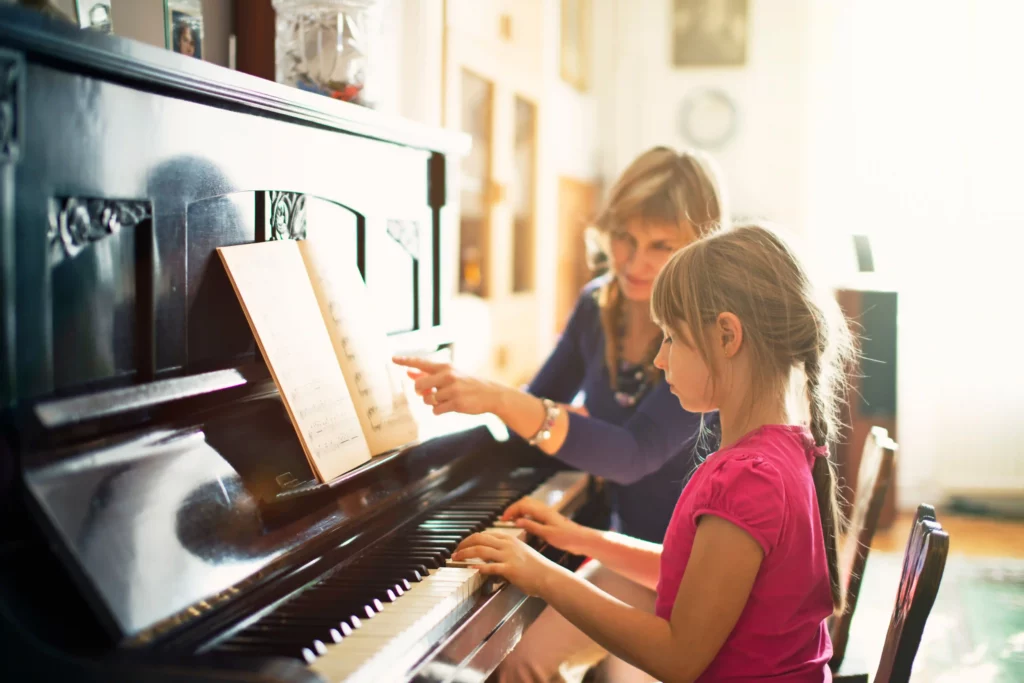
The injury, though, proved to have interesting consequences for my piano teaching, and got me thinking about motivation, a topic often in my thoughts concerning my students, who are currently between the ages of 4 and 11.

Because my right hand was immobile, I dictated homework notes to the older children to write in their practice diaries. (The younger ones made do with the squiggly efforts of my non-dominant hand.) Two particular children took this responsibility very seriously, to the extent that they are continuing to write their own notes and adhering to them, too. One of these children hadn’t been very motivated of late; she mostly did what was asked in terms of practice, but seemed to be going through the motions, rather than actually enjoying playing. Now, she makes annotations to the music, adding fingering or reminders of articulation and seems to be enjoying the piano once again. The difference in her playing is marked; there’s an expressive quality there that I hadn’t heard for months. There could be many different reasons, of course, for the change of attitude, but I think the shift in ownership has played a part. The child knows now that she is responsible for her own progress but I haven’t had to tell her that. The process has taught me a lesson, too; that for some children doing as much as possible for themselves is a real motivator. For others, it’s not important; they still have the intrinsic motivation they started out with.

Over the years, I’ve found that most children are motivated to play at first because they like the sound of the piano and take pleasure from being able to create that sound. (Very occasionally, a child has no interest in the instrument but his parents wish him to learn. Honesty, or extrinsic motivation are the options here.) Keeping hold of that initial motivation is key, and all teachers of young children have their own thoughts on how to do this. Here are mine:

Performing. This depends on the child, but I have found in schools that most children love to play in assembly or to their class and will devote considerable time to practice if they have this goal.

Being the teacher. A pupil of six was thrilled to tell me recently that he had taught his younger sister how to play a tune. Some children enjoy teaching their friends. I say to children they can teach their mum/dad how to play and younger children often love it when their parents can play a duet part.

Composing/improvising. I do this from time to time in lessons and with some children it really absorbs their interest and allows them to enjoy and explore the range of the piano. Writing down their melody is a good way to revise or bring in notation.

Learning a well-known tune. Many children, especially older ones, really want to be able to play specific pieces. Mastering a manageable version of a song you like can be very rewarding and I think helps some children continue to play when they might otherwise have given up.

Stickers. My use of these is extremely judicious and only for those up to the age of 8. I find that if a child manages to do something he’s been trying to achieve, the satisfaction of accomplishment is reward enough. For the youngest, the excitement of playing the piano is similarly, quite a match for a humble sticker and that excitement must be retained. Having said that, some children love making collections and if a sticker helps a child practice, I would certainly advocate being generous.

Praise and positivity. There are different schools of thought on this. My view is that children really value praise when it is earned and therefore, used truthfully, it is immensely helpful to progress. I find this is particularly true with children who are in a cohort with many high-achievers and feel they are never going to catch up. Sometimes a child needs convincing they are playing well, even if it’s a simple tune.

As a teacher, I’m conscious of the need to retain that initial interest and enjoyment so the child doesn’t lose sight of why he is playing and practising. Even the most well-intentioned child (and adult) can suffer a dip in motivation whilst navigating the distractions of modern life. Frustrating, yes, but truly rewarding when a little creative thinking puts things back on track.

Frances Jones teaches piano in SW London. She has also taught and led music provision in London prep schools.


