Who or what inspired you to take up the cello, and pursue a career in music?

I’m not from a musical family. My parents and I never thought that I would become a cellist. It all started randomly as my first cello was a gift from my mom’s friend. However, we never took it too seriously and I was not especially curious to learn how to play the cello until a friend of mine came to my home to play games with me. She showed a great interest in the cello and my mom was about to give it to her but that definitely triggered something in me and it was the moment I decided to pick up the cello and learn to play it.  I perhaps would never have become a cellist if this didn’t occur and I have never stopped playing the cello ever since then.

 Who or what have been the most important influences on your musical life and career?

Curiosity coupled with a willingness to push myself out of my comfort zone. I always strive to broaden my perspective on life as a global citizen and to be resilient.

What have been the greatest challenges of your career so far?

As a cellist, the challenge is to reach people with my instrument who don’t necessarily know much about cello and classical music.  I hope to continue to make classical music more accessible to a wider audience and that my instrument will be appreciated as much as the piano or voice.

Which performance/recordings are you most proud of?

My first recording of French Cello Concertos with the London Symphony Orchestra.  It was a dream come true as a musician.

Which particular works do you think you play best?

I play everything from my heart.  Works that speak to me the most are the pieces I play so that can change with time.

How do you make your repertoire choices from season to season?

When I choose repertoire for concerts, I do this by consensus and after discussion with the artistic director, fellow musicians and the conductor. I do always try to include some new pieces so that I can expand my repertoire and bring something new to audiences.

Do you have a favourite concert venue to perform in and why?

I do love playing in Seoul in particular because it’s my hometown.  It is always special to perform in my home country.

Who are your favourite musicians?

I love the work of Yannick Nézet-Séguin, former chief conductor of the Rotterdam Philharmonic, with whom I used to work.

What is your most memorable concert experience?

It was one of my most recent concerts in the UK – a recital at the Bridgewater Hall in Manchester.  I was so honoured to be there to and felt privileged to play in this wonderful hall.

As a musician, what is your definition of success?

For me, I feel most rewarded when I overcome difficulties or discover new ways to interpret a piece I have been practicing. Finding my own way to play a piece means a lot to me.  It gives me a confidence and I am full of joy to play the music.

What do you consider to be the most important ideas and concepts to impart to aspiring musicians?

For myself, I always look for an inspiration so I visit art exhibitions, I travel a lot, I look for new partnerships, I seek out new repertoire…I like discovering new things.  Life is full of surprises that open up my mind and I would encourage aspiring musicians to always be curious about the world.

Where would you like to be in 10 years’ time?

I would hopefully be in a place where I can continue to follow my passion of music-making.

What is your idea of perfect happiness?

I’m not sure if such perfection exists, but for me I definitely feel most happy when I can immerse myself in music.

What is your most treasured possession?

My cello

What is your present state of mind?

I live in the present

Hee-Lim Young’s recording of French Cello Concertos with the London Symphony Orchestra is available now on the Sony Classical label.


Hee-Young Lim was appointed as the Principal Solo Cellist of the Rotterdam Philharmonic Orchestra under Yannick Nézet-Séguin. She was one of the first female Asian cellists ever to lead a section in a major European orchestra. In 2018, she was invited to join the teaching faculty of the Beijing Central Conservatory, the first Korean professor ever appointed to this prestigious conservatory. Praised by the Washington Post as “a deeply gifted musician, with a full, singing tone, near- flawless technique and a natural lyricism that infused nearly every note she played,” cellist Hee- Young Lim has quickly established herself as one of the most charismatic and fast-rising cellists of her generation.

Born in Seoul, she was accepted to the Pre-College division of Korean National University of Arts and Yewon Arts School, winning prizes for Excellence in Music and the Most Distinguished Alumni Award. She entered the Korean National University at age 15, as the youngest student ever to be accepted. She moved to the United States to further her education at the New England Conservatory. Upon graduation, she went on to study at the Conservatoire National Supérieur de Musique de Paris, studying with Philippe Muller, where she graduated with ‘Highest Distinction’. She is also a graduate of Hochschule für Musik ‘Franz Liszt’ Weimar, where she earned her degree summa cum laude.

In-demand as a soloist, she has in recent years performed with distinguished ensembles including the German Berlin Chamber Orchestra, the Budapest Radio Philharmonic, the Warsaw National Philharmonic, the Jena Philharmonie, the Houston Symphony Orchestra, the KBS Symphony Orchestra, the Seoul Symphony Orchestra, the Baden-Baden Philharmonie, the Württembergische Philharmonie Reutlingen, the Bandung Philharmonic, the Korean Chamber Orchestra, the Incheon Symphony Orchestra, the Ningbo Symphony, Zagreb Soloists and many others.

As an enthusiast advocate of contemporary music, Hee-Young Lim is privileged to champion the work of today’s composers. Most recently, Columbia University in New York commissioned her to give the European premiere of Peter Susser’s Cello Suite in Paris and in 2019 she will give the Asia premiere of Jakub Jankowski’s Aspects of Return at the Tong Yeong International Music Festival.

Teaching has been a very significant aspect of Hee-Young Lim’s career. She has held master classes at Seoul’s Ewha University, Rotterdam Conservatory, Paris Reuil-Malmaison Conservatoire and Jakarta University, among others.

She plays on a 1714 Joseph Filius Andrea Guarneri Cello graciously given by a private donor and a Dominique Peccatte bow.

Who or what inspired you to take up singing and pursue a career in music?

I grew up with a passion for singing, and when I got to grade school, I met my music teacher who encouraged me to sing in school performances and consider pursuing it as a career. At age 7, my parents took me to my first opera (Britten’s A Midsummer Night’s Dream) at San Francisco Opera and I was absolutely hooked. At age 10 I joined a local community theater and began performing musical theater while I waited to grow into my “opera voice.” It was during a summer program after my junior year in high school where I met my undergrad teacher and mentor, Edith Bers. She encouraged me to come to New York City to get my Bachelor of Music in Vocal Performance at Manhattan School of Music. I have had the unique experience of being encouraged at every turning point in my journey towards becoming a professional singer, and for that I am grateful to many people.

Who or what have been the most important influences on your musical life and career?

The community theater that I joined as a kid had a profound influence on my passion for performing. It was at The Western Stage that I forged my deepest friendships and became completely hooked on the “theater” lifestyle and experience. The environment of professionalism, acceptance and community still shapes what I seek out and what fulfills me in my career journey.

What have been the greatest challenges of your career so far?

For a long time, I thought there was one way to be a classical singer… go to a prestigious conservatory, immediately start performing in Young Artist Programs, then sit back and watch as your career blossomed. I realized as an undergrad at MSM that I didn’t fit into the “standard” mold of the classical opera singer. Despite everyone being impressed with my talent and performances, I never seemed to book the roles in the Mozart operas, and I didn’t know why. I felt out of place for a long time, unsure of where I fit, and where I would find my community within the classical world. After my senior recital at MSM, my teacher Edith Bers told me and my mother, “Maggie will find her place in this career… I don’t know what it is yet, but there is a place for her, and she will find it.” I have replayed this statement in my head many times and I’ve kept my trust in her vision for me. With perseverance and an open mind, I have finally found my place in this world.

Which performance/recordings are you most proud of?

I performed O Zittre Nicht at the Washington Award Gala last Spring in Washington DC, and the video from that performance is one of my favorites. It was the first time I’d performed the aria, and I had a great time singing it, and I believe the video reflects that joy.

Which particular works do you think you play best?

Hands down my favorite thing to sing, and the thing I think I sing the best, is a song by composer Lembit Beecher called “A Paradoxical Thing.” It is from his song cycle Looking at Spring for soprano, violin, viola, cello, double bass and piano. The song is for solo soprano and is virtuosic, charming, thoughtful and through it I can express everything that makes me unique as a performer.

How do you make your repertoire choices from season to season?

My repertoire is driven largely by the composers that I meet or work with throughout the year. I concentrate on new opera and art song and feature this repertoire when I design my own programs. I also peruse social media to see what my favorite artists are performing and go down the youtube rabbit hole looking for new and exciting musical adventures.

Do you have a favourite concert venue to perform in and why?

I don’t have a specific favorite venue, but my favorite type of venue is hands down the black box theater. While the acoustics often leave something to be desired, I love being close to my audience and I feel that the blank canvas of an empty room has great dramatic potential. A black box theater can become anything the artists want and allows them to take the audience on a dramatic and musical journey. I also believe that because often the actors and audience members are on the same plane (the stage is not raised), the black box can be an equalizer, knocking down the artificial barriers that often separate the performers from the ‘non performers.’ This helps me feel like my audience is with me and not just passively witnessing the action on stage.

Who are your favourite musicians?

My favorite musicians are people who create straight from their truth with joy in their heart. I am fortunate to work with a group called The Broken Consort.As a group we devise and create new programs using music spanning from medieval to contemporary. Using improvisation, discussion and trial and error, we hone in on the truest expression we can make, and through this process we have produced amazing music as well as lasting and deep friendships. I have so much respect and I highly value anyone who inspires me to live and create from my true self.

Some of my other favorite classical musicians are Stephanie Blythe, Frederica Von Stade, Anthony Roth Constanzo, Joyce DiDonato, Dawn Upshaw and John Shirley-Quirk.

My current favorite non-classical musician is Janelle Monáe. Her incredible music and performances coupled with her message of self-love, acceptance, inclusivity and perseverance absolutely transport me to a place of bliss (and fierceness!)

What is your most memorable concert experience?

This past spring I performed the workshop of part of a piece I am creating entitled Reassemble With Care. Members of The Broken Consort and I devised the music around a text that I wrote, which is based on my personal experience with sexual assault. Performing Movement 12 was a deeply moving experience, and embodies everything I am searching for as a performer. While on stage I felt completely connected with and supported by my fellow musicians. Using the words I wrote as my guide, I fearlessly improvised the music, subconsciously accessing all the technique I have honed over my 20 years of study, and the result was magical. I felt my body deeply grounded on the stage and felt my voice reach high and out into the room. It felt like true freedom, and is a moment I will never forget. Next fall we’re going to premiere the entire work, which consists of written music by composer Dominick DiOrio and devised music by myself and The Broken Consort.

As a musician, what is your definition of success?

For me, success is achieved when I am able to support myself financially by performing in a way that fulfills me artistically. Performing in this way means that I am free to access my own creativity, call upon my vocal technique, and explore new ways to express myself.

I think it is entirely possible for people to be successful performers while working other jobs to supplement their income, but for me this element is part of my own personal goal in my career path.

What do you consider to be the most important ideas and concepts to impart to aspiring musicians?

Find out exactly how you want to use your talent and create opportunities to make that vision come true. It’s very easy to get caught up into trying to fit into a “mold” as a classical artist, and I believe that true fulfillment comes from creating straight from individual truth. While you’re taking the time to hone your skills and perfect your craft, take as many diverse opportunities as possible to broaden your knowledge of what is out there. Then when you’ve figured out what you want to do, go create something uniquely yours.

Where would you like to be in 10 years’ time?

I would like to be living with my partner (it doesn’t matter where) and still traveling for work. I would like to be performing at least 3 large-scale operas a year in major houses and pursuing my own projects the rest of the time. My own projects could include cabarets, art song recitals, salons, and anything else I come up with!

What is your idea of perfect happiness?

Perfect happiness is being in the moment and fully experiencing the abundance around me.

What is your most treasured possession?

Okay, moment of vanity here… My most treasured possession is probably the hair paste I use to style my hair. My haircut is a very big part of my personal identity, and the paste makes this image possible. It seems silly, but my hair feels like a talisman that helps me to take the world on with strength and well… style 🙂


Hailed by The Washington Post for her ‘silvery, pitch-perfect voice’ and by Opera News for her ‘noteworthy acting prowess,’ Maggie Finnegan is a versatile soprano, singing repertoire spanning from medieval to contemporary. Awards include the S&R Foundation’s 2017 Washington Award,  First Place in the Washington International Competition for Voice and second place in The American Prize Competition. Specializing in new opera, she performed the world premiere of Lembit Beecher’s opera Sophia’s Forest , Beth Morrison Projects: Next Generation and Rachel Portman’s The Little Prince with Opera Parallele.  She made her Handel and Haydn Society solo debut at Jordan Hall, singing the soprano arias in Bach Cantatas 36 and 147.  Past seasons included premiers with Vital Opera, The American Chamber Opera Company in New York City and the Center for Contemporary Opera in Louis Andriessen’s Odysseus’ Women/Anais Nin.  Other career highlights include The Sound of Music  with Paper Mill Playhouse, the Metropolitan Opera Guild’s School Touring Program of The Magic Flute and Boris Godunov with The Metropolitan Opera Chorus. Her recent concert appearances include performances with the Avanti Orchestra, the New Dominion Chorale, The Camerata Singers of Monterey County, The City Choir of Washington, the Handel and Haydn Society and the PyeongChang Winter Music Festival in South Korea. She was featured as a soloist in the revival of the play Extraordinary Measures, in which she worked with Tony award winning playwright/activist Eve Ensler.

An avid chamber music performer and recitalist, concert highlights include the U.S. Premiere of Jacob TV‘s Van Grote en Kleine Vogels (for soprano and soundtrack) at the 2018 {Re}Happening Festival at Black Mountain College, Paola Prestini’s Body Maps with Fresh Squeezed Opera  and studying American art song with Stephanie Blythe as a Fall Island Fellowship Artist.  She is a core member of the critically acclaimed ensemble The Broken Consort, which recently presented the world premiere of Movement 12 of her new project Reassemble With Care.   Maggie honed her improvisation skills at the Opera Works Advanced Artist Program and has since then made improv a regular practice.

Maggie earned her Bachelor of Music degree from Manhattan School of Music and her Master of Music degree from Peabody Conservatory. She currently splits her time between New York City and Boston, where she shares a home with her partner and three step-kids. 

maggiefinnegansoprano.com

Why would a talented leading British composer include a document called a Failure CV on her website, alongside details of her extensive oeuvre and the many plaudits for her work?

British composer Cheryl Frances-Hoad is not alone in including such a document on her website. She prefaces it with the comment that “for every success I have, there are usually a LOT more failures that nobody ever gets to hear about”, and each entry on this Failure CV includes a note of how each project or submission turned out. On one level, it’s sobering reading – proof that composers (and musicians in general) must work hard and that success is often hard won. But it’s also rather inspiring and positive. Its honesty shows that Cheryl, and others like her, accept that a successful career trajectory is paved with many setbacks and failures, and it reveals a certain confidence which seems far more genuine than a list of accolades, prizes and press reviews.

The more usual kind of CV lists successes only, but this does not represent the bulk of one’s efforts. Nor does it acknowledge that failure is a necessary part of progress and without it, one cannot reflect on nor learn from those failures.

A composer can “hide” their failures. They need not mention the rejected funding applications nor the works which never got commissioned. A performing musician, however, exposes themselves to criticism in the very public forum of a live concert and errors will be remarked upon by audiences and critics. As musicians, failure can have a very profound effect on how we approach our music making and professional career. It can create feelings of personal humiliation which in turn may stifle our ability to learn and develop. Sadly for many of us, the “wrongness” of making mistakes is inculcated in us from a young age – by parents, teachers, and peers – and such prejudices combined with a constricted mindset lead us to blame and criticise ourselves for our failings

In fact, mistakes and slips in concert are a very tiny part of the “setback-reflect-progress” habit of the serious musician, who regards mistakes as positive learning opportunities rather than unresolved failures. Failure is part of creativity and mastery, and without it we cannot learn, explore, experiment, expand our horizons, and progress

It also fosters resilience and equips one with the tools to cope with the exigencies of one’s creative life. Being honest about failure is empowering, for oneself and for others, as it can help them deal with their own shortcomings and career setbacks, and encourage them to stick to the task.

What Cheryl Frances-Hoad’s Failure CV so neatly proves is that failure – and a willingness to learn from it – is a fundamental part of success: without those setbacks, Cheryl may never have reached the pre-eminent position she now holds in classical music in the UK and beyond.

Meet the Artist – Cheryl Frances-Hoad

Extensive learning and engagement activities take piano out of the concert hall and into communities 

Outstanding young scholars from Lang Lang International Music Foundation also perform

“Artistry of that kind is rare in pianists of any age; to find it in a 20-year-old is simply astounding.”
The Daily Telegraph

Following his win at the Leeds International Piano Competition in September 2018, 21-year-old pianist Eric Lu returns to ‘The Leeds’ for Leeds Piano Festival, with recitals in Leeds and London. World-renowned pianists Steven Osborne and Barry Douglas also perform recitals, with Osborne leading a masterclass with Young Scholars from the Lang Lang International Music Foundation, building on the ongoing relationship between the Foundation and The Leeds.

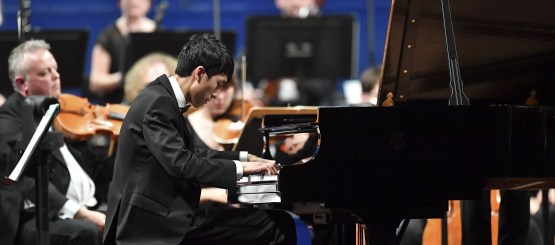
Eric-Lu-winner-of-the-Leeds-International-Piano-Competition-2018-performs-at-the-Finals-at-Leeds-Town-Hall-c-Simon-Wilkinson-Photography-e1537184338402

The Festival continues the much-enriched programme of events that surrounded the 2018 Competition, allowing audiences to engage with the piano and The Leeds beyond the triennial Competition. As part of The Leeds’ commitment to developing new and exciting ways of bringing the piano to as wide an audience as possible, the Festival – successfully inaugurated in 2018 – will again comprise many learning and engagement activities, including the return of the ‘Discover the Piano: Piano Fantasia’ on 28 March – The Leeds’ biggest primary school event to date, reaching more than 1,000 schoolchildren. The Young Scholars also participate in learning activities in primary schools and adult care settings in both Leeds and London – the latter once again in partnership with Wigmore Hall’s learning and participation programme – inspiring music lovers young and old with their prodigious talents.

Leeds Piano Festival recitals 

Eric Lu’s return to The Leeds is part of the revolutionary prize package at The Leeds last year, designed with career development in mind. The prize also included world-wide management with Askonas Holt, a release of his Leeds-winning performance on major label Warner Classics (released to much acclaim in November 2018), opening the Royal Liverpool Philharmonic Orchestra’s 2018/19 season, mentoring with jury members and more. Lu performs Chopin’s Piano Sonata No. 2 – a piece he performed in the Competition semi-finals and released as a single on Warner Classics following his win – as well as works by Mozart, Brahms and Handel.

Former Royal Philharmonic Society ‘Instrumentalist of the Year’ Steven Osborne explores Beethoven’s final three piano sonatas. Osborne is a renowned interpreter of Beethoven’s music, not least from his critically-acclaimed recordings of the composer’s piano sonatas on the Hyperion label, and these recitals offer a rare opportunity to see him perform in an intimate setting.

Internationally-renowned pianist Barry Douglas pairs miniatures with more expansive works in both halves of his programme for the Festival, contrasting Tchaikovsky’s vignettes The Seasons with his Grande Sonata in G major, before pairing Rachmaninov’s Six Moments Musicaux with Schubert’s intense Sonata in A minor.

The Festival also showcases three Young Scholars from the Lang Lang International Music Foundation, developing the continuing relationship between the Foundation and the Leeds. Three exceptional young pianists, Aliya Alsafa, Jaspar Heymann and Shuheng Zhang – handpicked and mentored by Lang Lang, the Competition’s Global Ambassador –perform recitals at both Festival venues, as well as participate in a masterclass led by Steven Osborne at Leeds College of Music.

Speaking at the Finals of the 2018 Competition – where he also presented prizes and was conferred with an Honorary Doctorate from the University of Leeds – Lang Lang stated: I’m extremely proud of my association with the city of Leeds, and with the Piano Competition – which is doing so much to unite excellence and accessibility”.

Closing the Festival, celebrity pianist Alistair McGowan returns to The Leeds with Introduction to Classical Piano at Besbrode Pianos. An alumnus of the University of Leeds, McGowan previously performed at The Leeds during Piano + events at the 2018 Competition, and his 2017 recording The Piano Album reached Number One in the UK Classical Album Charts.

Learning and Engagement 

In addition to their recitals and masterclass, the Young Scholars participate in many external learning and engagement activities, following the success of similar events at last year’s Festival. As well as performing in the Piano Fantasia to over 1,000 primary schoolchildren, they also visit local primary schools in both Leeds and London, as well as adult care settings.

The University of Leeds, a principal partner of the Competition, hosts a ‘Steinway Experience’ on 30 March as part of Be Curious, the University’s research open day, where families can enjoy these wonderful instruments. Steinway & Sons, also a partner of The Leeds, has provided the pianos for the Competition since its beginnings in 1963.

Coinciding with Piano Day on 29 March, pop-up performances take place on the Leeds Piano Trail, in partnership with Leeds Business Improvement District (BID). These Besbrode pianos, decorated by local artists, were a popular feature of last year’s Competition and encouraged the public to play and experience the pianos at high-profile locations around Leeds city centre; most of the trail pianos stayed in place after the Competition due to the huge popularity of the initiative.

Adam Gatehouse, Artistic Director of the Leeds International Piano Competition, said: “After winning over both the jury and audiences at the 2018 Competition, we’re delighted to welcome Eric Lu back to The Leeds for the second annual Leeds Piano Festival. We’re thrilled too that Steven Osborne, Barry Douglas and the extraordinary Lang Lang Scholars will join him in both Leeds and London, allowing audiences to experience their remarkable talent and help us share in wonderful performances of great piano music. Deepening our roots in our communities by developing fun, diverse and inclusive events to enable more people to discover and fall in love with the piano is also crucial to our mission, and the Festival continues its inspiring work to attract ever-wider audiences.” 

Tickets for the Leeds recitals and the masterclass can be booked here, and the London recitals here.


Leedspiano.com

@leedspiano

