
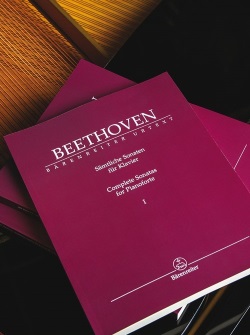
 To Wigmore Hall on Friday evening, at the invitation of music publisher Barenreiter, to celebrate the recent publication of a new three-volume edition of the complete Beethoven Piano Sonatas, edited by renowned Beethoven expert Jonathan del Mar.
Prior to the pre-concert talk, I had lunch with an old pal from university. We hadn’t seen each other for about 30 years, and had only recently reconnected thanks to Facebook. Our lunch conversation was a mixture of catching up and reminiscing about a very happy (and, to be honest, fairly well-behaved) three years at Exeter University in the mid-1980s, a time when there were no tuition fees, when gaining a degree still held a fair amount of cachet, and when it was relatively easy to find a job on graduation. Talking about music, we recalled the songs and bands which had been so meaningful to us at that time – Talking Heads, The Communards, The Smiths, Prefab Sprout, The Beastie Boys….. I almost had to “reset” when I walked through the gilded doors into the plush crimson-and-gold foyer of the Wigmore Hall.
2020 is Beethoven’s year, and however you may rail against it, protest that he’s getting far too much attention, demand more diversity in concerts programmes etc etc, you can’t escape the Old Radical and his music (and maybe there’s an undergraduate thesis to be written on whether Beethoven was the original Beastie Boy!). There’s a good reason for this, in my opinion, and that’s because in addition to this being the 250th anniversary of his birth, his music is absolutely bloody marvellous! He is “great” – and that was amply demonstrated in Jonathan Biss’ performance, the third concert in his odyssey through the complete Beethoven piano sonatas at London’s Wigmore Hall.
The compulsion to play and record this music, combined with, more often than not, a fair degree of reverence, is very much alive and well – and each generation brings a fresh crop of pianists willing to rise to the challenge; Biss’ cycle at the Wigmore comes hot on the heels of those of Igor Levit and Llyr Williams – and all three pianists have released recordings of the complete sonatas (Biss’ final instalment is due soon from Orchid Classics). This music enjoys an elevated stature which goes far beyond the notes on the score, and despite some relaxation in the rituals and etiquette of classical concerts, the 32 piano sonatas are still regularly presented in an atmosphere of awed reverence. This was palpable when I and my concert companion entered the sacred shoebox of the Wigmore auditorium (as my companion commented, hearing Beethoven is like an anticipating a grand meal, with steak as the main component!). Any pianist who takes on the colossal challenge of the piano sonatas enjoys special respect: not only is this music physically and psychologically demanding, but the hand of history, tradition and expectation weighs heavily upon their shoulders.
intense, immersive, impassioned, hugely demanding and hugely enriching
Jonathan Biss, pianist
Friday’s concert was prefaced by a special event hosted by Barenreiter in which Jonathan del Mar talked engagingly about the process of producing another edition of the complete piano sonatas when so many already exist. He outlined the obvious prerequisites for the “ideal” edition:
- It consults all surviving sources, to ensure “all the right notes” are included
- It provides a commentary for musicians which is open and transparent
- It delights the musician’s eye in its clear design and spacious layout, with “as good as possible” page turns.
Del Mar’s research revealed some interesting and entertaining “mishaps” in previous editions; for example, a hole in the paper being mistaken for a staccato marking or essential details being lost in the conservation and cleaning up of manuscripts. His interesting commentary was illuminated by musical demonstrations on the piano.
Jonathan Biss is a “thinking pianist” with an acute intellectual curiosity, as evidenced by his writings on Beethoven, and other composers, and his online course on the Sonatas. It was therefore a surprise to encounter a performer who appeared anything but a stuffy academic. Here was vivid expression, vitality and flamboyance; no standing back from the music as if in modest reverence but rather a deep dive into its every nook and cranny to winkle out and reveal details afresh.
The programme offered an overview of Beethoven’s creative life, with sonatas from all three periods of his compositional output (No. 1 in F , No. 10 in G, No. 18 in E-flat, No. 24 in F-sharp and No. 30 in E), and the first half in particular suggested an exuberant lust for life on the part of the composer, the performer reflecting this with sparkly, febrile runs and dizzying tempi. A tiny memory lapse in the first sonata was handled with bravura (and gave hope to aspirational amateurs, a reminder that this pianist is also human!). The final sonata in the triptych, nicknamed ‘The Hunt’, was a rollicking romp, its barely-reined-in energy given only a brief respite in the elegant Menuetto. In the finale, horses and hounds were fully unleashed and galloped around the keyboard in a vigorous, earthy tarantella. Edge-of-the-seat playing for audience, Biss electrified his performance with the sense that this music could run out of control at any moment (except that it wasn’t going to because this pianist clearly understands the paradox “through discipline comes freedom”) lending a special frisson to the performance. I turned to my companion at the end of the first half and found he was equally open-jawed at what we had just experienced.
There’s something seductive about this process of really going to your limit with this music
– Jonathan Biss
And here’s the thing: live music, done this way, truly is an experience. Not a polite recreation of what’s exactly on the page, a solemn ceremony of reverence, of fidelity and and “authenticity” (whatever the f*ck that actually means!) and honouring the composer’s “intentions”, but a thrillingly personal, witty, eccentric, captivating and unpredictable account of music which this pianist clearly adores. It’s not to everyone’s taste and it’s the kind of playing that will probably irritate the keepers of the sacred flame, but I loved it because it made me feel energised, fully alive.
The second half further confirmed this (and any performer who causes me to spontaneously cry during the Op 109 is clearly “doin’ it right”). A sensitive, but never saccharine Op 78, dedicated to Therese, and then the transcendence that is the Op 109, No false sentiment here – from the lyrical opening movement through the rambunctious middle movement, and finally the gorgeous, seductive theme and variations which open and close with a prayer, this was beautiful, thoughtful and vivid playing.
Companion and I retired to a noisy pub down the road from the Wigmore for post-concert conversation and more wine, neither of us truly able to put into words what we had just experienced. My only comment then was that this is music which can “take anything a performer throws at it”. And therein, for me at least, lies its greatness.
Really, Music is above all other things a language, and since no one used that language more daringly than Beethoven the more of it you speak, the more of it you feel, the more you will find in his Music.
– Jonathan Biss
Jonathan Biss’ Beethoven cycle continues at Wigmore Hall on 20 April (with a talk by Biss on 19 April). Further details.
My concert companion writes: Biss at Wigmore




 The Cross-Eyed Pianist