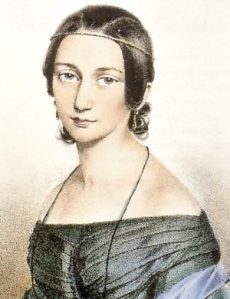
 This breath-taking, beautifully crafted book by Janice Galloway presents a fictionalised account of the life of Clara Schumann from childhood to the committal to a mental asylum of her husband, Robert, her growing friendship with the young Johannes Brahms, and Robert’s death.
Clara Schumann is all too often eclipsed by her more famous husband, yet this book reminds us that from a very early age, she was a formidably talented pianist in her own right, and a fine composer. It is Clara who, along with Liszt, made the piano recital what it is today, in particular, the habit of playing without the score. She exerted her influence over a 61-year career, hardly interrupted by marriage and pregnancy, changing the tastes of the listening public and the format of the traditional piano recital.
From the outset, we sense the extreme pressures of the life as a child prodigy and young virtuosa, with an overbearing, highly ambitious and extremely controlling father, and a muddled, disjointed family life (her parents divorced when she was four, and her father remarried). A life of self-denial and duty was drummed into her from a very young age. Endless practising, studying, being fitted for concert dresses, and touring, where she was presented to the crowned heads of Europe – all in the company of her father, Friedrich Wieck. Written in a slightly breathless, immediate style, the author creates a sense of Clara looking in on her own life, observing herself at arm’s length. Yet, this book does not lack passion: as her love affair with Robert, who was nine years her senior, develops, we sense the frustration of two young people, deeply connected – physically and spiritually – but bound by the conventions of the time.
After their marriage, Clara continued her concert career, though Robert loathed touring with her, managed the their home and finances, and produced eight children (one died in infancy). In the book, the author offers a unique view into the Schumann household: two creative people living and working side by side – dedicated artists in one home can prove a test with their selfish habits and fickle moods – and the tensions of trying to maintain a ‘normal’ family life while continually feeding the artistic talent. Clara comes across as immensely talented, pragmatic, patient, loving: supporting her husband and his increasingly fragile mental state (it has been suggested that Robert suffered from bipolar disorder). She was his wife, mother to his children, his helpmeet and, perhaps above all, his muse.
The narrative introduces some of the key musical and cultural personalities of the day – Mendelssohn was a friend of the Schumanns, Liszt a regular visitor; Moscheles, Thalberg, Sterndale Bennett, Chopin, Paganini, Goethe; later, the young violinist Joachim, and fledgling composer Johannes Brahms – and takes the reader to many of the cultural centres of nineteenth-century Europe as we tour with Clara and her family. There are musical soirees at home and grand concerts in the great venues of Europe: the Gewandhaus, the Musikverein, the Concertgebouw. It is a restless, urgent journey, and with Robert’s increasingly unstable mental state, we empathise with Clara’s predicament: the constant tug of the artistic life against her commitment to her family.
This book is thoroughly researched, full of information about the Schumanns, and sympathetic to Clara’s enormous personal burdens and self-sacrifice. The author is adept at bringing Clara to life, but we never really see Robert as a “normal” person, and the reader remains distanced from him, observing, rather than feeling, what is happening to him. Readers who are not familiar with the cultural landscape of the day, and the life of the Schumanns may find the narrative a little hard to follow in places, but it never ever lacks atmosphere.
‘Clara’ perfectly captures the internal life of a musician, muse, wife and mother, and in many ways it is a modern story, for Clara was a working woman who supported her family. Clara’s love is beautifully rendered – like a madness all of her own, at the same time both thrilling and terrifying.
A couple of years ago, I read another novel about Robert and Clara Schumann, based on their letters, Longing by J D Landis. Another rollercoaster of a narrative, it offers a poignant context to their intense and oft-thwarted love by presenting the totally encompassing musical, literary, philosophical, and political climate of the day. A good ‘companion read’ to Clara, and equally well-researched.






 The Cross-Eyed Pianist