This week I am wrestling with one of my personal pianistic bête noirs: the dread cross-rhythm (or ‘poly-rhythm’). I am ashamed to confess that at my time of life (mid-40s) and pianistic ability (advanced), I have never truly mastered playing a cross-rhythm (for example, triplets in right hand over duplet quavers in left hand). I suspect I was never taught how to do it properly by the teacher I had in my teens, though I do recall that one of my Grade 8 pieces, a Chopin Nocturne in D minor, had a few cross-rhythms, which were just skimmed over: I seemed to play them all right, and I passed my Grade 8 with a creditable mark. Unfortunately, for me, being able to play a cross-rhythm convincingly, and, more importantly, correctly, is a basic requirement for a pianist of my level of (so-called) expertise. It is also essential for the Debussy I am learning for my Diploma (the ‘Prelude’ from Pour le Piano), which contains a small section of triplets over semiquavers. For the uninitiated, playing a cross-rhythm is the pianistic equivalent of rubbing your stomach with one hand whilst patting your head with the other (or vice versa).

Over the years, my silly difficulty with the cross-rhythm has forced me to exclude a great deal of music from my repertoire: a good deal of Chopin, Schubert, Brahms, Rachmaninov, Tchaikovsky, Prokofiev has, until recently, remained a mystery to me, because I only have to see a group of triplets against quavers, and I go cold with fear.

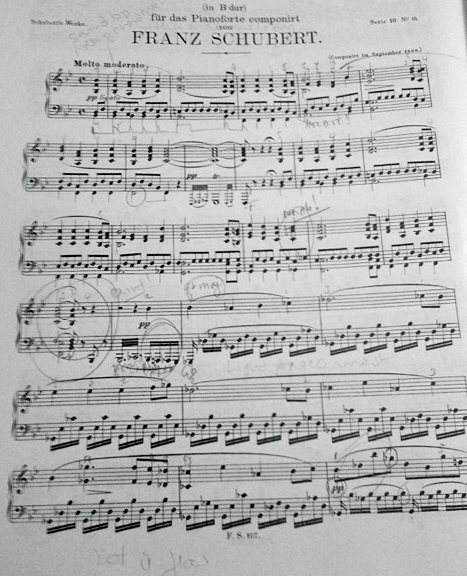
A few years ago, I taught myself the opening movement of Schubert’s great last sonata, the D960 in B-flat Major. (I also taught myself the rest of sonata, but the glorious first movement was my main preoccupation). In the development section, there are six, yes six, bars of triplets in the right hand over duplets (pairs of quavers) in the left hand. This section marks the climax of the movement, and, when played correctly, is extraordinarily dramatic, as the two strands of music come together. Whenever I encountered this section, I just “fudged” it, playing a rough approximation of what it should sound like and feeling relieved when I reached the end of the section. A brief encounter with a piano teacher (one who I quickly dropped like the proverbial hot potato when I discovered some rather unsavoury truths about him – but that’s another story) gave me a little ditty to help cope with the cross-rhythms in the Schubert. A quick trawl of the internet earlier today, while trying to find a proper exercise to help me with the Debussy, threw up a number of rhymes and suchlike for this purpose, the most popular being “Nice Cup of Tea” or the variant “Cold Cup of Tea” to cope with triplets against duplets. Rhythmically, it works like this:

Nice (both notes together) Cup (2nd triplet) of (2nd duplet) Tea (3rd triplet).

It helps to tap the rhythm out on alternate knees while saying the words a few times before attempting it at the keyboard. This ‘system’ works for very short passages of three against two, or better still, one triplet group against two quavers. But try saying Nice Cup of Tea over and over again for six bars – as for the Schubert – and it quickly becomes apparent that one needs a more rigorous approach.

When I played the Schubert for my current teacher, at my first lesson with her, she immediately picked up my difficulty with the cross-rhythms in the development section, and gave me a neat exercise, which forces one to keep a regular pulse going (essential to ensure the notes of the cross-rhythm fall in the right place). Take the simplest one-octave C major arpeggio in the right hand, in triplets, descending from the C above middle C (C-G-E, C-E-G etc), while the left hand plays crotchet C’s and G’s on the beat (say, in 2/4 time). Get a good sense of the pulse before dividing the left hand rhythm into quaver duplets, and allowing the second duplet to fall just after the second triplet of the group. Be careful not to allow the triplets to turn into a dotted rhythm. I found this exercise really helpful as it prevents one from playing too mechanically and does not interrupt the flow of the music.

Other people advocate a more mathematical approach, involving diagrams and numbers. This is for 3 against 4, pulled from an ABRSM forum on the subject:

1 2 3 4 5 6 7 8 9 0 1 2
x       x        x       x      (x falls on every third beat)
o          o          o     (o falls on every fourth beat)

Now, count aloud while patting alternate knees: 1(Both) 2 3 4(left) 5(right) 6 7(left) 8 9(right) 10(left) 11 12

Do this very slowly at first and build up speed, until you can ‘feel’ the rhythm and you won’t have to count it in your head.

Sounds simple? I will be trying this method tomorrow with the Debussy….. I suspect there will be a degree of “fudging” involved: the tempo of the piece means that one could wing it, but I am sure my teacher would notice it – and I want to play it correctly! Very slow practice, playing the notes from left to right in the order they are written and making sure to stress the strong beat where both hands fall together may help my poor brain (and fingers) from getting in a tangle! Knowing each hand’s part intimately (from memory, ideally) should help too. Expect a follow up post on this subject in a few weeks’ time!

Meanwhile, here are some resources which I found helpful.

The first of Brahms’s 51 Exercises is an exercise in cross-rhythm, rather than a fingering exercise. Download a PDF file Brahms 51 Exercises No. 1
PDF Worksheet on Cross-Rhythms

The holiday is over, and my students return next week for the start of the spring term – which means I must get organised! As I start to plan the upcoming term, with the usual emphasis on finessing pieces for exams later in the spring, and encouraging students to think “musically”, a quote from the pianist Artur Schnabel comes to mind, that bar lines – like children – should be seen and not heard.

When I introduce the way music is constructed and written to novice students, I explain that bar lines are there to “keep the music tidy”, and that each ‘measure’ of music is separated by a bar line. This immediately sets them up as notional hurdles to keep the unruly sheep of notes tethered in the right place. Quite soon after, students meet phrase marks, and are then presented with a conflict: bar lines forces the eye read music vertically, while phrase marks ask the eye to read horizontally.

Many novice students play music bar by bar,  literally “vertical” playing, since seeing the notes contained within each bar as a single entity that must not be allowed to stray along the stave seems to force the hand and fingers to adopt a piston-like up and down action, which can result in very chunky, “notey” and overly accented playing. Meanwhile, I try to encourage students to see music in terms of phrases, or “sentences”, as long strings of melody, and urge them to “read ahead” so that they are continually anticipating what is to come. Alongside this, I ask students to think about the movement of their hands, and to play with more relaxed, elliptical movements (“polishing” was one of the words I used with Bella to help her achieve a lovely fluidity in her Bach Prelude). This is one of the great conflicts of playing the piano: the mechanical action of the instrument requires an up-down movement to produce a sound, but to produce beautiful sound – which is what we all strive for, whether the quietest pianissimo or the most forceful fortissimo – one must free arms, hands and fingers to play with looser, more parallel movements, and learn how to distribute weight through the fingers or to allow the arms and back to draw weight away from the fingers.

With practice, one learns to read the music horizontally, and good keyboard geography will enable a student to stop checking their hand/finger position every bar. And so, from reading line by line, one goes on to take in the whole page in a single glance. I tell my adult students that reading music is like driving: one must look at the road ahead to anticipate hazards, speed markings, and stop signs. Anticipation is crucial, for it allows one to play fluently, and seeing beyond the bar lines helps to avoid placing unnecessary emphasis on the first beat of every bar. When looking at new music, I now ask all my students, children or adults, to point out phrase marks, tempo, dynamic and articulation markings, and any other signs or symbols which they need to be aware of in their journey through the score. Thus, the music becomes a map – and the job of the pianist is to navigate and interpret it.

Of course, it would be far easier, in many ways, if bar lines did not exist. Without these hurdles and dividers, our eyes would automatically take in the score horizontally and read along the stave rather than up and down it, and we would be able to achieve more nuanced phrasing and fluent playing. As it is, the majority of music we encounter will be divided into measures, and so we must train our eyes to see past the bar lines, to read the score as a whole rather than in small sections, and to strive for a coherent, fluid and well-shaped reading,

With all this in mind, I really should be practising…….

synergy syn·er·gy (sĭn’ər-jē)
n.
The interaction of two or more agents or forces so that their combined effect is greater than the sum of their individual effects.

“those three minutes of perfection – when time stands still and the music just washes over you….”

This was Bruce ‘The Boss’ Springsteen, talking on Radio 4 on Saturday morning about playing and performing, in an interview broadcast to coincide with the release of his book and a new album ‘Promise’, and the re-release of his album ‘Darkness on the Edge of Town’.

Those of who play and listen to music regularly known what The Boss is talking about: that moment when one is ‘transported’, taken out of oneself; where the experience transcends the norm and seems to take one to another plane of consciousness. I felt it on Monday evening at the Wigmore, while listening to Messiaen’s transcendental ‘Quartet for the End of Time’.  Such moments can be rare, and so they must be cherished because they can be fleeting and soon forgotten.

When one is playing music, it is even harder. In order to achieve such a state, one must work hard, for one must know the music intimately – and such intimacy only comes from repetitive work and thoroughly immersing oneself in the music. One must also possess purpose and focus, trust in one’s musical self, have a highly-developed ability to concentrate, blanking out all other distractions, and be able to stand back from oneself and the music.

I used to find it hard to concentrate on my practising; my piano is in the conservatory and I was regularly disturbed by birdsong (the famous Bushy Park parakeets usually start their daily squawking at about 4pm), a dog barking, a road drill, my neighbour mowing his lawn. Gradually, I trained myself to ignore these sounds; they merged into the background, becoming a foil for the music instead of competing with it. Sometimes the sounds of nature are helpful: working on Debussy’s ‘Voiles’ in the summer, with the French windows flung open, I listened to the wind in the bamboos in my garden, and drew inspiration from that sound.

Some days, when I’m practising something for technique alone, a passage of Chopin, for example, which is just fingerwork, purely mechanical playing, before the shaping and finessing begin, I can let me mind wander, but not too far because there needs to be a degree of engagement to ensure the fingers land in the right place each time. This kind of practising acts as an exercise, to strengthen the fingers and to train the muscular memory to achieve accuracy. As Vladimir Horowitz said “From the moment one feels that the finger must sing, it becomes strong”: it is at this point that one stops playing mechnically and starts to play musically. Pianists, who draw so much information from the tips of the fingers, transmitting it to the brain and back to the fingertips again – almost as if one has “eyes in the fingertips” as my teacher put it once – can feel when that moment is achieved. Rather like a runner or cyclist being “in the zone”, reaching that point of perfect synergy between body and mind, when all limbs, lungs and heart seem to be working properly and the action becomes fluid, comfortable, beautiful.

When one plays in this state, it seems as if everything has fallen into place. Sometimes, it even feels easy! I have the sensation of observing myself, standing back from the music, and myself, watching myself playing. There is a sense of having “let go” – and yet, it is at this point that one is concentrating most furiously. One has also done all the groundwork: learnt all those notes, assimilated and acted upon those dynamic, articulation, tempo or stylistic markings, understood the composer’s intentions. At this point, one feels one has created exactly the right balance between spontaneity and structure, technique and inspiration

In his excellent book ‘The Inner Game of Music’, Barry Green (a professional double-bassist) talks about us having two Selfs: Self 1 is critical, cautious, doubting, sensible, interfering. It gets in the way, telling us what we should and should not be doing; it predicts successes and failures, and talks of “if only”. Self 1 can also be extremely distracting. Self 2 is intuitive, tapping into the vast resource of our nervous system and drawing information from non-verbal cues, and our vast memory-bank of past musical experiences: everything we have heard, learned from others, or experienced ourselves. Self 2 is more creative, and is connected to an earlier, childhood state – that wide-open, receptiveness that exists in children until they are about eight years old, ready to absorb whatever comes before us. As we grow up, subtle changes occur as we begin to collect information, ideas, attitudes, and form our own conclusions. We also become more cautious, more risk-averse, more fearful of the consequences of our actions, and the gap between our “critical” self (Self 1) and our “creative” self (Self 2) widens. The ability to spontaneously tap into our intuitive resources of Self 2 disappears, as Self 1 takes over. It is possible to train oneself to let Self 2 back in, to master what Barry Green calls “the inner game” (a technique borrowed from tennis coaching), and to reduce mental interference which can inhibit the full expression of one’s musical (or sporting) capabilities.

Choosing to ignore Self 1’s commands, its “what ifs” and “if onlys” is an important process in learning good concentration skills and teaching us to trust our musical selves. It is also crucial in helping to overcome performance anxiety: as I say to my adult students (who are currently in a collective paroxysm of fear about performing in my forthcoming Christmas concert), “What’s the worse thing that can happen?”. I assure them that no one will boo, nor slow hand-clap, nor heckle. Indeed, most people in the audience are full of admiration of anyone who can get up on a stage and perform. It is no surprise that most of the children I teach, especially the younger ones (8 – 10 year olds), are eager to perform and love showing off what they can do. They don’t worry about making mistakes or stopping mid-performance; they just get on with it, demonstrating that their Self 2 is more powerful than Self 1 at this point in their lives.

So, those “three minutes of perfection”, which Bruce Springsteen talked about, that moment of perfect synergy, are a true product of one allowing Self 2 to take over, driving out the doubts and fears of Self 1, letting one’s true musical self play, and permitting one’s fingers, hands and body to make the decisions.


Resources:

Green, Barry: The Inner Game of Music. Pan Books. London, 1987

—————- The Mastery of Music. Macmillan. London, 2003

Rink, John: Musical Performance: A Guide to Understanding. Cambridge University Press, 2002

Westney, William: The Perfect Wrong Note: Learning to Trust Your Musical Self. Amadeus Press, 2006

Bernstein, Seymour: With Your Own Two Hands: Self-Discovery Through Music. 1981

Moderato (It.)

‘Moderate’, ‘restrained’, e.g. allegro moderato (‘a little slower than allegro ’).

adv. & adj. Music (Abbr. mod.)
In moderate tempo……. Used chiefly as a direction.

‘Moderato’ is one of those rather nebulous musical terms, like andante (“at a walking pace”). If I ask one of my students what it means, they say “moderately”. But what does it really mean? At the most basic level, it is a tempo marking, slower than allegretto, but faster than andante. The modern metronome gives a marking of 96 to 100, a very narrow range – and I would always guard against assigning a specific metronome mark to a piece marked moderato, or allegro moderato, or molto moderato. Like so much else in music, moderato is not just a tempo marking; it also suggests mood and character. It is personal feeling and sense of  music, and one person’s moderato might be rather different from another’s, both in terms of tempo and character.

The opening movement of Schubert’s last sonata is marked molto moderato, literally “very moderately”. And taken literally, that could result in a very slow tempo, virtually alla breve (two beats in a bar), which can make the music appear to drag. Schubert also used the German term mässig, implying the calm flow of a considered allegro. But the word “allegro” suggests a certain character as well as a certain speed, and so the moderato marking is more appropriate, Schubert suggesting in it a graceful strolling tempo. There are many, many different interpretations of Schubert’s marking, resulting in some wildly varying lengths of the first movement. Richter’s is an almost self-indulgent 25 minutes – listening to it, you get the feeling he is thinking about every single note and where to place it; while Maria Joao Pires brings it in at 20 minutes, which feels both fluid and eloquent, and Imogen Cooper at 16 minutes, which is thoughtful and serene. In another recording I have, one which I listen to most often, and used as a benchmark when I was learning the piece,  the movement lasts just over 21 minutes, yet at no point is there a sense of the music stagnating, even in the most poignant sections; it moves forward with grace.

Of course, at the end of the day, all these timings are rather meaningless: one would not notice the time passing at a good performance unless one was pedantic enough to sit there with a stopwatch – and if one was doing that, one would not be concentrating on the music! Creating a sense of the music and conveying mood, colour and shading is more important. One pianist, who shall remain nameless, did take it far too fast for my liking at a lunchtime concert at the Wigmore, and the music just felt rushed, as if he couldn’t wait to finish it. (He also omitted the repeat of the exposition, which is inexcusable, in my view. Without the repeat and the absolutely transcendental bridging figure, one does not achieve a full appreciation of the composer’s intentions in the development section.)

When I was learning the sonata a couple of years ago, I had a tendency to play the opening movement “molto molto moderato”! This was partly to enable me to cope with some of the more tricky measures in the development section, but whenever I played it, I had a terrible sense of the music plodding. When I listen to the piece, I always feel the opening movement suggests a great river broadening into its final course before reaching the sea: unhurried but with continual forward motion. There are moments of “other-wordliness” in this movement as well, which demand sensitive rubato playing and some very fine pianissimos.  There are storms too, but these are short-lived, and do not disturb the overall, almost hymn-like, serenity of the movement. But no matter how often I practised the wretched movement, it always sounded chunky, and “notey”, as if the river was made of treacle through which one was wading painful step after painful step!

Discussing my difficulty with my friend Michael was more a discussion of the meaning of moderato in a literal sense rather than in relation to Schubert. In the end, Michael suggested I tried playing the movement quicker: the difference was instant. Never mind that some passages were still very rough in my hands, the overall sense of the music was of a relaxed serenity and spaciousness. There was still time to hear every note and to enjoy each one, but there was also a much greater forward propulsion, especially in the climactic passages of the development section, which highlight Schubert’s long lines of melody and the overall evolution of the movement. Armed with Michael’s helpful advice and my renewed interest in the work, it was one of the first pieces I presented to my teacher when I started having lessons again, nearly two year’s ago.

In Chopin’s Ballade in G minor, a piece of fluctuating tempos and ever-changing moods and textures, the first theme is also marked moderato. Here, I would read this marking as a much slower tempo than in the Schubert sonata. The mood is very different too: the key is darker, and the off-beat quaver figures and the rather uncertain harmonies, with the prominent use of diminished and dominant seventh chords to add moments of tension which are not always resolved immediately, create a sense of hesitancy in the music, as if it is not quite sure where it is going. After the fioritura, the opening theme returns, slightly elaborated with a sighing quaver figure, but rather than increase the sense of forward motion, I feel the music becomes more suspended; thus when one reaches the direction agitato, there is a far greater sense of climax. This continues right through to the arpeggiated figures and onwards, in a section marked sempre piu mosso. After the great, memorable second theme is heard, the first theme returns, this time in A minor, and the music returns to the moderato tempo and mood of the opening. Here once again, uncertain harmonies are used to contrive a feeling of suspense, while the insistent repeated low E’s in the bass tether the music even more firmly in one place. This is a useful device for introducing another climax, which seems to suddenly free itself from the restraints of the moderato marking; the restatement of the second theme on a far grander scale than its first appearance. So, one could argue here that the use of moderato at the opening of the piece, and its reappearance later on, is a very deliberate device which serves to create moments of great tension, suspense and climax.

An interesting discussion of tempo came up during the piano course I attended in the spring. One of the students played some Bach, one of the French suites, I believe, the opening movement of which he took at such a lick, we could hardly hear the notes. When asked to put the brakes on, the result was charming: measured and elegant. This led to a discussion about “comfortable tempos”: just as one person’s moderato may be different from another’s, it is also true for presto or allegro. Nimbleness of brain and fingers can result in very lively, speedy, clean playing: if you feel comfortable playing at that speed, good for you. But speed at the expense of accuracy or musicality can wreck a piece.

The opening movement of Poulenc’s Suite in C, which I am currently learning, is marked Presto, and on my recording Pascal Rogé takes it at an alarming presto, far quicker than my 44 year old brain and fingers can manage – at the moment. Thus, I am practising it at a “comfortable” tempo; eventually, I hope that comfortable tempo will be quicker – the music needs to sound light yet sophisticated (its C Major key gives it an innocence which should shine through all the time)  – but for the time being I am concentrating on accuracy, with a beautiful sound. It ain’t easy: sometimes just learning the notes is hard enough, without all the other attendant directions and markings one has to take note of and execute!