“Do not find yourself in the music, but find the music in yourself” (Heinrich Neuhaus)
Heinrich Neuhaus’s book The Art of Piano Playing is now available to read online. So, that’s my holiday reading for next week sorted…. Joking apart, this is still regarded as one of the most authoritative and widely-used books on the subject: my teacher regularly quotes from Neuhaus (and Matthay).
Neuhaus was born in the Ukraine in 1888, and though his parents were both piano teachers, he was largely self-taught. The biggest early influence on him came from his cousin, the composer Karol Szymanowski, and his uncle, Felix Blumenfeld. He also studied with Leopold Godowsky in Berlin before the outbreak of the First World War. In 1922 he began teaching at the Moscow Conservatory (where he was also director from 1935 to 1937). His pupils include some of the greatest pianists of the twentieth century: Emil Gilels, Sviatoslav Richter, Nina Svetlanova, Alexei Lubimov and Radu Lupu. His legacy continues today – through his pupils, his grand-pupils, great-grand pupils, and through the many teachers around the world who regard his book as the most authoritative on the subject of piano playing. His own playing was renowned for its poetic magnetism and artistic refinement.
Sviatoslav Richter talks at length about his studies with Neuhaus in the film Richter: the Enigma, directed by Bruno Monsaingeon.
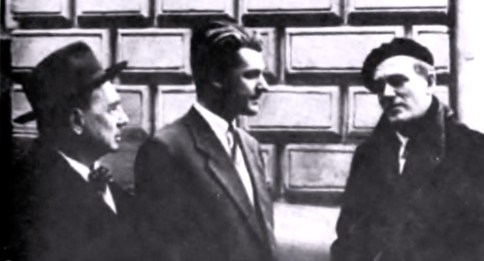
Heinrich Neuhaus with Sviatoslav Richter and Stanislav Richter
Several of my students have been learning and enjoying this well-known piece by the Penguin Café Orchestra, and so I thought it might be helpful to have some background.
The Penguin Café Orchestra (PCO) was a collective of musicians, founded by Simon Jeffes in the 1970s. It is hard to categorise their music, but it combines elements of exuberant folk music, and the minimalist music of composers such as Philip Glass and Michael Nyman. The music also contains references to South American and African music, and uses a variety of instruments including strings, pianos, harmoniums, slide guitars, cuatros, kalimbas, experimental sound loops, mathematical notations and more. A number of their works are very familiar as they have been used in film, tv and advertising.
Perpetuum Mobile is one of PCO’s most famous pieces, and comes from their fifth album, ‘Signs of Life’ (1987). The title is Latin for “perpetual motion” (or continuous motion) and in music it refers to two things:
pieces or parts of pieces of music characterised by a continuous steady stream of notes, usually at a rapid speed
whole pieces, or large parts of pieces, which are to be played repeatedly, often an indefinite number of times.
In both cases, there should be no interruption in the ‘motion’ of the music. Examples from classical music include the presto finale of Chopin’s Piano Sonata No. 2 in B flat minor. Marked “sotto voce e legato” (literally “under the breath and smoothly”), the entire movement is a musical stream of consciousness of unremitting parallel octaves, with unvarying tempo and dynamics, and not a single rest or chord until the final bars. The difficulty for the pianist, aside from keeping the triplets absolutely equal and even throughout, is the sotto voce (a fairly common marking in Chopin’s music) which suggests a muted sound. Careful pedalling will, in part, create the desired effect but the sound should never become woolly or muddy: we want to hear every single note. This movement has a strange and mysterious cast: Arthur Rubenstein remarked that the fourth movement is like the “wind howling around the gravestones”, and a pianist colleague of mine described performing it as “horrible – like having your entrails picked over on stage”. Interestingly, Chopin himself said of the movement: “The left hand unisono with the right hand are gossiping after the [Funeral] March” (source: James Huneker in his introduction to the Mikuli edition of the Sonatas). Played well it is inscrutable and brief; played badly and it’s just a muddle.
Here is Ivo Pogorelich, with a good view of his hands at work
Schubert’s Impromptu in E flat is another perpetuum mobile, at least in the outer sections (the middle section of the piece is a rough gypsy waltz), which, like the example by Chopin, is built from almost continuous triplets in swirling, tumbling scalic figures which never quite break free from the secure tether of the bass line. The difficulty in this piece, as in the Chopin, is keeping the triplets even, though with some give-and-take/rubato and dynamic shading to add interest: unlike the Chopin, there is prettiness and charm in this piece, and the dance rhythm of the bass line should be highlighted too. My problem when I was learning this piece (or rather relearning – I first encountered it in my teens) was lifting the fingers too high, which produced a chunky, “notey” sound and interrupted the flow of the music. It also made my arm tense. I taught myself to keep the fingers curled into the keys and to start with a slightly higher hand position: the result was a pleasing “trickling” effect in the long scalic runs, and the piece was far less tiring to play.
Pedalling is another issue in this piece, and I had a long discussion with a colleague about this, who kindly heard my Diploma programme ahead of the exam. In the end, I compromised on 1/8 pedal: like the Chopin Sonata, you don’t want a muddy sound (and I’ve heard plenty of live and recorded performances of this work with some very sloppy pedalling!). The beauty of this music, in my opinion, is the clarity of the writing, and the elegant song lines which are subtly embedded in the triplet figures. Careless or over-pedalling won’t highlight these interior elements to the listener.
A further danger of this piece is getting so caught up in the perpetual motion of it that you forget to breathe! This may sound daft, but I can confirm that in my Diploma recital, I probably played the restatement of the opening section on one breath. And in rehearsal one afternoon, my page turner was so absorbed in the music, he forgot to turn over the pages for me!
Walter Gieseking:
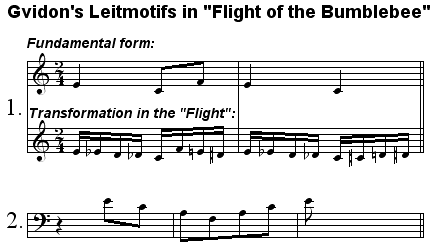
Perhaps the most famous example of a musical perpetuum mobile is Rimsky-Korsakov’s Flight of the Bumble Bee, an orchestral interlude from his opera The Tale of Tsar Saltan. This popular work, often performed as an virtuosic encore, consists of nearly uninterrupted runs of chromatic semiquavers, with leitmotifs (Givdon’s themes) from the opera. It is not so much the pitch or range of notes that present the challenge, but the sheer speed of it and the musician’s ability to move quickly around the notes.
(picture source: Wikipedia)
Other famous perpetuum mobiles from classical music include Debussy’s ‘Mouvement’ for piano (from the first book of Images), and Francis Poulenc’s Trois Mouvements perpétuels.
PCO’s Perpetuum Mobile is built on a simple repetitive melody which is put through several harmonic and textural changes, building in grandeur as it goes. The repetitions of the melody make it a hypnotic piece, but the changes prevent it from being boring. Instead, the accumulation of elements and orchestration make this an energetic and exciting piece to listen to, and to play.
A friend of mine has adapted the music for easy piano (Grade 2-3 level), and although simplified, the music retains key features from the original, including the harmonic and textural changes. After the introduction, the main melody is introduced and repeated in the right hand before the left hand joins in with a progression of stern chords in open 5ths and octaves. Further along in the score, and both hands play the melody unison, reflecting the string articulation in the original. The two-bar melody, which is scored in 7/8 and 4/4, contains an octave leap which might be tricky for smaller hands. However, this also offers a great opportunity to practice ‘rotary motion’: I get students to practice the second, 4/4, part of the melody first, as the smaller stretches make rotary movement easier to grasp.
Before playing a single note on the piano, we practice rotary motion above the keyboard, or even away from the keyboard. Many teachers and tutor books describe rotary as “turning a doorknob” (an old-fashioned round doorknob, obviously) or turning cooker knobs. But my teacher and I decided the movement was more like the windscreen wipers of a car: it’s an “out-in” movement rather than “in-out”. To practice it at the piano, start in a 5-1 position, G-C (either Middle C position or an octave higher, if more comfortable), and place the hand in a “karate chop” position on the G with the fifth finger. Allow the hand to “flop” onto C with the thumb, and repeat. Encourage the student to watch the movement of the wrist: if the wrist isn’t moving, it ain’t rotating! Speed the movement up so that the student understands that it is the rolling (“rotary”) movement of the wrist that makes the sound, rather than the fingers. Keep the wrist and hand flexible and soft throughout: this will also help achieve a good tone.
Everyone I’ve taught this piece to wants to play it fast, but to try and play it up to tempo before you have practised rotary motion and grown comfortable with it will lead to tension in the hand and possibly pain. Keep the tempo sensible and perfect the rotary motion and good legato-playing before cranking it up. Meanwhile, enjoy experimenting with different dynamic levels for dramatic effect. The unison section should be light, nimble and nicely articulated to achieve the effect of the strings from the original.
At my recent piano lesson, I worked on Rachmaninov’s Etude-Tableaux Opus 33 No. 2 in C. In order to practice the tricky arpeggiated left-hand accompaniment, which includes many awkward extensions of more than an octave, my teacher asked me to imagine that my arms had no bones in them, no fulcrum at the elbow, and that they were made of “soft, uncooked pastry dough”. And the following day, while teaching an adult student who is studying George Nevada’s nostalgic Wenn Paris Traumt (When Paris Dreams) for her Grade 2 exam, I gave her the image of thick, warm, scented oil running down her arms and into her fingers to create the smoothest, most beautiful legato playing.
Such visual cues may seem odd, but they can be really helpful, as sometimes it is not possible to find the technical vocabulary to describe the sensation one wishes to create in the hand and arm. A metaphor is often better (see my teacher’s post on Playfulness in Piano Playing for more thoughts on this), and children, in particular, can be quick to pick up and act on such images.
A sense of both relaxation and connection in the arms and hands is essential for both the production of good tone and to avoid physical tension or, worse, an injury. Tightness and stiffness produces a tight, stiff, and sometimes very harsh sound. I ask students to listen to the difference in the sound they are producing once they have been encouraged to relax their arms and hands: my adult was certainly very surprised when she heard herself playing the other day!
A few months ago, I reviewed the French-Canadian pianist Marc-André Hamelin in a coruscating concert of very varied and physically demanding repertoire (Haydn, Stockhausen, Villa Lobos and Liszt). During the interval, my friend (who is also one of my adult students) commented on how floppy and loose Hamelin’s arms appeared to be. Even as he walked onto the stage, his arms swung loosely from his shoulders, as if attached by thick, stretchy ‘bungees’. This incredible freedom and relaxation allowed him to bring a huge variety of tonal colour, touch and balance to his performance, and even the most jagged passages of the Stockhausen and percussive sections of the Villa Lobos had an extraordinarily fine quality of sound.
My teacher advocates a series of arm and shoulder loosening exercises as a warm up before any practice session or performance (at her courses, we usually do these in the garden if the weather is fair, allowing us plenty of freedom to swing our arms around). You need only do them for about five minutes to begin to notice a difference in the arms, hands and shoulders. The arms feel looser, longer even! The fingers are light and warm, and the shoulders, back and chest are opened. Try to retain these sensations when you sit at the piano.
To soften the arms and hands further, let your arms rest loosely in your lap and start to roll your arms gently around on your thighs. Imagine there are no bones between your hands and your shoulders, and that everything is very soft and pliable (like uncooked pastry!). When you place your hands on the keyboard, check underneath the wrist and forearm to ensure that lightness remains. And keep checking during your practice session, particularly if you are working on a small technical passage: it is all to easy to allow tension to creep back into the arms, resulting in uncomfortable playing and an ugly sound.
Last week, I heard Leon McCawley in a lunchtime recital at the Wigmore Hall. He played Debussy’s suite Pour le Piano (the ‘Sarabande’ from which was one of my Diploma pieces) and I was fascinated by the playfulness and lightness in his hands and fingers as he played the outer movements of the piece (both the ‘Prelude’ and the ‘Toccata’ demand digital dexterity and fleetness). I observed a softness in his arms too, but it was very subtle, and, as my teacher pointed out when I was discussing it with her, a few years ago, I wouldn’t have noticed it, because it was not something I was aware of at the time.
I find it quite hard to encourage students to let their arms move more freely: this is partly because far too many early piano students (and even more advanced ones!) sit too close to the piano, with elbows resolutely glued to the body. The image of a skipping rope is helpful here, to encourage more freedom and “swing” in the arm. One end of the skipping rope is the finger on the key, the other the shoulder, and whatever is between should swing freely.
Meanwhile, I am pleased to report that the “soft dough” exercise, combined with a sweeping, eliptical movement in the hand (aided by using a middle digit – either the second or third finger – as a pivot), is enabling me to make progress with the Rachmaninov: it’s slow because I can only work on it for about 10 minutes before my arm gets tired, but, as with any technical exercise, it is worth the effort. The results come slowly at first, as the body adjusts to the new sensations, but eventually it becomes intuitive. Never push a technical exercise or overwork it: if your hands and arms feel tired, it is time to take a break.
by Penelope Roskell, pianist and Professor of Piano and Piano Pedagogy at Trinity Laban Conservatoire of Music and Dance
If we reflect on the language that we use in our teaching, we will probably notice that many of the words we use imply a rather serious, one might even say tedious view of life: practise hard, exercises, repetition, accuracy, evenness, examinations – no wonder so many students find piano playing boring compared to the fun of playing with friends or computer games!
I think we all need to remind ourselves frequently of the possible alternative words: ease, beauty, flow, flourish, caress, communication, fun, delight, and, most importantly perhaps, playfulness. I personally don’t remember ever having heard that word in any piano lesson when I was a student!
If we see and hear a true virtuoso play, we are not aware of fear or wrong notes, or stiffness in the joints, or awkward, ungainly movements. We are taken up in the joy and delight of sheer playfulness of physicality on the piano. Now, of course some people tend to look down their noses on “mere virtuosos” as somehow lacking in seriousness, and it is true that in some cases their playfulness may also equate with a certain superficiality of character. But when that delightful virtuosity is combined with depth of feeling, a rigorous intellect and real artistry, then we witness the pinnacle of piano playing in all its fullness.
It is a recognised fact that children learn more quickly and enthusiastically through play, and I believe this also applies to teaching piano technique, both for children and for adults. If we watch a child spending time alone at the piano, they delight primarily in any activities that involve movement around the piano. This might be big jumps, glissandi, staccato, big banging chords – they don’t generally relish playing the sort of two note legato “tunes” we find in many beginners’ tutor books.
Imagine how it must feel for a very active six year old to be asked not only to sit still for half an hour, but also not to move his arms beyond the middle C five-finger position (thumbs on middle C, elbows in, wrists swivelled inwards, shoulders up)! This straight-jacketed feeling can be absorbed into their experience of piano playing from the earliest stages, and can become a very entrenched habit.
Kurtag in ‘Jatekok’ (which means “Games”) attempts to address this problem in a fascinating way – approaching each aspect of piano playing with a very broad gesture (such as clusters around the piano) which then becomes more refined into a piece with notes which need to be played accurately. Various other tutor books recognise the advantage of embracing the whole of the keyboard. The Little Keyboard Monster series, for example, contains some delightfully imaginative pieces using glissandi, leaps etc. from an early level.
The fear of playing wrong notes is very powerful, and can lead to tension throughout the muscular structure. At all levels, I think it is important to balance the need for accuracy with freedom of movement, sometimes to exhort the student: “don’t worry about wrong notes at the moment – feel the technique freely first, then refine it!” Paradoxically, if we aim first for beauty of sound, muscular freedom and emotional expression, almost invariably we play more right notes in the long run.
Although I do frequently teach my students Etudes (particularly, at advanced level, the Chopin and Debussy Etudes from which so much can be learnt), I often find that much valuable time can be wasted learning several pages of somewhat indifferent music for just one aspect of technique – time which could have been much better spent learning some great repertoire. I feel there is much benefit to be gained for each teacher to develop his own notebook of very short exercises which cover all the necessary movements require for specific techniques. These should be simple and short enough to be taught by imitation, rather than by note-learning. The resulting enjoyment is liberating.
I was recently teaching an adult pupil the ‘Prelude’ from Pour le Piano (Debussy). She had worked at it very thoroughly, but the result was somewhat heavy and wooden. So, we started to make up some exercises together (perhaps I can now call these “games”) which were partly based on passages in this piece.
These exercises are very difficult to describe, because the main feature of them is of fluid, swirling hand and arm movements which flow, interact and overlap each other (if you have ever seen a chef tossing pizza dough between his hand you will know the sort of movements I mean). The arm, wrist and hand are extremely soft and fluid and the fingers just “play” very lightly on the keys. Each exercise should be played as fast as possible – caution is not recommended. There is no credit to be gained from playing correct notes, but the beauty of sound is encouraged. In fact, all the exercises are played by imitation (not reading the notes) so that the tension of note-reading and the fear of playing wrong notes are eliminated.
Each piece can be the starting point for similar “games”, and game can be simplified or made more complex, depending on the level of the student. The pupils themselves can start to make up their own. One new technique can be introduced in each lesson in this very amiable way. The possibilities are endless – and fun!
(This article first appeared in the summer 2012 issue of ‘Piano Professional’, the journal of the European Piano Teachers’ Association.)
Penelope Roskell is equally renowned as a performer of international calibre and as an inspirational teacher and professor of piano at Trinity College of Music. Full biography here.
For information about courses, private tuition, books and DVDs please visit:
The Cross-Eyed Pianist is free to access and ad-free, and takes many hours every month to research, write, and maintain.
If you find joy and value in what I do, please consider making a donation to support the continuance of the site




 At my recent piano lesson, I worked on Rachmaninov’s Etude-Tableaux Opus 33 No. 2 in C. In order to practice the tricky arpeggiated left-hand accompaniment, which includes many awkward extensions of more than an octave, my teacher asked me to imagine that my arms had no bones in them, no fulcrum at the elbow, and that they were made of “soft, uncooked pastry dough”. And the following day, while teaching an adult student who is studying George Nevada’s nostalgic Wenn Paris Traumt (When Paris Dreams) for her Grade 2 exam, I gave her the image of thick, warm, scented oil running down her arms and into her fingers to create the smoothest, most beautiful legato playing.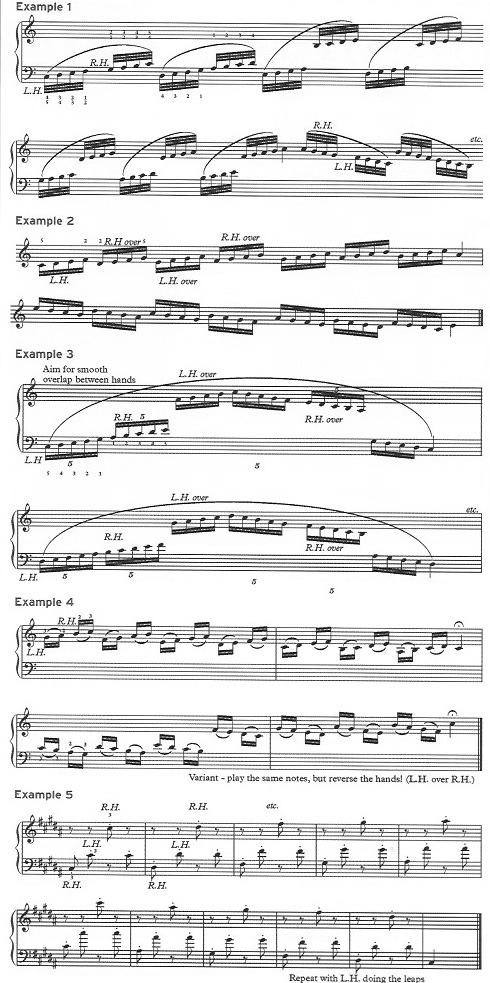




 The Cross-Eyed Pianist