A pleasing trend is the increasing number of enthusiastic adult amateur pianists who are enrolling for lessons. Some are players who had lessons in their youth but who gave up, for various reasons, and who are returning to the piano after a prolonged period away from it. Others simply want to learn a new skill, or, in the case of two of my adult students, want to learn so they can help their children who are learning to play the piano.

I am what is classed as an “adult returner”: I took lessons from the age of 5 to nearly 19, with two teachers, and worked through all the exams (practical and theory). Then I went to university, fell in love, started work in London, got married, all things that conspired to keep me away from the piano. It was only when I started writing a novel in which the principal character is a pianist that I began to play again, figuring the best way to research the music I was writing about was to actually play it. It was hard, at first, to return to pieces I’d played well in my teens, but it was also cheering to find I hadn’t forgotten that much.

I started taking lessons again in my 40s, in part to try and understand the psychology of being taught as an adult, so that I could help my own adult students, all of whom are very nervous and lacking in confidence.

This is a key factor in teaching adults: building confidence. As we get older, we seem more aware of the embarrassment of making a mistake or appearing foolish in front of someone else. Just as my teacher does with me, I try to make my adult students feel comfortable and confident. Yes, it is hard to play for someone else, but they know I am not going to bite them!

Confidence comes through good and thorough preparation, self-belief, and praise from a teacher or mentor. Many adults arrive at lessons with an idea of what kind of music they want to play, and many find their own choices are too difficult. I try to select repertoire which will suit my adult students, taking into account their individual abilities and tastes.

One of the nicest aspects of teaching adults is more involved communication than one enjoys with a child. One can explain concepts and technical issues, and feel that the student has understood what is being asked of them. There is greater opportunity for more discussion about the music, and many adults have a good grounding in music history and/or theory (if they had studied music as a child), or general music appreciation, which helps enormously. The relationship often becomes personal and close; one of my adult students has become a very good friend.

Some of my other observations on teaching adult amateur pianists:

Practising: many adult students have busy lives with other commitments such as work, family and so forth which can prevent them from practising as regularly as they would like to. A teacher should be able to guide and advise an adult student on best and most effective ways to practice given time constraints. I encourage focussed practice: breaking down the music into manageable chunks and learning how to spotlight tricky or problem areas for special attention.

Repertoire: some adults, especially “returners”, can have ideas somewhat above their capabilities and will arrive with music that is, in reality, beyond them. Rather than dampen their enthusiasm, I will either find a simplified version of the piece for them to learn, or suggest learning just a small part of the piece – though it can be frustrating, as a teacher, to listen to Debussy or Chopin being mangled week after week (!). I always let adults select the repertoire they would like to learn, rather than be dictatorial about it.

Exams and benchmarking: No one, neither adult nor child, is forced to do exams in my studio. I have two adult students who want to take exams because they enjoy the challenge of studying for an exam, and find that this keeps them focussed. When my student Sarah, who has been learning with me for four years now, achieved a Merit in her Grade 1 exam, we both enjoyed a huge sense of achievement! Other adult students are more than happy to play for pleasure, with the teacher offering more advanced repertoire so that they have a sense of progression. Another of my adults regularly asks me what level the music she is learning is (roughly around Grades 2-3 at the moment).

Performance anxiety: Many adult students can be very very nervous when faced with a performance situation. I can sympathise with this, having been in a similar condition myself a few years back when I first started having lessons again. But adult students who want to take exams need to be taught how to overcome their anxiety. First, they should be encouraged to play within their capabilities; and, secondly, they should take every opportunity to practice performing – be it to the family, pets, neighbours, or in the more formal setting of a music festival. “Mock” exams are useful, along with physical exercises away from the piano to help relieve tension.

Enthusiasm: Adult amateurs are generally very enthusiastic about their piano lessons, usually because they are learning for completely different reasons to children (sense of enjoyment, fulfillment, personal development etc). Never dampen that enthusiasm, and be accommodating if the student cannot make a lesson one week (I find it helpful to have adult students on a “pay as you play” basis) or hasn’t completed their practising.

Courses and workshops: a great way for adult amateur pianists of all levels to get together, share repertoire, receive tuition from top-class teachers (often professional pianists), and simply enjoy playing the piano! More on courses here.

At my recent piano lesson, I worked on Rachmaninov’s Etude-Tableaux Opus 33 No. 2 in C. In order to practice the tricky arpeggiated left-hand accompaniment, which includes many awkward extensions of more than an octave, my teacher asked me to imagine that my arms had no bones in them, no fulcrum at the elbow, and that they were made of “soft, uncooked pastry dough”. And the following day, while teaching an adult student who is studying George Nevada’s nostalgic Wenn Paris Traumt (When Paris Dreams) for her Grade 2 exam, I gave her the image of thick, warm, scented oil running down her arms and into her fingers to create the smoothest, most beautiful legato playing.


Such visual cues may seem odd, but they can be really helpful, as sometimes it is not possible to find the technical vocabulary to describe the sensation one wishes to create in the hand and arm. A metaphor is often better (see my teacher’s post on Playfulness in Piano Playing for more thoughts on this), and children, in particular, can be quick to pick up and act on such images.

A sense of both relaxation and connection in the arms and hands is essential for both the production of good tone and to avoid physical tension or, worse, an injury. Tightness and stiffness produces a tight, stiff, and sometimes very harsh sound. I ask students to listen to the difference in the sound they are producing once they have been encouraged to relax their arms and hands: my adult was certainly very surprised when she heard herself playing the other day!

A few months ago, I reviewed the French-Canadian pianist Marc-André Hamelin in a coruscating concert of very varied and physically demanding repertoire (Haydn, Stockhausen, Villa Lobos and Liszt). During the interval, my friend (who is also one of my adult students) commented on how floppy and loose Hamelin’s arms appeared to be. Even as he walked onto the stage, his arms swung loosely from his shoulders, as if attached by thick, stretchy ‘bungees’. This incredible freedom and relaxation allowed him to bring a huge variety of tonal colour, touch and balance to his performance, and even the most jagged passages of the Stockhausen and percussive sections of the Villa Lobos had an extraordinarily fine quality of sound.

My teacher advocates a series of arm and shoulder loosening exercises as a warm up before any practice session or performance (at her courses, we usually do these in the garden if the weather is fair, allowing us plenty of freedom to swing our arms around). You need only do them for about five minutes to begin to notice a difference in the arms, hands and shoulders. The arms feel looser, longer even! The fingers are light and warm, and the shoulders, back and chest are opened. Try to retain these sensations when you sit at the piano.

To soften the arms and hands further, let your arms rest loosely in your lap and start to roll your arms gently around on your thighs. Imagine there are no bones between your hands and your shoulders, and that everything is very soft and pliable (like uncooked pastry!). When you place your hands on the keyboard, check underneath the wrist and forearm to ensure that lightness remains. And keep checking during your practice session, particularly if you are working on a small technical passage: it is all to easy to allow tension to creep back into the arms, resulting in uncomfortable playing and an ugly sound.

Last week, I heard Leon McCawley in a lunchtime recital at the Wigmore Hall. He played Debussy’s suite Pour le Piano (the ‘Sarabande’ from which was one of my Diploma pieces) and I was fascinated by the playfulness and lightness in his hands and fingers as he played the outer movements of the piece (both the ‘Prelude’ and the ‘Toccata’ demand digital dexterity and fleetness). I observed a softness in his arms too, but it was very subtle, and, as my teacher pointed out when I was discussing it with her, a few years ago, I wouldn’t have noticed it, because it was not something I was aware of at the time.

I find it quite hard to encourage students to let their arms move more freely: this is partly because far too many early piano students (and even more advanced ones!) sit too close to the piano, with elbows resolutely glued to the body. The image of a skipping rope is helpful here, to encourage more freedom and “swing” in the arm. One end of the skipping rope is the finger on the key, the other the shoulder, and whatever is between should swing freely.

Meanwhile, I am pleased to report that the “soft dough” exercise, combined with a sweeping, eliptical movement in the hand (aided by using a middle digit – either the second or third finger – as a pivot), is enabling me to make progress with the Rachmaninov: it’s slow because I can only work on it for about 10 minutes before my arm gets tired, but, as with any technical exercise, it is worth the effort. The results come slowly at first, as the body adjusts to the new sensations, but eventually it becomes intuitive. Never push a technical exercise or overwork it: if your hands and arms feel tired, it is time to take a break.

by Penelope Roskell, pianist and Professor of Piano and Piano Pedagogy at Trinity Laban Conservatoire of Music and Dance

If we reflect on the language that we use in our teaching, we will probably notice that many of the words we use imply a rather serious, one might even say tedious view of life: practise hard, exercises, repetition, accuracy, evenness, examinations – no wonder so many students find piano playing boring compared to the fun of playing with friends or computer games!

I think we all need to remind ourselves frequently of the possible alternative words: ease, beauty, flow, flourish, caress, communication, fun, delight, and, most importantly perhaps, playfulness. I personally don’t remember ever having heard that word in any piano lesson when I was a student!

If we see and hear a true virtuoso play, we are not aware of fear or wrong notes, or stiffness in the joints, or awkward, ungainly movements. We are taken up in the joy and delight of sheer playfulness of physicality on the piano. Now, of course some people tend to look down their noses on “mere virtuosos” as somehow lacking in seriousness, and it is true that in some cases their playfulness may also equate with a certain superficiality of character. But when that delightful virtuosity is combined with depth of feeling, a rigorous intellect and real artistry, then we witness the pinnacle of piano playing in all its fullness.

It is a recognised fact that children learn more quickly and enthusiastically through play, and I believe this also applies to teaching piano technique, both for children and for adults. If we watch a child spending time alone at the piano, they delight primarily in any activities that involve movement around the piano. This might be big jumps, glissandi, staccato, big banging chords – they don’t generally relish playing the sort of two note legato “tunes” we find in many beginners’ tutor books.

Imagine how it must feel for a very active six year old to be asked not only to sit still for half an hour, but also not to move his arms beyond the middle C five-finger position (thumbs on middle C, elbows in, wrists swivelled inwards, shoulders up)! This straight-jacketed feeling can be absorbed into their experience of piano playing from the earliest stages, and can become a very entrenched habit.

Kurtag in ‘Jatekok’ (which means “Games”) attempts to address this problem in a fascinating way – approaching each aspect of piano playing with a very broad gesture (such as clusters around the piano) which then becomes more refined into a piece with notes which need to be played accurately. Various other tutor books recognise the advantage of embracing the whole of the keyboard. The Little Keyboard Monster series, for example, contains some delightfully imaginative pieces using glissandi, leaps etc. from an early level.

The fear of playing wrong notes is very powerful, and can lead to tension throughout the muscular structure. At all levels, I think it is important to balance the need for accuracy with freedom of movement, sometimes to exhort the student: “don’t worry about wrong notes at the moment – feel the technique freely first, then refine it!” Paradoxically, if we aim first for beauty of sound, muscular freedom and emotional expression, almost invariably we play more right notes in the long run.

Although I do frequently teach my students Etudes (particularly, at advanced level, the Chopin and Debussy Etudes from which so much can be learnt), I often find that much valuable time can be wasted learning several pages of somewhat indifferent music for just one aspect of technique – time which could have been much better spent learning some great repertoire. I feel there is much benefit to be gained for each teacher to develop his own notebook of very short exercises which cover all the necessary movements require for specific techniques. These should be simple and short enough to be taught by imitation, rather than by note-learning. The resulting enjoyment is liberating.

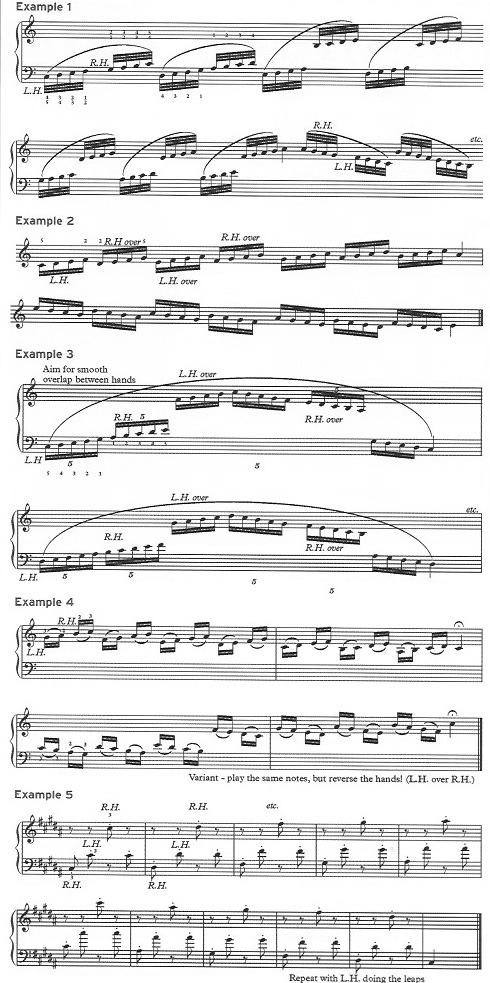
I was recently teaching an adult pupil the ‘Prelude’ from Pour le Piano (Debussy). She had worked at it very thoroughly, but the result was somewhat heavy and wooden. So, we started to make up some exercises together (perhaps I can now call these “games”) which were partly based on passages in this piece.

These exercises are very difficult to describe, because the main feature of them is of fluid, swirling hand and arm movements which flow, interact and overlap each other (if you have ever seen a chef tossing pizza dough between his hand you will know the sort of movements I mean). The arm, wrist and hand are extremely soft and fluid and the fingers just “play” very lightly on the keys. Each exercise should be played as fast as possible – caution is not recommended. There is no credit to be gained from playing correct notes, but the beauty of sound is encouraged. In fact, all the exercises are played by imitation (not reading the notes) so that the tension of note-reading and the fear of playing wrong notes are eliminated.

Each piece can be the starting point for similar “games”, and game can be simplified or made more complex, depending on the level of the student. The pupils themselves can start to make up their own. One new technique can be introduced in each lesson in this very amiable way. The possibilities are endless – and fun!

© Penelope Roskell

(This article first appeared in the summer 2012 issue of ‘Piano Professional’, the journal of the European Piano Teachers’ Association.)

Penelope Roskell is equally renowned as a performer of international calibre and as an inspirational teacher and professor of piano at Trinity College of Music. Full biography here.

For information about courses, private tuition, books and DVDs please visit:

www.peneloperoskell.co.uk

Another excellent three days in the company of other advanced pianists – some students, some piano teachers like me, and some professional pianists – on the piano course run by my teacher, Penelope Roskell. We enjoyed a wide range of repertoire, from Scarlatti to Stephen Montague, and discussed and practiced aspects of technique such as soft hands and forearms, ‘Mozartian’ staccato (what Penelope descibes as “detached legato”), ‘orchestrating’ sonatas and piano works by Haydn and Mozart, and how to achieve a beautiful cantabile sound in Schubert’s Impromptu in G flat (D899 No. 3) and Chopin’s ‘Aeolian Harp’ Etude (Opus 25, No. 1). And much more besides….. Our coffee and lunch breaks were full of interesting ‘piano chat’ and it was both instructive and enjoyable to exchange ideas with other pianists and teachers. The next course is on September – details at the end of the post.

Despite finding the first course (in April 2009) very daunting, because of the very high standard of the other participants, I have always gained a huge amount from these courses: they are instructional, inspiring, very supportive, and non-competitive. Everyone comes to the course with different needs and interests, from help with tension or performance anxiety, or simply a desire to play through some repertoire to other people in a relaxed setting. The course always ends with a concert, to which friends and family are welcome. The performance aspect of these courses has done wonders for my confidence and I have lost any shyness I had about performing, and now actively enjoy it. The 30 seconds of contemplative silence which greeted my performance of Chopin’s Nocturne in E, Opus 62, No. 2 was the ultimate compliment at the concert yesterday afternoon, and I was flattered and touched by some of the comments I received afterwards.

What we played during the course:

Debussy – Preludes Book I: ‘La fille aux cheveux de lin’

Villa-Lobos – Prole de bebe No. 1: ‘O Polochinello’

Bach – Prelude & Fugue in F minor, XII, WTC Book 2

Chopin – Nocturne in E, Op. 62, No. 2 (me)

Mendelssohn – Variations Serieuses, Op. 54

Chopin – Berceuse, Op. 57

Scriabin – Piano Sonata No. 4, in F sharp major, Op. 30

Mozart – Piano Sonata in A minor, K 310 (1st & 2nd movements)

Haydn – Piano Sonata in E flat, No. 59, Hob. XVI:49 (1st movement)

Mozart – Piano Sonata in D, K 576

Chopin – Waltz in E minor, No. 14

Beethoven – Piano Sonata in F major, Op. 10 No. 2

Mozart – Piano Concerto No. 5 (1st movement)

Dave Brubeck – ‘Dad Plays the Harmonica’

Henry Cowell – ‘Exultation’

Stephen Montague – ‘The Headless Horseman’

Bach – Concerto in D minor after Marcello BWV 974 (me)

Chopin – Etude, Opus 25 No. 1 ‘Aeolian Harp’

Mozart – Rondo in A minor, K511 (me)

Scarlatti – Sonata K.215

Martin Butler – ‘After Concord’

Joanna MacGregor – Lowside Blues

Diana Burrell – ‘Constellations’

Schubert – Impromptu in G flat, D899 no. 3

Chopin – Nocturne, Op. 48 No. 1

Bach – Prelude & Fugue in C-sharp major, WTC Book 2, III

Prokfiev – Piano Sonata No. 3 (1st movement)

Liszt – Concert Study: ‘Un Sospiro’

Charles Tebbs – ‘Moonlight from Sunlight’ (Charles is a pianist and composer who attended the course and performed some of his own pieces for us)

You can hear most of the pieces via this Spotify playlist

‘Moonlight from Sunlight’ by Charles Tebbs

More on piano courses here (includes details of Penelope Roskell’s September course)
