Guest post by Caroline Wright

There’s little doubt that a performance diploma should not be undertaken lightly. Preparing takes a long time and requires thought, dedication, consistency and patience. The pieces are hard and, for most of us, the performance is anxiety-provoking. Indeed, for amateur pianists, the challenge can seem insurmountable. That said, the process of learning a diploma programme can also be fascinating, absorbing, energising, and hugely rewarding.

After recently taking my FTCL exam (but before knowing the result!), I’ve been reflecting on the last 18-months of work – was it all worth it? The answer is a resounding YES! I’ve learnt an enormous amount and grown immensely as a musician. I’ve also been fortunate enough to interact with the thriving piano community across the UK, and meet people of all walks of life who love the piano and are pondering their next pianistic step. So I wanted to share my experience, and thank the many people out there who listened, advised and encouraged me along the way.

Planning the programme

I’d been playing pretty consistently for quite a few years as an adult, but had drifted since my LTCL (back in 2012) and fallen out of the habit of really practising rather than just playing. I needed something to kick myself into action, and the FTCL seemed like ideal goal, albeit a rather daunting one. Perhaps it would be impossible, whilst also working full-time outside music, but how would I know unless I tried?

The first task seemed to be to select a programme. We pianists are spoilt for choice – there are just so many great pieces to play! I read the different syllabuses, and went round and round in circles for months, listening and playing, deciding and undeciding. Overall, the programme had to be musically balanced and make some kind of narrative sense. The pieces also needed to be at least potentially playable. (My hands are quite small, so realistically some repertoire is literally out of reach, and always will be.) And, most importantly, to survive the countless hours of practice, I had to really love the pieces – otherwise what’s the point?

Early on, I decided that I ideally wanted to combine something from one of the “great” classical composers (for me, that means Bach or Beethoven), with something short(er) and light(er), plus something from a contemporary composer. In the end, after much agonising, I settled on:

· Beethoven’s Waldstein Sonata, Op. 53 – good for the fingers, good for the soul.

· 3x Gershwin songs, from 7 Virtuoso Etudes, arranged by Earl Wild – beautiful mini-masterpieces.

· Graham Fitkin’s Relent – it’s not on any syllabus, but I’ve loved this whirlwind of a piece since I first heard it a decade ago, and dared to hope I might be able to play it.

It took me quite a while to arrive at the final selection, and there were ups and downs along the way. As I started to learn the pieces, I questioned my choices regularly, and almost gave up every piece because it seemed too hard! But I loved the whole programme and thought it would make a bold and exciting recital. The pieces are high-energy and life-affirming, which was just what I wanted!

Learning the programme

Deciding on a programme was one thing, but actually playing it was quite another. Learning to play 45 minutes of technically challenging piano music was clearly not going to happen overnight. I needed a plan.

Once I had finally decided maybe to give it a go, I gave myself a maximum of 2 years to work towards the FTCL. I peppered my time every few months with piano lessons (with my long-term teacher) and piano weekends (Jackdaws, Finchcocks, and Oxford Piano Weekends), plus a week-long music summer school (Dartington). These gave me a series of small goals to work towards, provided a source of regular expert input, and offered opportunities to play in front of people. As a result, I had a fairly clear timetable for learning the pieces, based on where I wanted to take them and when. I like to play from memory (and have blogged extensively about this before), so as well as physically playing the piano, the learning process also involved studying the scores and doing mental practice – which was really useful on holiday!

To my astonishment, everything worked out as planned. In the final few months, once everything was learnt and just needed (a lot of!) polishing, it was interesting to reflect on my progress*. I found the process of learning these three contrasting pieces quite different. I started with the Beethoven sonata, and initially made quick progress – the piece just made sense to me. I found it relatively easy to look at the score, understand the classical sonata structure, and memorise the notes. However, going from a mediocre to a good performance took ages. There’s a profound depth to this music that I hadn’t fully anticipated, and achieving satisfactory nuances of phrasing and dynamics whilst also maintaining rhythmic integrity was nearly impossible.

Once I had committed the Beethoven to memory, I moved onto learning the Gershwin songs (one at a time, of course). In contrast to the Beethoven, I found these almost impossibly difficult to read and memorise. While he was arranging these pieces for solo piano, Earl Wild added a staggering number of extra notes, many of which come from jazz harmonies and modal scales that were unfamiliar to me. Although the structure followed the original songs, it was sometimes hard to find the melodies buried deep inside the luxuriously dense texture. All three songs left me struggling and despondent for months, until things suddenly clicked, and I could just play them. After that, it was plain sailing.

When I had two Gershwin songs under my belt, I started on Graham Fitkin’s terrifying Relent. Initially, I wasn’t even sure how to approach learning and memorising such a complex modern piece, and had abandoned learning it years ago on the grounds that it was too difficult. But, motivated by my diploma goal, I worked away at it slowly, learning very small chunks at a time – often doing multiple micro-practice sessions throughout the day – then piecing them together gradually. Unlike the other pieces, my progress was pretty linear, and day-by-day I steadily got better at playing it. Graham himself was also kind enough to give me some advice about playing his piece, which was fantastic. When played at full performance speed and dynamics, the physical demands of this piece are considerable, and I had to be quite careful not to over-practice and injure myself.

After finally selecting and working on the last Gershwin song, eventually all the pieces were learnt, and I had played them all to various piano pedagogues along the way. Eventually, there was nothing left to do but admit that I probably could play these pieces and therefore really should give the exam a go!

* Being a scientist by training, I think quite conceptually, and couldn’t resist the urge to plot a simplified representation of these different, entirely subjective learning curves! Has anyone tried doing this before? I started by defining the top of a hypothetical “performance quality” scale as 10/10, an unattainable perfection that one can only imagine for any piece but never achieve – perhaps it’s a recording, or maybe just an idea. Then, somewhere below this, let’s optimistically say 9/10, is my realistically attainable performance. I think I came close to the latter, but probably never achieved it. Then, there’s the actual path of progress towards the best possible performance, which ideally tends upwards from zero as time goes by, moving at different rates and with different shapes for different people and different pieces. It’s hard not to plateau and stop improving, or worse, to go backwards, particularly when learning multiple pieces. However, I was doggedly single-minded about practising, and although my pieces progressed differently, I think they were all on a par with each other by the end.

Preparing for performance

Unfortunately, I’m not a natural performer. I don’t like being in the spotlight; I get nervous and mess things up. Although public speaking is usually OK, public piano playing is much harder. Performance anxiety is not uncommon amongst pianists, particularly adult amateurs, but it is incredibly frustrating! However, it is possible to improve, and clearly I was going to have to in order to get through an exam and indeed be deserving of something called a “performance” diploma! So, as well as learning my pieces really really well, I tried a number of different approaches to try to become more comfortable with performing.

First, I practised performing. I played in front of people, fairly regularly, mostly at informal gatherings of other pianists – because we’re a forgiving bunch, right? I also recorded myself often and learned to keep going, no matter what. As the exam date approached, I organised numerous small recitals in front of friends, family and (most intimidatingly) colleagues. I trialled different strategies for the day itself – including a mixture of practising, exercising and resting – until I knew exactly what I would do and when. I recorded myself, listened, critiqued, took notes, and improved. Little by little, the performance anxiety reduced; it didn’t go away, but I got better at managing my nerves.

Second, I augmented my musical preparation with yoga and mindfulness meditation. By the final few months, I knew I could play the pieces technically, but I was still working on communicating the programme in its entirety, and minor concentration lapses threatened to throw me off course. I needed to learn to be fully present in the moment of music-making, and not allow any unhelpful or self-sabotaging thoughts to distract me. Even a moment’s inattention can result in small slips that cascade into disasters, and the dreaded memory lapse is a perennial fear for anyone playing without a score. But I figured learning to stay focussed was like everything else in music: it improves with practice. So I started doing daily short meditation sessions aimed at recognising the wandering mind and bringing it back to the present. Ultimately, I have no doubt that mindfulness meditation helped me stay focused on the music and breathe through my nerves.

And finally, I studied. I read about Beethoven, about pianists, about memory and about performance. The list of authors included pianists, musicologists, music historians and psychologists. I also listened to different performances, as well as podcasts, interviews and lectures from musicians talking about their craft. All this helped me to get into the mindset of being a performing pianist and a musical interpreter.

Waiting for the result

It’s an age-old truism that the journey is more important than the destination. And that is certainly how I feel about my FTCL. Of course, I hope I’ve passed! But, regardless of the outcome, I’m glad I did it, from start to finish. I feel lucky to have been able to bask in such glorious music, to study it and really get to know it well. And I feel grateful to have shared that journey with so many other people who are passionate about the piano.

The only question now is: what shall I do next?


Caroline Wright is a musician (MMus, LTCL) and scientist (MSci, PhD). Her compositions have a diverse range of influences, from classical and contemporary to blues and jazz, film and folk, dance and electronica.
I came across this phrase on Twitter, to describe doing short bursts of practicing, rather than long stretches. This may seem counter-intuitive: surely we should be practicing for long stretches of time to see noticeable progress?

It’s a myth, which unfortunately persists, that professional pianists do hours and hours of practicing, cloistered in solitude with just the instrument and scores for company. In reality, many of the professional pianists I know personally or have interviewed acknowledge that after about 45-60 minutes the law of diminishing returns starts to kick in, one’s concentration and energy starts to flag, and it’s time to take a break.

Practicing the piano requires commitment and consistency, but many people, especially amateur pianists and children, may feel overwhelmed by the prospect of long practice sessions; this can be dismotivating too.

Time is an important factor for the busy professional, amateurs pianists who need to fit practicing into the realities of daily life, and children. While it may be tempting to cram in hours of practice at a time, small amounts of regular practice can be much more beneficial in the long run.

Enter the notion of ‘practice snacking’.

When I taught piano, mostly to children and teenagers, the hardest aspect of the job was encouraging them to do their practicing. 30 minutes can seem A Very Long Time to a young child or a teenager who wants to be hanging out with friends rather than with Chopin and Co. I often pointed out to my students that 3 slots of 10 minutes each adds up to 30 minutes, and that it is possible to do very useful work in just 10 minutes.

I didn’t confine this advice only to my students. I applied it to myself, because when I was working towards my performance diplomas, I was having to fit in my practicing around my teaching and other work, and I became adept at practice snacking. Doing small amounts of practice allowed me to focus more intensely on specific aspects of the pieces I was studying.

A “little and often”, snacking approach to practice can be extremely beneficial. It is a truth universally acknowledged that consistency and quality of practice wins over quantity. Mindlessly hacking away at that Etude for 2 hours is not only boring, but is largely wasted time. It’s far better to take a focussed approach, to know exactly what needs to be practiced – perhaps that tricky arpeggiated passage or the left-hand accompaniment – and to break down the practicing into manageable, ‘snackable’ sections. Focusing on specific areas during shorter practice sessions can help you to identify and address any problem areas. When you only have a short amount of time, you are forced to be more efficient and targeted in your practice. You can work on a specific passage, technique, or even just one hand at a time, and really work at improving it. Additionally, breaking down more complex pieces into smaller, more manageable segments can make learning them feel less daunting. Keep a regular note of what needs work and know exactly what you want to do/achieve at each practice session.

One of the most significant advantages of doing small amounts of piano practice like this is that it helps build consistency. Consistency is key when it comes to learning a new skill and by committing to a few minutes of practice every day, you are more likely to build the habit of practicing regularly. Regular, ‘practice snacks’ can help you build good habits, routine and discipline. It’s much easier to commit to practicing for 15-20 minutes a day than it is to find hours at a time to dedicate to the piano. By making a habit of practicing every day, even for a short amount of time, you are actually setting yourself up for success in the long run; over time, this consistency will result in noticeable progress.

Small amounts of piano practice can also help you avoid burnout and fatigue. Practicing for hours at a time can be mentally and physically exhausting, leading to frustration and even injury. By breaking up your practice into smaller chunks, you give yourself time to rest and recover in between sessions. This can help you stay motivated and engaged with the piano over a longer period of time.

Nutritionists tell us that snacking can be bad for us, but in the case of piano practice, it’s definitely beneficial!

Related content

Are you practicing enough?


This site is free to access and ad-free, and takes many hours to research, write, and maintain. If you find joy and value in what I do, please consider making a donation to support the continuance of this site

Make A Donation

There are certain habits of piano practice which are ingrained in us from an early age and which have become a form of “piano dogma”. As young piano students, we may accept these practices without question, trusting in our teacher’s seniority and greater knowledge – and the assertion that these activities are “good for you”, that they will make you “a better pianist”. These include scales, arpeggios and other technical exercises (Hanon, Czerny etc), separate hands practicing, slow practice and use of the metronome. Many of these practices come from theorists, lesser musicians, traditional teaching, and exam boards, who perhaps exert far too much influence on what is “good practicing” rather than actually listening to active musicians who have formulated their own ways of doing things which reflect the realities of learning and performing music today.

Scales, broken chords and arpeggios

These are generally considered an essential part of the pianist’s practice regime, still seen by many as the path to superior technique. By the time the piano student is approaching Grade 8, they will have learnt scales and arpeggios in all the major and minor keys, plus various permutations such as scales in major and minor thirds and sixths, octave scales and arpeggios, chromatic scales (also in thirds), dominant and diminished seventh arpeggios, and contrary motion scales and arpeggios. Scales and arpeggios have a use – they teach us about keys and key relationships.

But, like the technical exercises devised by Hanon et al, scales and arpeggios are generally mechanical exercises used to build greater finger dexterity, independence and velocity. Although one can practice such exercises in a musical way (fluctuating dynamics, different articulation or rhythms), in my opinion, they are fundamentally unmusical.

How often are you required to play a full four-octave arpeggio or scale in major thirds in a piece of music? Sure, we encounter many scale and arpeggio patterns within pieces but these are devices to illustrate the drama and narrative of the music or to create specific effects (a descending chromatic scale can be darkly, spookily dramatic, for example). You may have practiced octave scales in a book of exercises but the test is whether you can play them musically in the context of real repertoire.

Not scales, never. Exercises, never….. I worked on pieces. Then if that didn’t work, I’d work on individual passages.

~ Martha Argerich, in an interview with Charles Dutoit

Separate Hands Practicing

This is one of the “holy grails” of piano practice – perhaps the holy grail! – that we should learn the music hands separately first and then bring the hands together. This was how I was taught as a young piano student and many, many students have the benefit of separate hands practice drummed into them from their early years to conservatoire level.

There are many occasions when separate hands practicing is very useful; but there are also occasions when separate hands practice is less helpful or even a hindrance to learning. Sometimes it is necessary to hear the complete harmony of the music or to have the foundation of a bass line or melody to support the other hand.

Slow practice

Another holy grail of piano practice! Like separate hands practice, there are occasions when slowing the tempo right down can enable us to manage a tricky section, get the notes learnt and under the fingers before speeding the music up. Slow practice also allows us to hear details in the music (but only if you are actually listening while practicing – and you’d be amazed how many pianists, including advanced or professional pianists, don’t listen to themselves!). But if you always practice the same passage at below tempo, the procedural (“muscle”) memory will find it harder to cope with playing at full tempo. In reality, tempos should be able to work both too slowly (a musical challenge) and too fast (an efficiency challenge).

Practicing with the metronome

Tick tock tick tock tick tock…..The insistent tick of the metronome is one of the abiding memories of my childhood piano lessons; my teacher made me play scales to the beat of a metronome. It was pretty hellish, but I submitted anyway. As a result, my scales were fluent, accurate and even.

The metronome can be useful in helping you establish a clear pulse, but practice too much or too often with that insistent tick and your playing may become overly mechanical without the necessary nuance of tempo which adds ebb and flow to music.

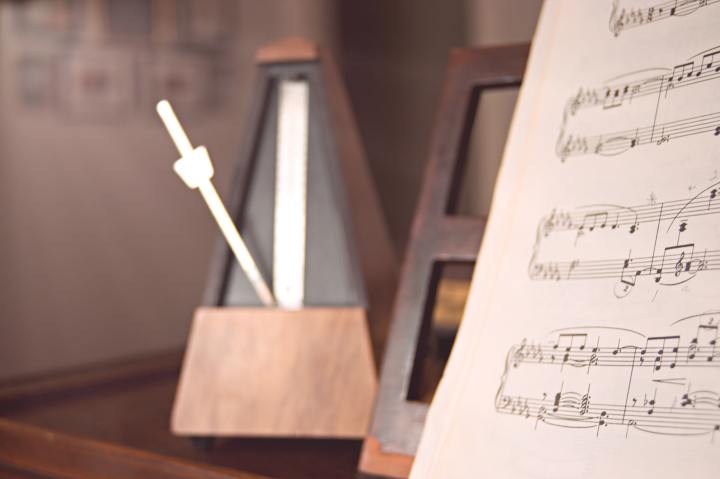
I’ve observed a certain metronome addiction amongst some student and amateur pianists: nearly all exam repertoire comes with a suggested metronome speed – note suggested. Yet some people believe they will be marked down in their exam performance or play the music incorrectly if they don’t adhere exactly to the metronome marking. It’s often worth pointing out that the metronome wasn’t invented until 1815; before that time musicians relied on an innate sense of pulse and an understanding of what tempo was appropriate for directions such as allegro, largo or adagio, for example – and that’s what we should all aim for. By all means use the metronome to get a feel for the pulse in the music, but don’t become addicted to it!

A music-led approach

While I may employ all of the above activities in my own piano practice, I have found that a “music-led” approach allows me to practice more productively and, importantly, enjoyably. The first teacher I had when I returned to the piano as an adult after a 25-year absence encouraged me to create exercises out of the music I was learning – a far more useful tool than turning to boring, mechanical exercises. There is so much beautiful music out there for us to play and a Bach Prelude, for example, can offer far greater technical and artistic challenges than a book of exercises by Hanon.

Don’t be afraid to look for alternatives and to experiment with practicing. Fundamentally, it’s about finding an approach that works for you as an individual, rather than a “one size fits all approach”.

You should diligently play scales and finger-practices. There are many, however, who believe they’ll achieve all, by practicing daily on technique for hours on end, up till high age. It’s like practicing every day to enumerate the alfabet faster and faster. One would think one could make better use of their valuable time.

~ Robert Schumann

This article first appeared on my sister blog A Piano Teachers Writes….


This site is free to access and ad-free, and takes many hours to research, write, and maintain. If you find joy and value in what I do, please consider making a donation to support the continuance of this site

Make A Donation

At the beginning of this year, my son (24) passed his driving test, his achievement made more remarkable by the fact that, due to the covid restrictions, his test was postponed 6 times over the course of 18 months. He displayed a dogged pragmatism towards the disappointment of the cancelled tests (he was ready to take his test in July 2020) and simply carried on practicing his driving whenever he could – in my car, his own car, and with his driving instructor.

While my son was having his lessons, I was reminded of my own driving lessons, some 30-odd years ago, and how my instructor stressed the importance of “time at the wheel” – that any driving practice was useful. My son certainly appreciated this and we enjoyed lots of excursions in the car which relieved the monotony of lockdown while also giving him useful driving experience.

While we were out and about, I pointed out to my son that one of the most important aspects of having lessons is so that one learns how to pass the test. A good instructor knows what needs to be covered to ensure the candidate is well-prepared. I remember my instructor made me practice manoeuvres like parallel parking and three-point turns over and over again so that the all the processes, physical and mental, became fixed in my procedural (muscle) memory, were almost intuitive, and ensured that I was not nervous on the day of the driving test. The same was true for my son – his parking abilities impress me no end (especially as I can no longer parallel park successfully!)

What does this have to do with the piano and music practice? Well, playing an instrument, like driving, is a series of movements and processes, which utilise and train the procedural memory. Most of us know well the old adage “practice makes perfect”, but, more importantly, practice also makes permanent, so that movements, processes and gestures become intuitive – we do them without (apparently) thinking.

This permanence comes, of course, from practicing – not mechanical note-bashing, (or mindlessly driving around Tesco’s carpark) but from thoughtful, careful practicing to ensure we are well-prepared.

The great Russian pianist Vladimir Horowitz apparently had a little phrase which he repeated ahead of a performance – “I know my pieces” – meaning he knew he had done his preparation. It’s a helpful mantra, and one which I have used in my own preparation for performance.

It is this preparation which gives us perhaps the most useful skill of all – confidence – which enables us to perform to the best of our abilities in an exam or concert situation, can help allay nerves, and ensures that the odd error or slip will not derail the overall performance.


This site is free to access and ad-free, and takes many hours to research, write, and maintain. If you find joy and value in what I do, please consider making a donation to support the continuance of this site

Make A Donation


