This post is inspired by Episode 2 of Season 3 of The Bear, a drama series about a young chef, Carmy Berzatto, trained in the fine dining world, who comes home to Chicago to run his family sandwich shop after a heartbreaking death in his family. By the third series, the noisy sandwich shop has been transformed into an elegant fine dining restaurant and Carmy is seeking a coveted Michelin star. In this episode, Carmy draws up a massive list of what he calls “non-negotiables”: the things that the restaurant must do on a consistent basis to achieve greatness.

Jeremy Allen White as Carmy Berzatto in The Bear

Looking through the list, while some of the non-negotiables are explicitly related to cheffing and kitchen/restaurant management, a number could apply equally to the musician in pursuit of consistency and excellence in their practice and performance of music.

It is a truth universally acknowledged that noticeable progress, at whatever level you play, comes from a well-organised, consistent, focussed and thoughtful approach to practicing. It’s not quantity (of hours spent practicing) but the quality of practicing that counts.

This, for me, is where Carmy’s non-negotiables come in.
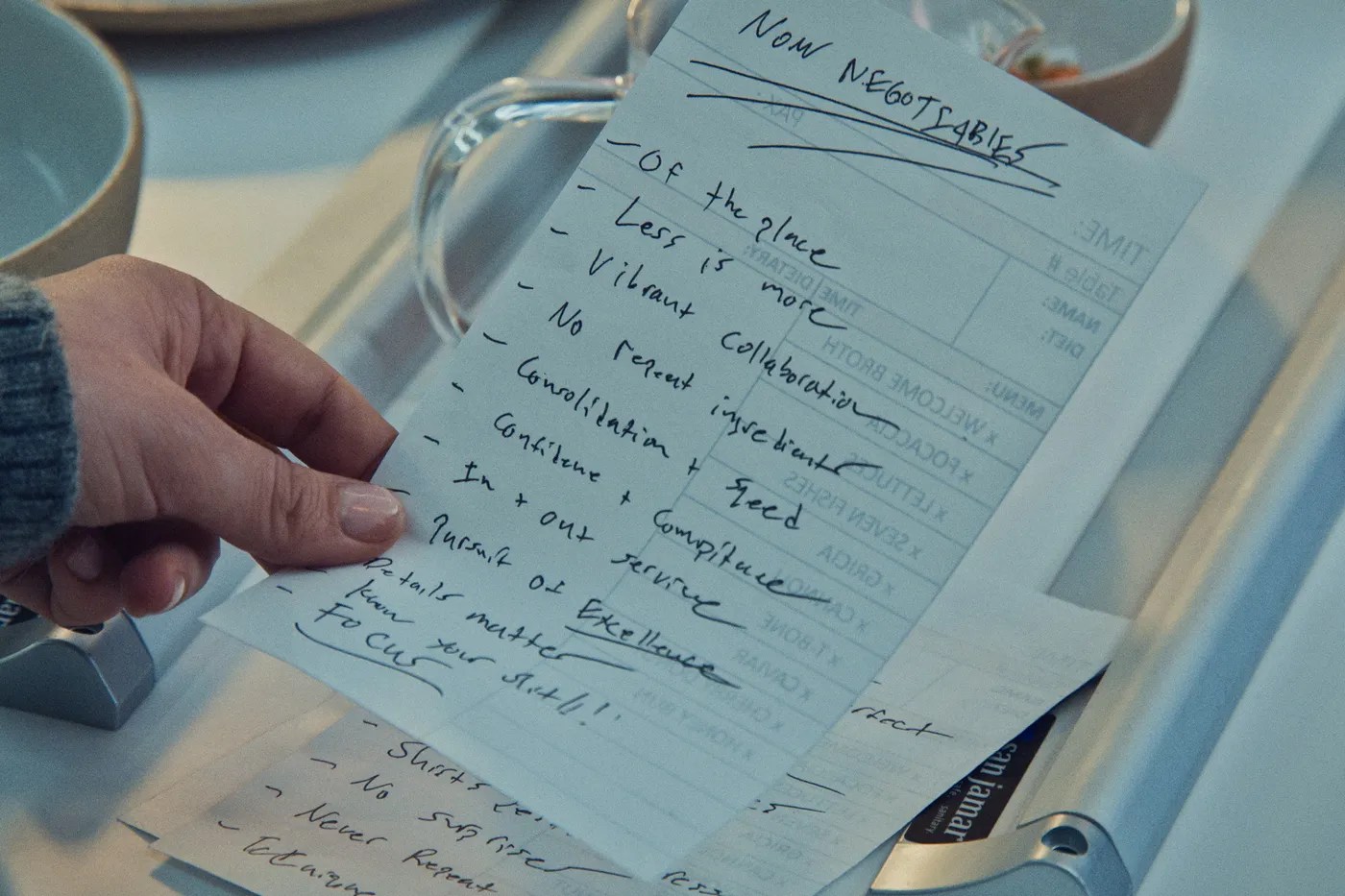
These principles, though originally used in contexts like culinary arts or other forms of craftsmanship, translate beautifully into music practice.

Change the Menu Every Day

Boredom is the enemy of progress, so incorporate variety into your daily practice routine. Instead of doing the same exercises daily or beginning with the same piece in the same place, try different approaches to challenge yourself in new ways.

No Repeat Ingredients

Avoid getting stuck in repetitive patterns. Constantly seek new skills, concepts, and exercises to enrich your practice. Challenge yourself with new materials rather than only practicing familiar ones. For example, if you’re used to playing pieces in a specific genre, try something completely different, like a jazz standard if you usually play classical repertoire.

Know Your Sh*t!

Fully understand the fundamentals of music, including theory, notation, and instrument mechanics. This knowledge helps you interpret music more intelligently and aids problem-solving

Respect Tradition

Appreciate and study the foundational pieces and techniques of your instrument. Understanding the work of past masters and traditional techniques gives you a solid framework of musical knowledge. BUT don’t let tradition or orthodoxy stand in the way of your approach to your music making or your personal interpretative choices. Remember, you can use the pedal in Bach!

Push Boundaries

Explore new techniques, unusual genres, or challenging pieces that lie just outside your comfort zone. This pushes your growth and helps you develop your own musical voice and autonomy as a musician.

Technique, Technique, Technique

Build a strong technical foundation. Mastering technique gives you control, precision, and freedom to express yourself without being limited by physical obstacles. But always remember that technique should serve the music, not the other way. Don’t let technique become the be all and end all of your music practice.

It’s Not About You

Remember that music serves a larger purpose – whether it’s storytelling, emotional expression, or creating a shared experience. Approach practice as a way to honour the music, not just to showcase your skills. If we become too emotionally attached to our music and instrument, it can cloud our objectivity: don’t let a bad practicing session translate into general negativity. Reflect and move on.

Additionally, be open-minded about taking advice from others – teachers, mentors, trusted colleagues and friends.

Less is More

Instead of overplaying or adding unnecessary elements, focus on clarity and purpose in each note. Embrace simplicity and avoid cluttering your performance or practice. For example, avoid false sentiment or the over-use of rubato to add more “expression” – it can sound contrived.

Details Matter

It goes without saying that we should pay attention to small details- dynamics, articulation, tempo changes, phrasing, pedal markings. These details bring music to life and distinguish good from great performances.

Confidence and Competence

Cultivate both confidence and competence through thorough preparation (“deep practicing”). Knowing you’ve practiced well allows you to play with conviction, which listeners can feel.

Constantly Evolve Through Passion and Creativity

Approach each practice session with curiosity, open-mindedness, and a willingness to improve. Use your passion to fuel your creativity and push yourself to develop.
Guest post by Ingrid on the experience of studying with Dr Michael Low


Like many musicians, my journey started thanks to a fabulous piece I heard one day (and for sure so many more, but it has been a while so I can’t quite tell) that moved my heart and soul so deeply that I started daydreaming about it and about being able to do that same thing with the piano. I was maybe 10 or 13, but it took a while until I finally got to convince my parents to allow me to start learning the piano.

This led me to begin music lessons at the National Conservatoire here in Guatemala, and, as all music schools based on tradition, the curriculum included not only piano per se, but also Solfege, History, Tonal Harmony, and other subjects that are intended to nurture (and they actually do) your musical understanding and therefore your musical interpretation. A couple of years later I decided to pursue a music degree at university, and I obtained a Teacher’s Diploma in Music and a bachelor’s degree in music composition.

All of this gave me the tools to finally “play the piano”, which we normally say when we hear someone “play” that instrument. But little did I know that there is a huge dimension behind the mere study of any artistic discipline, that is sometimes overlooked and underestimated – that is, the Human Dimension, with all its intricacies and complexities.  

And why is it overlooked? Well, maybe because we usually assume that as artists (musicians, painters, writers…) that dimension is an obvious part of us, and even if that is true, no one ever prepares us for the setbacks and negative experiences that are inevitably part of the journey. As musicians we may suffer from stage fright, we may face abusive/authoritarian teachers, we may be immersed in a toxic competitive environment, we may be the target of intended mean critics, and none of that has to do with the subjects that we learn in during our studies, and that prepare us to become professional musicians – but it has a lot to do with who we are as human beings and how we practice our art.

These setbacks may lead us to reconsider our career path and that maybe we need a change. Some of us may decide to make a radical change, some of us may decide to make a small change. But all of this raises the question of how we can thrive when facing such difficult challenges.

I started searching for answers and began to read blogs where other musicians shared their own experiences in similar situations; blogs where teachers shared their thoughts on how to build a healthy technique and learning environment; blogs where authors shared their thoughts on creativity and how to foster it in your own practice; blogs that shared research based tips to better manage performance anxiety; and I found great resources in authors like Noa Kageyama, Forrest Kinney, William Westney, Graham Fitch, Penelope Roskell, Frances Wilson (The Cross-Eyed Pianist), Rhonda Rizzo, Zsolt Bognár and Michael Low.

In one of those blogs, I was particularly struck by an article that Dr. Michael Low shared where he talked about his own journey with the piano, performance anxiety and the tradition in music education. It really resonated with me, so I started following his work closely.

At some point we also started sharing our musical impressions through social media and video chat. I shared with him that I was re-studying the Brahms’ Intermezzo in A, op. 118 no. 2, and sent him a recording I made of the piece.  I remember he gave me some observations about it and his enthusiasm to work on it musically. I am not exaggerating when I say that this experience has been life changing.

I have to say I’d never had the chance to really discover and experiment with that (or any other) piece, nor I have had the chance to “think outside the box” musically speaking, because you are normally taught that there are “rules” that you must respect as interpreter, and sometimes even “fear”. There is nothing wrong with rules, but as an artist you can always trust your own criteria to use them; however, only an open-minded teacher and artist can help you discover that, and one of them is Dr. Michael Low.

It amazes me how spontaneously Dr. Low fosters that safe environment for experimentation, and how through funny examples and direct questions he challenges your own beliefs: be it about the piece or the composer or your own playing, always in a very kind and respectful manner, going beyond the surface and helping you to start thinking more as an artist than just a “piano player”. And the best part is that there are plenty of Eureka! moments, when you discover all the possibilities you have in your own hands, under his guidance.

And even if I have been in piano lessons before, there has always been a rush and a pressure to play a particular piece “perfectly”, not giving any space to really discover it (besides the obvious aspects of technique and analysis that are intrinsic to the music study), and to find one’s own voice as a musician and, most importantly, as artist. When there is too much noise outside, we get distracted from what we must look for on the inside.

After working all this time with Dr. Low and sharing interesting discussions about music, while also applying and following all of his very insightful advice in my own practice (both as teacher and as pianist), I have come to various conclusions that make me think about how we can thrive.

  • There is not just one answer, nor a right or wrong one, but there are some general thoughts that are worth always keeping in mind:
  • Music is a lifelong learning career/experience where one of our biggest enemies is the obsession with perfection
  • Kindness, in every aspect: with ourselves and with others, is a life changer as it creates wonders
  • Patience with our own artistic growth, as no path is the same as other and there is no one-size-fits-all solution for such big endeavor

As Vincent van Gogh wrote to his brother Théo, in a letter from May 1882, with relation to the meaning of being an artist:

“(…) Those words naturally imply always seeking without ever fully finding. It’s the exact opposite of saying ‘I know it already; I’ve already found it’. To the best of my knowledge, those words mean ‘I seek, I pursue, my heart is in it’.” 

This article is translated from the original Spanish, which you can read here:


Dr Michael Low is a pianist and teacher based in South Africa. If this article has piqued your interest in his work, why not come along to a masterclass at Coach House Pianos London showroom on Saturday 1 June to observe Dr Low teaching advanced amateur pianists in a variety of repertoire. The event is hosted by Frances Wilson AKA The Cross-Eyed Pianist.

Further details/tickets here

Coach House Pianos London Showroom

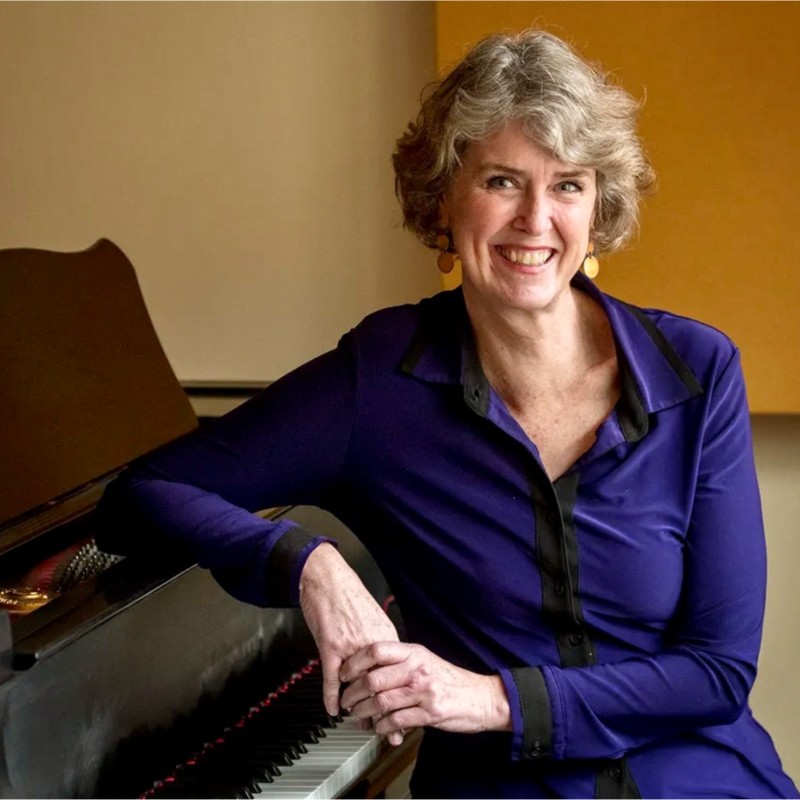
Guest post by Jennifer Griffin Gaul

My mom used to tell a story about me. She said that she would lie in the bathtub at night and listen to me practice piano.

I find this story strange because I honestly have very, very few recollections of practicing. I know I played because I remember the irritation I would feel at competing with the blare of the TV, or my angry older brother yelling at me to stop making a racket. But then there was the idea of “practice”, which was a bit of a fuzzy concept for me. Was it playing things over and over again until I could play it perfectly? Or was it something else altogether? I didn’t really know and there was no one at home who understood it either.

I didn’t start piano until I was 9 years old. We didn’t own a piano and my parents only
experience with music lessons was my brother’s aborted attempts at trumpet, which
left them unenthusiastic about investing in lessons for me. The subject of piano only
came up because they received a call from my best friend’s mother. Mrs. Kim had
called to say that I seemed to spend a lot of time around her piano and she thought
they should have me start lessons. My father balked at the idea of purchasing a piano
for an 8-year-old so I was given a plastic recorder and signed up for recorder lessons. I played recorder for a year and when it became clear that I loved music, they figured
out a way to get a small spinet piano.

I adored my first piano teacher, Mr. Erikson. He was a tall, gangly, bearded man with a
raspy voice. He started me off and we worked together until I was nearly 16 years old.
Every week when my lesson rolled around I’d feel a flurry of emotions. Anticipation was usually the biggest one. Sometimes a bit of shame for not doing the music worksheets he would assign. And also for not “practicing”. I didn’t like to let him down and I knew that practicing was important. I just wasn’t sure how to do it. But I also didn’t want to ask him what it meant because it seemed like I should understand it already.

Something magical always happened in those lessons with Mr. Erikson. Our work
together would absorb me completely. The lesson would flash by as I immersed myself in each new intricacy of music-making and sound. I progressed steadily. I must of practiced, right? How do you progress without it? And yet why didn’t I understand
what it was?

My musical life stumbled after a tearful parting from Mr. Erikson when he moved to
California. Limited for competent piano teachers in my small town in Rhode Island I
had begun lessons with a music professor at the local university. That relationship was life-changing. My weekly lessons became agony. There was no flow or understanding during lessons. Just a series of orders of what I was supposed to do. I was unable to focus because I was so frightened of this teacher. My ability to immerse myself in the music and grow and learn evaporated. Each week became worse as I was berated over and over again with my musical (and perhaps personal) deficiencies.

By this point, I had been accepted into the university at age 16 to pursue a Bachelor of
Music. He was the teacher I needed to work with in order to get my degree. He was
annoyed with me for this early acceptance, which he had been against. He said I
wasn’t mature enough. He was also annoyed with me for being accepted into the
Young Artist Piano Program at Tanglewood over the summer before I started at
university. He had told me I would be wasting the time of the audition committee if I
applied and would never be accepted. I auditioned anyway and spent a month
studying with Robert Taub, surrounded by amazing young musicians who were far
better than I was. They practiced! I was starting to get the concept.

And I DO remember practicing for him. I practiced a lot! But I just couldn’t seem to
progress. I couldn’t connect with the music. And each time I sat down to practice,
determined to show him what I could accomplish, I would just become more
discouraged. I ran scales. I did technique exercises. I worked on the assigned music.
Joylessly and with trepidation, driven by a sense of his seemingly endless disapproval.
It all came to a head during a lesson when I was mucking up the Mozart Sonata he had
assigned. By this point every time I played for him my hands would shake, my eyes
would have trouble focusing and my brain would go blank. In a fit of irritation he told
me that I had no capacity for hard work and I was just someone who liked music but
would never be a musician. He then told me to play it again for him. I couldn’t because
I was crying so hard I couldn’t see the music. He sighed and said “This proves what
I’ve said. Go home.”

I was devastated. My teacher Mr. Erikson came back for a visit that fall. I played for him and he just stared when I finished. “What happened?” he said weakly. Not only could I not play fluidly or with any musicality, I had developed so much tension that I was losing the feeling in my arms and hands. All that practice had done significant damage.

Before he returned to California, Mr. Erikson helped me to make some changes. I
altered my program from a Bachelor of Music to a Bachelor of Arts in music because
that allowed me to drop piano lessons.He had a long consultation with a friend who
had a D.M.A. from Eastman School of Music and set me up with this new teacher. I
began commuting to Boston every Saturday for lessons. I had to relearn how to play
again. Gradually I began to heal. Gradually I started to play again (or was it practice?). I adored my lessons with my new teacher. The sense of ultra focus and immersion
during lessons returned and I made enough progress to be accepted into University of Texas at Austin’s music program where I earned a Master of Music in piano.

So how does this impact my own teaching and the advice I give to parents and
students about the importance of practice?

In my opinion, at every level students need help understanding what they’re trying to
achieve when they practice. That understanding needs to be age appropriate. And it all springs from the quality of the teacher/student engagement during lessons. Working together in a way that feels collaborative, exploratory and uncovers each student’s connection to the music sets students up for better success on their own. Lessons that include regular, honest, and non-judgmental conversations between a teacher and a student about what (if anything) the student achieved in the week. We all know lesson time is precious because there just isn’t enough of it. But it is time well spent for students. Learning to self-reflect. Learning how to engage with sound. Learning to recognize how technique is tied to the sound produced. Learning to immerse themselves in a process that, when it goes well, can make an incredible difference.

Many years ago, I heard a friend joke that “you don’t need to practice if you just play
every day.” And I realized I finally had my answer to how I had made my progress.


Jennifer Griffin GaulJennifer Griffin Gaul is a US-based pianist and educator. She holds a Master of Music in piano pedagogy and performance from the University of Texas at Austin.


Find out more

At the beginning of this year, my son (24) passed his driving test, his achievement made more remarkable by the fact that, due to the covid restrictions, his test was postponed 6 times over the course of 18 months. He displayed a dogged pragmatism towards the disappointment of the cancelled tests (he was ready to take his test in July 2020) and simply carried on practicing his driving whenever he could – in my car, his own car, and with his driving instructor.

While my son was having his lessons, I was reminded of my own driving lessons, some 30-odd years ago, and how my instructor stressed the importance of “time at the wheel” – that any driving practice was useful. My son certainly appreciated this and we enjoyed lots of excursions in the car which relieved the monotony of lockdown while also giving him useful driving experience.

While we were out and about, I pointed out to my son that one of the most important aspects of having lessons is so that one learns how to pass the test. A good instructor knows what needs to be covered to ensure the candidate is well-prepared. I remember my instructor made me practice manoeuvres like parallel parking and three-point turns over and over again so that the all the processes, physical and mental, became fixed in my procedural (muscle) memory, were almost intuitive, and ensured that I was not nervous on the day of the driving test. The same was true for my son – his parking abilities impress me no end (especially as I can no longer parallel park successfully!)

What does this have to do with the piano and music practice? Well, playing an instrument, like driving, is a series of movements and processes, which utilise and train the procedural memory. Most of us know well the old adage “practice makes perfect”, but, more importantly, practice also makes permanent, so that movements, processes and gestures become intuitive – we do them without (apparently) thinking.

This permanence comes, of course, from practicing – not mechanical note-bashing, (or mindlessly driving around Tesco’s carpark) but from thoughtful, careful practicing to ensure we are well-prepared.

The great Russian pianist Vladimir Horowitz apparently had a little phrase which he repeated ahead of a performance – “I know my pieces” – meaning he knew he had done his preparation. It’s a helpful mantra, and one which I have used in my own preparation for performance.

It is this preparation which gives us perhaps the most useful skill of all – confidence – which enables us to perform to the best of our abilities in an exam or concert situation, can help allay nerves, and ensures that the odd error or slip will not derail the overall performance.


This site is free to access and ad-free, and takes many hours to research, write, and maintain. If you find joy and value in what I do, please consider making a donation to support the continuance of this site

Make A Donation
