Do Not Mistake Activity for Progress: A Lesson for Musicians

The phrase “Do not mistake activity for progress” serves as a powerful reminder that being busy is not the same as being effective. Nowhere is this more relevant than in the life of a musician, where countless hours are spent practicing, refining technique, and mastering pieces. A romantic misconception persists, amongst musicians themselves as well as the general public, that musicians must spend hours and hours in the practice room to achieve perfection.

This article explores how the distinction between mere activity and genuine progress is particularly important for musicians, and how understanding this difference by employing focussed, thoughtful practice – quality rather than quantity – can lead to more productive and meaningful practice and results.

For many musicians, the act of practicing can become habitual. Sitting down you’re your instrument, playing through scales, or repeating pieces from memory may feel productive because it takes time and effort. But if these routines are executed without thoughtful engagement, they may offer little return in terms of technical and artistic development. In other words, you can be very active without actually improving. This is where the warning not to conflate activity with progress becomes critical. Just because a musician is practicing does not mean they are practicing well.

Effective practice requires focus, intention, and feedback. It’s not just about the quantity of time spent, but the quality of that time. For example, a violinist who practices a difficult passage for thirty minutes without addressing the underlying technical issues – such as bowing technique, intonation, or rhythm – is likely to repeat and reinforce mistakes. This is, in effect, simply “going through the motions” rather than engaging in deep, thoughtful, considered practicing. In contrast, a musician who spends just ten minutes isolating and correcting these problems may make far more progress. Thus, mindful, goal-oriented practice can achieve more in less time than mindless repetition.

The concept of deliberate practice, popularised by psychologist Anders Ericsson, is particularly useful in this context. Deliberate practice involves working just beyond one’s current abilities, identifying weaknesses, setting specific goals, and seeking constructive feedback. For musicians, this might mean slowing down a difficult section, using a metronome, recording oneself for critique, or working with a teacher, mentor or even a trusted colleague or friend to identify areas for improvement. Each of these activities is targeted and purposeful, aimed at achieving real growth rather than simply filling practice hours.

In addition, mistaking activity for progress can lead to frustration, burnout and even injury. (‘over-practicing’ is a real issue!). Musicians may feel that despite spending many hours practicing, they are not advancing, which can be discouraging and demotivating. Understanding that not all practice is equal allows you to assess the effectiveness of your practice routines and make the necessary adjustments. It encourages reflection, a crucial aspect of productive practicing: What am I trying to achieve? Is this exercise helping me reach that goal? What could I change to improve my results?

By focusing on the quality rather than the quantity of practice, musicians can ensure that their activity translates into meaningful progress. Ultimately, it is not how much one practices, but how one practices, that leads to mastery.

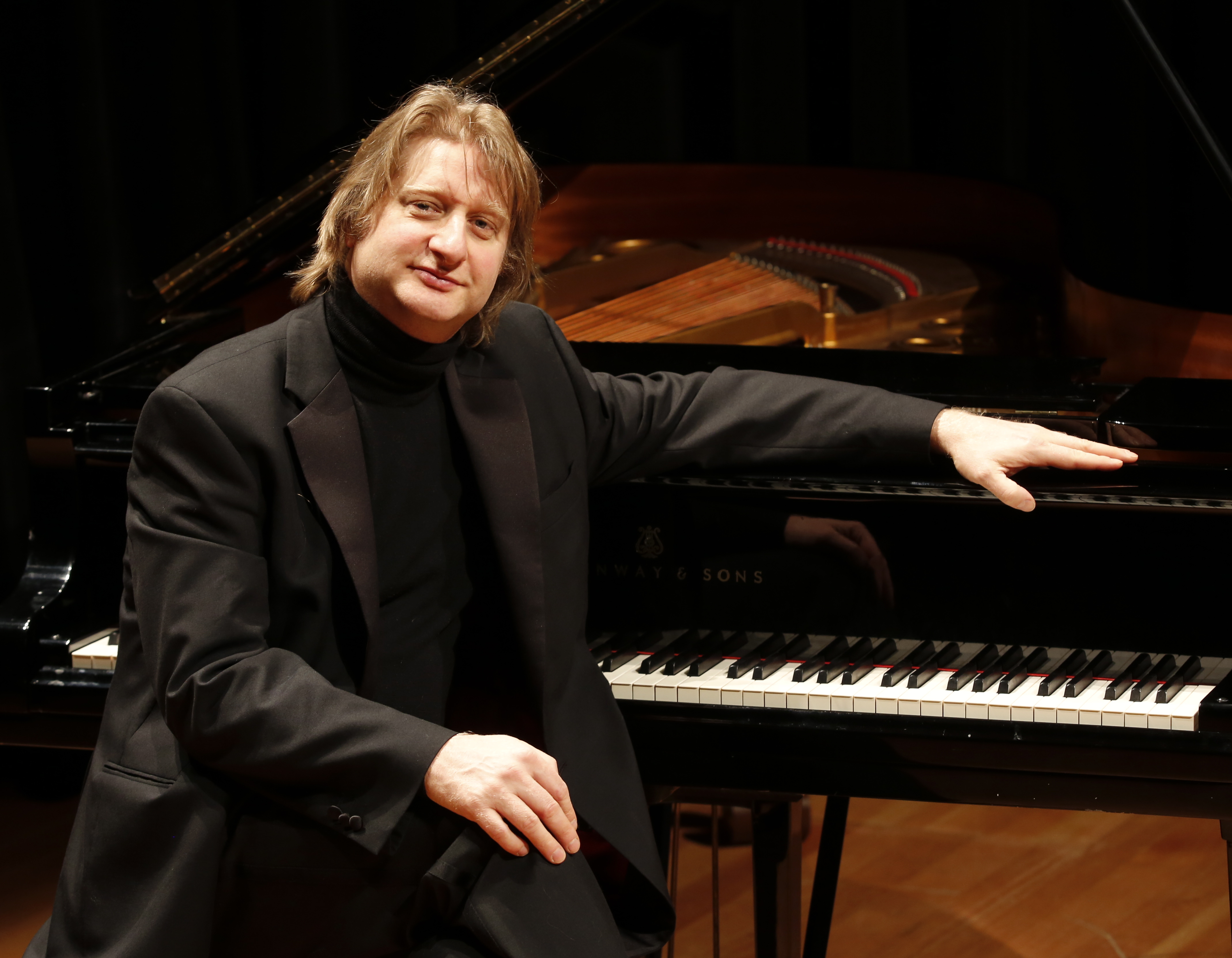
Guest post by Anthony Hardwicke


Instrumental Music Teachers as Individual Learning Coaches

In Episode 4 of his A Land Without Music? podcast series, Julian Leeks collected lots of evidence that a musical education can benefit our children. However, he stopped short of claiming that learning a musical instrument can boost a child’s progress right across the school curriculum. I believe we can and should make this claim, and the reason is simple: when children are given piano lessons, they get weekly one-to-one coaching on how to learn

Learning how to learn involves acquiring a key set of skills, such as planning, repetition, memorising, listening, feedback loops, etc. Once encountered, these can be deployed to help master other academic disciplines. Learning to learn has been championed in the past by academics such as Professor Guy Claxton. The main takeaway is that if we focus more on making children better learners, they can use their ‘learning muscles’ to make a success of other areas of their lives. 

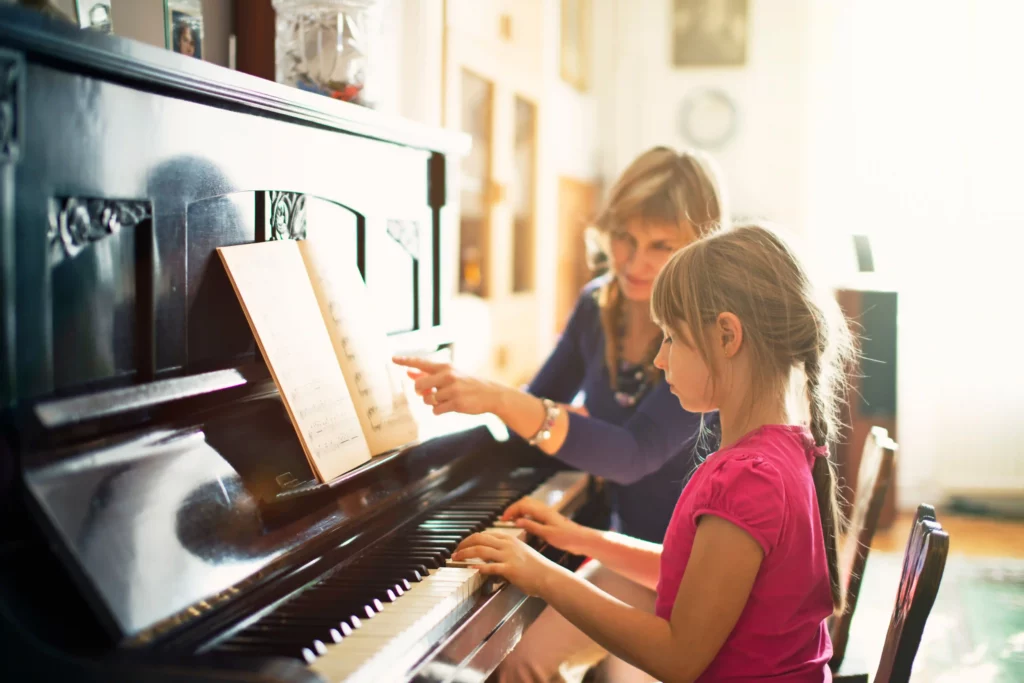
In a weekly one-to-one piano lesson with a peripatetic teacher, the child will experience a wide variety of different approaches to learning to play the piano. The teacher might discuss the most efficient strategies for effective practice, explain how to memorise a piece of music, talk about how music theory relates to a Mozart sonata, or they might give the student an impassioned pep-talk about how interesting and exciting Beethoven is. Perhaps they might not even intend this as an outcome, but the piano teacher might find themselves auditing that individual child’s learning skills in a way that a classroom teacher simply hasn’t got time to. I really do see the peripatetic instrumental teachers in a school as a super-motivated, highly experienced team of personal learning coaches.

What nobody talks about is how easily these useful learning approaches can be applied to learning about STEM subjects (and indeed other academic subjects). To memorise eight different chords to let you play 20 pop songs, is a very similar proposition to memorising the formulae of eight different ions so as you can work out the formulae of 20 different ionic compounds in chemistry. 

Teach a child to play the piano and you will almost certainly additionally grant them regular access to an inspirational teacher who will coach them and rehearse the priceless skills they need to learn all other school subjects. In most cases, because the lessons are one-to-one, the teacher will diagnose which skills the child individually needs to develop and move forwards their ability to learn effectively. 

Whether you’re a parent who wants your child to have a competitive advantage, or a politician pondering how best to invest for future society, we must have more music education.


Anthony Hardwicke has been a classroom science teacher for nearly 30 years and is a dedicated amateur pianist. 

In this episode we discuss gesture in piano playing – when it’s useful and when it’s most definitely not!

Find all previous episodes here


This site is free to access and ad-free, and takes many hours to research, write, and maintain. If you find joy and value in what I do, why not

A few months ago, I met the parent of one of my former piano students at an event. I was pleased to hear that the student (we’ll call her Jane) was now studying English Literature at one of the UK’s top universities, but the most gratifying piece of news was that she was still playing the piano and enjoying it. Jane’s mum told me that she liked to download music from the internet and play it for the sheer pleasure of doing so. “You gave her a love of music”, Jane’s mum said, “and that’s the most important thing!”.

I was so touched to hear this, as I think any teacher would be. Because surely our fundamental role, as teachers, is to encourage a love of music?

(This is one of the pieces Jane played for her Grade 5 exam, which she passed with a high merit)

Jane started having lessons with me as quite a young child, and at that age (5 or 6) she was very quiet and lacked confidence. But gradually, as her piano skills developed and blossomed, so too did her confidence, to the extent that she began to play with real poise, beautiful tone production, and above all a sense of real pleasure in the music she was learning.

Piano teachers – indeed all music teachers – have the unique opportunity to shape not only the musicianship and technical ability but also the lifelong relationship that their students have with music.

Here are 5 tips for encouraging a love of music in students:

1. Create a Positive Learning Environment

A nurturing atmosphere allows students to feel safe to explore and express themselves through their playing, and a place where students feel comfortable sharing their thoughts, questions, and concerns. By actively listening and addressing individual needs, teachers can build a strong rapport with their students and create an environment that nurtures a genuine connection with music.

2. Share the Passion

Enthusiasm is contagious A piano teacher who exudes enthusiasm for music can ignite a similar fervour in their students. Enthusiastic teachers inspire curiosity and a desire to explore beyond the confines of the lesson, encouraging students to discover their own musical tastes and interests.

3. Treat your students as individuals

Every student is unique, with distinct musical tastes and preferences – yet too often teachers take a “once size fits all approach” which does not take this into account. Customise your teaching to suit each student by getting to know what kind of repertoire they prefer, their particular strengths and weaknesses, and their approach to learning. In other words, show that you really “know” each and every student personally.

4. Connect music to everyday life

Classical music in particular suffers from an image problem and many young people today regard it as old-fashioned, highbrow or simply not for them. Show students how to relate musical concepts to real-life experiences, emotions, and events, and how music fits into everyday life, such as in film or TV soundtracks. By illustrating the universal nature of music and its ability to communicate feelings, teachers can instil a sense of purpose in their students, fostering a connection between the notes on the page and their own emotions.

Dance of the Knights (theme from The Apprentice TV show)

5. Encourage individual creativity and expression

Beyond technical proficiency, a true love of music involves the ability to express oneself creatively. Piano teachers can inspire this by encouraging students to experiment with interpretation, dynamics, and even composition. Allowing students to infuse their personality into their playing brings a sense of ownership and pride in their music and this sense of empowerment and personal autonomy contributes to a lasting passion for music that extends beyond the confines of the instrument.


This site is free to access and ad-free, and takes many hours to research, write, and maintain. If you find joy and value in what I do, why not