I reviewed the world premiere of ‘Marnie’ at ENO for my sister site ArtMuseLondon.
Read the full review here: ‘Marnie’ at English National Opera

I reviewed the world premiere of ‘Marnie’ at ENO for my sister site ArtMuseLondon.
Read the full review here: ‘Marnie’ at English National Opera
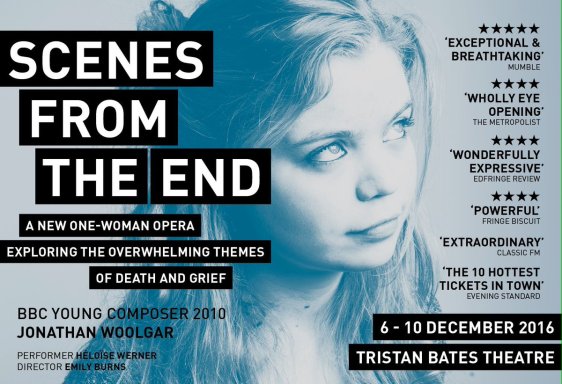
‘Scenes from the End’ by British composer Jonathan Woolgar is a one-woman opera focusing on grief in a variety of forms, from the abstract to the deeply personal, from the philosophical to the everyday. It explores big ideas – the notion of “the end” and what it might mean at different times and in different forms – concepts far bigger and complex than our individual comprehension can easily grasp or make sense of; and the frustration of the individual in a state of grief, surrounded by people whose prosaic or patronising attempts at offering “comfort” merely compound one’s sense of loss and anger.
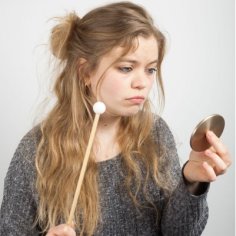 Heloise Werner is a young soprano and cellist with a particular interest in new music and music as drama. She is co-director of contemporary ensemble The Hermes Experiment and a member of new vocal ensemble SHARDS. ‘Scenes from the End’ developed from previous collaborations with Jonathan Woolgar and Heloise’s interest in exploring the boundaries between theatre and singing, and how that might work in a one-woman show.
Each of its three parts has a specific musical and textural focus. The first part explores grief for the end of the universe, a concept so vast we cannot possibly understand nor process it. The second part grieves for the human species and explores the arrogance of humankind (“We have done well, but we forgot to survive“), and, to my mind at least, offers a comment on our reckless plundering of the earth’s resources and man’s seemingly insatiable need to wage war on others. The final part grieves for an individual life, the pain of personal grief and the griever’s frustration at those around her who seem unable to respond appropriately (“Do not speak to me……but, stay with me“).
Sparsely staged, with only a chair and stool as props, the work has an immediacy which is arresting and very powerful. Heloise’s voice has a piercing clarity and depth, one moment beautiful, the next visceral and freighted with distress. The sung episodes are interspersed with spoken words (whispered, shouted), and gasping and panting, which calls to mind the gulping sobs of a grieving person who almost cannot cry any more. There are also recorded episodes, Heloise’s voice heard hauntingly from a distance, and percussion. Quotations are projected onto a screen which inform and expand on the narrative. The work is direct and thought-provoking with a raw intimacy enhanced by the simple staging and small size of the venue: one is close enough to see the broad range of emotions passing across Heloise’s face as she performs.
While the performance unfolded, the sounds of Hampstead Road filtered into the theatre – people talking, the rumble of traffic, a police or ambulance siren – reminding us, perhaps appropriately, that human life in all its humdrum and everyday continues.
‘Scenes from the End’ is at Tristan Bates Theatre, London WC2 from 6-10 December 2016.
Further details and tickets here
Regional and local classical music festivals are such a good idea. They take music out of formal metropolitan concert venues and into communities, forging important and lasting connections between musicians, local people and venues, and many attract world class performers, as well as encouraging young musicians. Conchord Festival boasted an impressive roster of performers, including actor Simon Callow and baritone Roderick Williams. I was delighted to attend the Saturday afternoon concert, music for piano duo performed by Alasdair Beatson and Julian Milford.
The theme of the concert was dance and the connecting thread was Sergei Diaghilev, ballet impresario and founder of the Ballets Russes, who collaborated most famously with Igor Stravinsky in the staging of The Rite of Spring, the piano 4-hands version of which concluded the concert. The afternoon opened with Debussy’s Prelude à l’Aprés Midi d’un Faun, a symphonic poem which formed the basis of the ballet Afternoon of a Faun, choreogaphed by Nijinsky and staged by the Ballets Russes in Paris in 1912. The piano duo version was transcribed by Ravel and loses nothing of its sinuous lines and erotic textures in the piano reduction. Beatson and Milford’s performance was languorous, nuanced and sensuous, perfect for a humid summer’s afternoon. This was followed by four of Dvorak’s Slavonic Dances, a reminder of the popularity of music for piano duo during the nineteenth-century and a foot-tapping musical palette-cleanser before the main event, The Rite of Spring, which followed the interval.
When The Rite of Spring opened in Paris in May 1913 the avant-garde nature of the music and the staging caused a near-riot in the audience. The piece still has the power to shock over 100 years later, with its narrative of savage rituals and human sacrifice. Stravinsky first performed his own four-handed version of The Rite of Spring with Debussy, the arrangement created to accompany rehearsals for the first performance of the ballet. This music was born on the piano, written in a tiny room, so Stravinsky tells us, on an upright piano, and it contains an exhilarating and precarious excitement. Forget the orchestral version: here is a work of raw energy, convulsive rhythms and pagan exoticism, aptly described by Debussy as “a beautiful nightmare”. It remains a vertiginously challenging work for piano duet, straining the medium to its limits. Beatson and Milford rose to the challenge with aplomb, managing pianistic gymnastics with ease and creating a riot of colour, texture, rhythmic drive and narrative. The famous stamped-out chords were percussive and metallic, redolent of heavy machinery, pistons and steam engines. (Let us not forget this piece received its first performances as Europe was preparing for the most mechanised and destructive war in its history.) This was truly an enthralling journey.
Next year’s Conchord Festival takes place from 9-11 June 2017.
“The music is not in the notes, but in the silence between.”
This quote from Mozart seems particularly apt for Steven Osborne’s concert at Milton Court which featured music by Morton Feldman and George Crumb, two radical American composers with a special interest in exploring the piano’s expressive qualities as much through the spaces between the notes as in the notes themselves. Eschewing melody as the main vehicle for expression in their music, both Feldman and Crumb offer the listener a special soundworld infused with simplicity and stillness. Osborne’s interest in stillness in music combined with his ability to produce magical kaleidoscopic shadings, as evidenced by his very fine performances and recording of Messiaen’s Vingt Regards sur l’enfant Jèsus, make him the perfect performer for this programme.

(Photo Benjamin Ealovega)
Silence in music, any music, is very important. Pauses and silences provide “punctuation marks” and create ebb and flow, just as in speech. Silences also create drama and set up expectations in the minds of the listener, while stillness and quietness in music allow the listener to be drawn in to create a special, sometimes very intense connection with the performer. In the pre-concert talk, Osborne talked of how, as a child, he liked to experiment at the piano to see how quietly he could play, fascinated by the tactile experience of producing very soft sounds. He described how the simplicity and stillness of Feldman’s music in particular – music which is sometimes merely a handful of notes or a few carefully chosen chords with no clear narrative nor organic development – allows the listener to engage with the music “in the moment”, with a mindfulness akin to meditation without the need to conceptualise nor admire it as an “art-object”.




 The Cross-Eyed Pianist