Tenor Ian Bostridge (image credit: David Thompson)

The final Chamber Prom of this season offered a pause to savour the music of the great English Renaissance lutenist, singer and composer John Dowland, whose 450th birthday falls this year.

Dowland’s music epitomizes the spirit of melancholy, fashionable in the Elizabethan period, and his most famous work is the Lacrimae, a set of seven pavanes for viols and lute, each drawn from the song Flow, My Tears.

For this concert, acclaimed tenor Ian Bostridge was joined by accomplished lutenist Elizabeth Kenny and the renowned viol consort Fretwork. Cadogan Hall is perhaps not the best venue to enjoy the intimate simplicity of Dowland’s music, but, seated in a semicircle, the musicians created an atmosphere of concentrated closeness, which held the audience’s attention for an hour and more, and allowed the seductive melancholy of Dowland’s music to shine through.

Read my full review

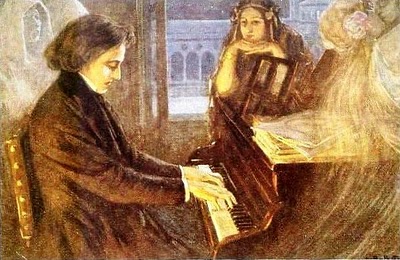
The story of composer Fryderyk Chopin and writer George Sand is one of the most compelling, romantic and passionate, a nine-year love affair which continues to fascinate and grip the imagination. It is a story of creative union and artistic inspiration, of a relationship severed by ugly jealousy and recrimination, and one which ended tragically with the untimely death of Chopin in October 1839.

For many, the relationship between Chopin and Sand is an attraction of opposites: she with her fiery, mercurial, outspoken personality, her penchant for men’s clothes and cigars contrasted with Chopin’s fastidiousness, his delicacy and shyness (particularly in performing in public). Yet during the nine years of their relationship, Chopin produced some of his finest piano music, including the 24 Preludes Op 28 and the B minor Piano Sonata. Despite her reputation for taking up with and then discarding lovers with the casualness one might discard a dirty chemise, Sand gave Chopin love and affection, and a settled home life, divided between Paris and her house at Nohant, that enabled him to compose. She nursed him when he was ill and offered solace and support when he felt his muse had deserted him. Added to this, their circle of friends comprising artists (the painter Eugene Delacroix, amongst others), musicians (Pauline Viardot, Auguste Franchomme), writers and composers (Franz Liszt) provided Chopin and Sand with a supportive and inspirational background against which they could create music and words.

‘Divine fire’ was Sand’s own description of the intensity of her attraction to Chopin, suggesting a love that transcended the purely physical to a more spiritual plane, a meeting of bodies and minds. It is also the title of a words and music presentation conceived and written by actress Susan Porrett with music performed by pianist Viv McLean.

The narrative runs chronologically, picking up the story of Chopin and Sand from their first meeting in Paris (at which Chopin initially found Sand “repulsive”) through their ill-starred winter in Majorca, contentment at Nohant, Chopin’s acclaimed recital at Salle Pleyel to their stormy parting and Chopin’s tragic death. The narrative is interspersed with music, selected by Viv to complement the text, and comprising some of Chopin’s loveliest works. The opening piece, the fleeting Prelude in A, Op 28 No. 7, set the tone for the evening – played with an ethereal delicacy, the last note was no more than a whisper.

The great strength of this format is the subtle interweaving of words and music. Susan’s text brings to life the personalities of Chopin and Sand through letters between them and their friends, and contemporary accounts. The readings set the tone, and the music reflects it, each piece sensitively rendered by Viv with expression and commitment, from the tenderest, most intimate Nocturnes (Op 9, No. 2, Op post. In C sharp minor) to an intensely poignant Mazurka (Op 17 No 4). Two Ballades (A major and G minor) illustrate Chopin’s contrasting textures and moods, while the Scherzo in C sharp minor is a heroic declamation, shot through with a contrasting motif combining a chorale-like figure with sound showers high in the treble register. Viv’s understated, modest delivery always allows the music to speak for itself, while Susan’s words lend greater focus, encouraging us to listen to the music even more attentively.

Viv expressed some concerns about the piano (an Estonia) to me afterwards, but I and several other audience members assured him that the range of sound was absolutely appropriate for the size of the venue (Bridport Arts Centre is a converted chapel, with cinema-style seating for c200), from the sweetest, most lyrical cantabile (in the Nocturnes, Prelude and Mazurka) to the thunderous, dramatic Presto con fuoco coda of the G minor Ballade. At times the music was accompanied by the faint, plaintive wailing of seagulls (Bridport is close to Dorset’s Jurassic coast), which lent even greater pathos to the music and narrative.

The concert closed with a poignant account of Chopin’s death, and an intense and emotional performance of the Polonaise Fantasie in A flat, Op 61, bringing to an end an absorbing, moving and beautifully presented evening of words and music.

www.vivmclean.com

More about 7 Star Arts

Further reading:

Chopin’s Funeral – Benita Eisler

Chopin: Prince of the Romantics – Adam Zamoyski

Chopin in Paris – Tad Szulc

Chopin’s Letters (Dover)

A Winter in Mallorca – George Sand

(image credit © Sim Canetty-Clarke)

Concerts by Canadian pianist Marc-André Hamelin are always challenging and exciting: a fearless approach to repertoire and unusual programme juxtapositions, combined with insightful musicianship, all underpinned by formidable technique create some of the most compelling musical experiences, and Hamelin’s latest Wigmore Hall offering was no exception.

Read my full review here

I purchased my ticket to hear Polish pianist Piotr Anderszewski almost a year ago, to avoid disappointment: he is a pianist I’ve long wanted to hear live, in particular after seeing ‘Unquiet Traveller’, the wonderful and quirky film about him by Bruno Monsaingeon. In it, Anderszewski revealed himself to be a sensitive, thoughtful and original musician, and his comments about the need to “sing to Mozart” struck a special chord (forgive the pun!) with me as I was, at the time of seeing the film, involved the final work on Mozart’s Rondo in A minor K511 for my diploma, a work full of arias and operatic statements, with an opening melody that looks forward to Chopin at his most intimate.

Anderszewski is a famously perfectionist musician (he walked off the stage during the semi-finals of the Leeds Piano Competition in 1990 because he wasn’t happy with his playing) and is one of the few musicians I’ve encountered in interview to talk openly about performance anxiety and the loneliness of the concert pianist (more here). But there was no sense of a precious personality at work when he strode onto the stage at Queen Elizabeth Hall on Thursday night, to a full house, and launched into a sprightly and colourful ‘Allemande’ of Bach’s French Suite No. 5, its melody streaming forth. Bach’s French Suites are more intimate than the English Suites, and Anderszewski offered a persuasive and thoughtful account, particularly in the exquisitely measured Sarabande and the stately Loure. The faster movements were dancing, witty and playful.

Despite being called English Suites, there is nothing especially English about them: they are essentially French in the dances featured in them, and are ‘player’s music’ rather than concert pieces. Anderszewski brought the grandiose opening ‘Prelude’ to life with a strong sense of the orchestral textures and fugal elements, and the following movements were elegantly presented. It was in the ‘Sarabande’, a movement which fully exploits the dark hues and gravity of G minor, that Anderszewski’s exquisite control, sensitivity and beauty of sound really came to the fore. He is also unafraid of exploiting the possibilities of the modern piano to the full, including the use of the pedal to create rich, warm sounds and shimmering pools of colour, and to highlight the melodic aspects of the movements. A marked contrast to the rather more mannered, traditional interpretations of Bach’s keyboard music.

After the interval, the less well-known Book 2 of Janacek’s On An Overgrown Path, a suite in five movements written at a time when the composer was coming to terms with the untimely death of his daughter Olga. These intensely introspective movements are emotionally searing and highly personal, imbued with references to Moravian folk music and harmonic fragments akin to Debussy’s soundworld.

It was in these pieces that Anderszewski’s ability to move from the most delicately nuanced pianissimos to rich, full fortes was most evident, and the subtleties and shifting moods of these poignant works were highlighted with great sensitivity and insight.

If we were wondering whether Anderszewski could also offer passion and sweeping virtuosity, without compromising his beautiful quality of sound, we were left in no doubt after his performance of Schumann’s Fantasie in C Major, Op 17, a work the composer described as “a profound lament” for his wife, Clara. It was a grandiose, declamatory and heartfelt close to a superb evening of piano playing of the highest order.

After several curtain calls, Anderszewski returned the piano and announced he would play the French Suite again. The audience laughed, a little uncertainly, perhaps not sure that he meant this, but by the time he reached the Sarabande, it was quite obvious he intended to complete the entire suite. It is rare to be given such a generous encore: indeed, I could have happily listened to Piotr Anderszewski playing Bach all night, such was the allure of his sound, understanding and musical sensitivity.

Piotr Anderszewki – Unquiet Traveller. More about the film by Bruno Monsaingeon here


