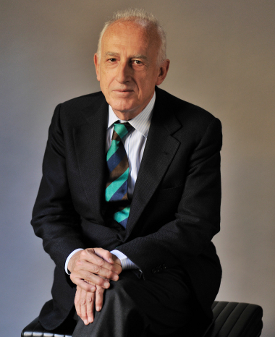
Maurizio Pollini (© Cosimo Filippini)

How does one define “greatness” in a pianist? Is it the willingness to tackle a broad sweep of repertoire from Baroque to present-day? Profound musicality and penetrating insights, founded on pristine technique? A fearless approach to risk-taking in live concerts? Italian pianist Maurizio Pollini is the sum of these parts – and much more – as his recent concerts in London have demonstrated. Here is an artist who is equally at home in the elegance of Bach, the intimacy of Chopin’s miniatures and the spiky modernism of Pierre Boulez, always bringing supreme pianism and fresh insights to his performances.

For his second International Piano Series concert at a packed Royal Festival Hall, Pollini trod a more traditional path in an all-Beethoven programme. Traditional, but also ambitious: to perform three of the most well-known, revered and technically demanding of Beethoven’s thirty-two piano sonatas would be a challenge for any artist. For a man of seventy-two (and he looks older and frailer) this was a monumental programme, which scaled the highest Himalayan peaks of pianism…..

Read my full review here http://bachtrack.com/review-maurizio-pollini-beethoven-apr-2014

Ronald Center: Instrumental and Chamber Music 

Volume One:

Music for Solo Piano

Catalogue Number: TOCC0179
EAN: 5060113441799
Release Date: 2 September 2013

Christopher Guild, piano

Sometimes described as “the Scottish Bartok”, composer Ronald Center (1913-73) was born in Aberdeen, the youngest member of a musical family. Despite his active working life as a soloist, accompanist, organist and teacher, his music was somewhat overlooked during his lifetime and after his death, and the centenary of his birth was rather lost amid the furore of last year’s composer anniversaries of Britten, Wagner and Verdi.

Fellow Scotsman and pianist Christopher Guild is a crusader for the neglected Center, and makes a persuasive case for Center’s piano music in his new disc on the Toccata Classics label. There are intimations of the percussive spikiness of Prokofiev, the folk idioms and harmonies of Bartok, the simplicity of Poulenc, the wit and humour of Shostakovich, and the sensuality and stately parallel harmonies of Claude Debussy (in a work entitled ‘Hommage’ which is dedicated to Debussy). Hints of Scottish airs make intriguing appearances in the music, reminding us of the composer’s heritage. There are moments of haunting beauty and wistful lyricism, such as in the ‘Larghetto’, the middle movement of the ‘Sonatine’, the ‘Impromptu’, or the first of the Six Bagatelles. Meanwhile, the Piano Sonata opens with a sprightly Bartokian Allegro molto,

Alert to the musical and emotional cross-currents in the music, Guild offers a sensitive reading of these interesting and varied works that is insightful, colourful, brimming with rhythmic vitality, and meticulously presented on this high-quality recording. An excellent introduction to Ronald Center’s oeuvre.

Toccata Classics

Meet the Artist……Christopher Guild

Prokofiev – Sarcasms

Ravel – Miroirs

Prokofiev – Visions fugitives Op. 22

Rachmaninov – Piano Sonata No. 2 in Bb minor Op. 36

Steven Osborne, piano

Anyone requiring evidence of a thriving musical life outside of mainstream concert halls should look no further than local music societies, which offer varied concerts and busy seasons and attract top flight artists. St Luke’s Music Society, based at St Luke’s, a beautiful church in south-west London modeled on an Italian basilica and boasting a fine acoustic, was founded in 2003 and offers a popular season of concerts.  Artists this season include Nicola Benedetti and Michael Collins.

Appropriately for a concert held on Burns’ Night (25th January), the soloist was Scottish pianist Steven Osborne. But there the association ended, for the programme featured works by Russian and French composers – Prokofiev, Ravel and Rachmaninov.

The concert opened with Prokofiev’s rarely-performed Sarcasms (which Osborne has recorded for Hyperion). In these provocative miniatures, Prokofiev eschews the trend amongst late-nineteenth and early twentieth-century composers for writing salon pieces based on fairy tales and impressionistic evocations, and instead opts for biting mockery and the grotesque, much in the manner of Schoenberg’s Three Piano Pieces Op 11 or Bartok’s Burlesques and Allegro Barbaro. Alert to the idiosyncratic character of these brief pieces, Osborne’s imaginative approach gave the works the necessary snap and humour, with terse rhythms and a vivid percussive attack, though never at the expense of clarity and tonal quality.

In contrast, Ravel’s Miroirs are very much about impressionistic evocations, though they share Prokofiev’s desire to break free of formal confines. Steven Osborne has a deep affinity with the music of Ravel, and other French composers such as Debussy and Messiaen (his recording of the Vingt Regards sur l’enfant Jesus has received high praise, and his performance of the complete Vingt Regards at London’s Queen Elizabeth Hall last year was one of the most involving and profound musical events I have ever experienced). His unerring ability to fully comprehend the structure and meaning of this music was amply demonstrated in an evocative and colourful performance, from the limpid figures of ‘Noctuelle’ to the foam-flecked swell of ‘Un Barque sur l’ocean’, the sultry rhythms of the ‘Alborada del gracioso’ and the plaintive, distant chimes of ‘La vallée des cloches’. Clarity of sound, tonal shading, deftness of touch and musical understanding brought Ravel’s impressions to life with an atmospheric and shimmering palette of colours and sounds.

More Prokofiev after the interval, and snapshots of his most characteristic moods – grotesque, aggressive, assertive, poetic, mystical, delicate – in the Visions Fugitives, short pieces which shows the composer’s burgeoning talent in their contrasting moods, melodies, textures and rhythms. Osborne acute ability to move between the capricious individual characters of these short pieces – graceful melodies, moments of meditation and repose, violent virtuosity – made for a persuasive and engaging account.

The final work of the evening, Rachmaninov’s Piano Sonata No. 2 in B-flat minor, was tautly managed, yet expansive, Osborne giving rein to the full romantic sweep of this work, at times redolent of the Third Piano Concerto. The rich hues and dense textures of the first movement contrasted with a beautifully nuanced second movement before a brilliant and vibrant final movement which had members of the audience on their feet applauding before the last notes had died in the hall. A single encore, one of Ravel’s Valses nobles et sentimentales, brought to a close a superb evening of music making of the highest order.

Steven Osborne performs the same programme at Wigmore Hall on 14th February.

St Luke’s Music Society

It’s unusual to enter the auditorium of the QEH and see a small unassuming upright piano on the stage instead of the usual swaggering concert Steinway. In front of the piano, near the edge of the stage, flimsy sheets of  music were arranged on eight spindly stands. Overlooking the whole scene, a plaster bust of Beethoven, frowning down upon the proceedings.

A recital featuring the music of Hungarian composer and pedagogue George Kürtag is always going to be quirky, unusual and playful – and this concert was no exception.

Kurtag’s Hipartita for solo violin, a work composed for violinist Hiromi Kikuchi, who performed it at this concert. Combining the soloist’s name with the Baroque partita, a collection of pieces related to each other, the Hipartita contains movements dedicated to figures from Hungarian musical life, ancient Greece, Hungarian folk dances, including the Czardas, and even J S Bach himself. A curious work full of wails and squawks, skittish scurryings and glissandi, it was strangely haunting and witty all at once, and was presented with intense concentration and an aching beauty by Hiromi Kikuchi. At the end of the performance, Hiromi gestured into the audience, and after a pause György Kurtág himself, frail but smiling broadly, tottered onto the stage to receive applause alongside the soloist.

After the interval the piano had been shifted to centre stage, a duet bench set before it and another selection of flimsy pages on the music stand. Kurtág and his wife Márta walked slowly onto the stage, gently supporting one another. They were going to perform and selection of short pieces from Kurtág’s Játékok (Games), a series of works for children and beginner pianists, for which the model was Bartok’s Mikrokosmos. In Játékok, the focus is on movement and gestures rather than accuracy, thus drawing on the educational philosophy of Rudolph Steiner. These charming and idiosyncratic miniatures were interspersed with Kurtág’s own transcriptions of works by Bach, for four hands, and all played with great delicacy of tone and touch.

Here is the scene: Gyõrgy seated at the piano, Márta at his side quietly removing the pages, and joining him in duets of his own music and his Bach transcriptions, the practice pedal permanently depressed so that the sounds emerging from the piano are soft, gentle and intimate. Enhanced only slightly by amplification, the sound of the piano is domestic, homely. The Kurtágs lean towards one another as they play or mirror one another’s gestures, reaching across each other at the keyboard; sometimes they look tenderly at each other. It is as if we are peeping in on an afternoon of private music-making in their home.

This all-too brief yet exquisite and unassuming recital was met with a standing ovation, people rising to their feet not to applaud greatness but rather to share in the emotional spell this miniature music and its frail and deeply sensitive performers had cast upon us all. Many people were in tears, overcome with an emotion that was impossible to describe.

John Gilhooly took to the stage to present Maestro Kurtág with the RPS Gold Medal, in the presence of Beethoven (who himself was awarded the gold medal). In response to Gilhooly’s eulogy, Gyorgy Kurtág, as quietly-spoken as his music, said “I am not a man of words”, and then returned to the piano to play Mozart’s G major Variations with Márta.

An extraordinary and rare afternoon of music, curiously subversive by dint of the fact that it went against the grain of the traditional concert, and one many of us are unlikely to experience again.