
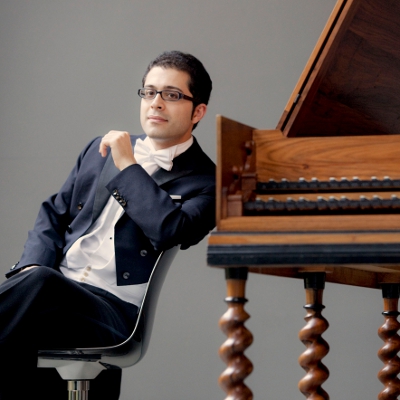
Who or what inspired you to take up the harpsichord, and make it your career?
I think it’s impossible for people involved with the harpsichord to deny the influence of Wanda Landowska (1879-1959). Landowska was the first to make the modern concert stage take it seriously, and, quite frankly, I wonder whether successive generations did plenty to kill the goodwill of the public that she had so painstakingly engendered. Her command, her confidence, her authority, her drama, her understanding of what a plucked string means – she is why I am here. I guess you could say that the decision to take it full on and make a career out of it had a bit to do with latent adolescent rebellion against parents who loved the Romantic repertoire…
Who or what were the greatest influences on your playing?
Probably my playing as a soloist has been most influenced by a lot of the orchestral recordings I grew up with. Otto Klemperer’s readings of the Bruckner and Beethoven symphonies go to the very depths of each piece without resorting to any formulae or cliches. Nikolaus Harnoncourt shows that it is possible to be historically-informed and yet not resign oneself from the messy business of artistic licence and an aesthetic principle.
What have been the greatest challenges of your career?
You would think that my answer would have something to do with the mainstream not taking the harpsichord seriously. I won’t say that hasn’t been a challenge, but so far the biggest challenge has come from fighting the dogmatism, ignorance, sensationalism, inability to embrace change, increasing emphasis on a star system at the expense of actual music, and general intellectual laziness of the so-called world of historical performance.
Which performances are you most proud of?
I’m proud (if that can be the word – delighted, happy?) when someone says to me that I can make the harpsichord sing. That’s me at my best – not fast fingers, not certain effects, but just the idea of the instrument singing and, might I add, speaking.
Do you have a favourite concert venue to perform in?
Where the spirit of the composer descends and in an act of transubstantiation inhabits our ears, our minds, our hearts, and, occasionally, my fingers (if I’m lucky), that’s the best place.
Favourite pieces to perform? Listen to?
I like to perform whatever is in front of me at the moment! To listen to, there’s nothing better for me than one of the Bach Cantatas, or Haydn’s Creation. Lately I have been listening to Elgar’s Chanson de Nuit on repeat; how can anyone write such a beautiful melody? I have to admit that I like salon music very much – Quilter, Sullivan, and all that. I recently heard Cesar Franck’s Piano Quintet – it’s a work of genius!
Who are your favourite musicians?
Sviatoslav Richter. He is like a bear at the piano – always struggling, fighting, taking risks, thinking out loud. Sometimes it works, sometimes it doesn’t, and it is always imparting his special genius. I always try hear and study everything by Nikolaus Harnoncourt.
What do you consider to be the most important ideas and concepts to impart to aspiring musicians?
To aspiring musicians, I can only say: focus only on your music and the quality of your execution and your message, and the rest will come. You will come into contact with a lot of young ‘musicians’ who think they need to dress the part, attend nice parties, and in general fit some sort of silly expectation of what artistry means, and I’m afraid it usually has to do with the bank of Mummy and Daddy. This is all nonsense. These people don’t believe in their musicianship. Even if you are destitute on the street and haven’t two coppers to rub together, you will always have your music, and that is more valuable than anything. I know a lot of voices say otherwise, but, really, trust me on this.
What are you working on at the moment?
I’m working on a very interesting harpsichord transcription of Bach’s A-minor Solo Sonata BWV 1004; it may have been made by one of his sons or, in all probability, by his student and son-in-law Johann Christoph Altnickol. I’ve also just gotten my teeth into another marvellously fiendish concerto by C.P.E. Bach.
What is your most treasured possession?
Right before I left university, my mentor George Houle gave me two very special things as parting gifts. One was a small booklet with a cover reading, ‘the Dolmetsch Concerts,’ which contains the various dates and programmes for a set of concerts performed by Arnold Dolmetsch and his family in the United States in the first decade of the twentieth century. These were amongst the first performances of music on period instruments ever attempted in the United States, and so it’s very precious. Dr. Houle also gave me a turquoise bolo tie, a piece of American Western fashion which I think is now rather passé – this belonged to Landowska’s American student Putnam Aldrich, who later went on to found the early music programme at Stanford. It’s a nice connection to those pioneers who started this whole movement, and for some reason the bolo tie in particular reminds me of my university years in California, which were very happy and eye-opening in every respect.
Review of Mahan Esfahani’s Proms 2011 performance of the Goldberg Variations




 The Cross-Eyed Pianist