This article is reblogged from the blog On An Overgrown Path. The article poses some interesting questions about how classical music might seek new audience members. I was delighted to be invited to contribute to the article.

Is classical music asking the right questions in its search for a new audience? Should we be debating the way musicians dress, the style of lighting used in concert halls and the rights and wrongs of applause between movements? Or should we be spending more time deliberating over what music will appeal to that elusive new audience? As the name of the game is classical music, my vote goes unequivocally for deliberating over what music to recommend and promote to new listeners. Which is why the following Facebook exchange sent me off down a path that is worth sharing.

Reader – Hey there. I am a big fan of On An Overgrown Path and a friend of mine wants to start off listening to classical music. I wanted to know some recommendations for beginners
Me – You ask a very important question, and one to which there is no easy answer. Can you give me a brief biographical sketch of your friend to help me? With some background I will make some suggestions.

Reader – Brief bio: Female. Educational background: Marketing and IT. Age: 27. Occupation: IT Consultant. Hobbies: Singing pop rock. Favorite movies: The Hunger Games saga. Music they currently listen to: Joan Baez, Nick Cave, Tom Waits and have heard a bit of Wagner.

Max Hole and the other new classical gurus are curiously quiet on the crucial question of what a classical beginner should start by listening to. Current concert programmes suggests that Mahler, Shostakovich and Sibelius are the only games in town, while Classic FM and BBC Radio 3 playlist programmes favour the ‘Tchaikovsly’s greatest hits’ approach. None of which, I feel, would hook our 27 year old pop rock singing Nick Cave fan on the classics. So I enlisted the help of four ‘virtual’ friends, all of who are professionally involved in classical music, to recommend music for this specific classical neophyte. Here are their responses.

Frances Wilson: pianist, blogger and piano teacherI’m basing my suggestions partly on my idea of “lateral listening” and also on the premise that everything is “new” if you’ve never heard it before – i.e. a new listener will, hopefully, approach his/her listening with open ears and few preconceptions. Here goes…..

Baroque – Bach French Suite V, 1st Partita, some of the Chorales

Moving laterally to ‘Variations for Judith’ (various living composers). A set of variations on Bach’s Bist bei du Mir. An excellent intro to contemporary piano music and all the movements are very individual and brief. This might pique an interest in variations, in which case back to Bach and the Goldbergs…..

Chopin – Preludes (even if one doesn’t know them, they are “familiar” in their idiom and soundworld). Moving laterally to Syzmanowski (Etudes, Metopes) and early Scriabin (Preludes, Morceaux).

Liszt – Annees de Pelerinage, 1st year. Fountains at the Villa d’Este – and laterally on to Ravel Jeux d’Eau and Ondine

Debussy – Preludes and Children’s Corner. Clair de Lune. Again, I think this music will seem “familiar” even if it is not instantly recognisable. From Debussy early Messiaen (Prelude: La Colombe)

Prokofiev – Visions Fugitives. Brief, varied, accessible. And an intro to more atonal music

Shostakovich Preludes Op 87 – varied, short, melodic, rhythmic, colourful

Cage – In a Landscape, Dream. And thence to Philip Glass – piano Etudes, Metamorphoses (I find my students love Glass’s music because it is familiar from film and TV scores)

Ligeti – Musica Ricercata. Proof that 20th-century classical music can be witty and fun. Which leads us back to Bach….and now perhaps the Goldbergs and the 48….

James Weeks: conductor and composerHow about

Machaut chansons (virelais, rondeaux, ballades)
Beethoven symphonies
Stravinsky Symphonies of Wind and Rite of Spring
Varèse Amériques
Riley IN C
Cage Sonatas and Interludes
Andriessen De Staat or Hoketus

for a start?

Vanessa Lann: composerI would say that a good start might be to listen to any Hildegard von Bingen; then Bach’s Matthew Passion or B minor Mass; I’ll let other people recommend everything in the next century and a half; then maybe Stravinsky’s Rite of Spring; then maybe Google “composer non-white” and “composer female” for a selection of more modern works. I’ll leave out the ten-page list I could write including all the amazing work written by composers of all sorts (classical and otherwise) in the last century and a half, as I would not want to limit a new listener – and I would not know who to include, and who to leave out – and it is a bit too close to home…

Ian Sidden: baritone at Dortmund Opera

I became somewhat obsessed with this project. In fact, I might have gone a bit overboard with it, because I’ve written a long blog post with a playlist both on YouTube and Spotify along with short annotations to each of the contained pieces. As I acknowledge in the blog post, I don’t consider this frozen in place, and I will update the playlist and annotations as I think of new appropriate music or as people suggest music to me.

What does “appropriate” mean? The blog post goes into much more detail, but there were six criteria:

Sense of story or place.
Brevity (as much as possible).
Novelty.
Opens doors to more music.
Easy to enjoy.
Quality without condescension.

I began with “story” because of my own experiences with classical, and from what we know about this young professional who wants to learn more, “story” seemed relevant to him as well. From there I considered what challenges new listeners face to flesh out the other criteria.

And the resulting playlist (as of now) is too long to post here entirely, but it’s 40 selections as of now. It has composers like Mozart, Bach, Vivaldi and Beethoven, of course, but also Barber, Victoria, Puccini, Bernstein, Josquin, Copland, Schubert, Britten, Wagner, Hildegard, Scriabin and Prokofiev. There are some modern composers like Larsen, Adams, Tavener, Whitacre, and Salonen. And Gottfried Huppertz is in there as the composer of the Metropolis score, which opens many doors into to the present day and to the past.

The pieces chosen from them tried to satisfy the criteria and offer a doorway inside the composers’ world. Sometimes that meant ignoring dominant genres in which particular composers composed (opera for Britten and religious vocal music for Bach, for examples) to find an easier path in. Sometimes it just meant finding the shortest expression of characteristics of a composer (Symphony no. 5 Allegro con brio from Beethoven, for example). But sometimes it meant challenging even new listeners to something unusual and potentially difficult (“Der Leiermann” from Schubert or “Helix” by Salonen).

Some major names were left out who I hope to add later, and additionally I’d like to add more diversity to this list of names. It’s a start though. You can read the aforementioned blog post via this link:

Please feel free to contribute to this interesting discussion either via the comments box below or over at On An Overgrown Path

A guest post by Bernard Kerres, founder/CEO of HelloStage


The world has changed significantly over the last twenty years. The development of the internet and its almost virus-like spread into all corners of the world as well as our lives has an impact on society not yet fully understood. Who will need a musician in tomorrow’s world when you can chose between the holograms of Arthur Rubinstein, Vladimir Horowitz, Glenn Gould or Friedrich Gulda playing for you in your home “live” – or at any concert stage for that matter? Why waste time on music education when a robot can play flawlessly and adapt to the style of your preferred pianist?


We are not quite there yet. But we can be sure that the scenarios described above are technically entirely possible in the not-too-distant future. The only thing that will take longer is for a robot to develop its own interpretation. I doubt that it will ever be possible for robots develop emotions – at least not in the near or medium term future.


Nevertheless, the scenarios mean that the reproduction of music, including classical music, will enter completely new realms never even thought of. This is actually good news. This means that more music will be consumed and music will become an even bigger part of every day life. 


But what happens to live music? My view is that the more people who are listening to music anywhere the more will also listen to live music. There a lots of examples in human behaviour where individuals get more into a subject the more they are in contact with the subject matter.


Often classical music makes it very difficult for new audiences to attend. There is a whole unwritten code about behaviour in a concert – from how to dress to when to clap. This is a huge entry barrier for new music lovers. Many people have developed a taste for classical music, have listened to it on the radio or in recordings, but they still shy away from going to the opera or to a concert.


So technology gives us these amazing opportunities but we, the classical music community, build up barriers against really utilizing these opportunities.


Nevertheless, technology also allows us in the classical music community to communicate and collaborate with each other in completely new ways. The author and readers of this blog have developed a great interest in news and thoughts around the piano. We at HELLO STAGE are providing tools for those in the classical community to engage with each other.


From experience I know that people in the music world are generally very self-focused. They have to be. They have to really believe  in their music, in their concerts and in their performances. But if we all change just a tiny little bit, using some of the technology available to us, to write, speak, blog, tweet etc. about classical music in general, we could create an amazing network effect.


I personally have the great advantage of seeing one of the most amazing network effects at work. I have relocated to Silicon Valley in California at least for four months, if not longer. Within days of arriving, I saw an amazing network driven by the belief in technology and a passion for entrepreneurship. Everyone here speaks about the latest app they have seen, a cool start-up they came across, or an inspiring team. Only after several questions, they might actually also speak about their own start-up or investments. 


At HELLO STAGE we initiated the hashtag #classicalbuzz. The idea behind it is simple. As a first step each one of us shares one comment about a performance we have just heard or a recording which has inspired us with the hashtag #classicalbuzz. Second, we all share at least one post with #classicalbuzz. Can you imagine the fast spread of #classicalbuzz and therefore classical music in the world? It is an easy step that we all can easily join in with. It can be the beginning of a classical music revolution. 


Let us create a #classicalbuzz together, perhaps also a #pianobuzz driven by our love for classical music. I am looking forward to sharing your posts and tweets with these hashtags. I am greatly looking forward to reading more and more ideas about how people around the world lower the barriers of entry into our concert halls and opera houses and make them welcoming for so many new music lovers out there. Thanks for being part of that.

Bernhard Kerres is the founder and CEO of HELLO STAGE – an innovative independent online platform for the classical music community, connecting musicians, ensembles, managers, and promoters in the classical music world.

Bernhard started his career as an opera singer, before graduating with an MBA from London Business School. After five years in strategy consulting for Booz & Co. in the high technology, internet and telecom sectors, he subsequently became CEO, CFO, and COO of various technology companies in Europe. From 2007 to 2013, he was the CEO and Artistic Director of the Wiener Konzerthaus, one of the most active concert houses in the world, with over 800 events and over half a million visitors per season.

Read more about Bernard here


This is an article I wrote for HelloStage, a social media platform which allows musicians, promoters, agents and other music professionals to connect.

social media

noun
noun: social media; plural noun: social medias 

1. websites and applications that enable users to create and share content or to participate in social networking. 

If you are reading this article, I can almost guarantee that you found it via a social media platform – a blog, a blog embedded in a website, a link shared on Facebook, Twitter, LinkedIn or Google+, or via a “discovery engine” such as Stumbleupon or Reddit. Or indeed via any of the other myriad platforms that allow people to create and share content across the internet.

Social media offers musicians quick and easy ways to build and enhance one’s profile, and connect with one another, promoters and agents, venues and audiences, radio stations and recording companies across the web. It has created international stars and opened up the world of classical music to a broader audience and fan base. The barriers to entry are low, and costs minimal or non-existent, and a robust online presence will make you more attractive to presenters, managers and record companies who will look at the size of your fan base, the number of views, and how actively you engage with your fans.

Before social media, there was the personal website, the musician’s “shop-window” containing one’s biography, concert schedule, discography, media such as photographs and video clips, and perhaps some links to other people’s sites. Now, in addition to the website, most tech-savvy musicians will have a Facebook fan page (separate from one’s personal profile page), a YouTube channel, and a Twitter account – and that’s just for starters. Taken all together, these are powerful tools to create international connections and allow others to discover you and your music.

In a recent survey I conducted to explore how classical musicians use social media, the most popular and frequently-used platform was Facebook, with Twitter and YouTube following close behind. In terms of purpose, 87% of respondents said they use social media to connect with others in the profession, with 72% using it for self-promotion, and 66% for advertising concerts, CD launches and other events. The majority of respondents (77%) felt it was important to have a presence on social media as a musician in the 21st century, though, interestingly, only 41% felt social media had been “very useful” in their professional life.

In addition to networking, self-promotion and advertising, respondents to my survey also cited a number of other important uses for social media including: 

• Building community with like-minded professionals and developing a targeted client base 

• Speaking engagements, e-book promotion, increased blog traffic 

• Ticket sales, awareness of opportunities for training, meeting and contacting other musicians 

• Higher profile; creating relationships with journalists; creating relationships with other musicians 

• Greater recognition. Helps to establish an international presence. Helps to ignite/sustain/rekindle current relationships with fellow musicians & colleagues 

• Reconnecting with long lost colleagues to create new working relationships 

• Broader audience for concerts, connecting and sharing ideas with other musicians 

With these obvious benefits of using social media, it always surprises me when I come across active performing musicians who hardly use social media or claim not to know how to use it. If you’ve got a computer, it’s easy. If you have a smart phone, it’s even easier. 

Here are two examples of musicians making effective use of social media, from either end of the UK classical music spectrum. 

First, Emmanuel (Manny) Vass, a young concert pianist from Yorkshire whose active and engaged online presence has succeeded in quickly raising his profile. Manny comes across as down-to-earth, genuine and committed, and it is no surprise that his latest Kickstarter campaign, to fund his second CD (his first CD was also self-funded) has already exceeded its target. Manny uses no agent, promoter nor PR company to market himself. 

Secondly, Stephen Hough. Internationally-renowned pianist and musical polymath, Stephen’s Twitter feed is busy and varied, reflecting his many interests, including religion, food and hats, and offering insightful snapshots into the life of the busy touring musician. 

What both Manny and Stephen share in their online presence is a lack of ego: they don’t “big” themselves up – they come across as genuine and “normal”, and this is a crucial aspect of using social media. 

Some thoughts on using social media successfully. 

Twitter: Do interact with others. Observe good “Twitterquette” by thanking people if they say nice things about you, or post a favourable review. Don’t big yourself up too much in posts (because no one likes a boaster, do they?), but equally don’t sound too desperate (“Please please please come to my concert next Friday!”). Avoid capital letters – this is the Twitter equivalent of shouting – or too many exclamation marks (which just looks over-excited). Offer snapshots of your professional life – your audience are interested. Don’t get into arguments with people online, and don’t use Twitter to slag off colleagues, conductors, critics or others, or moan about the exigencies of your life. Twitter is a very powerful tool – use it intelligently and skillfully and it will reap rewards. 

Facebook: Facebook is a funny beast. At one time, it was the social platform of choice for young people, but now seems to have been taken over by their parents as youngsters move to other platforms such as Snapchat and Instagram. Use Facebook wisely and think carefully about how much information about yourself you want to reveal to the public at large. (Remember, the privacy settings of all posts can customized.) Many musicians have an “artist page” which is separate from a personal profile and is the place to post reviews, information about upcoming concerts and other events, and share links which are relevant to one’s professional profile or career. Facebook also allows you to create events which can be useful in attracting people to a concert or CD launch. Again, the privacy settings can be customized. 

You Tube: It’s impossible to ignore the “Valentina effect” – how the pianist Valentina Lisitsa built a massive online following through her videos of her practise sessions and concerts. YouTube is useful for sharing samples of your work – but only if the recording is good quality. 

SoundCloud: This music-sharing platform has eclipsed YouTube in recent years, and now many artists (from all genres) use it as a place to share tracks and samples of their work. Your personal profile can be embedded on your website or blog, and tracks can be shared across other networks, or kept private and shared only via an emailable link. 

Blogging: This is more niche and requires much more commitment than the platforms above. I meet plenty of people who tell me they are going to start a blog: they get set up with an attractive template, write a handful of articles and then lose interest. A successful blog takes time and effort (see my earlier article on blogging for more detailed advice on how to get started). 

The exigencies of life as a musician in the 21st century mean that most people have to do their own promotion and PR. Very few musicians can afford the luxury of a PR company or powerful publicity machine, and you should not rely on venues to publicise your concerts – unless you are very famous. Social networking gives you powerful, and importantly, free tools to self-promote, and the more active you are online, the more your profile grows. The key to success with any social media platform is to build a distinct and compelling online profile. 

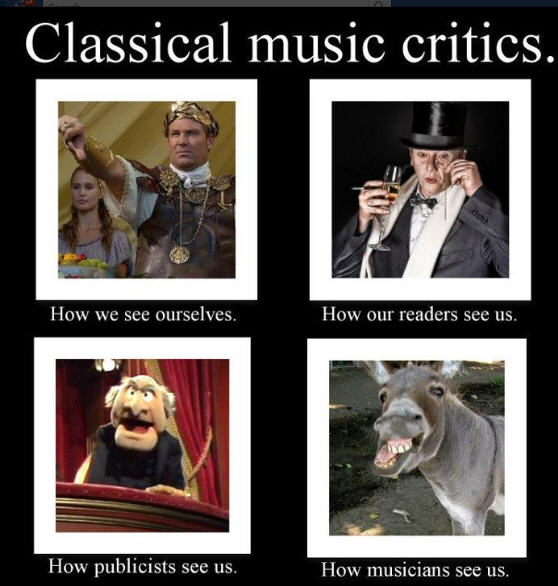
Reviews, and critics, are curious things. As Lisa Hirsch says on her blog ‘Iron Tongue of Midnight’, music reviews and music criticism serve the following purposes:

  • Journalistic: recording what happened and when and by which musicians
  • Opinion: recording a critic’s opinion (we hope a highly informed opinion) of what happened
  • Contextual: placing what happened within some historical and musical context
  • Preservation: enabling people in the far future to get a look at what happened, why, and the impression it made

Good reviews don’t make personal comments on the performer (recall the storm around the very negative comments about the physical appearance of singer Tara Erraught), nor allow the writer’s personal taste to rule the review (i.e. reviewers shouldn’t give a negative review just because they don’t like a particular composer or work: they should be able to put aside such likes or dislikes to offer an objective comment on the performance). Good reviews offer the writer’s considered opinion of the concert: was it effective and did it work? Which parts stood out, which did not? But at the end of the day, a review is one person’s view on someone else’s interpretation.

Some years ago I attended a concert of music by Musorgsky and Liszt by Georgian pianist Khatia Buniatishvili at London’s Wigmore Hall. For many members of the audience, and some critics it was a coruscating display of imaginative and risk-taking pianism, the Liszt pieces in particular performed with the kind of vertiginous virtuosity which Liszt himself may well have approved of. One critic didn’t like the concert, describing the playing as “rash” and “immature” and ended his review with the comment “on the question of whether Buniatishvili can ever be a serious artist, the jury is very much still out” (full review here). A few days later, Khatia Buniatishvili responded to this review with some remarks on her personal interpretation of the pieces (read her response here)

Ms Buniatishvili’s detractor in ‘The Guardian’ had just as much right to give her three stars as ‘The Evening Standard’ critic did in awarding her five stars. And she had every right to reply to her detractor. But I wonder whether such a rebuttal serves any real purpose in the great scheme of things. An international artist like Khatia Buniatishvili will play many concerts in many cities across the world and be heard by many hundreds of people, some of whom are critics and reviewers. A single concert is just a day in the life, and a single negative review is unlikely to make or break an artist.

The violinist Patricia Kopatchinskaja had, for awhile, her own way of dealing with negative reviews. One page of her website was a ‘trashcan’ for negative reviews through which she responded to factual errors and rebuked lapses of taste. She also demanded to know who – herself or the critic – had spent longer studying the score or living with the composer.

Some artists simply don’t bother to read their reviews, and some have agents, managers, mentors and partners who filter the reviews. Performers have to have the courage of their convictions, to get up on stage day in day out and give concerts without worrying unduly what reviewers and critics are going to say. Fundamentally, concerts are about sharing music and entertaining the audience, not playing to please the critics. Without an audience, there would be no concerts (and without concerts, there would be fewer reviewers!).

An informal poll amongst the musical/journalistic community with whom I interact online revealed that most performers felt responding to reviews was a waste of time and that one should hold one’s head high and move on. The only time when a response may be justified is if the review contains inaccuracies or comments which can be construed as slanderous or unduly personal, or where the reviewer has made assumptions about the performer’s lack of form without proper justification or being in possession of all the facts (for example, if the performer is ill, but no announcement is made ahead of the concert). For the purposes of this debate, I am quoting some of the comments by colleagues (musicians and critics/reviewers):

“the dynamic in all this has changed substantially with social media. The critic makes a public statement and the artist can, if he or she so wishes, make a public statement back without having to do anything as cumbersome as, say, write an open letter. These days, artists, both talented and less talented, can succeed by simply getting the public behind them without any help from PRs and record companies.”

This is a good point: social media has had a huge impact on the way artists and performances are received, and has “democractised” reviewing: everyone can be a critic or reviewer these days, with tweets and Facebook/YouTube “likes”

“this whole issue goes round and round and round and round. There are critics. Some are good, some not so good. Some are helpful, some not. Some, sometimes, offend intentionally or otherwise. All get it wrong sometimes, some more than others. But better to be written about than ignored. So there are critics.”

“I have only once responded to a critic. And that is because he was inaccurate and commented on a discography which doesn’t exist. Beyond that, I just play and don’t give a flying duck what anyone thinks – I’ve been at a piano since I was a toddler and have earnt that right. Many/most critics have been to a certain mileage of performances and done a certain amount of reading/research and have an impressive general knowledge of all things musical. They have earnt the right to write. The best any of us can do is go to live concerts and make up our own minds” (a musician)

And a reviewer writes:

When I review, I arrive at the concert wanting to enjoy it and assuming that the performer will give sincerely of their best. Intelligent listening will always find flaws as well as good things, and it’s dishonest to misrepresent the experience; but there are ways of phrasing this – and still keeping it lively and readable (the critic has as much of an obligation to their audience as the performer has to theirs). I’ll only hand down a slating if I detect actual cynicism.”

I return to my earlier comment: a review is just one person’s opinion and is neither right nor wrong. Confident artists know this and are able to move on from a negative review, looking ahead to the next concert. And some artists will always divide critics…..


