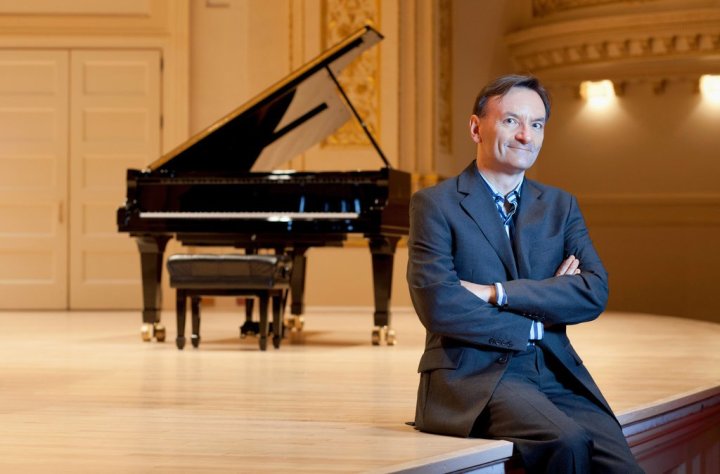
For this concert, I exchanged the deep red plush seats of London’s Wigmore Hall for my first visit to Plush Festival, held in the tiny village of Plush, deep in Thomas Hardy country in Dorset. Here in 1995, far from the madding crowd, Adrian Brendel established the festival in a spirit of collaboration and shared music-making. A deconsecrated church, which sits in the arcadian grounds of Plush Manor (bought by the Brendel family in the early 1990s as a bucolic retreat) is the venue for the concerts. Its generous acoustic and small size make it perfect for intimate chamber music and solo recitals; in addition, visitors may sit in on open rehearsals.

I’d known about the village of Plush (the pub, the Brace of Pheasants does a good Sunday lunch) and the Brendel connection for years, but this was my first visit to the Festival – part of my determination to seek out quality classical music in Dorset, my new home since I moved from London in May.

The drive to Plush suggests one is entering a special place. Leaving Dorchester (Hardy’s “Casterbridge”), I left the A-road and passed through the villages of Piddletrenthide and Piddlehinton (“Longpuddle”). Then a sharp right turn and up a steep hill and there was a sign to Plush Festival, guiding the way. The village is chocolate-box-pretty, with the pub at its heart. The signs to the festival pointed beyond the centre of the village and a winding, tree-lined lane takes you into the grounds of Plush Manor. A helpful gentleman guided me to park my car in an adjacent field and asked if I’d been to Plush before.

Outside the church, small groups of people lolled in foldout camping chairs or lounged on picnics rugs. Some were even enjoying a picnic ahead of the concert. A small bar offered wine, prosecco and soft drinks, and there was a bunting-draped stall next door selling CDs. The murmur of conversation was accompanied by birdsong. A friend texted (before my mobile reception disappeared) to say he was at Glyndebourne for the afternoon, and I thought there was a touch of the Glyndebourne experience, in microcosm, at Plush – though minus the dinner jackets: people were dressed casually. After all, this was a lunchtime on a sunny Saturday in August…..
10567-b5caaf2a50ce50da7f81d22244175770The soloist for this concert was Filippo Gorini, a prize-winning young Italian pianist. His programme was unexpected for a weekend lunchtime recital – Schumann’s Geistervariationen (“Ghost” Variations) and Beethoven’s mighty Hammerklavier Sonata – but Kat Brendel, Festival Director, told me afterwards that this was “the programme he wanted to play”. It proved a bold and successful choice.

Schumann composed his Ghost Variations in 1854, shortly before he was committed to a mental asylum. It was his final piece, dedicated to his beloved Clara, and the work is freighted with melancholy and tenderness. Filippo Gorini caught the tragic intensity and intimate poignancy of the work. Understated, elegant and restrained, one felt Gorini fully appreciated that Schumann is a composer who wears his heart on his sleeve; the final variation ended on a whisper, with Gorini allowing the sound to fade into the stillness of the church.

Beethoven, by contrast, is at his most declamatory in the Hammerklavier Sonata, which opens with a daring leap across the keyboard and a rollicking fanfare motif. This was masterfully shaped by Gorini who brought energy and vivid colour to the music. At its heart is the Adagio, a huge slow movement of infinite serenity and profundity which in Gorini’s hands felt like a stand-alone piece of music. Time was suspended, and while a butterfly fluttered, agitato, around the church, nothing could break Gorini’s concentration – nor the audience’s (who were as committed as any Wigmore audience). This movement, played with an intense concentration which echoed Gorini’s sensitive approach to the Schumann, has an almost Schubertian harmonic trajectory and introspection, with the improvisatory qualities of a Chopin Nocturne. Out of this other-worldly space came a finale of restless physicality.

Chatting afterwards, I mentioned to one audience member that I felt Gorini had the ability to make one forget a pianist was actually present during the performance. It’s a rare talent, and his lack of ego or unnecessary gesture undoubtedly contributed to this impressive performance.

If you think great music is only to be found in the metropolis, think again: Sir Andras Schiff returns to Plush Festival tomorrow for a sold out concert, and past seasons have enjoyed performances by Paul Lewis and Till Fellner.


This years Plush Festival continues from 14-16 September. Full details here


Header image: courtesy of Plush Manor


1474399967_piter

Scriabin – Piano Sonata No.2 in G sharp minor Op.19
RavelMiroirs
Mozart – Piano Sonata in C K279
Schubert – Piano Sonata in A D959

Monday 18th June 2018, Wigmore Hall. Peter Donohoe, piano

I can think of few better ways to celebrate a significant birthday than a concert at London’s Wigmore Hall: a beautiful venue with a warm atmosphere, an audience of friends and supporters, and a generous programme of music reflecting the breadth and range of Peter Donohoe’s talents and musical tastes, and celebrating a long and acclaimed international career.

Anyone who attended Peter’s Scriabin sonatas marathon at Milton Court last year (the complete piano sonatas performed in three concerts in a single day) will know that Peter has a real affinity for the diverse and mercurial qualities of Scriabin’s writing, so this early piano sonata proved a good opener, reconfirming Peter’s ability to create multi-hued, highly expressive music and capture Scriabin’s fleeting, often volatile moods. And its rather fantasy-like qualities set the scene well for Ravel’s Miroirs, which for me was the real tour de force of this concert. Here was piano playing of the highest order – exquisite layers of sound, moments of aching beauty, and a clear vision for each movement to shape their individual characters and narratives. Oiseaux Tristes was heat-soaked and languid, its ennui washed away by the sparkling, rolling waves of Une barque sur l’océan – for me the highlights of this set. In both the Scriabin and Ravel, Peter displayed a wonderfully natural insouciance, presumably born of a long association with this music, which brought spontaneity to the performance.

The second half was occupied with the classical sonata form, in the hands of two masters – Mozart and Schubert. While the Mozart was elegant and intimate, as if played at home amongst friends, Schubert’s penultimate piano sonata was pacy and expansive. Here Schubert experimented with the possibilities of the classical sonata form, creating, with its companions the D958 and D960, a triptych of sonatas of “heavenly length” and wide-ranging musical ideas. The first movement of the D959 had grandeur and scale, emphasised by the exposition repeat, which Peter observed, and tempered by moments of introspection and wistfulness, though never melancholy. Its infamous slow movement was a reflective meditation shot through with a barely-controlled frenzy, rather than a funereal dirge with hysteria (the preferred approach of some pianists who shall remain nameless and who insist on reading the marking Andantino as Adagio….). Schubert’s shifts of gear, bittersweet harmonies and moments of wistfulness were neatly captured throughout. The finale was warm and consoling, nostalgic and ultimately hopeful. One can only wonder what else Schubert might have done with the sonata form had he lived longer…..

For an encore, Peter played Mozart’s D minor fantasy, beloved of pianists everywhere and a neat contrast to the quasi-fantasy of the Scriabin which opened this magnanimous concert.

The genteel Wigmore Hall audience was startled by the abrupt slamming of the lid of the piano, heralding the start of a brand new work by a composer celebrating a significant birthday on the day of the concert. The pianist was Igor Levit, always very popular with Wigmore audiences, and the composer was Frederic Rzewski. As a student Levit was captivated by Rzewski’s music and asked the composer to write a new piece. The work premiered at this concert was commissioned by Wigmore Hall for Levit to play.

Read my full review here

03HOUGH1_SPAN-jumbo-v2What can I write about Stephen Hough’s startling, stunning concert at the Festival Hall last night?



During the second half, between the miniatures by Debussy and Beethoven’s elemental Appassionata Sonata (Op 57), I leaned across to my concert companion and muttered that this concert seemed to be all about spontaneity and improvisation, the short works by Debussy which opened both halves of the concert, in themselves, and in Hough’s skillful hands, improvisatory in character, revealing the same qualities in the works by Schumann and Beethoven. One had the sense of meticulous preparation – and Stephen has talked before in interviews and articles about practising of the need to be “a perfectionist in the practise room” so that one can be “a bohemian” on stage – which enabled him to step back from the music and set it free.

It was an unusual programme. Other pianists may not have been able to pull it off so convincingly, and certainly opening with Debussy’s much-loved Claire de Lune from the Suite Bergamasque was potentially risky. The piece is so well-known, so prone to clichéd readings – yet Hough’s sensitive, unfussy shaping of this work saved it from saccharine sentimentality, and the delicacy of his sound and touch encouraged concentrated listening while also creating a wonderful sense of intimacy in the vastness of the RFH. It was as if we were in Debussy’s drawing room, gathered around his upright piano. And as Stephen said in the pre-concert talk, in the moments of the concert, we can “all be friends”, forgetting our differences of opinion or politics, joined in the shared pleasure of music.

In the programme notes, Stephen Hough explained that his choice of repertoire highlighted the very different approaches the three composers took to writing for the piano. While Debussy’s works (Clair de Lune, the two books of Images and the Prelude La terrasse des audiences du clair de lune) are “sensual paintings with mystical suggestions” [SH] (and even without the titles, their distinctive soundworld immediately conjures up potent, perfumed images in the listener’s mind), the two works by German composers are abstract and tightly structured with clear musical architecture.

And so while Debussy was light (feathery, but never fluffy) and delicately hued, the textures of Schumann’s Fantasie in C seemed all the richer in comparison, the composer’s passion for Clara all there in every note and phrase (Schumann often wears his heart on his sleeve), balanced by lyricism and tenderness, particularly in the glorious closing movement which seemed to evolve and expand there and then.

Similarly, the Beethoven felt wrought before our very eyes and ears, the opening measures creeping out of the mysterious darkness of the lower registers into something resembling light, if only briefly, the work fantasy-like in its range of ideas and striking contrasts. The outer movements were fraught with emotion, urgent and agitated, the middle movement providing a calm respite before the finale was unleashed upon us with, its feverish intensity all the more terrifying for the restrained tempo: this was music on the edge of chaos.

Stephen returned to Schumann for the first encore, one of the Symphonic Etudes which was rejected by the composer – a brief few moments of meltingly beautiful filigree traceries. And a Chopin nocturne to close this exceptional evening.